


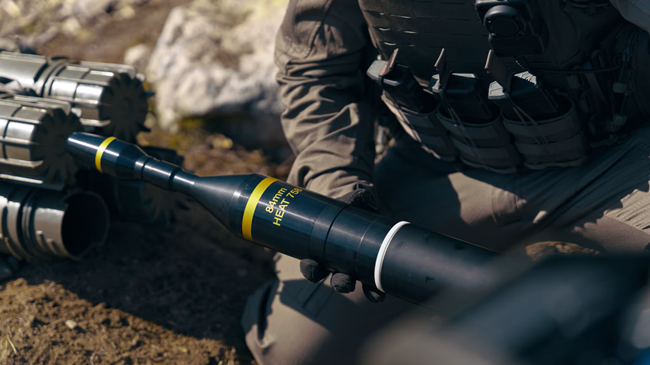
Saab AB (STO: SAAB-B) has launched the HEAT 758, a new tandem warhead anti-tank round for its Carl-Gustaf M4 recoilless rifle, during a customer live-fire demonstration on May 5 at the Bofors Test Center in Karlskoga, Sweden. The round is engineered to defeat the latest generations of Russian explosive reactive armour and can penetrate up to 700 millimetres of rolled homogeneous armour equivalent behind ERA, a 40 percent uplift over the outgoing HEAT 751. An undisclosed launch customer has already placed an order and production is underway, giving Saab a paid pipeline before the formal product announcement on May 7. The launch lands at a pivotal moment for Saab AB, whose B shares trade at SEK 551.30 in Stockholm on May 8, well off the SEK 748.80 all-time high set on January 19, 2026, even as the company’s Dynamics segment carries a book-to-bill ratio of 1.2 and a group order backlog of SEK 274.1 billion.
What does the HEAT 758 anti-tank round actually change about infantry firepower against modern Russian main battle tanks?
The HEAT 758 is an 84mm tandem high-explosive anti-tank round built specifically to defeat the explosive reactive armour packages now standard on Russian platforms including the T-72B3M, T-80BVM, and T-90M. It uses a tandem warhead with a precursor charge designed to neutralise the ERA panel, allowing the main copper-lined shaped charge to reach the underlying armour plate intact. Saab declares 700mm RHA-equivalent penetration behind ERA, sufficient against the most heavily protected main battle tanks currently fielded by any non-NATO army. Effective range has also moved out from 500 metres on the predecessor HEAT 751 to 600 metres on the HEAT 758, with the additional reach delivered via rocket motor assist. During the Karlskoga demonstration, Saab fired the round against a salvaged T-80 hull at 500 metres in front of an audience drawn from 25 countries, a deliberate signal to Carl-Gustaf operator nations that the new round is ready for integration rather than a future capability.
What sets the HEAT 758 apart from earlier tandem rounds is the technical approach to the precursor. Saab describes it as a Non-Initiating Precursor, meaning the front charge is engineered to physically traverse the ERA tile without reliably triggering it, rather than detonating it outright. This avoids the chaotic interaction between a triggered ERA blast and the inbound main jet, allowing more of the shaped charge to arrive at the primary armour as a coherent slug. Saab has not disclosed the operating mechanism of the precursor, but the company has confirmed it used artificial intelligence and machine learning tools to evaluate over 50,000 geometric configurations during development, validating designs against all three generations of Russian ERA, namely Kontakt-1, Kontakt-5, and Relikt. The tactical consequence is that gunners no longer need to identify the ERA generation fitted to the target before engaging, removing a battlefield variable that the Ukraine war has shown to be unforgiving in close combat.
Why is Saab pushing a new tandem warhead round into production now in the middle of an already overheated European defence procurement cycle?
The timing is not accidental. The Carl-Gustaf has earned the moniker “slayer of Russian tanks” in Ukrainian service, with Ukrainian forces credited with destroying T-90M and T-72 variants using earlier rounds. But Russian armour has adapted, with newer ERA suites and active protection developments compressing the effective performance of legacy HEAT munitions. Saab’s HEAT 751 was specified at roughly 500mm penetration behind ERA; against the Relikt array fielded on T-72B3M and T-90M tanks, that margin has been narrowing in real combat conditions. By moving the floor up to 700mm and qualifying performance across all three Russian ERA generations, Saab is restoring a comfortable overmatch margin for infantry platoons and pre-empting the next round of Russian armour upgrades.
Russian armour has spent four decades layering progressively more capable explosive reactive armour onto its main battle tanks. The Kontakt-1, fielded in the early 1980s, used externally mounted bricks that detonated outward to disrupt incoming HEAT jets, and was effective against shaped-charge warheads but largely ineffective against kinetic energy penetrators such as APFSDS rounds. Kontakt-5, introduced in the late 1980s, closed that gap by reducing APFSDS penetration by an estimated 25 percent or more, and was the standard ERA on the T-80U and early T-90 variants. The Relikt suite, fitted on the T-72B3M, T-80BVM, and T-90M, is a third-generation system designed specifically to defeat tandem charge warheads, the very class of weapon that the HEAT 751 belongs to. Each generation has compressed the effective penetration envelope of legacy Western infantry anti-armour rounds, which is the operational gap that the HEAT 758 is engineered to close.
The commercial logic is equally direct. Saab’s Carl-Gustaf M4 customer base has expanded rapidly since Russia’s full-scale invasion of Ukraine in February 2022, with 24 nations on the M4 platform and over 40 nations across all variants. Recent contract activity has been concentrated and large. Poland signed a SEK 12.9 billion (USD 1.2 billion) framework in 2024, the largest ground-combat contract in Saab’s history. The Netherlands selected the Carl-Gustaf M4 in May 2025 to replace its Panzerfaust 3 stocks, with deliveries running through 2028. Japan ordered 300 systems, the United Kingdom is replenishing inventories drawn down by donations to Ukraine, the United States Air Force became a fresh customer in 2024 alongside the existing US Army, US Marine Corps, and US Special Operations Command users, and the NATO Support and Procurement Agency placed a EUR 60 million order covering four member states in 2025. Each of these customers is a candidate for HEAT 758 ammunition contracts over the next five to seven years, and ammunition revenue typically delivers higher unit margins than the launcher itself.
How does HEAT 758 fit into Saab’s Firebolt programmable ammunition strategy and what does it mean for infantry digitisation?
The HEAT 758 is only the second round in the Carl-Gustaf family to be designed from scratch around Saab’s Firebolt programmable ammunition system, following the high-explosive HE 448. Firebolt enables a chambered round to communicate bidirectionally with the Carl-Gustaf M4 weapon and the Fire Control Device 558. The round transmits its charge type and propellant temperature to the FCD 558, which combines that data with target range, ambient temperature, and atmospheric pressure to compute a firing solution automatically, removing the requirement for the gunner to manually input ammunition type and fuze settings. In a contested close-combat scenario, this compresses reaction time, reduces cognitive load on a stressed two-man team, and materially raises first-round hit probability against moving armoured targets at the new 600 metre engagement envelope.
The strategic point is that Saab is using ammunition-led platform refresh to extend the Carl-Gustaf franchise without forcing customers to replace launchers. Firebolt-compatible rounds work in fielded M4 launchers paired with the FCD 558, meaning the entire installed base across 24 M4 nations is a serviceable market for Firebolt ammunition without a new platform sale. This is the same operating model that has worked for missile primes, where seekers and warheads are refreshed inside a stable airframe, but Saab is now applying it at the platoon weapon tier. For competitors selling disposable infantry anti-armour systems such as the AT4 family, the NLAW from Saab itself, the Panzerfaust 3 from Dynamit Nobel Defence, or the various single-shot launchers from Instalaza, the durability of a reloadable architecture with a programmable ammunition roadmap creates a structural cost-per-effect advantage that becomes more visible as customers stockpile munitions for prolonged conflict scenarios.
What does the launch tell investors about the underlying momentum at Saab AB’s Dynamics business and the wider order book?
The Dynamics segment, which houses the Carl-Gustaf, AT4, NLAW, ground-based air defence systems including RBS 70 NG, and missile programmes, is one of the principal engines of Saab’s growth story. The unit reported a book-to-bill ratio of 1.2 in Q1 2026 with a backlog of approximately SEK 90 billion at the close of the prior reporting cycle, against a group backlog of SEK 274.1 billion. Group organic sales rose 23.6 percent year-on-year in the first quarter, EBIT was up 32 percent to SEK 1.92 billion, and the operating margin expanded to 10.0 percent from 9.2 percent. Order bookings for the full year 2025 totalled SEK 169 billion, including a Q4 order intake of SEK 100.1 billion, dominated by large-platform wins including the Colombian Gripen contract worth approximately EUR 3.1 billion.
For the HEAT 758 specifically, Saab’s confirmation that an undisclosed customer has already ordered the round and that production is underway is significant. Saab does not typically launch a round publicly without a paid programme behind it, and the company has form in disclosing the customer name only after deliveries commence or when the customer authorises release. Investors should expect to see HEAT 758 contracts begin to populate Dynamics order intake disclosures over the next two to four quarters, with framework refreshes from existing operators including Sweden, the United States, Poland, Australia, Japan, the United Kingdom, the Netherlands, and the NATO Support and Procurement Agency among the higher-probability candidates.
How is the market positioning Saab AB shares relative to the operational momentum and what is the read on valuation discipline?
Saab AB B shares closed at SEK 562.50 on May 7 and were trading at SEK 551.30 by May 8, a session decline of roughly 5 percent. The stock has corrected approximately 26 percent from its January 19, 2026 all-time high of SEK 748.80 but is still up around 23 percent over a trailing twelve-month window, and the broader European defence complex has pulled back roughly 11 percent from its 2026 peaks even as analyst earnings estimates for the sector continue to be revised higher. Saab’s market capitalisation sits near SEK 298 billion, with a trailing P/E above 42 and price/sales of 3.77, both elevated relative to historical Saab averages and to most large-cap European defence peers including BAE Systems, Leonardo, and Rheinmetall.
The investment debate is whether the order book and the segment-level book-to-bill ratios justify the multiple. Morningstar had Saab trading at a 42 percent premium to its fair value estimate as of late April 2026, with a 1-Star price of SEK 288.20 and a 5-Star price of SEK 466. Bulls point to the SEK 274.1 billion backlog providing roughly 3.5 years of revenue visibility, the medium-term organic growth target of 22 percent annual average through 2027, and the structural demand from European defence budget rebasing that has only partially flowed into orders. Bears note that the Aeronautics segment is still margin-constrained by the T-7A Red Hawk ramp, free cash flow turned slightly negative in Q1 2026 at SEK minus 300 million, and execution risk grows as Saab simultaneously scales new manufacturing facilities in the United States, India, and Sweden to absorb the backlog.
For a product launch like HEAT 758, the immediate revenue impact is unlikely to move the consolidated 2026 P&L meaningfully, but the strategic signalling effect is more important. Each ammunition franchise refresh extends the lifespan of the underlying Carl-Gustaf programme by three to five years, deepens customer dependency on Saab’s proprietary fire control architecture, and adds another high-margin recurring revenue stream into a Dynamics business that already offers some of the most attractive economics inside the group.
What are the second-order effects on competitors, NATO infantry doctrine, and Russian armoured force planners?
For competitors, the HEAT 758 hardens the Carl-Gustaf’s positioning as the default reloadable anti-armour weapon at platoon level across NATO and partner forces. The disposable AT4 from Saab, the FGM-148 Javelin from Lockheed Martin and Raytheon Technologies, the NLAW jointly developed by Saab and Thales, the RPG-32 produced under licence in Jordan, and the various Panzerfaust 3 follow-ons from Dynamit Nobel Defence each occupy adjacent niches, but none combines a sub-7-kilogram reloadable launcher with a 700mm RHA penetration behind ERA at 600 metres in a tandem 84mm round. Customers running mixed loadouts will now have to weigh whether to deepen their Carl-Gustaf ammunition stocks with HEAT 758 or invest in next-generation guided weapons at significantly higher unit cost. For most ground forces operating under fiscal pressure, the unguided tandem HEAT economics are likely to win.
For NATO infantry doctrine, the round reinforces the post-Ukraine emphasis on distributing heavy anti-armour capability down to the section and platoon level rather than concentrating it in vehicle-mounted ATGM platforms. This has implications for force structure, training pipelines, and ammunition logistics, with infantry battalions likely needing to reconfigure their ammunition basic loads and resupply chains around tandem warhead consumption rates that will be higher in any peer or near-peer contingency.
For Russian armoured force planners, the HEAT 758 raises the cost of operating heavily protected main battle tanks within range of Western-equipped infantry platoons. The fact that the round is qualified across all three Russian ERA generations removes the option of upgrading legacy ERA suites as a counter, and pushes the Russian response toward either active protection systems such as Arena or Drozd derivatives, or fundamental armour redesign, both of which are expensive, slow to field at scale, and currently constrained by Russian industrial capacity. The economic asymmetry is stark, with a single Carl-Gustaf launcher and a small number of tandem rounds costing a fraction of a single T-90M, yet now able to defeat one with high probability at platoon range.
One important caveat sits inside the HEAT 758’s specification. Saab has explicitly qualified the round against Kontakt-1, Kontakt-5, and Relikt, the three ERA generations currently fielded across the deployable Russian armoured force. The round has not been characterised against the newer Malakhit ERA suite associated with the T-14 Armata, which is designed to defeat top-attack munitions including the FGM-148 Javelin and the NLAW and which represents the leading edge of Russian protective armour design. Russian production volumes of the T-14 remain limited and the platform has not yet been fielded at scale, so the operational significance of this gap in 2026 is modest. But it is the next front in the Saab versus Russian armour cycle, and a credible read of the HEAT 758 launch is that Saab has closed the door on every fielded Russian ERA generation while leaving the door to the next-generation suite open for a future ammunition refresh. Investors should expect a HEAT 758 successor or upgrade variant within the typical four-to-six-year ammunition refresh cycle, particularly if Malakhit fielding accelerates or if active protection systems such as Arena-M proliferate beyond limited deployment.
Key takeaways on what the HEAT 758 launch means for Saab AB, its competitors, and the global infantry anti-armour market
- Saab AB has delivered a 40 percent step-change in tandem warhead penetration to 700mm RHA-equivalent behind ERA, restoring a meaningful overmatch margin for Carl-Gustaf operators against current Russian main battle tank protection
- The Non-Initiating Precursor approach, validated through over 50,000 AI-assisted simulations against Kontakt-1, Kontakt-5, and Relikt, is a technical differentiator that competitors will struggle to replicate quickly, although the round has not been qualified against the newer Malakhit ERA suite on the T-14 Armata
- An undisclosed launch customer has already placed orders, with production underway, meaning the HEAT 758 enters the Dynamics order book as a paid programme rather than a marketing exercise
- Saab is using ammunition-led platform refresh to extend the Carl-Gustaf franchise lifespan, deepening lock-in across 24 M4 customer nations without requiring launcher replacement
- Firebolt integration with the FCD 558 fire control device shifts the competitive frame from launcher economics to fire control software economics, an area where Saab now has a first-mover advantage at the platoon weapon tier
- The Dynamics segment book-to-bill of 1.2 and segment backlog near SEK 90 billion provide multi-year delivery visibility, and HEAT 758 contracts should populate order intake disclosures over the next two to four quarters
- Saab AB shares at SEK 551.30 trade roughly 26 percent below the January 2026 peak of SEK 748.80 even as Q1 2026 organic sales grew 23.6 percent and EBIT grew 32 percent, reflecting valuation rather than operational concerns
- Trailing P/E above 42 and Morningstar’s 42 percent premium-to-fair-value flag mean the stock requires continued execution against the SEK 274.1 billion backlog to justify the multiple
- For NATO infantry doctrine, the round accelerates the trend of pushing heavy anti-armour capability down to section and platoon level, with knock-on effects for ammunition logistics planning across alliance members
- For Russian armoured force planners, the HEAT 758 forces a strategic choice between expensive active protection retrofits and accepting elevated combat losses against Western-equipped infantry, an asymmetry that compounds existing Russian industrial capacity constraints
- The HEAT 758 closes the door on every fielded Russian ERA generation but leaves room for a future ammunition refresh against fourth-generation Malakhit and emerging active protection systems, signalling a continuing four-to-six-year cycle of Saab AB ammunition revenue
Discover more from Business-News-Today.com
Subscribe to get the latest posts sent to your email.