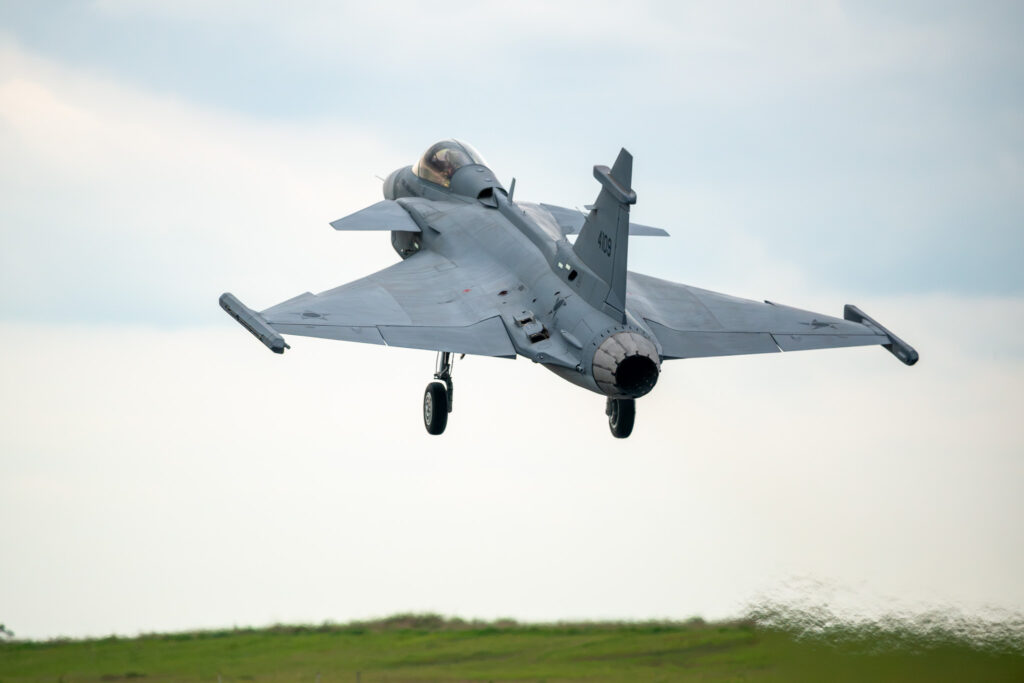
Saab AB (Nasdaq Stockholm: SAAB B) and Embraer S.A. (NYSE: EMBJ) have successfully completed the maiden flight of the first Gripen E fighter aircraft manufactured in Brazil, marking a significant production milestone in the country’s military aerospace programme. The aircraft departed Embraer’s Gavião Peixoto facility in São Paulo state on October 6, 2026, as part of the production acceptance process for the Brazilian Air Force. The achievement demonstrates progress in establishing advanced fighter manufacturing, integration and flight-testing capabilities outside Saab’s home market of Sweden. Its longer-term industrial value will depend on completing certification, delivering the aircraft to the customer and sustaining production across the remaining Brazilian-built fighters.
The test flight represents an important step in a programme structured around technology transfer rather than imported aircraft alone. Saab and Embraer have spent years developing the engineering, manufacturing and testing arrangements required to establish Gripen production in Brazil. The first locally produced aircraft now provides tangible evidence that those capabilities have advanced into flight operations. Nevertheless, a successful maiden flight is not equivalent to final acceptance or completion of the broader manufacturing programme.
Why is the first Brazil-built Gripen E flight important for Saab and Embraer’s defence partnership?
The October flight took place at Embraer’s industrial complex in Gavião Peixoto, the site of the Gripen production line established through the Brazilian programme. Saab chief test pilot Jakob Högberg conducted the flight, which was designed to verify basic aircraft systems and assess initial performance. Embraer flight engineers were responsible for planning and executing the test activity with support from Saab. The flight initiated the final production phase for the aircraft rather than marking its immediate operational entry into Brazilian Air Force service.
The achievement is particularly relevant because modern combat aircraft manufacturing requires much more than assembling imported components. Production involves the integration of complex avionics, flight-control systems, software, structural assemblies and equipment supplied by multiple manufacturers. Establishing the capability to conduct acceptance testing domestically demonstrates a level of industrial competence extending beyond conventional aircraft assembly. Continued production and successful aircraft certification will provide stronger evidence of how completely those capabilities have been embedded in Brazil.
The programme also strengthens Embraer’s position within advanced military aircraft manufacturing alongside its established aerospace activities. The Brazilian company already has experience in commercial aviation, business jets, military transport aircraft and associated aerospace engineering. Participation in the Gripen programme adds exposure to modern supersonic combat-aircraft production and specialised systems integration. However, the financial benefits of those capabilities cannot be quantified solely from the maiden flight because the companies have not disclosed a standalone margin or incremental contract value associated with the milestone.
How many Gripen fighters will Brazil manufacture under its existing agreement with Saab?
Brazil’s original Gripen acquisition agreement, signed in October 2014, covered 36 fighter aircraft and associated development and industrial cooperation arrangements. The contract was originally valued at approximately SEK 39.3 billion and included substantial technology transfer to Brazilian industry. The aircraft composition comprises 28 single-seat Gripen E fighters and eight two-seat Gripen F aircraft. Fifteen aircraft are scheduled to be produced in Brazil under the current programme, creating a domestic manufacturing commitment within the wider procurement arrangement.
Embraer officially presented the first locally manufactured fighter in March 2026 before it entered the production acceptance flight phase in October. According to the companies’ October programme updates, ten Gripen aircraft had already been delivered to the Brazilian Air Force. The locally built aircraft will undergo further acceptance flight testing and airworthiness certification before being transferred to Anápolis Air Force Base in Goiás state. It is expected to join the First Air Defence Group, which is already operating delivered Gripen fighters.
The distinction between delivered aircraft and locally produced aircraft is necessary for an accurate understanding of the programme. The first ten deliveries show that Gripen aircraft are entering Brazilian service, while the October flight demonstrates progress in domestic production capability. These are complementary achievements within the same procurement programme, not evidence that all aircraft have already been manufactured locally. The schedule for completing the remaining Brazilian production commitment will depend on manufacturing throughput, acceptance testing and customer delivery arrangements.
Can Brazil’s Gripen production line become a meaningful international fighter manufacturing hub?
Gavião Peixoto hosts the Gripen production line established outside Sweden and forms part of Saab’s international manufacturing and supply-chain network. Developing this capability gives Brazil a more substantial industrial role than would arise from operating imported fighters without domestic production participation. It also provides Saab with additional manufacturing and engineering resources that could potentially support future international requirements. However, any export production would depend on customer agreements, government approvals, industrial allocation and the contractual framework governing the relevant aircraft.
The Brazilian facility’s strategic value may extend beyond the 15 aircraft scheduled for domestic production because the programme has developed engineering expertise and specialised industrial infrastructure. The ability to manufacture, integrate and test fighter aircraft domestically could strengthen Brazil’s position in future military aerospace programmes or associated sustainment activities. Saab could also benefit from maintaining a wider production network if international Gripen demand increases. Such possibilities remain commercial opportunities rather than confirmed additional aircraft orders for Embraer’s production line.
Export growth would present additional requirements involving supply-chain planning, component availability and national defence procurement policy. Military aircraft transactions can involve approvals from multiple jurisdictions, particularly where aircraft incorporate internationally supplied engines, electronics or other controlled technologies. Potential customers must also consider training, maintenance infrastructure, weapons integration and long-term support costs alongside the aircraft purchase price. Consequently, a capable Brazilian production facility could improve Saab’s competitive position without guaranteeing that future export campaigns will result in contracts.
What do Saab’s latest financial results reveal about the economics of expanding fighter production?
Saab entered the second half of 2026 with a substantial order backlog supported by increasing European and international defence procurement. The company reported second-quarter sales of approximately SEK 25.45 billion, compared with SEK 19.79 billion a year earlier. Organic sales growth reached 29.8%, while quarterly EBITDA increased to approximately SEK 3.77 billion and the EBITDA margin improved to 14.8%. Its reported order backlog stood at approximately SEK 318 billion at the end of June 2026, providing significant visibility across multiple defence programmes.
Those financial results reflect the wider Saab portfolio rather than the Gripen Brazil programme alone. The company is active in fighter aircraft, missile systems, naval platforms, radar, surveillance and other defence technologies, with programme timing influencing the distribution of revenue between quarters. The Brazilian manufacturing milestone demonstrates industrial progress within its aeronautics operations, but the immediate contribution to consolidated earnings has not been separately disclosed. Investors therefore need to distinguish the operational achievement from the company’s broader order intake and revenue performance.
For Embraer, the manufacturing arrangement supports its Defence & Security activities within a company whose financial performance also depends on commercial aviation, executive aviation and services. The Gripen programme broadens its engineering and industrial exposure, although its economics should not be equated with Saab’s original fighter procurement contract value. Contract consideration is distributed across aircraft development, manufacturing, systems, suppliers and other programme obligations. The sustained benefit to Embraer will depend on its actual contractual workshare, production efficiency and any future orders that utilise the established industrial capability.
How did Saab and Embraer shares perform during the week of the Gripen E milestone?
Saab AB’s Class B shares closed at SEK 599.70 on Nasdaq Stockholm on October 9, 2026, gaining approximately 2.46% during Friday’s session. The stock had closed at SEK 624.70 on October 5, illustrating that the positive final-session movement occurred within a weaker overall week. The difference between those prices represents a decline of approximately 4%, showing that the successful Gripen flight did not coincide with a sustained weekly advance in Saab’s valuation. Other defence-sector developments and broader investor expectations may also have influenced trading.
Embraer’s United States-listed shares closed at $71.16 on October 9, up approximately 0.23% for the session. The shares had closed at $75.20 on October 6, the day of the first Brazilian-built Gripen E flight, and subsequently traded lower. These movements demonstrate that the operational milestone was not accompanied by an unambiguous positive market response across both manufacturers. Given the diversification of each company’s business activities, attributing their share-price performance entirely to the Gripen programme would overstate the evidence.
The longer-term financial interpretation is more closely connected to industrial utilisation and programme execution than to the initial share-price reaction. Saab’s substantial defence backlog already reflects expectations of future production activity, while Embraer’s valuation incorporates several aviation businesses with different market conditions. Successful fighter deliveries and additional confirmed international manufacturing work would provide more concrete evidence of the programme’s financial potential. A slowdown in Brazilian procurement or underutilisation of the production line could weaken that outlook even if the underlying engineering achievement remains significant.
What are the next milestones for Brazil’s Gripen programme and the wider aerospace industry?
The first locally built Gripen E must complete its production acceptance flight campaign and obtain the necessary airworthiness certification before handover to the Brazilian Air Force. Subsequent aircraft will need to move through the established manufacturing and testing process, providing evidence of whether Brazil can sustain repeatable production rather than complete an isolated milestone. The pace of those deliveries will influence utilisation of the Gavião Peixoto facility and the continuing requirements placed on domestic suppliers. Future production performance should also reveal how effectively the technology-transfer arrangements are supporting routine manufacturing operations.
The broader programme illustrates a change in how some countries approach advanced defence acquisitions by seeking domestic industrial capabilities alongside finished equipment. Saab has invested in a partnership model that connects international procurement with local engineering and manufacturing participation. Embraer has gained a role in the production of advanced combat aircraft that may be relevant to future programme opportunities. Whether this creates additional long-term value will depend on the delivery of the 15 Brazilian-produced aircraft and the emergence of commercially committed work beyond the existing programme.
The October flight is therefore an operationally meaningful achievement, but not the endpoint of Brazil’s fighter manufacturing ambitions. Certification and customer acceptance will establish the immediate success of the first locally manufactured aircraft, while sustained throughput will indicate whether the production line has reached an economically useful level of maturity. Additional confirmed aircraft orders or export allocations would strengthen the longer-term industrial case. Without those follow-on commitments, the programme’s success would remain principally tied to fulfilling the original Brazilian Air Force procurement.
Key takeaways from Saab and Embraer’s first Brazil-built Gripen E flight
- The first Gripen E manufactured in Brazil completed its maiden flight on October 6, 2026.
- The aircraft was produced at Embraer’s Gavião Peixoto facility in São Paulo state.
- The existing Brazilian programme covers 36 fighters, including 28 Gripen E and eight Gripen F aircraft.
- Fifteen Gripen aircraft are planned for Brazilian production under the current programme.
- Ten Gripen aircraft had been delivered to the Brazilian Air Force by the October announcement.
- The locally manufactured aircraft must complete acceptance testing and certification before delivery.
- Saab reported approximately SEK 318 billion in order backlog at the end of June 2026.
- Saab and Embraer shares showed mixed performance following the programme milestone.
- Future manufacturing utilisation and confirmed export work will shape the industrial return from Brazil’s production capability.
Discover more from Business-News-Today.com
Subscribe to get the latest posts sent to your email.