


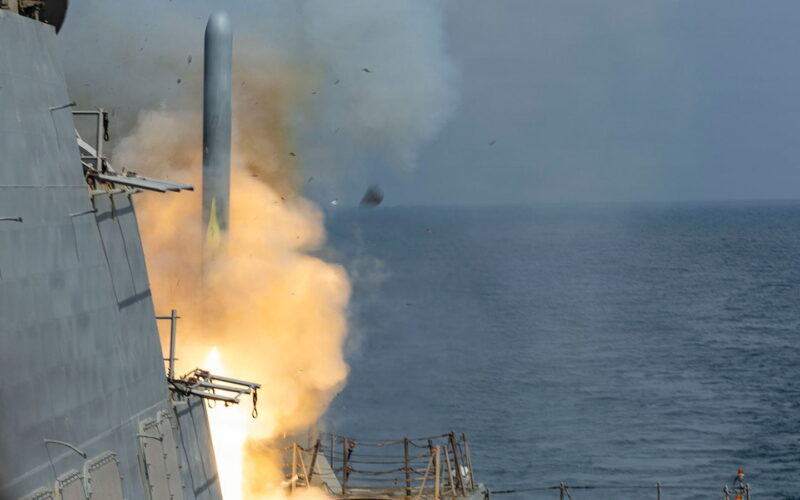
RTX Corporation, listed on the New York Stock Exchange as RTX, has received one of the clearest demand signals yet in the U.S. precision-strike rearmament cycle after its Raytheon business was awarded a seven-year $22.9 billion U.S. Navy contract for Tomahawk cruise missiles. The agreement is designed to support a ramp in annual Tomahawk production to more than 1,000 missiles, a scale that would transform the programme from a specialised long-range strike line into a much larger industrial replenishment effort. The award follows earlier framework agreements between Raytheon and the Department of War covering Tomahawk, AMRAAM, Standard Missile-3 and Standard Missile-6 production expansion. RTX shares were trading around $223.38 intraday on August 17, close to the recent 52-week high of $226.88 reached on August 10 and up strongly from mid-July levels. The investment question is whether Raytheon can convert a historic missile demand cycle into durable revenue and margin growth without running into the same supplier, labour and materials constraints now visible across the wider munitions sector.
The award matters because Tomahawk is not an experimental system seeking a market. It is one of the U.S. Navy’s most established long-range precision-strike weapons, launched from surface ships and submarines and used to attack high-value land targets from standoff range. That maturity changes the business story. The main challenge is no longer proving battlefield relevance. It is scaling production fast enough to meet U.S. and allied demand while preserving reliability, cost discipline and delivery cadence.
Why does RTX’s $22.9 billion Tomahawk contract matter beyond the headline award value?
The headline value is large, but the deeper significance lies in the seven-year structure and the production objective. A contract designed to support output above 1,000 Tomahawks a year gives Raytheon and its suppliers a long enough runway to justify hiring, tooling, facility investment and multi-year supply commitments.
That matters because munitions production cannot be scaled like software. Cruise missiles require propulsion systems, guidance packages, airframes, warheads, canisters, electronics, mission planning integration, quality assurance and test capacity. If even one critical supplier line remains constrained, the final missile output target becomes difficult to reach.
The Tomahawk award also shows how the U.S. military is moving from annual purchase behaviour toward industrial-base signalling. Instead of buying missiles in small batches and hoping industry keeps capacity warm, the government is creating a larger and more predictable demand environment. That approach is increasingly common as inventories across several high-end weapons categories are being reassessed.
For RTX, the award strengthens the Raytheon defence segment at a time when the group is also benefiting from strong commercial aerospace demand through Collins Aerospace and Pratt & Whitney. The company’s Q2 results already showed record backlog and higher 2026 guidance. The Tomahawk contract adds another large, named production line to that backlog-quality argument.
The risk is that investors treat the full $22.9 billion as near-term revenue. It will be recognised over years, with actual sales depending on production milestones, customer funding, supplier readiness and delivery schedules. The award gives visibility. It does not remove execution risk.

How does the Tomahawk production ramp fit into America’s wider munitions rebuilding cycle?
The Tomahawk ramp fits into a broader U.S. effort to rebuild and expand stocks of high-end precision weapons. Demand has been lifted by Ukraine, tensions in the Middle East, Indo-Pacific planning, allied procurement and concern that peacetime production rates are inadequate for prolonged conflict.
Tomahawk sits in a different category from air-defence interceptors such as Patriot PAC-3 or THAAD. It is an offensive long-range strike weapon rather than a defensive interceptor. However, the industrial logic is similar. In both cases, the United States is trying to move from boutique annual procurement toward production scale.
The production target of more than 1,000 Tomahawks a year would represent a major increase from historical U.S. production levels. That kind of ramp requires suppliers to commit capacity before every end-use scenario is certain. It also gives the Navy and allies a stronger replenishment path if missiles are used in a crisis.
The Navy’s long-range strike problem is becoming more urgent because surface ships and submarines need weapons that can hold targets at risk without moving inside the most dangerous threat envelopes. Tomahawk has remained relevant because it offers range, launch-platform flexibility and a decades-long operational record.
The contract also supports allied demand. Tomahawk has a long history of foreign military sales, including the United Kingdom, and future allied interest could increase as navies reassess land-attack and maritime-strike requirements. A higher production base makes allied deliveries more feasible, although U.S. stockpile needs will still take priority.
The strategic shift is clear. Precision weapons are no longer being treated as low-volume exquisite assets. They are becoming consumable strategic inventory, and that changes how industry must manufacture them.
What does the award mean for Raytheon’s defence business inside RTX?
Raytheon is the direct beneficiary of the Tomahawk contract and one of the strongest contributors to RTX’s recent defence momentum. In Q2 2026, Raytheon sales rose 18% to about $8.27 billion, supported by higher volume in air and missile defence, naval programmes and weapons systems.
The Tomahawk award strengthens that trajectory because it gives Raytheon a large, long-duration production programme tied to a proven weapon. Unlike some emerging defence technologies, Tomahawk does not depend on whether a customer accepts a new operational concept. The U.S. Navy already understands the missile’s role. The contract is about supply, not market education.
This matters inside RTX because the company’s portfolio has three different operating stories. Collins Aerospace is tied heavily to aircraft systems and aftermarket demand. Pratt & Whitney is recovering while managing geared turbofan fleet issues and commercial engine demand. Raytheon is the principal defence growth engine, benefiting from air defence, missile defence, naval weapons, sensors and precision munitions.
The $22.9 billion award gives Raytheon a stronger place in the company’s overall investment narrative. It helps offset investor concern that commercial aerospace issues at Pratt & Whitney could overshadow defence growth. It also reinforces management’s message that defence demand is not only strong but increasingly funded.
However, Raytheon must deliver the production ramp without margin erosion. Large missile programmes can be profitable, but they can also carry cost pressure if suppliers raise prices, materials become scarce or production learning curves take longer than expected.
The contract is therefore a major positive for revenue visibility, but the margin outcome will depend on execution across hundreds of suppliers and multiple production stages.
Why is Tomahawk still strategically relevant after decades of service?
Tomahawk remains strategically relevant because it offers long-range precision strike from naval platforms that can operate without relying on nearby land bases. Surface ships and submarines can carry and launch the missile, giving commanders flexible strike options in theatres where basing access may be politically limited or operationally risky.
The missile has evolved over time. Block V configurations, recertification efforts and maritime-strike variants have extended the programme’s relevance beyond its original land-attack role. The Maritime Strike Tomahawk is particularly important because navies are again focused on long-range anti-ship capability in contested seas.
A missile with decades of service may appear less glamorous than hypersonics, autonomous drones or space-based interceptors. Yet established systems often become more valuable during replenishment cycles because the infrastructure, customer training and mission planning ecosystem already exist. Customers can buy more without waiting for an entirely new doctrine.
Tomahawk also solves a practical strike problem. Not every target requires a hypersonic weapon. Not every scenario justifies risking aircraft. A long-range cruise missile can provide a lower-risk option against fixed or maritime targets, especially when launched from submarines or ships already deployed in theatre.
The challenge is survivability. Adversary air defences, electronic warfare and sensor networks continue to improve. Tomahawk must remain capable enough to justify production growth, which is why upgrades, mission planning, navigation resilience and maritime-strike capabilities matter.
The U.S. Navy is not only buying a legacy weapon. It is buying a proven strike architecture that can be upgraded while the next generation of long-range weapons matures.
How could the Tomahawk ramp reshape the U.S. missile supplier base?
A production ramp to more than 1,000 Tomahawks a year cannot be achieved by Raytheon alone. RTX said the award will involve hundreds of small and mid-sized suppliers across the United States. That supplier-base expansion is one of the most important parts of the contract.
The missile supply chain includes airframe structures, propulsion components, electronics, navigation systems, warhead-related components, cables, castings, canisters, test equipment and materials. Many of these categories have qualified suppliers that cannot be replaced quickly if capacity is unavailable.
The contract gives suppliers a clearer signal that Tomahawk demand is durable. That can support investment in machine tools, skilled labour, inventory, specialised production lines and quality systems. Smaller companies are more likely to invest when they see multi-year demand rather than uncertain annual orders.
The supplier opportunity also creates risk. Smaller suppliers may face working-capital strain as they buy materials and hire workers before payments fully arrive. Defence quality standards are strict, and a rapid ramp can increase the chance of rework or delivery slippage.
This is why the award should be viewed as an industrial-base contract, not just a missile order. The Navy is effectively asking Raytheon to manage a national production network that can scale faster than it has in recent years.
For investors, supplier health will be an early indicator. If RTX reports smooth output growth and stable margins, the contract will strengthen confidence. If supplier bottlenecks appear, the market may start discounting the production target even while headline demand remains strong.
How should investors read $RTX after the August 17 Tomahawk award?
RTX was trading around $223.38 intraday on August 17, up slightly from the previous close and near its recent 52-week high of $226.88 reached on August 10. The stock has also moved materially above mid-July levels, helped by Q2 earnings, upgraded guidance, record backlog and rising defence demand.
The share-price context matters because RTX is not an undiscovered defence story. Investors have already rewarded the company for improving execution, strong commercial aerospace demand and Raytheon defence bookings. The Tomahawk award supports the existing momentum, but it arrives when the stock is already close to the high end of its annual range.
That does not make the contract unimportant. A seven-year, $22.9 billion award improves revenue visibility and reinforces the case that Raytheon is a major beneficiary of the U.S. munitions cycle. It also adds to the credibility of RTX’s defence backlog, which stood at $119 billion at the end of Q2.
The valuation question is whether the market is pricing only backlog, or also successful conversion of that backlog into higher earnings and free cash flow. RTX’s Q2 free cash flow, backlog growth and guidance upgrade suggest investors have reason for confidence. However, large munitions contracts bring working-capital, supplier and production risks that can influence margin.
The stock’s near-high positioning means future upside may require more than award announcements. Investors will want production milestones, evidence of capacity expansion, stable Raytheon margins and confirmation that the broader RTX portfolio remains on track.
The immediate read is constructive but not risk-free. The contract strengthens RTX’s defence narrative. The stock now needs execution to match the award size.
What does the Tomahawk award reveal about the Navy’s long-range strike priorities?
The U.S. Navy’s willingness to support a major Tomahawk production ramp shows that long-range strike remains central to maritime strategy. Ships and submarines need weapons that can reach targets from distance, complicate adversary planning and avoid unnecessary exposure to layered defences.
Tomahawk also complements other Navy weapons rather than replacing them. Standard Missile, Naval Strike Missile, hypersonic weapons and future strike systems all address different mission sets. Tomahawk fills a proven long-range land-attack and evolving maritime-strike role with a large installed launch-platform base.
The contract also reflects the reality that fleets need inventory depth. A missile that can perform well is not enough if only limited numbers are available. Modern conflict has shown that high-end munitions can be consumed faster than peacetime procurement systems expected.
A larger Tomahawk inventory would give commanders more flexibility in a crisis. It could support strike operations, deterrence signalling, allied reassurance and distributed maritime operations. It also gives the Navy a stronger bridge while newer strike weapons mature.
The production ramp may also shape allied procurement. If the U.S. can increase output, allies may have more confidence that future orders can be delivered without waiting behind U.S. replenishment needs for years.
The core point is that the Navy appears to be prioritising capacity as much as capability. Tomahawk’s value now lies not only in range and accuracy, but in whether enough missiles can be built and sustained.
What are the main execution risks behind a 1,000-missile annual production goal?
The first risk is supplier throughput. A cruise missile contains many specialised parts, and a shortage in a seemingly small component can slow the entire production line. Raytheon must coordinate hundreds of suppliers and ensure that each can scale in sequence.
The second risk is skilled labour. Missile manufacturing requires engineers, machinists, assembly technicians, quality-control specialists, materials experts and programme managers. Hiring is easier than building a fully trained production workforce.
The third risk is materials availability. Precision weapons use electronics, propulsion-related materials, composites, metals, energetic materials and specialised assemblies. Some inputs may compete with demand from other missile, air-defence and aerospace programmes.
The fourth risk is test capacity. Higher output requires more inspection, testing and acceptance infrastructure. Production can be limited by test bottlenecks even when assembly capacity improves.
The fifth risk is cost control. A rapid ramp can increase overtime, supplier pricing and capital expenditure. If the contract does not allow enough pricing flexibility or if execution is inefficient, margins can suffer.
The sixth risk is demand timing. A seven-year contract provides visibility, but annual funding, allied orders and Navy requirements can still influence production pacing.
The seventh risk is technology relevance. Tomahawk has been upgraded over time, but adversary defences are improving. Continued investment in navigation resilience, targeting, survivability and maritime-strike capability will be needed to keep the missile operationally credible.
The production goal is achievable only if Raytheon treats the contract as an integrated industrial programme rather than a larger version of normal annual procurement.
How does the award compare with other recent missile-defence and munitions expansion moves?
The Tomahawk award is part of a larger pattern that includes Patriot, THAAD, AMRAAM, Standard Missile and hypersonic-related production initiatives. The U.S. government is giving industry longer and larger demand signals because the old procurement rhythm no longer fits the threat environment.
Recent agreements involving Lockheed Martin and Northrop Grumman focused on Patriot and THAAD interceptor parts. Those programmes are defensive. RTX’s Tomahawk award focuses on offensive long-range strike. Together, they show that the replenishment problem is not confined to one mission area.
The comparison also highlights why RTX is strategically well positioned. Raytheon has exposure to several munitions categories that are receiving production attention, including Tomahawk, Standard Missile, AMRAAM and missile-defence systems. That gives the segment multiple demand drivers rather than dependence on one platform.
However, broad exposure also creates management complexity. RTX must prioritise capital across Raytheon, Collins Aerospace and Pratt & Whitney, while Raytheon itself must balance air defence, naval weapons, strike missiles, sensors and international demand.
The industrial-base challenge is cumulative. The same suppliers, skilled workers and materials may be needed across multiple weapons programmes. A Tomahawk ramp can collide with other production ramps unless capacity is added across the entire ecosystem.
The positive reading is that RTX has an unusually strong munitions portfolio at the right time. The cautious reading is that the company must now execute across several strained supply chains simultaneously.
What should executives and investors watch after Raytheon’s Tomahawk award?
The first signal will be production-rate disclosure. Investors should watch for updates showing how quickly annual output moves toward the more than 1,000-missile target.
The second signal will be Raytheon margin performance. Higher volume should support operating leverage, but supplier costs and ramp investments could offset some benefits.
The third signal will be supplier expansion. Announcements involving propulsion, electronics, canisters, airframes, test infrastructure and materials would show whether the production base is widening.
The fourth signal will be working capital. Large production ramps can require inventory and supplier advances before full cash collection. RTX’s free cash flow will be an important check on contract quality.
The fifth signal will be allied demand. Additional Tomahawk foreign military sales or allied naval strike orders could extend the production runway beyond U.S. Navy requirements.
The sixth signal will be technology updates. Maritime Strike Tomahawk, Block V upgrades and recertification work will determine how the missile remains relevant against stronger defences.
The seventh signal will be broader RTX guidance. If Raytheon’s munitions cycle continues to strengthen while Collins and Pratt & Whitney remain solid, the company’s earnings outlook could receive further support.
Raytheon’s $22.9 billion Tomahawk contract gives RTX a major role in the U.S. Navy’s long-range strike rearmament cycle. The award is strategically important, financially meaningful and industrially demanding. The next test is whether RTX can make missile output, supplier capacity and margins rise together.
Key takeaways on RTX’s Raytheon Tomahawk contract and missile production ramp
- Raytheon, an RTX business, received a seven-year $22.9 billion U.S. Navy contract for Tomahawk cruise missiles.
- The contract is intended to support annual Tomahawk production of more than 1,000 missiles.
- The award follows earlier Department of War framework agreements covering Tomahawk and other critical munitions.
- RTX said it delivered three times more Tomahawks in the first half of 2026 than in the first half of 2025.
- Tomahawk remains one of the U.S. Navy’s key long-range precision-strike weapons, launched from ships and submarines.
- RTX’s Q2 results showed company backlog of $289 billion, including $119 billion of defence backlog.
- Raytheon Q2 sales rose 18% to about $8.27 billion, helped by missile, air-defence and naval programme demand.
- $RTX traded around $223.38 intraday on August 17, close to its recent 52-week high of $226.88.
- The main execution risks are supplier capacity, skilled labour, materials availability, test infrastructure, working capital and margin control.
- Investors should watch production-rate milestones, Raytheon margins, supplier expansion, Tomahawk technology upgrades and whether the contract improves RTX free cash flow over time.
Discover more from Business-News-Today.com
Subscribe to get the latest posts sent to your email.