




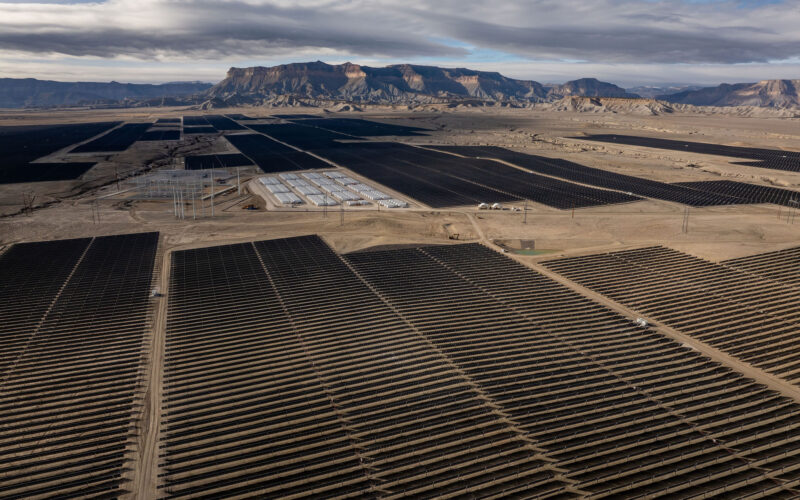
rPlus Energies has started commercial operations at the Green River Energy Center, a 400 MW solar and 400 MW/1,600 MWh battery energy storage development in Emery County, Utah. The privately owned developer commissioned the project on June 22, 2026, before formally announcing commercial operation on June 23. Green River is the largest solar-and-storage facility within PacifiCorp’s six-state electricity system and is backed by a long-term power purchase agreement with the utility. The project required capital investment of more than $1 billion, supported by over $1 billion of construction debt and more than $500 million of tax-equity commitments. Its start-up transforms rPlus Energies from a development-led renewable company into an independent power producer responsible for operating one of the largest solar-plus-storage assets in the western United States.
Why does Green River Energy Center matter more than another large solar commissioning?
Green River’s significance comes from the scale and duration of its battery system rather than from solar capacity alone. The facility can deliver 400 MW for four hours, allowing it to store as much as 1,600 MWh before discharging electricity when demand, market value or grid requirements are higher. This changes the project from a daytime-only generating asset into a more flexible power resource capable of supporting evening demand and periods when solar output has fallen.
The storage capacity was originally considerably smaller. rPlus Energies and PacifiCorp amended the project’s power purchase agreement in 2024 to expand storage from 400 MWh to 1,600 MWh, quadrupling the system’s energy capacity before construction moved into its principal execution phase. That decision indicates that PacifiCorp placed greater commercial value on duration and dispatchability than on simply adding another large block of midday solar production.
Green River also represents a genuine operating milestone rather than another financing announcement, equipment reservation or development pipeline. The project includes almost one million photovoltaic modules, approximately 130,000 foundation piles and 484 battery units across more than 2,500 acres of high-desert land. The physical scale creates a substantial operating and maintenance challenge, but it also provides a highly visible reference for developers attempting to finance similarly integrated projects.
The commissioning has broader implications for western electricity markets. Utilities face growing power demand from population growth, industrial investment, data centres and electrification, while also managing ageing thermal plants and congestion across a large regional network. Four-hour storage cannot provide continuous supply through multiday weather events, but it can make solar output more useful during the daily period when demand remains high after sunset.

How will the four-hour battery change the way PacifiCorp uses Green River’s solar output?
The solar array generates electricity primarily during daylight hours, with production generally strongest around the middle of the day. Without storage, part of that output could enter the grid when regional solar generation is already abundant, reducing its marginal value and potentially contributing to congestion or curtailment. The battery allows PacifiCorp to shift part of the electricity into later hours rather than accepting the solar generation profile exactly as nature delivers it.
A four-hour battery can serve several potential functions. It can discharge during evening peaks, respond to short-term grid imbalances, reduce the need to start more expensive peaking generation and provide reserve capacity when unexpected outages occur. The exact dispatch and revenue arrangements have not been disclosed publicly, but the expanded power purchase agreement demonstrates that the storage system is central to the contracted value of the project rather than a small experimental addition.
Green River will not behave like a conventional 800 MW power plant. The 400 MW solar array and 400 MW battery share a combined headline capacity of 800 MW, but the battery must first be charged and can sustain maximum discharge for only four hours. Presenting the development as an 800 MW project is useful for describing its component scale, but it should not be interpreted as 800 MW of continuous generation.
The project’s operational quality will depend on charging discipline, energy losses, degradation and availability. Battery systems consume some electricity through conversion and auxiliary equipment, meaning less energy is returned than was originally stored. rPlus Energies and PacifiCorp must therefore optimise dispatch around electricity prices, grid needs and the long-term health of the battery fleet.
Why did Green River require more than $1.5 billion of announced financing commitments?
rPlus Energies secured more than $1 billion of construction debt in 2024 from a lending group involving Crédit Agricole Corporate and Investment Bank, KeyBanc Capital Markets, MUFG Bank, Truist Securities and Wells Fargo Securities. The company subsequently closed a tax-equity commitment exceeding $500 million with RBC Community Investments and a syndicate that included Utah-based FJ Management. The scale of these financings reflects the cost and capital complexity of combining hundreds of megawatts of solar generation with 1.6 GWh of battery storage.
The financing figures should not simply be added together and presented as the project’s construction cost. Debt facilities may include capitalised interest, contingency reserves, letters of credit, working capital and other project-finance requirements. Tax-equity capital is structured around federal investment tax credits and depreciation benefits, meaning its value and timing differ from conventional construction borrowing.
Tax equity was particularly important because Green River qualified for the United States federal Investment Tax Credit. RBC and its co-investors supplied capital in exchange for tax attributes and agreed economic returns, reducing the amount of ordinary sponsor equity required from rPlus Energies and its backers. This model can improve project returns but adds legal, accounting and compliance complexity because the asset must satisfy eligibility, placed-in-service and operating requirements.
The financing structure also indicates strong institutional confidence in the power purchase agreement and construction plan. Lenders and tax-equity investors would have examined generation forecasts, battery warranties, construction contracts, grid arrangements, insurance, environmental compliance and PacifiCorp’s credit position before releasing capital.
That diligence does not guarantee profitability. The project must now generate contracted electricity, maintain battery availability and avoid unexpected operating expenditure for decades. Construction financing has solved the capital requirement needed to reach operation, but long-term asset performance will determine whether the investment ultimately meets sponsor and lender expectations.
How does Green River change the private business model of rPlus Energies?
rPlus Energies historically developed renewable projects and moved them through permitting, contracting and construction, sometimes selling completed or advanced assets to larger owners. Green River represents a strategic shift because the company plans to own and operate the facility as an independent power producer rather than exiting after development.
Ownership changes the company’s revenue profile. Development fees and asset-sale proceeds can produce attractive but uneven earnings, while an operating power plant generates longer-duration contracted cash flow. The transition can create greater enterprise value if the asset performs well, although it also exposes rPlus Energies to operational, financing and merchant risks that a pure developer can transfer to buyers.
Sandbrook Capital committed up to $460 million to rPlus Energies in 2024 alongside continued backing from Gardner Group. The investment was intended to help rPlus Energies bring around 1 GW of shovel-ready generation and storage into operation while advancing a development pipeline exceeding 15 GW across solar, wind, battery storage and pumped-storage hydropower.
Green River is therefore not an isolated project. It is the first major proof point for a platform strategy in which rPlus Energies retains selected assets and builds an operating portfolio. The company can use the project’s cash flow, financing relationships and technical experience to support future developments.
The commercial opportunity is substantial, but ownership requires different capabilities from project development. rPlus Energies now needs asset-management systems, battery-performance monitoring, revenue optimisation, maintenance planning and long-term regulatory compliance. A talented development team can secure land and contracts, but operating nearly one million panels and hundreds of battery units is a different sport, with fewer ribbon cuttings and considerably more spreadsheets.
What construction challenges did Sundt face while delivering the Utah project?
Sundt Renewables provided engineering, procurement and construction services for Green River, marking its fourth project with rPlus Energies and its first large battery energy storage assignment. The contractor’s disclosed project scope included the solar field, battery yard, substation infrastructure and the integration required to make the assets function as one power facility.
The remote Emery County location created logistics challenges for equipment, materials, offices and worker mobilisation. Large renewable projects depend on continuous delivery of modules, steel, cables, inverters, transformers and battery equipment, meaning even small supply-chain disruptions can create knock-on effects across multiple construction crews.
Ground conditions presented another material difficulty. Sundt found rockier soil than expected and had to perform remediation on more than 13,000 piles in the solar field. Every pile in the battery yard also required remediation, increasing the engineering and field work needed to preserve structural integrity without moving the completion schedule.
The project’s successful commercial operation suggests that the parties managed these complications without allowing them to derail the overall programme. However, neither rPlus Energies nor Sundt has disclosed the final project cost or whether the unexpected ground work affected contractor margins, contingency usage or sponsor equity.
This distinction matters for future projects. Completing a difficult site proves execution capability, but repeating the model economically requires developers to incorporate better geotechnical information and realistic contingency allowances into future bids. Green River’s engineering lessons may be nearly as valuable to rPlus Energies as the project’s operating revenue.
Can Green River strengthen Utah’s grid while the state retains coal and gas generation?
Utah is pursuing an energy strategy that emphasises additional generation rather than depending on one technology. Governor Spencer Cox’s Operation Gigawatt aims to double the state’s electricity production over ten years, reflecting concern that future demand could outpace available supply.
Green River fits this strategy because it adds locally produced electricity and storage without requiring fuel deliveries. It also sits in Emery County, a region with a long history of coal-fired generation and energy-sector employment. The project therefore represents industrial transition within an established energy community rather than renewable development in a location with little previous connection to power production.
The facility is not a direct one-for-one replacement for a coal or gas power station. Thermal plants can operate through prolonged periods with appropriate fuel supplies, while Green River’s battery provides four hours of discharge before it must recharge. PacifiCorp will still need a balanced portfolio of generation, storage, transmission and demand-management resources.
The project can nevertheless reduce pressure on conventional plants during predictable daily peaks. By storing solar electricity and dispatching it later, Green River can decrease the number of hours when the system requires more expensive or less efficient generation. It also gives PacifiCorp greater flexibility when wind, solar and customer demand change rapidly.
This is why the project’s combined design is more strategically useful than a standalone solar development. Solar generation lowers the cost of producing electricity during daylight hours, while storage improves when that electricity can be used. Neither technology solves every reliability problem, but together they cover a larger portion of the operational challenge.
What economic value does the project create for Emery County beyond construction employment?
Green River employed hundreds of workers during construction and is expected to generate more than $55 million in property taxes supporting schools and public services. The project partners also committed $375,000 in scholarships for students pursuing local and energy-related careers, while an additional contribution was announced for the Ferron Fire Department during the commissioning ceremony.
Property-tax revenue is especially significant for rural counties because utility-scale projects occupy large areas but may require relatively small permanent workforces after construction. The local economic case therefore depends less on long-term headcount and more on tax payments, contractor activity, land arrangements and ongoing maintenance spending.
The development also helps Emery County retain its position within the regional energy economy. Communities built around coal generation face the possibility of declining employment and tax revenue as ageing plants retire or operate less frequently. Solar and battery projects cannot replicate every coal-sector job, but they can preserve some energy-industry activity and expand the local tax base.
Community benefits should still be evaluated against land use, visual impact, construction traffic and environmental considerations. Green River occupies more than 2,500 acres of previously undeveloped high-desert land, making responsible vegetation management, drainage, fire planning and eventual decommissioning important parts of the project’s long-term obligations.
The facility has been designed for an expected operating life of around 40 years. Over that period, modules, inverters and batteries will require replacement or refurbishment at different intervals. The quality of those future investment decisions will affect both local economic value and the amount of waste or recyclable material created by the project.
What operational risks remain after the 1.6 GWh battery system enters commercial service?
Battery degradation is the most important long-term technical risk. Repeated charging and discharging gradually reduce usable capacity, while temperature, operating intensity and state-of-charge management influence the speed of decline. rPlus Energies must manage the system so that it continues meeting contractual requirements without requiring uneconomic levels of augmentation.
Utah’s climate creates additional operating considerations. High summer temperatures can increase cooling demand, while cold winter conditions can affect battery efficiency and available power. Dust, wind and remote-site logistics may also influence maintenance requirements across both the battery system and solar array.
Fire safety will remain under close scrutiny. Large battery facilities require thermal monitoring, compartmentalisation, emergency-response planning, ventilation and coordination with local fire services. The donation to the nearby fire department has community value, but the more important operational requirement is a tested response framework designed around the project’s equipment and site layout.
The project also concentrates substantial capacity within one location. A major substation, transformer, control-system or grid-connection failure could restrict both solar generation and battery dispatch. Redundant systems, spare components and preventive maintenance will therefore be critical.
Cybersecurity represents another risk because dispatch, monitoring and energy-management systems depend on digital controls. As one of PacifiCorp’s largest solar-and-storage resources, Green River forms part of critical electricity infrastructure and must be protected against unauthorised access and operational disruption.
Could Green River become a repeatable financing template for large US storage projects?
Green River combines many of the elements required to make a large storage project bankable: a long-term utility contract, experienced sponsors, a full EPC arrangement, more than $1 billion of construction debt and a substantial tax-equity commitment. The project also expanded storage capacity before construction, showing that offtakers may be willing to contract for longer-duration flexibility when the grid value is clear.
The model can be repeated, but not every project will have the same advantages. Developers need suitable land, a viable interconnection, a creditworthy buyer and access to tax-equity investors. Transmission constraints and interconnection queues remain major obstacles, even when battery and solar equipment are readily available.
Federal tax incentives materially improved Green River’s financing structure. Changes to tax policy, domestic-content requirements or eligibility rules could affect projects that follow. Developers may also face higher equipment costs or financing rates depending on trade policy and capital-market conditions.
The project’s successful operation strengthens rPlus Energies’ credibility with utilities and lenders. A developer that has moved a 1.6 GWh battery from contracting through financing and construction into commercial service is more persuasive than one presenting a large but unbuilt pipeline.
Green River’s most important contribution is that it converts solar-plus-storage from an abstract planning solution into an operating western power asset at meaningful scale. The next test is no longer whether rPlus Energies can build it. The test is whether the facility can deliver availability, battery life and contracted value over several decades.
What are the key takeaways from Green River Energy Center entering commercial operation?
- rPlus Energies has started commercial operation at a 400 MW solar and 400 MW/1,600 MWh battery project in Emery County, Utah.
- The four-hour battery allows solar electricity to be shifted beyond daylight production and used during higher-demand periods.
- Green River is the largest solar-and-storage facility within PacifiCorp’s six-state electricity service territory.
- The project required more than $1 billion of capital investment and secured over $1 billion of construction debt.
- RBC Community Investments and its syndicate committed more than $500 million of tax-equity financing supported by federal tax credits.
- Nearly one million solar panels and 484 battery units were installed across more than 2,500 acres.
- Commercial operation marks rPlus Energies’ transition from a development-focused company into an independent power producer.
- Sandbrook Capital’s commitment of up to $460 million gives rPlus Energies capital to expand ownership across its wider project pipeline.
- Battery degradation, fire safety, digital controls and major equipment availability remain the principal operating risks.
- Green River becomes a repeatable industry template only if long-term operating performance matches the assumptions used by lenders, investors and PacifiCorp.
Discover more from Business-News-Today.com
Subscribe to get the latest posts sent to your email.


