

IREN Limited (NASDAQ: IREN) has moved from being viewed primarily as a renewable-powered Bitcoin miner to becoming one of the most closely watched challengers in artificial intelligence cloud infrastructure. The Sydney-headquartered company now describes itself as a vertically integrated AI cloud provider, using its portfolio of grid-connected land, power capacity, data centres and graphics processing units to supply computing infrastructure for AI training and inference. Its latest expansion plan targets more than $4 billion in annualised AI cloud revenue by the end of 2026, with approximately 85% of that amount under contract following $2.8 billion of new multiyear agreements announced in July. However, that target is an annualised operating metric rather than recognised revenue, and IREN’s latest reported quarter still generated substantially more revenue from Bitcoin mining than from AI cloud services.
That distinction sits at the centre of the IREN Limited company profile and investment debate. IREN has demonstrated an ability to secure power, construct data centres, purchase advanced GPUs and attract high-profile customers. It must now bring hundreds of megawatts of capacity online, satisfy customer acceptance requirements, finance billions of dollars of equipment and infrastructure, and convert contracts into dependable cash flow without allowing debt, impairments or equity issuance to overwhelm the value created by its AI expansion.
What does IREN Limited do and how does its business model operate in 2026?
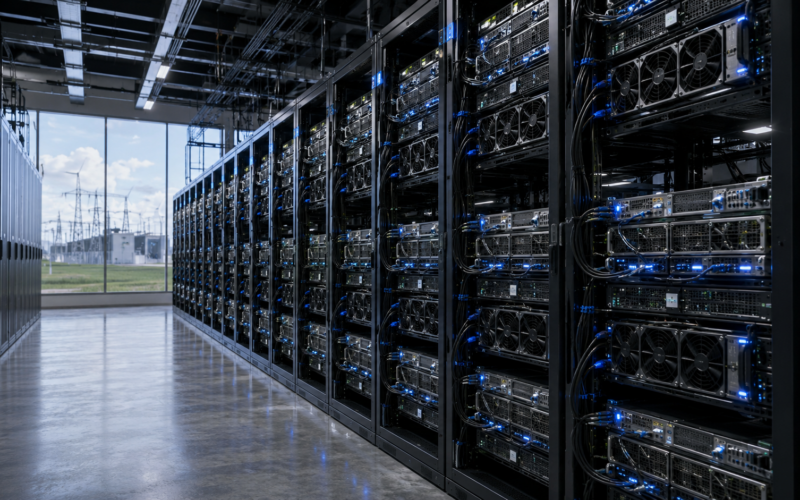
IREN Limited develops and operates large-scale data centres that support AI cloud computing and Bitcoin mining. Its emerging core business provides customers with access to GPU-based computing clusters used to train artificial intelligence models, run inference workloads and develop AI applications. Depending on the contract, customers may purchase dedicated bare-metal computing capacity or managed cloud services for a defined period, with revenue recognised as the contracted service is delivered.
The company’s business model differs from that of a conventional software provider. IREN owns or controls the physical infrastructure beneath the computing service, including land, grid connections, substations, data-centre buildings, cooling systems, servers, networking equipment and GPUs. This vertical integration gives IREN greater control over power procurement, construction schedules and operating costs, but it also makes the business highly capital intensive.
IREN’s Bitcoin mining operations generate revenue by using specialised mining computers to validate transactions and earn Bitcoin rewards and transaction fees. The company generally sells the Bitcoin it mines rather than retaining a large cryptocurrency treasury, which means its financial exposure is primarily through mining economics rather than the appreciation or depreciation of Bitcoin held on the balance sheet. As of March 31, 2026, IREN reported approximately 38 exahashes per second of installed mining capacity and said it typically liquidated mined Bitcoin daily.
Management now considers AI cloud services the company’s strategic growth engine, while Bitcoin mining is expected to contribute a decreasing proportion of the business over time. Mining nevertheless remains important because it has generated revenue and operating cash flow while IREN develops its more capital-intensive AI platform.
How did Iris Energy evolve from a Bitcoin miner into the present IREN Limited business?
IREN was incorporated in New South Wales, Australia, in November 2018 as Iris Energy Pty Limited. Brothers Daniel Roberts and William Roberts founded the company after careers spanning infrastructure investment, energy, commodities, real assets and finance. The company converted into an Australian public company in October 2021 and completed its United States initial public offering in November 2021, with its shares listing on the Nasdaq Global Select Market.
The original strategy centred on building Bitcoin mining facilities in regions with access to relatively low-cost renewable or renewable-linked electricity. IREN initially developed operations in British Columbia before expanding into Texas, where the scale of available power and the structure of the Electric Reliability Council of Texas market created opportunities for larger computing campuses.
The company began operating AI cloud services in February 2024. It started doing business under the shorter IREN name that month and formally changed its corporate name from Iris Energy Limited to IREN Limited in November 2024. The rebranding reflected a strategic effort to avoid being defined exclusively by Bitcoin mining and to position the company as a broader computing-infrastructure operator.
This evolution accelerated as demand for AI computing outpaced the availability of data-centre power, liquid cooling and advanced NVIDIA GPUs. Infrastructure developed for cryptocurrency mining could not simply be converted into AI capacity by swapping one machine for another, but IREN already possessed several scarce inputs, including grid-connected land, power agreements, construction capabilities and experience operating high-density computing assets.
Which data centres, power assets and geographic markets define IREN’s operations?
At March 31, 2026, IREN reported seven data-centre sites with executed grid arrangements or equivalent agreements representing approximately 4,510 megawatts of power capacity. These included the 750-megawatt Childress campus, the 1,400-megawatt Sweetwater 1 project, the 600-megawatt Sweetwater 2 project and a 1,600-megawatt Oklahoma site in the United States. Its Canadian portfolio comprised Canal Flats, Mackenzie and Prince George in British Columbia.
Childress is particularly important because it is becoming the centre of IREN’s AI transition. The company is developing liquid-cooled Horizon data centres there for its Microsoft agreement, preparing additional capacity for NVIDIA and progressively repurposing areas previously used for Bitcoin mining. Management has indicated that Bitcoin mining at Childress is expected to cease over time as existing infrastructure is redeployed for AI cloud services.
IREN reported approximately 150,000 GPUs installed or on order at March 31, although the number of GPUs actually commissioned and generating customer revenue was significantly lower. By July, the company said it was working toward delivering 480 megawatts of AI cloud capacity during 2026 and targeting approximately 1.2 gigawatts in 2027. Customer acceptance, GPU delivery, data-centre commissioning and network readiness will determine how quickly that planned capacity becomes billable.
The company also completed its acquisition of Spain-based Nostrum Group in June 2026. The transaction added approximately 490 megawatts of Spanish power capacity and expanded IREN into Europe, while also bringing development, engineering, construction and operating capabilities. IREN is separately pursuing projects in Australia, giving the company an emerging development pipeline across North America, Europe and the Asia-Pacific region.
IREN states that its operating data centres use 100% renewable energy, either through direct clean or renewable electricity supplies or through renewable energy certificates. The qualification matters because renewable energy certificates do not necessarily mean that every electron consumed at a facility was generated from a renewable source at the same location and time. Nevertheless, access to renewable-rich grids may improve IREN’s positioning with customers that have demanding energy and emissions objectives.
How does IREN generate revenue and what do its fiscal 2025 results reveal?
IREN generated $501 million in revenue during the fiscal year ended June 30, 2025, representing growth of approximately 168% from $187.2 million in fiscal 2024. Bitcoin mining contributed $484.6 million, while AI cloud services contributed $16.4 million. AI cloud therefore accounted for only about 3.3% of fiscal 2025 revenue, demonstrating how recently the strategic transition began.
Bitcoin mining revenue increased as IREN expanded its average operating hashrate and benefited from higher average Bitcoin prices. The company mined 5,499 Bitcoin during fiscal 2025, compared with 4,191 in fiscal 2024. Its average operating hashrate increased to 25.7 exahashes per second from 6.6 exahashes per second.
IREN reported fiscal 2025 net income of $86.9 million, reversing a $28.9 million loss in fiscal 2024. That improvement should not be interpreted as a clean measure of recurring profitability. Fiscal 2025 earnings included a $77.5 million unrealised gain on financial instruments, while depreciation and amortisation increased sharply to $181.1 million as the company expanded its mining hardware, data centres and GPU assets.
Operating cash inflow reached $245.9 million during fiscal 2025, but investing cash outflow was approximately $1.38 billion. The difference illustrates the defining feature of IREN’s economics: its operating assets can generate substantial cash, but the growth programme requires much greater upfront expenditure on power infrastructure, construction and computing equipment.
What do the latest fiscal 2026 quarterly results say about IREN’s AI transition?
IREN’s latest reported financial period as of July 26, 2026, was the third quarter of fiscal 2026, covering the three months ended March 31. Full-year fiscal 2026 results for the year ended June 30 had not yet been released.
Third-quarter revenue was $144.8 million, almost unchanged from the corresponding period a year earlier. The composition of that revenue, however, shifted meaningfully. AI cloud services revenue increased to $33.6 million from $3.6 million, while Bitcoin mining revenue declined to $111.2 million from $141.2 million. AI cloud services therefore represented approximately 23% of quarterly revenue, up from less than 3% a year earlier.
For the first nine months of fiscal 2026, total revenue increased approximately 82% to $569.8 million. Bitcoin mining contributed $511.5 million, while AI cloud services produced $58.3 million. The nine-month figures show that IREN remained economically dependent on Bitcoin mining even as AI cloud revenue accelerated.
IREN reported a third-quarter net loss of $247.8 million and an operating loss of $233.5 million. Results included $140.4 million of impairment charges, primarily connected with mining equipment being decommissioned as facilities were prepared for GPU deployments. Depreciation and amortisation reached $121.2 million, while selling, general and administrative expenses increased substantially, including higher stock-based compensation. Adjusted EBITDA, which excludes several of these items, was $59.5 million, down from $83.1 million a year earlier.
These results reveal both progress and disruption. AI cloud revenue is growing rapidly from a small base, but the physical conversion of mining infrastructure is creating impairments, downtime and higher corporate costs before all replacement GPU capacity begins generating revenue.
How strong are IREN’s cash position, balance sheet and expansion funding?
IREN reported $2.21 billion of cash and cash equivalents at March 31, 2026. By June 30, the company said preliminary cash and cash equivalents had increased to approximately $7.6 billion, although this total included $1.7 billion of restricted cash associated with GPU financing for the Microsoft contract.
The increase reflects aggressive capital raising rather than operating cash generation alone. IREN issued convertible senior notes, completed equity offerings and repeatedly used at-the-market share-sale programmes. A March 2026 prospectus authorised the sale of up to an additional $6 billion of ordinary shares. By April 30, IREN had issued approximately 24.7 million shares under that programme for gross proceeds of about $1.06 billion.
The company also entered purchase arrangements with Dell Technologies for approximately $3.5 billion of GPUs and related products scheduled for phased delivery during the second half of 2026. Goldman Sachs Bank USA and JPMorgan Chase Bank committed, subject to definitive agreements and closing conditions, to underwrite approximately $3.6 billion of delayed-draw financing associated with the Microsoft deployment.
IREN’s contractual commitments stood at approximately $11.9 billion at March 31, with most due within the following 12 months. This does not mean the company faced an immediate uncovered cash shortfall of the same amount, because commitments may be matched with financing, customer prepayments, staged deliveries and contract cash flows. It does demonstrate the scale and complexity of the capital programme.
The July customer agreements provide some relief. IREN said advance payments attached to contracts signed since June 1 represented approximately 45% of the estimated GPU capital expenditure associated with those deployments. Customer funding reduces IREN’s net capital requirement and provides commercial validation, although the terms may not apply to future contracts.
The balance-sheet question is therefore not whether IREN has access to capital. It has repeatedly demonstrated that it can raise large amounts. The more important issue is how much future value will accrue to existing shareholders after accounting for interest costs, convertible securities, restricted cash, acquisition consideration and additional equity issuance.
Which customers, contracts and acquisitions could drive IREN’s growth through 2027?
Microsoft Corporation is a cornerstone customer for IREN’s AI expansion. IREN has described the Microsoft agreement as having an approximately $9.7 billion contract value, with expected average annual revenue of about $1.9 billion. Delivery depends on completing the Horizon 1 to Horizon 4 data centres, installing the required GPUs and passing customer acceptance procedures.
In May 2026, IREN signed a five-year cloud-services agreement with NVIDIA Corporation worth approximately $3.4 billion. The agreement covers dedicated GPU services at Childress, with deployments targeted during 2027. NVIDIA also received rights to purchase up to 30 million IREN shares at $70 per share as GPU delivery milestones are achieved, potentially providing IREN with up to $2.1 billion if fully exercised.
IREN’s July contracts broadened the customer base beyond these two large technology companies. The disclosed portfolio includes Perplexity AI, Figure AI, Together AI, Fluidstack, Fireworks AI, Fal AI and Hume AI, alongside another unnamed AI developer. IREN said the contracts had a weighted average term of approximately four years and lifted the company’s year-end 2026 AI cloud ARR target to more than $4 billion, with roughly 85% under contract.
The wording of that target requires careful interpretation. IREN calculates ARR by multiplying expected hourly GPU pricing for commissioned capacity by the hours in a year and adding annualised storage and ancillary revenue. It is not a Generally Accepted Accounting Principles revenue figure, and the target assumes timely GPU delivery, commissioning, testing, customer acceptance, utilisation and pricing. A GPU scheduled to begin service near the end of December could contribute to the annualised run rate while generating little recognised revenue during calendar 2026.
IREN has also agreed to acquire Mirantis, a cloud software and services business, for approximately $625 million, primarily through the issuance of IREN shares. The proposed acquisition is intended to add software orchestration, engineering and customer-support capabilities that could help IREN move beyond infrastructure rental. As of the latest quarterly filing, the transaction remained subject to closing conditions and regulatory approvals.
The strategic logic is understandable. Data-centre power and GPUs provide the infrastructure layer, but software, orchestration and support can increase customer reach and make the service more difficult to commoditise. The risk is that IREN is simultaneously constructing data centres, deploying GPUs, integrating acquisitions and replacing its historical revenue base.
How does IREN compare with CoreWeave, Nebius Group and Bitcoin-mining peers?
IREN occupies an unusual position between AI cloud specialists and publicly traded Bitcoin miners. Companies such as CoreWeave and Nebius Group compete for AI workloads, GPU supply and hyperscale customers, while Hut 8 Corporation, Cipher Mining Incorporated, Riot Platforms Incorporated and other mining businesses are also converting power portfolios into AI or high-performance-computing infrastructure.
IREN’s potential advantage is its ownership and control of grid-connected sites, power infrastructure and data-centre development. This allows it to integrate the physical and computing layers rather than relying entirely on third-party colocation capacity. Its renewable-rich power portfolio may also appeal to large customers seeking both computing capacity and progress toward energy commitments.
Its disadvantage is that reported AI cloud revenue remains small relative to the scale implied by its contracts and valuation. More established cloud companies have longer operating histories, larger software ecosystems and broader customer-support capabilities. IREN’s proposed Mirantis acquisition appears designed partly to address that gap.
Traditional Bitcoin-mining peers remain relevant because mining continues to fund a large portion of IREN’s operations and exposes its earnings to Bitcoin prices, network difficulty, hardware efficiency and electricity costs. IREN’s own historical compensation peer group has included Bitdeer Technologies Group, Bitfarms Limited, Cipher Mining, CleanSpark Incorporated, Hut 8, MARA Holdings Incorporated and Riot Platforms. However, its future valuation is increasingly likely to be judged against AI infrastructure companies rather than mining output alone.
How has IREN’s share price performed in 2026 and what is driving investor sentiment?
IREN shares closed at $37.07 on July 24, 2026, after falling 8.65% during that session. The stock had closed at $42.70 on January 2, meaning it was down approximately 13.2% for the year to date. It was also approximately 26.3% below its June 24 close of $50.30.
The stock remained exceptionally volatile. IREN shares gained about 16% on July 20 after the company announced its $2.8 billion of new AI contracts, yet the subsequent decline showed that positive contract announcements have not removed concerns about execution, capital expenditure and governance. The July 24 closing price was approximately 52% below the 52-week high of $76.87 but more than 150% above the 52-week low of $14.72.
Based on approximately 357.4 million shares outstanding reported at April 30 and the July 24 closing price, IREN’s indicative market capitalisation was around $13.25 billion. The true figure may differ because the company can continue issuing shares through its at-the-market facility.
A conventional price-to-earnings ratio provides limited insight into IREN’s valuation. GAAP earnings have been heavily affected by impairments, depreciation, derivatives and fair-value movements, while the expected AI revenue base has not yet fully entered the income statement. Investors are consequently valuing IREN on a combination of contracted annualised revenue, data-centre capacity, power access, customer quality and execution expectations.
A current market-data compilation showed an average 12-month analyst price target of approximately $81 across 15 analysts, with individual estimates ranging from $41 to $126. The unusually wide range is more informative than the average because it exposes the market’s uncertainty over funding, margins, commissioning schedules and the eventual value of IREN’s AI cloud platform.
What do IREN’s founder ownership, voting structure and governance disputes reveal?
Daniel Roberts and William Roberts remain IREN’s co-chief executive officers, while David Bartholomew serves as independent chair. The two founders owned approximately 2.3% of ordinary shares each as of August 31, 2025, but each also controlled a B Class share. Those shares gave each founder approximately 21.8% of total voting power, or around 43.6% combined. The enhanced voting rights can remain in place until November 2033 unless earlier redemption conditions are triggered.
This structure gives the founders significant influence over shareholder decisions despite their smaller economic ownership. Supporters may view that control as valuable while IREN executes a complex, founder-led transformation. Other investors may see it as a governance risk because voting power is less exposed to dilution than ordinary-share ownership.
Governance concerns intensified in July 2026 after IREN granted 9,099,328 restricted stock units to each co-chief executive officer. The awards vest in four equal annual instalments and include an additional two-year holding requirement after each tranche vests. IREN said neither executive would receive another equity incentive award until fiscal 2031.
The independent board argued that the awards were necessary to retain the founders through IREN’s next growth phase and align them with long-term shareholder value. Critics focused on their size, the absence of share-price or operating-performance conditions and the potential dilution. The dispute contributed to a sharp deterioration in retail-investor sentiment even though the grants cannot be immediately sold.
What are the biggest financial, operational and strategic risks facing IREN?
Execution is the most immediate risk. IREN must complete data centres, secure equipment, connect facilities to power grids, install and test GPUs, satisfy customers and operate the resulting clusters reliably. Delays at any stage could postpone revenue while interest, staffing and construction costs continue.
Financing risk remains material despite the June cash position. AI cloud infrastructure requires substantially more investment than conventional Bitcoin mining facilities. IREN has funded expansion through equity, convertible debt, equipment financing and customer prepayments. Future capital raising could increase leverage or dilute existing shareholders.
Technology risk is also significant. Advanced GPUs are expensive, subject to supply constraints and vulnerable to obsolescence as new architectures are released. IREN must maintain utilisation and pricing long enough to earn an attractive return before its hardware becomes less competitive.
The transition itself creates accounting and operational costs. IREN estimated that the planned conversion of remaining Childress mining infrastructure could result in approximately $520 million of additional impairment charges, subject to final project scope and accounting assessments.
Regulation and power access represent further risks. Large electricity loads can face changing grid-connection rules, curtailment requirements, construction obligations and political scrutiny. IREN’s Texas projects are particularly exposed to Electric Reliability Council of Texas processes and evolving large-load regulations.
Bitcoin prices and mining difficulty remain relevant until mining becomes a much smaller contributor. Lower Bitcoin prices, higher global hashrate or rising electricity costs could weaken the cash generation that supports IREN during its AI buildout.
Customer concentration may also become important. Microsoft and NVIDIA account for a substantial portion of contracted annualised revenue. These contracts validate IREN’s technical capabilities, but problems affecting one large deployment could have an outsized financial impact.
What is the long-term growth outlook for IREN Limited through 2027?
IREN’s outlook depends less on whether demand for AI computing exists and more on whether the company can convert its infrastructure pipeline into operational, contracted and profitable capacity. The July agreements suggest that customer demand is not currently the principal bottleneck. Power delivery, GPU installation, construction execution, financing and customer acceptance are more likely to determine the pace of growth.
The business could look materially different by the end of 2027. Bitcoin mining may represent a much smaller share of revenue, while long-duration AI cloud contracts could provide greater visibility than cryptocurrency-linked earnings. The Nostrum acquisition could expand IREN’s European pipeline, while Mirantis could add software and managed-service capabilities if the transaction closes successfully.
The opportunity is substantial, but the transformation should not be assessed solely through the more than $4 billion ARR target. Investors will need to examine recognised AI cloud revenue, gross margins, operating cash flow, capital expenditure, interest costs, share issuance and commissioned megawatts. Contracted annualised revenue provides evidence of demand, but financial durability will be established only when those contracts generate recurring cash after infrastructure and financing costs.
IREN Limited has assembled several assets that are difficult to replicate quickly, including grid-connected power, large development sites, data-centre construction expertise, GPU relationships and major customers. It has also accepted substantial execution, funding and governance risk to pursue the opportunity. Over the next cycle, markets are likely to reward the company if commissioned AI capacity and cash generation begin catching up with its contract announcements. Should deployment delays, dilution or cost overruns persist, the same ambitious expansion that created IREN’s growth narrative could become the central pressure on its valuation.
Discover more from Business-News-Today.com
Subscribe to get the latest posts sent to your email.