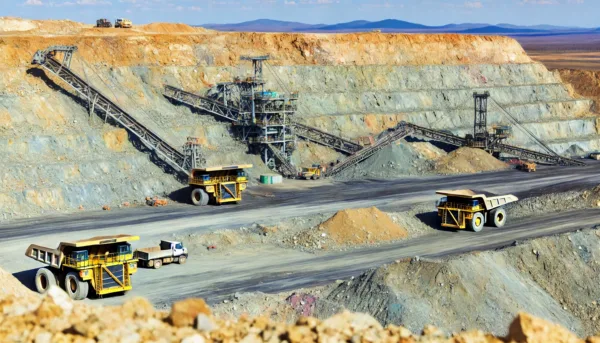

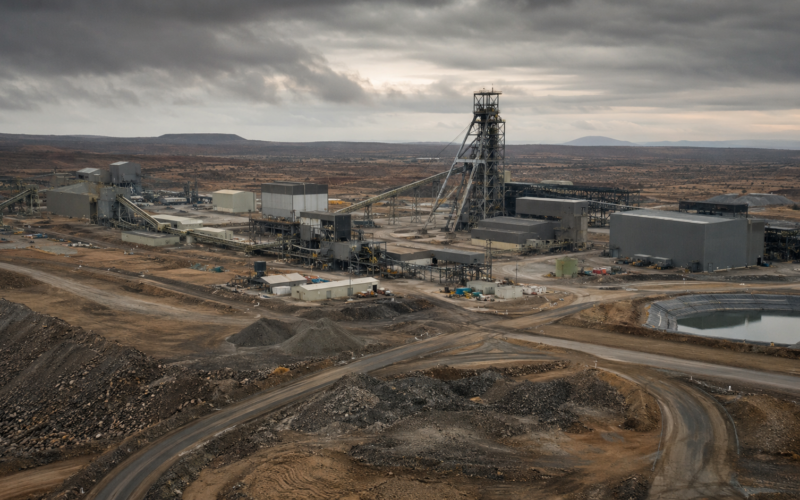
Petra Diamonds Limited has placed its Finsch mine in South Africa under business rescue and started group-wide workforce consultations as weak diamond prices, a stronger South African rand and liquidity pressure force one of the sector’s better-known producers into deeper restructuring. The London Stock Exchange-listed diamond miner, traded under the ticker PDL, is taking action at a mine that contributed 34% of its fiscal 2025 revenue and has historically been one of South Africa’s most important diamond operations. The decision matters because Finsch is not a marginal exploration asset being quietly shelved, but a producing underground mine caught in the structural weakness of smaller-stone diamond markets. Petra Diamonds Limited shares have recently traded near 9.5p to 10p, close to a 52-week low of 9p, showing that investors are treating the move as a survival test rather than a routine portfolio adjustment.
Why does Petra Diamonds Limited’s Finsch business rescue matter for the global diamond mining sector?
Petra Diamonds Limited’s decision to place Finsch into business rescue matters because it shows how severe the pressure has become for diamond miners exposed to lower-value and smaller-stone production. The global diamond market has been struggling with weaker consumer demand, cautious retailers, lab-grown diamond competition, inventory overhang and uncertain luxury spending patterns. These pressures have not affected all diamonds equally. Larger, rarer and higher-quality stones can still attract buyers, while smaller and more commercial categories have faced sharper price pressure.
Finsch sits directly in that difficult part of the market. The mine produces mostly diamonds of two carats and below, meaning Petra Diamonds Limited is exposed to the category where price recovery appears weakest. When a mine that previously contributed more than a third of group revenue becomes financially unsustainable, the issue is not only mine-level cost control. It points to a deeper demand and pricing problem across the diamond value chain.
The business rescue process also matters because it brings operational restructuring into a formal framework. Petra Diamonds Limited is no longer simply reviewing capital expenditure or trimming discretionary spending. It is moving to protect value, preserve liquidity and decide whether Finsch can be restructured into a viable operation. That shift from optimisation to rescue is the uncomfortable but important signal for the wider sector.

How did weak diamond prices and currency pressure push Finsch into business rescue?
Weak diamond prices created the core problem, but currency pressure made the pain harder to absorb. Petra Diamonds Limited sells into an international diamond market where pricing is shaped by global demand, tender performance and buyer confidence. Its South African cost base, however, is exposed to local inflation, labour costs, electricity tariffs and exchange-rate movements. A stronger South African rand can reduce local-currency revenue conversion at exactly the wrong time for an exporter.
The company’s own explanation points to several pressures converging at once. Smaller diamond prices have been structurally weak, the broader diamond market has not recovered fast enough, and Middle East turmoil has added uncertainty to global luxury and trading flows. For a mine like Finsch, that combination compresses margins and makes continued capital spending harder to justify.
The result is a classic mining squeeze. Production may continue physically, but the economics no longer support the same operating plan. In diamond mining, grade, size distribution, price mix and cost per tonne all matter. If the stones being recovered sell into a depressed market while costs remain sticky, operating leverage works in the wrong direction. Mining investors know that leverage can be beautiful on the way up. On the way down, it arrives with steel-toed boots.
Why is the Finsch mine strategically important despite its current financial distress?
Finsch remains strategically important because it is one of South Africa’s significant underground diamond operations and has long been part of Petra Diamonds Limited’s core portfolio. The mine has been operating since the 1960s and benefits from established underground infrastructure and processing capability. That history gives it industrial relevance, but it does not guarantee financial resilience in a structurally weaker pricing environment.
The mine’s 34% revenue contribution in fiscal 2025 underlines why the business rescue is significant for Petra Diamonds Limited. This is not a small divestment or a peripheral shutdown. Finsch has been central enough to group revenue that any restructuring, suspension or closure will reshape Petra Diamonds Limited’s operating profile. It could reduce scale, alter fixed-cost absorption and increase the company’s dependence on Cullinan.
There is also a South African employment and regional economy dimension. Petra Diamonds Limited said it is launching consultations with employees and unions, although it has not disclosed the number of potential job cuts. Mining operations often anchor local communities, contractors and service providers. When a mine enters business rescue, the impact is not confined to shareholders. It can flow through wages, procurement, municipal revenue and regional confidence.
What does the rescue process signal about Petra Diamonds Limited’s broader restructuring strategy?
The Finsch rescue signals that Petra Diamonds Limited is moving from broad cost reduction to sharper portfolio triage. The company has already been restructuring after a prolonged diamond downturn, including asset sales and leadership changes. Placing Finsch under business rescue suggests management is now prioritising liquidity preservation and higher-value assets over maintaining full production scale.
That strategic direction is understandable. In a weak market, miners often shift from volume to value. Petra Diamonds Limited’s challenge is that its remaining portfolio must be strong enough to carry the company after Finsch is restructured. Cullinan, famous for producing some of the world’s most notable diamonds, becomes even more central to the company’s future. That concentration may improve strategic focus, but it also increases operational dependence on fewer assets.
The suspension of fiscal 2026 to 2030 guidance is another important signal. Guidance suspension tells investors that management no longer sees enough visibility to provide credible medium-term production assumptions. That is not good for valuation confidence, but it is better than pretending a plan still holds when the market has clearly changed. In mining, optimistic guidance can be like a fragile drill bit. It looks useful until the hard rock arrives.
How should investors read Petra Diamonds Limited stock after the Finsch decision?
Petra Diamonds Limited shares have recently traded around 9.5p to 10p, close to the company’s 52-week low of 9p and far below its 52-week high of about 22.67p. That share price context shows that investors have already heavily discounted the company’s recovery prospects. The market is not treating Finsch business rescue as a temporary operational hiccup. It is pricing material uncertainty around the company’s liquidity, asset base and earnings visibility.
The stock’s near-low trading range also shows how difficult it is for investors to value diamond producers during a demand downturn. Unlike gold or copper, diamonds do not have the same transparent benchmark market or industrial demand floor. Rough diamond pricing depends heavily on discretionary spending, jewellery demand, inventories, cutting-centre liquidity and consumer confidence. That makes recovery timing harder to model.
For speculative investors, the potential upside lies in restructuring, cost reduction and any recovery in diamond prices. If Petra Diamonds Limited can reduce cash burn, stabilise Cullinan and manage Finsch through a credible process, sentiment could improve. However, the downside remains substantial. A weak diamond market, prolonged business rescue, further dilution, debt stress or deeper job cuts could keep pressure on the stock.
Why are smaller diamonds facing more structural pressure than larger stones?
Smaller diamonds are facing more structural pressure because they are more directly exposed to mass-market jewellery demand and lab-grown diamond substitution. Lab-grown diamonds have become much more affordable and widely accepted in commercial jewellery categories, especially where buyers are less focused on rarity and provenance. This has put natural smaller stones under greater pricing pressure than exceptional large stones.
The economics of mining small stones can become particularly difficult when operating costs rise. A mine may recover significant carats, but revenue quality depends on size, clarity, colour and buyer appetite. If the value per carat falls while underground mining costs remain high, a mine can quickly become uneconomic even if production volumes look respectable. This is why Finsch’s product mix matters so much.
The diamond industry’s marketing challenge is also relevant. Natural diamonds still have emotional and luxury appeal, but the industry has struggled to defend price premiums in lower-value categories where lab-grown alternatives are available at far lower prices. That does not mean natural diamonds disappear. It means miners with exposure to weaker categories must become more selective about production, capital spending and inventory management.
What does the Finsch rescue mean for South Africa’s mining employment and industrial base?
The Finsch business rescue raises difficult questions for South Africa’s mining employment base because formal restructuring usually comes with workforce uncertainty. Petra Diamonds Limited has launched consultation processes with employees and unions, and the final impact will depend on the rescue plan, operational decisions and whether any viable restructuring path emerges. For communities around mining operations, even uncertainty can be economically painful.
South Africa’s mining sector has already been navigating electricity constraints, rising costs, labour tension, safety requirements and global commodity volatility. Diamond mining adds another layer because the product market is driven by luxury demand rather than industrial necessity. That makes employment more vulnerable when discretionary consumer markets weaken.
The wider industrial implication is that South Africa’s diamond sector may continue moving toward fewer, more selective operations unless prices improve. Mines with stronger stone quality, lower costs or better capital backing will be better positioned. Operations dependent on weaker price categories may face tougher decisions. Finsch is therefore not just a Petra Diamonds Limited issue. It is a warning about the resilience of mature diamond mines in a changed demand environment.
Can Petra Diamonds Limited survive by focusing on higher-value assets like Cullinan?
Petra Diamonds Limited can improve its survival prospects by focusing on higher-value assets, but concentration creates a new risk profile. Cullinan gives the company exposure to a more storied asset with potential for higher-value stones, and that may be more attractive in a market where smaller commercial diamonds are under pressure. However, relying more heavily on one asset can increase operational volatility.
Cullinan has also faced its own production and tender challenges, including market uncertainty that affected sales timing. That means the company cannot simply shift investor attention from Finsch to Cullinan and declare the problem solved. Cullinan must deliver operationally, commercially and financially if Petra Diamonds Limited is to rebuild confidence.
The company’s future will likely depend on a smaller, more disciplined operating model. That may mean lower production, fewer assets and more focus on cash preservation. In a healthier diamond market, scale can support marketing, tender activity and fixed-cost absorption. In a weak market, scale can become a burden if it forces companies to produce stones that buyers do not value highly enough. Petra Diamonds Limited is now choosing survival discipline over scale optics.
What happens next for Petra Diamonds Limited and the Finsch mine?
The next phase will revolve around the business rescue process, workforce consultations, creditor engagement and decisions about whether Finsch can be restructured into a viable operation. Investors will watch whether the mine is suspended, downsized, sold, restructured or eventually closed. Each path has different implications for cash flow, liabilities, employees and remaining group assets.
Petra Diamonds Limited also needs to rebuild market confidence after suspending medium-term guidance. That will require clearer disclosure on liquidity, capital expenditure, debt management, Cullinan performance and tender results. The company’s communication with lenders, employees and shareholders will matter because uncertainty can deepen stress in already weak markets.
A neutral reading suggests that the Finsch rescue is a necessary but painful move. It may help Petra Diamonds Limited conserve cash and protect the stronger parts of the portfolio, but it also confirms how difficult the diamond market has become. For investors, the story is no longer about whether Petra Diamonds Limited can grow production. It is about whether Petra Diamonds Limited can emerge from the diamond slump with a smaller, stronger and financially survivable core.
Key takeaways on Petra Diamonds Limited’s Finsch business rescue and diamond-market pressure
- Petra Diamonds Limited has placed its Finsch mine in South Africa under business rescue as weak smaller-diamond prices and currency pressure hit mine economics.
- Finsch contributed 34% of Petra Diamonds Limited’s fiscal 2025 revenue, making the decision a major strategic shift rather than a minor operational adjustment.
- The mine produces mostly diamonds of two carats and below, the category facing structural pressure from weak demand and lab-grown diamond substitution.
- Petra Diamonds Limited has started group-wide workforce consultations, raising employment and regional economic concerns in South Africa.
- The company has suspended its fiscal 2026 to 2030 guidance, showing that management no longer has enough visibility to maintain medium-term production assumptions.
- Petra Diamonds Limited shares are trading close to their 52-week low, reflecting investor concern over liquidity, restructuring risk and diamond-market weakness.
- The business rescue process may help preserve cash, but it could also reduce the company’s operating scale and increase dependence on Cullinan.
- The diamond market downturn is different from normal commodity weakness because rough diamond pricing depends heavily on luxury demand, inventories and consumer sentiment.
- South Africa’s diamond mining base may face further pressure if mature mines with weaker product mix cannot generate sustainable returns.
- For investors, the key question is whether Petra Diamonds Limited can turn painful restructuring into a smaller but more resilient operating model.
Discover more from Business-News-Today.com
Subscribe to get the latest posts sent to your email.