

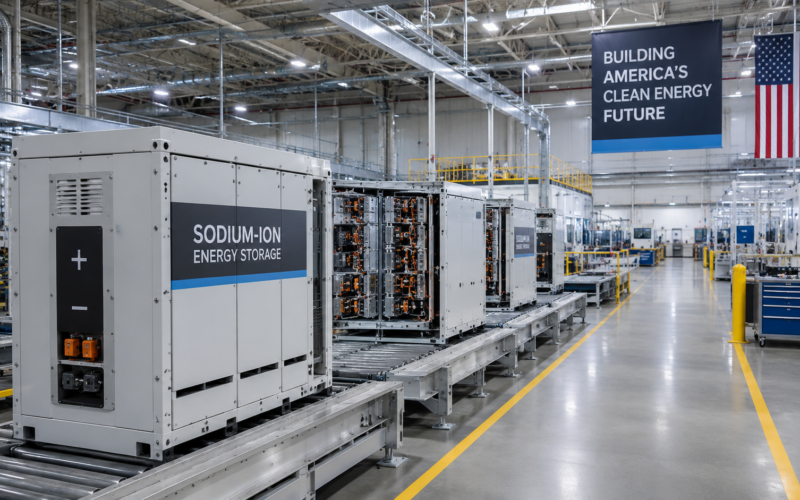
Peak Energy has selected Sacramento, California, for a sodium-ion battery energy storage systems factory representing up to $71 million of capital investment. The private company plans to equip a 183,000-square-foot facility at Metro Air Park with annual system production capacity of up to 4 GWh, with shipments targeted for the first quarter of 2027. The project is expected to create 239 jobs over 18 months and is backed by a $10.5 million California Competes tax credit. Strategically, the factory is intended to convert Peak Energy’s pilot deployments and more than 6 GWh of customer commitments into repeatable United States manufacturing. The larger test is whether sodium-ion systems can win on lifetime cost, cooling simplicity and supply-chain security while lithium iron phosphate batteries continue to dominate grid storage.
Why is Peak Energy building a 4 GWh sodium-ion battery systems factory in Sacramento now?
Peak Energy is moving into manufacturing at a point when electricity demand, data center construction and grid reliability concerns are converging. Battery storage developers increasingly need systems that can absorb power when supply is abundant and release it when demand, congestion or wholesale prices rise. Artificial intelligence infrastructure is adding urgency because large data centers require dependable power around the clock, often in regions where transmission capacity and new generation cannot be delivered quickly.
The Sacramento project is therefore less about competing directly with electric vehicle battery plants and more about capturing the stationary storage market. Sodium-ion batteries generally offer lower energy density than lithium-ion batteries, making them less attractive where weight and space are critical. Grid storage changes that calculation because a stationary project can accept a larger physical footprint when the chemistry offers lower material risk, simpler thermal management, longer useful life or lower operating costs.
Peak Energy also has a commercial reason to move now. The company says it has secured more than 6 GWh of customer commitments, including agreements or deployment relationships involving Jupiter Power, Energy Vault and RWE Americas. Building capacity before those commitments move into scheduled deliveries creates execution risk, but waiting too long would create a different problem. Customers planning projects for 2027 and beyond need confidence that Peak Energy can manufacture, test and deliver systems at utility scale.
Sacramento adds proximity to one of the largest energy storage markets in the United States. California’s renewable generation, electricity demand, grid constraints and data center economy create a natural test market for alternative storage technologies. The location also gives Peak Energy access to manufacturing workers, logistics infrastructure and a state government willing to subsidise advanced industrial projects.

Does the $71 million investment represent a true battery gigafactory or a systems assembly hub?
The distinction between cell manufacturing and battery system manufacturing is central to understanding the project. Peak Energy describes the Sacramento site as the first United States factory dedicated to grid-scale sodium-ion energy storage systems. However, the company’s separate partnership with General Motors indicates that General Motors will develop sodium-ion cells and retain exclusive manufacturing rights for that cell technology, while Peak Energy will integrate the cells into its storage systems.
That structure suggests Sacramento will initially focus on system integration, pack assembly, electrical architecture, thermal design, controls, testing and final delivery rather than manufacturing every electrochemical cell from raw materials. This does not make the project less important. Grid-scale battery systems require sophisticated engineering across cells, modules, enclosures, inverters, software, safety systems and grid interfaces. Poor integration can erase the theoretical advantages of even an excellent cell.
The investment level also provides a clue. Up to $71 million for 4 GWh of annual system capacity equates to less than $18 of capital investment for each kilowatt-hour of stated yearly output. That figure is not directly comparable with a full cell gigafactory because the Sacramento site may not include capital-intensive electrode production, cell formation and upstream material processing. The relatively lean capital requirement could allow Peak Energy to scale more quickly, but it also means the company remains dependent on external cell manufacturing.
That dependency creates both flexibility and risk. Peak Energy can concentrate capital on system design and customer delivery rather than building an entire battery materials chain. However, the company must ensure that cell development, qualification and production timelines remain aligned with its system orders. A battery factory can have gleaming floors, efficient assembly stations and a very impressive ribbon-cutting ceremony, but without qualified cells it is mostly an expensive warehouse.
How do Peak Energy’s customer commitments reduce commercial risk before production starts in 2027?
Peak Energy enters the Sacramento development with more demand visibility than many early-stage battery manufacturers. Its agreement with Jupiter Power includes approximately 720 MWh of expected delivery in 2027 and an option covering an additional 4 GWh between 2028 and 2030. The potential contract value could exceed $500 million if the full capacity reservation converts into deliveries.
That commitment is strategically important because the Sacramento factory is designed for up to 4 GWh of annual production. A customer pipeline exceeding the plant’s stated yearly capacity provides a credible reason for investment and gives equipment suppliers, employees and financing partners greater confidence. It also allows Peak Energy to plan manufacturing around defined customer requirements rather than producing systems in anticipation of unspecified future demand.
However, customer commitments do not eliminate commercial risk. Multi-year supply agreements may contain performance conditions, deployment milestones, options and project-specific approvals. An option for future capacity is not the same as a guaranteed shipment, particularly when customers can compare sodium-ion systems with falling lithium iron phosphate prices and other emerging storage technologies.
Peak Energy must therefore convert announced demand into factory utilisation. The first production year will be especially important because the company currently targets 1 GWh of deployment in 2027, which would use only part of the factory’s 4 GWh nameplate capacity. That may be sensible while production is stabilised, but underutilisation would weigh on unit economics if the ramp remains slow.
The company’s relationships with multiple developers reduce dependence on a single customer. Jupiter Power provides a large commercial pathway, while RWE Americas offers utility-scale operating validation. Energy Vault adds another potential deployment channel, and the General Motors relationship addresses cell technology and domestic supply. Together, these relationships create a more credible ecosystem, though Peak Energy still has to coordinate partners with different technical, financing and construction timelines.
Can sodium-ion batteries beat lithium iron phosphate on grid storage economics rather than energy density?
Sodium-ion batteries do not need to outperform lithium-ion batteries in every metric to build a meaningful market. They need to be better for specific applications where cost, temperature tolerance, maintenance, safety and material availability matter more than compact size. Stationary energy storage is one of the clearest opportunities because the system does not need to move and can accommodate lower energy density.
Peak Energy’s commercial proposition is built around passive cooling. Conventional lithium iron phosphate systems often use heating, ventilation and air-conditioning equipment to manage battery temperatures. These systems consume electricity, require maintenance and introduce pumps, fans, sensors and other components that can fail. Peak Energy is attempting to remove much of that complexity by using sodium-ion chemistry designed to operate across a wider temperature range.
The company estimates that its architecture can reduce energy storage costs by about 20 percent and provide more than 99 percent uptime. Those figures will ultimately need to be demonstrated across years of commercial operation, not only through pilots or engineering models. Grid operators and project financiers will scrutinise degradation, cycle efficiency, warranty coverage, maintenance costs and performance under extreme weather before accepting a new chemistry at scale.
Lithium iron phosphate remains a formidable competitor. Its manufacturing ecosystem is mature, suppliers have built enormous production capacity and costs have fallen rapidly. The International Energy Agency has cautioned that sodium-ion technology still trails lithium iron phosphate in energy density and supply-chain maturity, particularly when lithium prices are low.
Peak Energy is therefore competing on total lifetime economics rather than headline cell cost alone. If passive cooling reduces auxiliary power consumption, scheduled maintenance and equipment replacement, the system may deliver better project returns even when the cell is not cheaper. The challenge is convincing customers and lenders to value savings that emerge over 15 or 20 years against the certainty of purchasing a familiar lithium-based product today.
What does the General Motors partnership reveal about Peak Energy’s domestic supply-chain strategy?
The General Motors partnership gives Peak Energy access to battery engineering expertise that would be difficult and expensive to recreate independently. General Motors plans to develop sodium-ion cells in Michigan and retains exclusive manufacturing rights for the jointly developed technology. Peak Energy will incorporate those cells into its proprietary stationary storage platform.
This division of responsibilities is strategically logical. General Motors has laboratories, manufacturing knowledge and experience qualifying battery chemistries, while Peak Energy is focused on grid-scale architecture and customer deployment. The arrangement allows General Motors to extend its battery capabilities beyond electric vehicles and gives Peak Energy a potential domestic cell source aligned with its system requirements.
The partnership also addresses geopolitical and supply-chain concerns. Most global battery cell manufacturing remains concentrated in Asia, with China holding a dominant position across cells, cathode materials, anodes and processing capacity. Sodium-ion chemistry can reduce exposure to lithium, nickel and cobalt, but a United States supply chain still requires domestic manufacturing of hard carbon, cathode materials, electrolytes and finished cells.
Peak Energy’s Sacramento facility alone cannot solve that challenge. It can localise final system manufacturing, integration and employment, but upstream dependence will remain until cell and material production reaches commercial scale in the United States. The General Motors relationship provides a pathway, though the timing of cell qualification and volume manufacturing will be critical.
The arrangement could also change Peak Energy’s bargaining power over time. Depending on one strategic cell partner simplifies development but can create supplier concentration. Peak Energy will need contractual protection around production capacity, cost, quality and technology access. General Motors, meanwhile, gains exposure to stationary storage without having to build an entire project development and system sales organisation from scratch.
Why could artificial intelligence data centers accelerate demand while raising execution pressure?
Artificial intelligence data centers are becoming a major demand driver for generation, transmission and storage infrastructure. Data centers need continuous electricity and cannot depend entirely on intermittent renewable generation. Battery storage can help smooth demand, manage peak prices, support backup systems and enable more effective use of contracted solar or wind power.
Peak Energy positions its sodium-ion system as a solution for data centers because passive cooling can reduce parasitic energy consumption. In a large battery installation, cooling equipment consumes electricity that could otherwise be sold or used by the customer. Removing much of that load could improve system availability and lower lifetime costs, particularly in hot climates.
However, data center customers are demanding. Hyperscale operators prioritise reliability, safety, bankability and predictable delivery. They may support emerging battery technologies, but they will not compromise critical operations merely to diversify chemistry. Peak Energy will need extensive operating data, insurance acceptance, fire-safety approvals and strong warranties before sodium-ion systems become a mainstream data center choice.
AI demand can also distort manufacturing plans. Rapid growth may encourage suppliers to announce capacity before the supply chain, workforce or customer projects are ready. If data center construction slows because of grid constraints, permitting delays or financing conditions, some expected battery demand could move to later years. Peak Energy must scale quickly enough to capture the opportunity without building a cost base that assumes every announced data center will arrive on schedule.
What could prevent the Sacramento sodium-ion factory from reaching its 4 GWh ambition?
The first execution risk is the timeline. Peak Energy expects production and shipments to begin in the first quarter of 2027, leaving a relatively short period to prepare the building, install equipment, qualify processes, recruit workers and establish supplier flows. Any delay involving manufacturing equipment, cell availability or safety certification could affect customer delivery schedules.
The second risk is manufacturing yield. Battery system production requires consistency across modules, electrical connections, enclosures, software controls and safety systems. Early production lines often face rework, testing bottlenecks and component variability. Peak Energy must raise output without allowing quality problems to undermine the reliability advantage it is marketing.
The third risk is cell supply. The Sacramento factory’s value depends on receiving qualified sodium-ion cells in sufficient volumes and at competitive prices. General Motors’ future cell technology could strengthen the platform, but new battery chemistries require extensive development and validation. Peak Energy may need interim suppliers or multiple cell strategies while the domestic partnership scales.
The fourth risk is lithium iron phosphate pricing. Sodium-ion technology becomes more economically attractive when lithium prices are high or when its operational advantages outweigh higher upfront costs. Continued oversupply and falling lithium battery prices could make customers less willing to adopt a new chemistry, even when sodium-ion offers supply-chain or maintenance benefits.
The fifth risk is project bankability. Utility-scale storage projects depend on lenders, insurers, regulators and fire authorities as well as technology buyers. Peak Energy must demonstrate that its systems can be financed, insured and permitted on competitive terms. A technically successful battery that lenders treat as experimental will struggle to become a large commercial market.
The Sacramento factory is therefore an important industrial milestone, but it is not proof that sodium-ion has already won. It gives Peak Energy a credible production base, customer pipeline and domestic manufacturing narrative. The next phase will be measured in delivered megawatt-hours, operating availability, warranty performance and customer economics rather than factory capacity announcements.
What are the key takeaways from Peak Energy’s $71 million Sacramento battery factory?
- Peak Energy plans to invest up to $71 million in a 183,000-square-foot sodium-ion storage systems factory at Sacramento’s Metro Air Park.
- The facility is designed for up to 4 GWh of annual battery system capacity, with production and shipments targeted for the first quarter of 2027.
- The project is expected to create 239 jobs over 18 months and benefits from a $10.5 million California Competes tax credit.
- Peak Energy has more than 6 GWh of customer commitments, providing greater demand visibility than many early-stage battery manufacturers.
- The Sacramento operation appears focused on battery system integration rather than full upstream cell manufacturing.
- General Motors is developing sodium-ion cells for the partnership and retains manufacturing rights, making cell execution a critical dependency.
- Peak Energy’s commercial advantage depends on passive cooling, lower auxiliary power use and reduced lifetime maintenance rather than superior energy density.
- Lithium iron phosphate remains the main competitive threat because of its falling costs, established supply chain and widespread customer acceptance.
- Artificial intelligence and data center power demand could accelerate storage adoption, but these customers will require strong safety, reliability and warranty evidence.
- The decisive milestones will be 2027 production yield, customer deliveries, operating performance and the conversion of optional contracts into firm orders.
Discover more from Business-News-Today.com
Subscribe to get the latest posts sent to your email.