





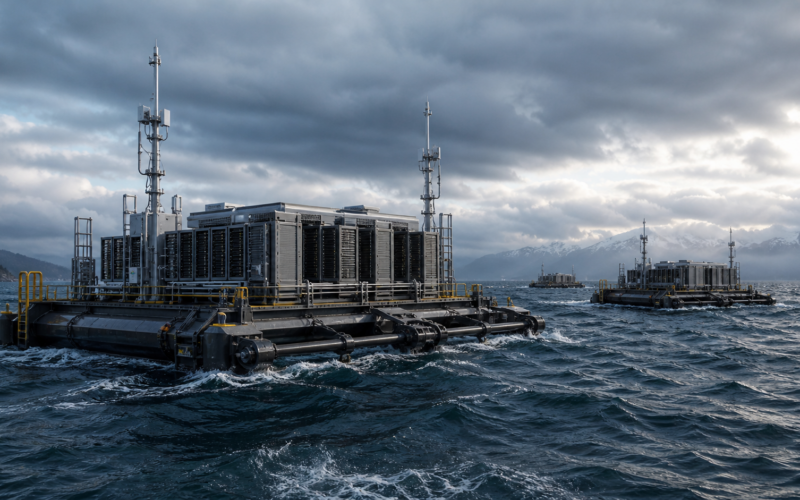
Panthalassa, a Portland, Oregon based public benefit corporation building wave-powered floating compute nodes, has closed a $140 million Series B financing round led by Peter Thiel, with participation from John Doerr, Marc Benioff’s TIME Ventures, Max Levchin’s SciFi Ventures, Susquehanna Sustainable Investments, Hanwha Asset Management’s venture fund, Anthony Pratt, Fortescue Ventures, Super Micro Computer (Supermicro, NASDAQ: SMCI), Sozo Ventures, Figma chief executive Dylan Field, and a long list of climate, regional, and strategic backers. Returning investors Founders Fund, Gigascale Capital, Lowercarbon Capital, Unless, and WovenEarth also re-upped. The capital will complete Panthalassa’s pilot manufacturing facility near Portland and accelerate deployment of the Ocean-3 series of nodes, which the company plans to drop into the northern Pacific in 2026 ahead of commercial rollout in 2027. The round vaults a 120-person, decade-old wave energy company into the same off-grid AI infrastructure conversation that has produced multibillion-dollar valuations for Crusoe and Starcloud over the past year, and it does so with a thesis that is structurally different from anything else in the AI build-out cycle.
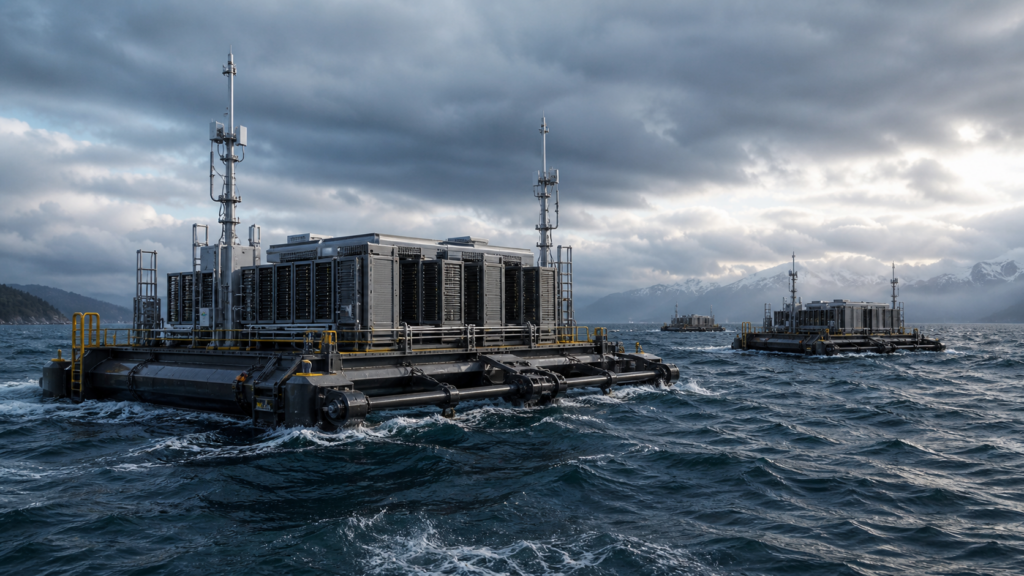
The pitch sounds outlandish at first hearing. Panthalassa proposes to mass-produce steel floating nodes in coastal factories, propel them autonomously into the most energy-dense wave regions of the open ocean, generate continuous electricity from wave motion, run AI inference chips directly onboard, cool them with the surrounding seawater, and beam the resulting tokens back to land via low-Earth-orbit satellite. The strategic logic, however, is unusually disciplined. Wave energy as a sector has spent twenty years failing to commercialize for one dominant reason, namely the cost of moving electrons from the open ocean to a terrestrial grid. By colocating high-value compute load directly on the generator, Panthalassa converts that historical liability into a strategic advantage. The product the company sells to land is not electricity. It is inference output, in the form of bits transmitted by satellite, which is a very different commodity with very different economics.
What is Peter Thiel actually betting on with the Panthalassa Series B and how does it fit the Founders Fund off-grid compute thesis?
Founders Fund has been Panthalassa’s earliest institutional backer, and Peter Thiel leading this round in his personal capacity is the second meaningful escalation of capital commitment from the same orbit. The bet sits inside a recognizable Founders Fund pattern. The firm has built large positions in Anduril, SpaceX, and a series of frontier infrastructure companies whose value proposition is defined by relocating critical capacity outside the constraints of conventional terrestrial systems. Crusoe, also a Founders Fund portfolio company, is now valued at roughly $10 billion on the back of stranded natural gas and a 1.2 gigawatt Abilene campus built for OpenAI’s Stargate project. Starcloud raised at a $1.1 billion valuation earlier this year on a thesis of orbital data centers powered by space solar. Panthalassa is the third coordinate in this triangle, an open ocean wager that treats the sea as another underused energy commons.
Thiel’s public statement about extra-terrestrial solutions no longer being science fiction is rhetorical, but the underlying capital allocation logic is grounded. The structural problem facing every hyperscaler is that the marginal megawatt of new compute is no longer constrained by chip supply. It is constrained by interconnect queues, transformer lead times, water rights, transmission line permitting, and increasingly hostile local politics around new data center construction. If even a small fraction of inference workload can be offloaded to platforms that bypass all of those constraints simultaneously, the value created is enormous. Whether Panthalassa is the platform that captures that value is a separate question, but the thesis is rational and the cost of the optionality at this round size is modest by frontier infrastructure standards.
Why is Super Micro Computer the only listed strategic investor in the Panthalassa Series B and what does it signal about the Charles Liang strategy?
The presence of Super Micro Computer (NASDAQ: SMCI) on the cap table is the single most analytically interesting detail in the syndicate. Super Micro Computer is not a traditional venture investor. The company is a server original equipment manufacturer whose AI build-to-order business has driven both its rise and its current pain. Super Micro Computer trades at $27.98 as of the May 4 close, a price that places the stock near the lower end of its $19.48 to $62.36 fifty-two week range and well below the late-2024 peak. The company carries a market capitalization of approximately $16.7 billion, an analyst consensus rating of Hold, and an average twelve-month price target of $35.50. Recent action includes target reductions from JP Morgan to $28 and Mizuho to $25, alongside ongoing securities class action filings related to undisclosed China exposure and an auditor exit earlier this year. Super Micro Computer reports its fiscal third quarter earnings after the close on May 5, with options markets implying a 12.5 percent move.
Read against that backdrop, the Panthalassa stake is small in dollar terms but strategically pointed. Super Micro Computer’s core thesis depends on the continued exotic diversification of AI infrastructure form factors. Liquid-cooled racks, modular containerized factories, and now floating maritime nodes all expand the addressable surface for the company’s modular blade and storage architecture. Backing Panthalassa places Super Micro Computer in a position to be the default supplier of the AI server hardware inside Ocean-3 nodes if and when the platform reaches commercial scale. For an embattled vendor whose terrestrial customer concentration is currently a source of investor anxiety, optionality on a novel category of customer that does not exist anywhere else has clear strategic logic, even if the near-term financial impact is immaterial.
The market will not price this development into Super Micro Computer shares meaningfully ahead of the Q3 print on Tuesday evening, but the announcement does add a faint positive signal at the margin. It demonstrates that the company’s strategic team is still placing forward looking bets on emerging compute substrates rather than retrenching to defend the existing GPU server business.
How does Panthalassa’s Ocean-3 platform compare with CorPower Ocean, Oscilla Power, and the rest of the wave energy industry?
Panthalassa is not the only well-funded company trying to commercialize wave energy. CorPower Ocean of Sweden has been deploying its grid-connected C4 wave energy converter off Aguçadoura, Portugal, since October 2023, has secured a forty million euro EU Innovation Fund grant for the ten megawatt VianaWave project, and is preparing a pilot array of three C5 devices for 2026 ahead of full commercial readiness in 2027. Marine Power Systems in the United Kingdom, Seattle’s Oscilla Power, Oregon State University spinout C-Power, and several other developers are pursuing comparable pathways. All of them are building wave energy converters intended to push electricity into national grids.
Panthalassa is the only well-capitalized developer in the space that has chosen not to do that. Its nodes are designed to operate far from shore, beyond the practical reach of subsea export cables, and to consume their own electricity onboard. This is a more capital-efficient architecture for a startup because it eliminates the single most expensive and politically fraught element of any offshore renewable project, namely the cable run to shore and the terrestrial grid interconnection. It is also a more defensible architecture commercially, because Panthalassa’s product is not competing in wholesale electricity markets against subsidized solar, wind, and gas. It is competing in inference markets against terrestrial AI cloud providers whose marginal economics are constrained by power purchase agreements, water cooling, and real estate. The two cost stacks are not directly comparable, and that is precisely the point.
The trade-off is execution risk. CorPower Ocean has spent fifteen years validating a single converter design through extensive dry-rig and offshore testing, and is only now approaching certified commercial array deployment. Panthalassa is attempting to commercialize wave power generation, autonomous propulsion, mass-produced steel hull manufacturing, distributed satellite-linked inference compute, and seawater immersion cooling for high-density chips simultaneously. Each of those subsystems carries non-trivial engineering risk, and the company is asking the Series B capital to validate all of them in parallel. The Ocean-1, Ocean-2, and Wavehopper prototypes deployed in 2021 and 2024 derisked the core mechanical and energy generation elements. The 2026 Ocean-3 pilots in the northern Pacific must demonstrate the full inference token workflow at sea before commercial deployments in 2027 become credible.
What second-order risks could derail the Ocean-3 commercial deployment timeline in 2027?
Three categories of risk deserve close scrutiny by anyone evaluating the Panthalassa thesis. The first is bandwidth economics. Inference workloads vary widely in latency tolerance, output token volume, and data sensitivity. A node generating tokens in the open ocean and sending them by low-Earth-orbit satellite is well suited to batched, latency-tolerant, high-value inference such as document analysis, code generation, scientific computation, and asynchronous agent workloads. It is poorly suited to real-time consumer chatbot responses where round trip latency directly affects user experience. The total addressable market for the Panthalassa platform is therefore a subset of the global inference market rather than the whole, and the company’s commercial pitch will need to specify which workloads it captures.
The second is regulatory ambiguity. Compute deployed in international waters or in the exclusive economic zones of multiple coastal states sits in a poorly defined legal space for taxation, data sovereignty, export controls on AI chips, and environmental compliance. The same chips that face restrictions on physical export to certain jurisdictions may face new questions when deployed on a propelled floating platform that can transit between jurisdictions. Resolving those questions will require either new regulatory frameworks or a deliberate decision by Panthalassa to operate in a constrained set of well-understood maritime zones, which would in turn limit the platform’s geographic flexibility and total deployable capacity.
The third is the satellite bandwidth supply chain. Panthalassa’s plan to transmit inference tokens by low-Earth-orbit satellite implicitly assumes continued aggressive expansion of constellations such as Starlink, Amazon Kuiper, and emerging Chinese alternatives. The unit economics of high-volume token transmission depend heavily on the cost per gigabyte of those services, and on the availability of high-throughput maritime terminals capable of supporting AI inference workloads in remote ocean conditions. Any disruption to that supply chain, whether commercial or geopolitical, would cascade directly into Panthalassa’s margins.
What does the Panthalassa investor list reveal about the convergence of energy, AI, and industrial capital?
The Series B syndicate is unusually broad and reads like a deliberate attempt to assemble a coalition rather than a single capital pool. Hanwha Group’s involvement signals interest from a major South Korean industrial conglomerate with deep capabilities in shipbuilding, defense, and energy. Fortescue Ventures, the corporate venture arm of the Australian iron ore and green energy giant, brings industrial steel manufacturing expertise relevant to Panthalassa’s coastal factory ambitions. Anthony Pratt, the Australian packaging billionaire, brings a long horizon and a recognizable willingness to back unconventional industrial bets. John Doerr’s participation extends the Kleiner Perkins veteran’s clean energy track record. Marc Benioff’s TIME Ventures and Max Levchin’s SciFi Ventures bring technology brand recognition and Silicon Valley network effects. Dylan Field’s participation, in addition to Susquehanna Sustainable Investments and the regional Portland and Oregon funds, rounds out the geographic and demographic diversity of the cap table.
The composition is telling because Panthalassa needs all of those capabilities. It needs steel and shipbuilding capacity to mass-produce nodes. It needs AI server expertise from Super Micro Computer to optimize the onboard compute stack. It needs Silicon Valley infrastructure relationships to land hyperscaler inference contracts. It needs climate-aligned capital to support the public benefit corporation structure. And it needs regional Oregon support for the manufacturing footprint near Portland. Few startups assemble that breadth of strategic capability inside a single round, and the breadth itself is a signal that Panthalassa’s leadership understands the platform requires a coordinated industrial coalition to scale, not just venture cash.
How will the Panthalassa raise affect the broader AI infrastructure financing pattern in 2026?
The Panthalassa round arrives in a financing environment where capital is flooding into AI infrastructure but is increasingly scrutinized for differentiation. Generic GPU cloud capacity is becoming commoditized as CoreWeave, Lambda, and Nebius scale, and as hyperscalers expand their own first-party fleets. Crusoe has differentiated through stranded gas and vertical integration. Starcloud is differentiating through orbital deployment. Panthalassa is now the third clearly differentiated frontier infrastructure thesis to attract serious capital this cycle, and its presence reinforces a pattern that early-stage investors are likely to extend further. Expect increased venture activity in adjacent categories such as desert solar compute, geothermal-coupled inference, modular nuclear AI factories, and a new wave of submarine cable plus offshore platform combinations.
For institutional capital allocators tracking the AI infrastructure stack, the strategic implication is that the next wave of value creation may not come from incremental improvements on terrestrial data center efficiency. It may come from companies that successfully decouple AI compute from the constraints of traditional grids entirely. Panthalassa is the most ambitious example of that decoupling thesis to date.
Key takeaways on what the Panthalassa Series B means for ocean energy, hyperscalers, and the AI infrastructure investment cycle
- Peter Thiel and Founders Fund have now backed three frontier off-grid AI infrastructure plays, namely Crusoe on stranded gas, Starcloud on orbital solar, and Panthalassa on open ocean waves, signaling a coordinated thesis rather than isolated bets.
- Super Micro Computer’s participation as the only listed strategic places the embattled server vendor inside the supply chain conversation for a novel category of AI hardware customer at a time when the stock trades near fifty-two week lows ahead of its May 5 fiscal Q3 print.
- Panthalassa’s decision to consume its own electricity onboard and ship inference tokens by satellite resolves the historical commercialization problem of wave energy, namely the prohibitive cost of subsea export cables and grid interconnection.
- The platform’s addressable market is a subset of global AI inference, specifically batched, latency-tolerant, high-value workloads, rather than real-time consumer applications, and the company’s commercial narrative will need to specify that distinction.
- CorPower Ocean and other established wave energy developers remain on a slower, grid-connected commercialization path, leaving Panthalassa with a defensible category of one in compute-coupled wave power.
- Execution risk is concentrated in the simultaneous validation of wave power generation, autonomous propulsion, mass-produced steel hull manufacturing, satellite-linked inference, and seawater immersion cooling during the 2026 Ocean-3 pilot.
- Regulatory ambiguity around offshore compute, including taxation, data sovereignty, and AI chip export control implications, represents a material non-engineering risk that will require deliberate jurisdiction selection.
- The 120-employee Portland headquartered public benefit corporation now has the capital to complete its pilot manufacturing facility, which is the bottleneck that determines how quickly Ocean-3 nodes can be produced at scale.
- The Series B syndicate composition, spanning South Korean industrial conglomerates, Australian commodity capital, Silicon Valley veterans, climate funds, and Pacific Northwest regional capital, signals that Panthalassa is being structured as a coordinated industrial coalition rather than a conventional venture-backed startup.
- Hyperscalers facing transmission queue constraints, water rights challenges, and permitting delays now have a credible long-dated alternative offload path, which over the medium term could reduce the strategic leverage of utility power purchase agreements over AI capacity expansion.
Share this:
Discover more from Business-News-Today.com
Subscribe to get the latest posts sent to your email.