



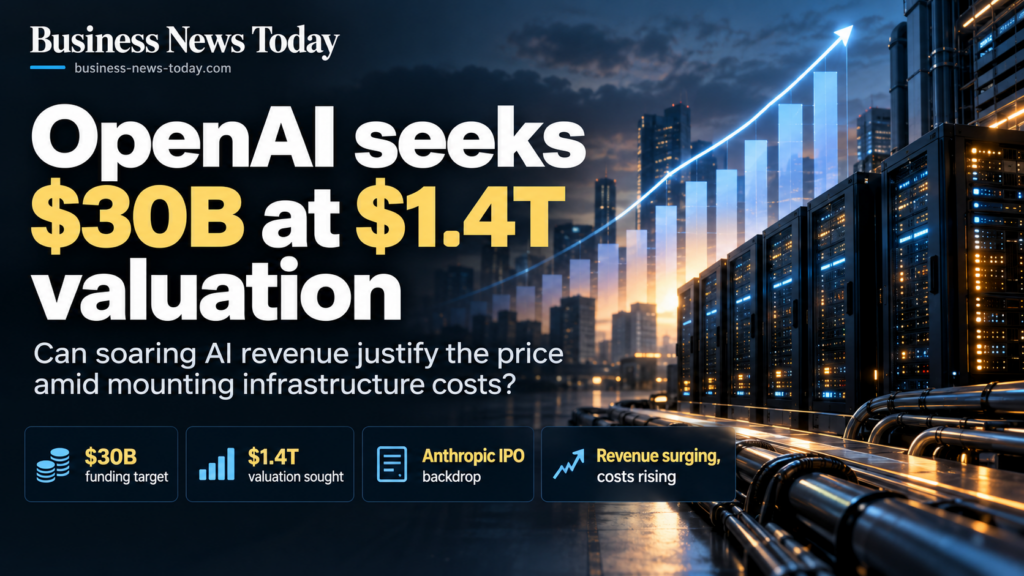
OpenAI is seeking to secure approximately $30 billion in fresh investor commitments at a potential valuation exceeding $1.4 trillion, accelerating its fundraising efforts ahead of rival Anthropic’s expected initial public offering in November 2026. The reported financing would represent another substantial increase in the ChatGPT developer’s private valuation, following its $852 billion valuation in March. According to Reuters, existing investors including SoftBank Group Corp. and Abu Dhabi-based MGX are discussing participation, although the financing has not been announced as completed. The accelerated timetable comes as both artificial intelligence developers compete for overlapping pools of institutional capital while facing growing scrutiny of revenue quality, infrastructure spending and future profitability.
Why is OpenAI accelerating its $30 billion funding round before Anthropic’s expected November IPO?
OpenAI’s fundraising timetable reflects a changing competitive environment in which access to capital is becoming almost as important as artificial intelligence model performance. Reuters reported on October 19 that OpenAI was seeking commitments before Anthropic’s anticipated mid-November stock market debut, citing people familiar with the negotiations. The report, by Echo Wang, Krystal Hu and Sabrina Valle, indicated that OpenAI had recently held discussions with long-only investment funds and sovereign wealth funds. Neither the proposed financing amount nor the valuation represents a completed transaction, and final terms could change.
The timing potentially gives OpenAI an advantage in securing commitments from investors that are also evaluating Anthropic’s public offering. Large institutional investors may have substantial capital available for artificial intelligence, but they still face portfolio concentration limits, liquidity requirements and valuation constraints. A financing agreement reached before Anthropic’s listing could give OpenAI greater certainty over its funding plans while reducing the amount of investor capital immediately available to its competitor. This is a capital allocation consideration rather than evidence that either company’s technology or commercial model has established a decisive advantage.
OpenAI’s financing strategy also reflects the potential value of obtaining private capital before public markets establish a more transparent benchmark for artificial intelligence developers. Anthropic’s listing, if completed, would give investors a publicly traded reference point against which to evaluate growth, expenses, margins and valuation. Such comparisons could make it harder for private companies to negotiate independently of market expectations. OpenAI’s effort to accelerate commitments suggests that financing timing has become a meaningful component of competitive positioning.
How does a potential $1.4 trillion OpenAI valuation compare with its latest reported revenue growth?
OpenAI’s proposed valuation would represent a substantial increase from the $852 billion valuation reported in March 2026, when the company announced a $122 billion financing round. A valuation of $1.4 trillion would be approximately 64% higher than that earlier benchmark. However, the new figure remains a reported financing objective rather than a verified completed transaction valuation. It would also place OpenAI among the world’s most highly valued businesses despite its continued status as a privately held company.
The valuation discussion is increasingly connected to OpenAI’s commercial growth following the introduction of its GPT-6 Astra model. According to Reuters, OpenAI has been telling prospective investors that annualized revenue has reached approximately $50 billion, with expectations that the annualized figure could climb to $70 billion by the end of 2026. These figures describe a revenue run rate based on recent activity rather than audited full-year revenue or guaranteed future sales. OpenAI has not publicly disclosed a complete set of financial statements supporting the proposed financing valuation.
At $1.4 trillion, the proposed valuation would equal approximately 28 times the reported $50 billion annualized revenue figure. If OpenAI achieved its projected $70 billion annualized revenue run rate, the corresponding multiple would decline to approximately 20 times, assuming an unchanged valuation. Both calculations are indicative revenue multiples, not earnings multiples or assessments of intrinsic value. They show how strongly the proposed price depends on investors accepting rapid growth as sustainable and economically attractive.
A high revenue multiple can be supported by exceptional growth if the business subsequently develops sufficient operating leverage and free cash flow. Artificial intelligence developers, however, face substantial expenditures associated with model training, inference capacity, infrastructure access, research personnel and platform development. Consequently, revenue growth alone provides an incomplete picture of the economics supporting a trillion-dollar valuation. Investors will need stronger visibility into gross profit, operating expenditure, infrastructure commitments and the path toward sustainable cash generation.
Why could Anthropic’s IPO force closer scrutiny of OpenAI’s revenue accounting and commercial economics?
Anthropic’s impending public offering could make differences in revenue recognition between major artificial intelligence developers more consequential for investors. Reuters reported that Anthropic’s annualized revenue reached approximately $65 billion in July and that its third-quarter revenue increased to $16.8 billion from $11.6 billion in the preceding quarter. Those reported quarterly figures demonstrate substantial commercial activity, although the pace of growth has moderated from earlier periods. Investors considering a valuation approaching $1.5 trillion or higher will be examining whether continued expansion justifies the premium.
Revenue presentation is another issue because OpenAI and Anthropic have different arrangements with cloud distribution partners. Reuters reported that OpenAI recognizes revenue after subtracting partner shares, while Anthropic has defended its use of gross revenue reporting for certain cloud-distributed contracts as consistent with established accounting practices. OpenAI has challenged the comparability of Anthropic’s reported revenue, but that disagreement does not itself establish that either company’s accounting is improper. Meaningful comparisons will require investors to reconcile revenue recognition, distribution economics and the costs of delivering artificial intelligence services.
The comparison is particularly relevant because the companies compete across enterprise artificial intelligence, coding assistance, application development and advanced reasoning systems. Enterprise customers increasingly evaluate models on performance, security, reliability, integration and total operating cost rather than model capability alone. Competition can therefore generate higher usage while simultaneously encouraging lower prices and narrower margins. Reuters reported that OpenAI has reduced prices for some lower-cost models and believes additional reductions could stimulate further adoption.
Revenue expansion supported by declining unit prices can be attractive when the cost of delivering each unit of service falls more quickly than the selling price. Conversely, higher usage does not necessarily translate into stronger profitability if inference expenditure, customer acquisition costs or infrastructure commitments rise disproportionately. Investors need to understand whether model improvements are generating durable operating efficiencies or primarily supporting competitive pricing. That economic relationship will become increasingly visible as the leading developers disclose more financial information.
How will OpenAI use additional financing to support its artificial intelligence infrastructure commitments?
Artificial intelligence infrastructure remains one of the largest financial considerations behind OpenAI’s fundraising plans. Advanced model training and commercial inference require substantial computing resources, data centre capacity, networking infrastructure and dependable electricity supplies. The scale of these commitments can create a timing mismatch between contracted infrastructure expenditure and revenue generated from customers. Access to additional equity capital could strengthen OpenAI’s ability to manage that mismatch without relying exclusively on debt or near-term operating cash flow.
Reuters reported that prospective investors also view additional capital as a means of strengthening OpenAI’s balance sheet if an eventual public listing is delayed. OpenAI has been associated with a possible 2027 listing, but such an outcome remains dependent on management decisions, market conditions and regulatory requirements. A successful private round would potentially reduce the pressure to enter public markets at an unfavourable moment. It would not, by itself, demonstrate that the company’s long-term infrastructure commitments have become economically sustainable.
The financing also has implications for OpenAI’s relationship with major technology partners. Companies including Microsoft Corporation, Amazon.com, Inc. and other cloud infrastructure providers participate in an ecosystem where capital investment, computing access and commercial distribution can be closely connected. Such relationships can accelerate expansion, but their economics depend on contractual terms, utilization levels and the allocation of infrastructure costs. Investors evaluating OpenAI’s valuation should distinguish strategic investment commitments from unrestricted cash and separately assess the obligations attached to computing arrangements.
Capital availability could also influence the pace at which OpenAI develops and commercializes future models. More funding may support research capacity, product development and enterprise expansion, but the return on that capital depends on converting technical improvements into revenue that exceeds the associated expense. A larger financing round could provide greater strategic flexibility without guaranteeing superior margins or market share. Commercial efficiency will become increasingly important as the sector moves beyond rapid adoption toward sustained financial performance.
Why are artificial intelligence valuations facing greater scrutiny despite strong revenue growth?
OpenAI’s proposed financing coincides with a more selective environment for technology and infrastructure investment. Reuters reported that volatility in technology equities, rising bond yields and concerns about artificial intelligence infrastructure costs have affected investor sentiment. Companies preparing public offerings have faced more demanding valuation discussions, while some planned listings have been withdrawn or postponed. These developments suggest that enthusiasm for artificial intelligence has not eliminated conventional expectations around financial discipline.
The funding environment is particularly sensitive to businesses whose expansion relies on large upfront infrastructure commitments. Data centre developers must finance assets before those facilities generate their full expected revenue, creating exposure to construction delays, financing costs and customer demand. Scrutiny of companies such as CoreWeave, Inc. has consequently become relevant to the wider artificial intelligence financing market. OpenAI operates a different business model from a specialist infrastructure provider, but its commercial expansion remains connected to the financial health and capacity of the infrastructure ecosystem.
The distinction between infrastructure demand and infrastructure profitability is central to the next phase of industry investment. Strong demand for artificial intelligence services can support rapid expansion, while the costs of supplying those services determine how much value is retained by developers, cloud providers and infrastructure owners. If prices for computing and models decline faster than costs, the benefits of adoption may flow disproportionately toward customers. If efficiency improvements exceed price reductions, the developers could establish increasingly attractive margins as usage grows.
Investors are therefore being asked to evaluate not merely whether artificial intelligence adoption will continue, but which participants will capture durable economic returns. OpenAI’s potential valuation implies confidence that its brand, distribution, technology and enterprise relationships can support a substantial long-term business. Anthropic’s forthcoming financial disclosures may make that assumption easier to test against a competing developer. The resulting comparison could influence valuations throughout the artificial intelligence sector.
What financial milestones will determine whether OpenAI can justify a valuation above $1.4 trillion?
The immediate milestone is whether OpenAI secures the proposed $30 billion in commitments and at what final valuation and financing terms. A completed round would strengthen visibility into investor demand, although a headline valuation would still need to be assessed alongside any preferential investor rights or other contractual provisions. Anthropic’s anticipated November IPO would provide a separate test of public-market appetite for large artificial intelligence developers. Neither event guarantees that investors will maintain the same valuation expectations after additional financial disclosures.
Beyond financing, the strongest evidence would come from sustained revenue growth accompanied by improving profitability and cash generation. OpenAI’s projected increase from a $50 billion to a $70 billion annualized revenue run rate represents a substantial commercial ambition, but the costs of supporting that growth remain important. Greater transparency over customer retention, enterprise usage, inference economics and infrastructure commitments would strengthen investors’ ability to evaluate the company’s financial trajectory. A slowdown in growth without corresponding efficiency improvements would make an elevated revenue multiple more difficult to defend.
The competition between OpenAI and Anthropic is consequently entering a phase where financing credibility and operating economics may carry increasing weight alongside model performance. Securing $30 billion would provide OpenAI with additional resources and strategic flexibility, but the more meaningful test would be whether those resources translate into a sustainable financial advantage. The next measurable evidence will come from the final financing terms, Anthropic’s public-market disclosures and OpenAI’s progress toward its reported year-end revenue target.
What are the key takeaways from OpenAI’s $30 billion financing plans and $1.4 trillion valuation?
- OpenAI is reportedly seeking approximately $30 billion in new investor commitments before Anthropic’s expected November 2026 IPO.
- The financing could value OpenAI above $1.4 trillion, compared with its previous $852 billion private valuation.
- SoftBank Group Corp. and MGX are among the existing investors reportedly discussing participation.
- OpenAI has reportedly presented a $50 billion annualized revenue run rate and a $70 billion year-end ambition.
- The potential valuation represents approximately 28 times the currently reported annualized revenue figure.
- Anthropic’s forthcoming financial disclosures could influence how investors compare major artificial intelligence developers.
- Differences in partner revenue recognition complicate straightforward comparisons of the companies’ reported sales.
- Infrastructure spending, inference costs and pricing competition remain central to long-term profitability.
- A successful financing would strengthen OpenAI’s funding flexibility without establishing that its proposed valuation is sustainable.
- Final financing terms, Anthropic’s listing and OpenAI’s revenue trajectory are the next measurable developments.
Discover more from Business-News-Today.com
Subscribe to get the latest posts sent to your email.