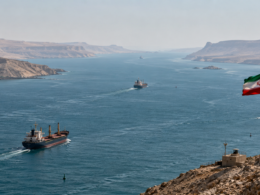



An international salvage operation has begun around the stricken oil tanker Caroline Bezengi after crude leaking from the vessel reached Oman’s coastline, escalating a two-month maritime incident into a major environmental emergency involving a sanctioned Russian oil cargo, a protected marine reserve and increasingly difficult monsoon conditions.
Risk-management company Ambrey said on August 13 that it is coordinating efforts to secure the tanker with Oman and other stakeholders. The operation includes salvage vessels, aircraft, specialist personnel and around 100 tonnes of equipment, while a major international oil-spill response company has been contracted to assist. Ambrey has not identified that contractor or provided a timetable for bringing the leak under control.
The Caroline Bezengi was carrying an estimated 800,000 barrels of Russian crude when it ran aground on June 30 near Oman’s Hallaniyat Islands following what Ambrey described as an apparent attack. The vessel had first reported trouble off Yemen on June 8 after maritime-security sources detected indications of a blast on board. No government or armed group has claimed responsibility for attacking the tanker.
Oman’s Environment Authority initially estimated the slick at approximately 390 square kilometres. Greenpeace, using separate satellite analysis, estimated an affected area of about 600 square kilometres several days earlier. Those figures were produced through different assessments and should not be treated as directly interchangeable measurements, but both indicate a spill extending across hundreds of square kilometres.
The situation worsened materially this week when Oman confirmed that oil had begun reaching the mainland coastline. Ambrey said seasonal monsoon conditions are complicating salvage work, while environmental organisations warn that the spill threatens coral reefs, turtle nesting areas, seabird colonies and the isolated Arabian Sea population of humpback whales around the Hallaniyat reserve.
What happened to the Caroline Bezengi before the tanker ran aground off Oman?
The vessel’s final voyage began months before the spill became an international environmental concern. Ship-tracking data reviewed by Reuters showed the Caroline Bezengi loading Russian crude at Novorossiysk on the Black Sea in April before travelling through the Suez Canal at the end of May and heading towards Asia.
On June 8, while sailing near Yemen, the tanker reported difficulties. Two maritime-security sources told Reuters that initial assessments indicated an explosion had occurred aboard the ship, although the cause remained uncertain. The vessel subsequently became disabled and ultimately ran aground near the Hallaniyat Islands on June 30.
No party has claimed the suspected attack. The tanker had travelled through a maritime region affected simultaneously by the Russia-Ukraine war and the wider Middle East conflict, making attribution particularly sensitive. Ukraine has previously targeted Russian-linked maritime assets, while shipping around Yemen has also faced attacks connected with the regional conflict involving the Houthis, Iran, Israel and the United States. None of that establishes responsibility for what happened to the Caroline Bezengi.
That distinction is important because the environmental emergency is confirmed while the cause of the original damage remains unresolved. Describing the incident as a confirmed Ukrainian or Houthi attack would therefore go beyond the available evidence.

How large is the Oman oil spill and why do estimates range from 390 to 600 square kilometres?
Oman’s Environment Authority said on August 10 that the slick covered approximately 390 square kilometres, or about 150 square miles, northeast of the Hallaniyat Islands. At that stage, the nearest visible oil was estimated to be about seven kilometres from the mainland coast.
Greenpeace Germany produced a higher estimate from satellite imagery. It said the visible spill had expanded from around 45 square kilometres by July 26 to roughly 150 square kilometres on August 2 and approximately 600 square kilometres in imagery analysed from August 4.
Differences of this kind do not necessarily mean one assessment is wrong. Oil slick dimensions can change rapidly with currents, wind, wave action and the thickness of oil visible to different sensors. Satellite systems may also identify different portions of a slick depending on the imaging method and observation time.
The more important development on August 12 and 13 is that the question is no longer merely how close the oil might come to Oman. Authorities have confirmed that parts of the slick are already reaching the country’s shoreline, while Ambrey is mobilising equipment to contain the source and salvage the vessel.
Why is the Hallaniyat Islands Nature Reserve particularly vulnerable to the Caroline Bezengi spill?
The tanker is stranded next to one of Oman’s most environmentally sensitive marine areas.
Sultan Haitham bin Tarik established the Hallaniyat Islands Nature Reserve by royal decree in 2025. The archipelago supports coral reefs, seabirds, turtles and marine mammals and contains habitat used by the Arabian Sea humpback whale population.
Reuters reported that only around 80 Arabian Sea humpback whales are believed to remain in this isolated population, making it the smallest and most endangered humpback whale population in the world. Researchers believe these whales have been separated from other humpback populations for tens of thousands of years.
The reserve also includes turtle nesting beaches and habitat used by Socotra cormorants and other seabirds. Greenpeace has warned that oil contamination could affect coral reefs, seagrass beds, coastal habitats and nesting areas throughout the archipelago.
Oil that remains offshore can sometimes be dispersed or recovered before reaching highly productive coastal ecosystems. Once crude enters shallow water, beaches, reefs or sediments, cleanup becomes substantially more difficult and environmental residues can persist long after the visible slick disappears.
Environmental microbiologist Tony Gutierrez of Heriot-Watt University told Reuters that keeping oil offshore would significantly reduce the potential impact compared with allowing it to reach shallow water and the coastline, where birds, fish and other marine life face greater exposure.
Why did salvage operations take so long after the tanker first reported trouble in June?
The long gap between the Caroline Bezengi’s initial difficulties and the full international salvage response has become one of the most difficult questions surrounding the incident.
The tanker first experienced trouble on June 8 and had been stranded near the Hallaniyat Islands for weeks before the environmental emergency received sustained international attention. Satellite imagery analysed by independent specialists showed evidence of an oil slick in July, but Oman did not provide its first detailed public assessment of the spill until August.
SkyTruth chief executive John Amos told Reuters that publicly available satellite images and ship-tracking information had shown no obvious vessel activity around the tanker indicating that it was being stabilised or that its remaining cargo was being removed during much of this period.
That changed by August 13, when Ambrey announced that salvage vessels, aircraft, specialists and oil-spill equipment were being mobilised. The company said it was working directly with Oman and other stakeholders, suggesting that the response has now entered a substantially more active phase.
Monsoon conditions are nevertheless complicating the operation. Rough seas and seasonal weather can interfere with booms, recovery vessels, aircraft operations and efforts to transfer oil from a damaged tanker.
The vessel’s location near environmentally sensitive islands further limits the margin for error. Salvors must try to stabilise the hull and remove remaining cargo without causing additional structural damage capable of releasing much larger quantities of crude.
Why is the Caroline Bezengi considered part of Russia’s shadow tanker fleet?
The Caroline Bezengi is sanctioned by multiple Western governments for its involvement in transporting Russian oil.
Britain formally designated the vessel, IMO number 9224439, on February 24, 2026 as part of sanctions targeting ships involved in carrying Russian oil to third countries. Reuters reports that the ship is also subject to sanctions imposed by the European Union, Canada, Switzerland and Ukraine.
The tanker was built in 2001 and has operated within the broader collection of older or commercially opaque vessels commonly described by Western governments as Russia’s shadow fleet. These vessels often use non-Western insurance arrangements, complicated ownership structures and changing flag registrations to continue carrying Russian oil outside traditional Western maritime-service networks.
The Caroline Bezengi illustrates those complications unusually clearly. Public shipping databases had listed it under the Cameroon flag, but Reuters reported that Cameroon removed it from its registry along with 38 other vessels in June. Greenpeace subsequently said the International Maritime Organization listed the tanker’s flag status as unknown.
LSEG data cited by Reuters lists Rentoor Shipmanagement Ltd as the registered owner and Villar Shipmanagement Ltd as the manager, with both apparently based in China. Reuters was unable to reach the companies for comment.
The unresolved flag, insurance and ownership questions matter because maritime accidents normally involve clearly identified parties responsible for salvage costs, pollution compensation and environmental restoration. When ownership and insurance structures are difficult to enforce against, governments may face greater difficulty recovering cleanup costs.
Could the Oman spill become a test case for the environmental risks of Russia’s shadow fleet?
European governments have repeatedly argued that environmental risk is one reason they are intensifying enforcement against sanctioned tankers.
The concern is not simply that shadow-fleet ships transport Russian oil. European regulators say many operate with irregular registration, older vessels, limited transparency or insurance arrangements outside established Western protection-and-indemnity systems, potentially making large accidents harder to manage.
The Caroline Bezengi provides a concrete example of the potential consequences. An older sanctioned tanker carrying hundreds of thousands of barrels of crude became disabled, lost recognised flag registration and remained stranded beside a protected marine reserve while oil spread across a large area.
This does not establish that every shadow-fleet vessel is unsafe or that sanctions caused the incident. The original damage may have resulted from an external attack rather than a mechanical failure, and the precise chain of events is still being investigated.
What the incident demonstrates is how complex an emergency can become once a damaged tanker with uncertain flag and insurance arrangements requires immediate international salvage assistance.
Greenpeace argues that opaque ownership and insurance structures could leave Oman and affected communities carrying a disproportionate share of cleanup and restoration costs if responsible commercial parties cannot be compelled to pay.
How much Russian oil could still remain inside the Caroline Bezengi tanker?
The tanker was carrying an estimated 800,000 barrels of Russian crude when it grounded, according to Ambrey’s latest assessment. Earlier reporting described the original load as close to one million barrels.
The amount that has already escaped and the amount still remaining aboard have not been publicly established with precision.
That uncertainty is central to the salvage operation. Even a large visible slick does not necessarily mean most of the original cargo has left the vessel, because crude oil can spread over enormous surface areas while remaining relatively thin.
If substantial volumes remain inside intact tanks, successfully transferring that oil to another vessel could dramatically reduce the risk of the emergency becoming larger. Conversely, structural deterioration during monsoon conditions could release additional cargo.
This is why securing the tanker itself is at least as important as collecting oil already in the water. Aircraft and surface equipment can address portions of a slick, but they cannot end the source of pollution if damaged cargo tanks continue leaking.
Are Oman’s desalination plants and tourism facilities currently threatened?
Oman’s initial Environment Authority assessment said there was no immediate cause for concern regarding nearby desalination plants or tourism facilities when the spill was measured at around 390 square kilometres.
That assessment preceded confirmation that oil had begun reaching parts of the coastline, meaning continued monitoring will be necessary as currents and weather move the slick.
Desalination is especially important in Gulf countries because coastal plants provide a large share of municipal drinking water. Oil contamination near intake systems can force operators to modify procedures or temporarily shut facilities if hydrocarbon concentrations become unsafe.
There is currently no confirmed report that Oman has had to close a desalination plant because of the Caroline Bezengi spill. Claims that the incident has already disrupted drinking-water supplies would therefore be premature.
The immediate confirmed environmental concern remains the coastline and marine reserve rather than national water infrastructure.
What are the key takeaways from the Caroline Bezengi oil spill reaching Oman’s coastline?
- The Caroline Bezengi is leaking Russian crude into the Arabian Sea after becoming damaged near Yemen and running aground beside Oman’s Hallaniyat Islands on June 30. No party has claimed responsibility for the suspected attack that preceded the grounding.
- Ambrey said on August 13 that an international salvage operation now involves vessels, aircraft, specialist teams and approximately 100 tonnes of equipment, although no deadline for securing the tanker has been announced.
- The tanker was carrying an estimated 800,000 barrels of Russian oil, while the quantity already released and the amount remaining inside the damaged vessel have not been publicly established.
- Oman initially estimated the oil slick at approximately 390 square kilometres, while Greenpeace satellite analysis produced a higher estimate of around 600 square kilometres. The assessments were made separately and should not be treated as identical measurements.
- Oman has now confirmed that oil from the tanker has begun reaching its coastline, while seasonal monsoon conditions are making containment and salvage operations more difficult.
- The vessel is stranded near the Hallaniyat Islands Nature Reserve, which supports coral reefs, turtle nesting grounds, seabirds and the critically vulnerable Arabian Sea humpback whale population.
- The Caroline Bezengi is sanctioned by Britain, the European Union and several other governments over its role transporting Russian oil and was removed from Cameroon’s ship registry in June.
- The emergency has become a broader test of responsibility for accidents involving commercially opaque sanctioned tankers, particularly where flag registration, ownership, insurance and cleanup liability are difficult to establish.
Why the Oman spill could become a defining environmental warning from the shadow-fleet era
The Caroline Bezengi disaster brings together three risks that have increasingly overlapped since sanctions transformed Russian oil trading: war at sea, ageing commercial shipping and uncertainty over who pays when something goes badly wrong.
The tanker travelled from Novorossiysk carrying Russian crude, sailed through an increasingly militarised maritime corridor, suffered an unexplained blast near Yemen and eventually grounded beside one of Oman’s newest protected marine reserves. Weeks later, a slick extending across hundreds of square kilometres has reached the Omani coastline and required an international salvage mobilisation.
The environmental outcome is still not fixed. If salvors can stabilise the tanker and remove the remaining cargo quickly, the volume of additional oil entering the Arabian Sea could be limited. If the hull deteriorates during the monsoon while substantial crude remains aboard, the scale of contamination could increase considerably.
The Hallaniyat location makes that uncertainty particularly consequential. Damage to ordinary open-water habitat would already require a major response, but this spill is occurring beside coral systems, bird colonies, turtle nesting areas and an exceptionally small humpback whale population.
There is also a larger policy consequence. European governments have justified tougher action against shadow-fleet tankers partly by warning that sanctions evasion increasingly relies on vessels with opaque flags, ownership and insurance. Russia argues that Western restrictions unlawfully interfere with legitimate commercial shipping. The Caroline Bezengi does not resolve that geopolitical dispute, but it provides a powerful demonstration of the environmental costs when a sanctioned tanker becomes disabled in a remote and ecologically important location.
For Oman, the immediate priority is simpler: stop the leak, secure whatever oil remains aboard and prevent further contamination of the coast and Hallaniyat reserve. The fact that a specialist international response is finally underway is significant, but the hardest part may still lie ahead because the tanker has already been damaged for more than two months and the monsoon is narrowing the conditions in which salvors can work safely.
The next several days should reveal whether the Caroline Bezengi can be stabilised before another major release occurs. If the operation succeeds, the incident will remain an extensive but potentially containable environmental disaster. If it fails, a tanker carrying hundreds of thousands of barrels of crude beside one of the Arabian Sea’s most vulnerable ecosystems could produce consequences lasting far beyond the war and sanctions disputes that brought the ship there.
Discover more from Business-News-Today.com
Subscribe to get the latest posts sent to your email.