


OKEA ASA (OSE: OKEA), the Norwegian mid- and late-life Continental Shelf operator, reported first-quarter 2026 net profit of USD 36 million against a USD 18 million loss in the previous quarter, driven by a USD 154 million impairment reversal at Statfjord, higher realised oil and gas prices, and a 13% production increase to 34.9 kboepd. The Trondheim-based producer also disclosed the divestment of its 20% working interest in the Mistral (PL1119) licence to Japex Norge AS for USD 30 million in fixed consideration, alongside contingent upside tied to a commercial Mistral Nord discovery. OKEA shares have run sharply over the past 12 months, with the stock more than doubling on a one-year basis as oil prices firmed on Middle East tensions, but the rally has begun to outrun consensus price targets. The quarter exposes a more nuanced picture beneath the headline numbers: operational execution at Brage is genuinely strong, but Draugen has slipped, hedges have absorbed the upside on rising prices, and the dividend remains parked while capital is funnelled into Bestla and Power from Shore.
How did Talisker East change the production economics at OKEA’s Brage field this quarter?
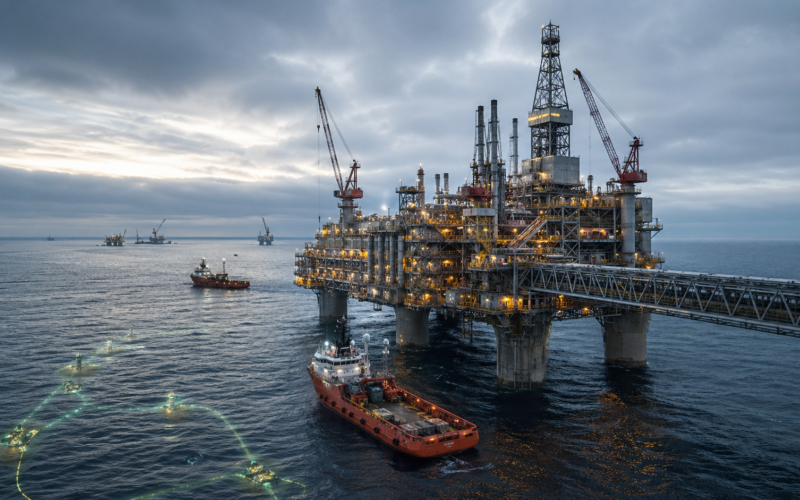
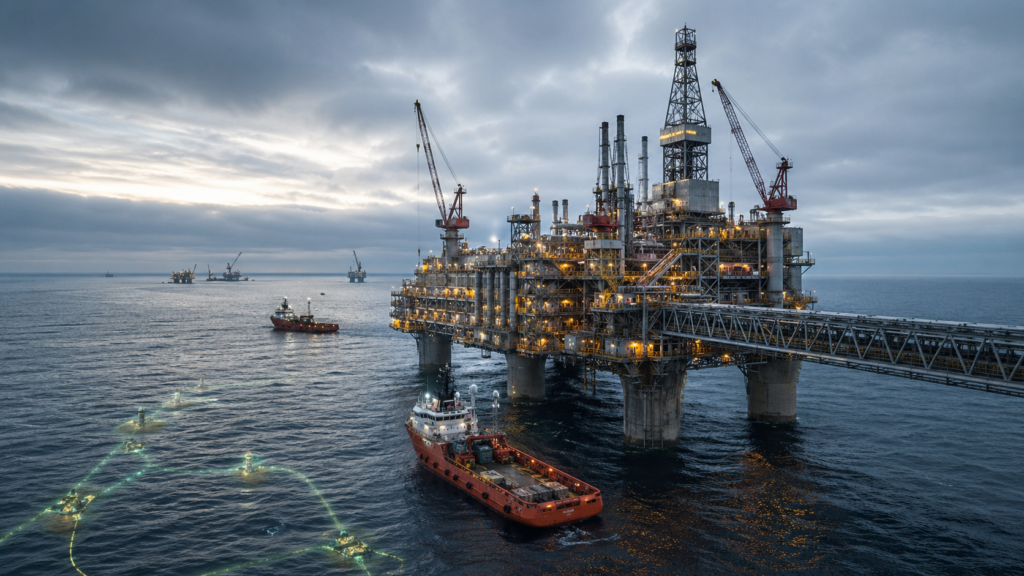
Brage delivered the standout operational result of the quarter, with production rising approximately 60% quarter-on-quarter to 9,481 boepd, the highest production level on the field since 2012. The driver was the start-up of the Talisker East production well in early January, which combined with strong baseline operational performance to push production efficiency at Brage to 98% from 89% in the fourth quarter of 2025. This is the kind of late-life asset uplift that justifies OKEA’s entire strategic premise on the Norwegian Continental Shelf. The company acquires mature assets that integrated majors no longer want to invest in, then extracts incremental value through targeted infill drilling and tie-back development. Brage is now a working proof point for that model.
The subsurface story extends further. OKEA disclosed that recoverable resource estimates (P50) at Talisker West have increased from 19 to 28 million barrels of oil equivalents through further maturation of the Statfjord formation. Total recoverable volume estimates from the Statfjord and Cook formations combined have moved up to a 23 to 44 mmboe range from the previous 16 to 33 mmboe estimate. Critically, the development concept remains unchanged. With volumes up materially, expected break-even cost has fallen to less than USD 10 per barrel of oil equivalent, which puts Talisker West among the most economically robust development opportunities currently being matured on the Norwegian Continental Shelf. Production is expected in 2027.
For competitors and peers operating mature North Sea assets, this is the second-order signal that matters. Late-life NCS production is not in terminal decline if operators can find subsurface upside through reinterpretation and selective drilling. Aker BP, Vår Energi, and Harbour Energy are running adjacent strategies on different geological footprints, and OKEA’s Brage data point will be examined closely.
Why did Statfjord deliver a $154 million impairment reversal and what does it signal about forward price assumptions?
The single largest driver of the swing from a Q4 2025 loss to a Q1 2026 profit was the USD 154 million reversal of previous impairments at the Statfjord asset, compared with a USD 62 million impairment in the prior quarter. The reversal was driven by increased forward prices, with OKEA’s impairment test now applying assumptions of USD 91.8 per barrel of oil equivalent for 2026, USD 73.8 in 2027, USD 71.9 in 2028, and a long-term price of USD 77.3 from 2030. These are notably bullish near-term assumptions reflecting current geopolitical risk premia tied to the ongoing conflict in the Middle East.
This is where executive readers should pause. Impairment reversals are non-cash and reversible. If forward curves soften, particularly the front-end 2026 assumption sitting near USD 92 per barrel, OKEA could find itself recognising fresh impairments on the same asset within the next 12 months. The company’s own sensitivity disclosure shows that a 10% reduction in oil and gas prices across the forward period would produce a USD 97.5 million pre-tax impairment swing. The post-tax impact is dampened by the 78% Norwegian petroleum tax rate, but the optics matter for institutional investors evaluating earnings quality.
The deferred tax line tells the same story. Deferred tax liabilities expanded to USD 240 million from USD 104 million at year-end 2025, with the change driven primarily by the Statfjord reversal. Net profit after tax came in at USD 36 million, with a tax expense of USD 193 million on pre-tax profit of USD 230 million, an effective tax rate of 84%. That high effective rate reflects the structural tax burden of operating on the Norwegian Continental Shelf and is the single biggest reason cash generation lags accounting profit.
What do the OKEA hedging losses reveal about the trade-off between revenue protection and price upside?
OKEA realised a USD 29 million unrealised hedging loss in the quarter, driven by collar-based crude positions where forward prices traded above the upper bounds of the structures. The hedge book covers approximately 74% of net post-tax crude production for Q2 2026 with ceilings between USD 75 and USD 122 per barrel and floors between USD 60 and USD 70. For Q3 2026, ceilings narrow to USD 75 to USD 85. Gas hedges run with ceilings of USD 105 to USD 185 per boe and floors of USD 57 to USD 90.
The strategic question for capital allocators is whether this hedging discipline is appropriate for a company of OKEA’s size and balance sheet profile. Bondholders prefer it, since the OKEA05 and OKEA06 secured bonds carry covenants on leverage ratio and liquidity. Equity holders, particularly retail investors who bought OKEA for the oil price upside narrative, are paying for that downside protection with capped participation when crude breaks through the ceilings. With realised crude prices of USD 79.5 per barrel in the quarter against current spot levels likely higher given Middle East volatility, the gap will continue to manifest as collar losses through 2026.
This is a real trade-off and it explains part of the disconnect between the underlying production story and the more measured share-price performance relative to peers without hedging programmes.
How is the Mistral divestment to Japex Norge changing OKEA’s exploration portfolio composition?
The April sale of OKEA’s 20% working interest in the Mistral (PL1119) licence to Japex Norge AS for USD 30 million in fixed consideration is a meaningful capital recycling move, particularly given the contingent consideration structure that retains upside on a commercial Mistral Nord discovery. The post-tax net profit impact of the transaction is estimated at USD 25 million, expected to be recognised on closing by the end of the third quarter of 2026.
For an asset that does not yet produce, USD 30 million up front plus retained optionality is a clean trade. It frees capital that would otherwise have been committed to appraisal drilling and concentrates the portfolio on producing or near-producing assets. OKEA is simultaneously rotating its exploration positions through other transactions, including farming into PL 1270 with a 30% working interest via DNO Norge AS, and swapping its 20% working interest in PL 1260 for an additional 30% working interest in PL 1255/1255B effective 1 January 2026. OKEA is positioning to take operatorship of the latter, subject to partner and Ministry of Energy approval.
The broader signal is one of exploration discipline. OKEA is selecting where to drill rather than spreading capital across a wider licence book. The Alpehumle prospect (PL 1153, 20% working interest) is scheduled for spud in the second quarter of 2026 with Aker BP as operator. The Kyllinglår prospect (PL 1214, 28% working interest) is scheduled for the first quarter of 2027 with Equinor as operator.
What is delaying Garn West South production at Draugen and how does it affect 2026 output guidance?
The operational disappointment of the quarter sits at Draugen, OKEA’s flagship operated asset where the company holds a 44.56% working interest. Drilling of the Garn West South production well was completed and the rig released, but commissioning challenges have pushed back expected start-up to the third quarter of 2026. This is a notable slip relative to earlier expectations and removes a chunk of incremental volume from first-half 2026 production.
In addition, the light-well intervention project on Draugen failed to resolve scaling issues on the D2 well, with alternative solutions now being assessed. Despite these issues, Draugen production rose to 9,136 boepd from 8,513 boepd in the previous quarter, with production efficiency at 97%. The asset is performing well on what is currently producing, but the well-stock additions are not arriving on schedule.
OKEA has maintained 2026 production guidance at 31 to 35 kboepd and 2027 guidance at 37 to 41 kboepd, suggesting that the Draugen delay is offset by Brage outperformance. However, executives evaluating OKEA on a year-end basis should track Garn West South commissioning progress carefully, since further slippage would push the company toward the lower end of guidance in a year where annual production guidance was meant to anchor the equity story.
Why is OKEA keeping its dividend on hold despite the strongest quarterly cash generation since early 2025?
OKEA generated USD 70 million in cash from operations in the quarter, up from USD 18 million in the prior quarter, with total cash balance rising to USD 269 million including money-market fund placements. Yet the dividend remains suspended. The board has framed this as consistent with the first capital allocation principle of maintaining a healthy balance sheet during a period of relatively high spending on value-accretive organic investments.
The numbers explain the discipline. Capital expenditure guidance for 2026 stands at USD 300 to 360 million, with USD 84 million already deployed in the first quarter. Bestla project investment, Power from Shore construction, and production drilling at Draugen and Statfjord are all consuming capital concurrently. Net interest-bearing debt swung to a USD 26 million net debt position from a USD 13 million net cash position at year-end 2025, reflecting working capital movements and continued investment.
For institutional investors who hold OKEA primarily for capital returns, this is a holding pattern with a clear unlock condition. The Bestla project is on schedule for first production in early 2027 with plateau output of approximately 10 kboepd net to OKEA. Mistral closing brings USD 25 million post-tax to the balance sheet by Q3 2026. If forward prices hold and Brage outperformance continues, OKEA could plausibly resume dividends from late 2026 or early 2027. The board has indicated it will revert with a dividend plan when in a position to distribute, and progress on Bestla and the Mistral divestment are explicit positives in that assessment.
Key takeaways on what this development means for OKEA, its competitors, and the Norwegian Continental Shelf
- OKEA returned to profitability in Q1 2026 with USD 36 million net profit, but USD 154 million of that swing came from a non-cash impairment reversal at Statfjord that is reversible if forward oil prices soften from current bullish assumptions
- Brage production rose 60% quarter-on-quarter to a 14-year high of 9,481 boepd following Talisker East start-up, validating OKEA’s late-life asset acquisition and infill drilling strategy on the Norwegian Continental Shelf
- Talisker West recoverable resources increased to 23 to 44 mmboe, with break-even cost now below USD 10 per barrel of oil equivalent, making it one of the most economically robust development opportunities currently being matured on the NCS
- Hedging losses of USD 29 million in the quarter signal that OKEA’s collar-based programme is capping equity-holder participation in the current Middle East-driven price upside, a deliberate balance-sheet trade-off bondholders prefer
- The Mistral divestment to Japex Norge AS for USD 30 million plus contingent upside represents disciplined exploration capital recycling, freeing balance sheet capacity for Bestla and Power from Shore execution
- Garn West South commissioning delays at Draugen push first production to the third quarter of 2026, removing incremental first-half volume but not yet threatening full-year production guidance of 31 to 35 kboepd
- Capital expenditure guidance of USD 300 to 360 million for 2026 keeps the dividend suspended, with the Bestla 2027 first-production milestone and Mistral closing emerging as the explicit unlock conditions for capital returns
- Effective tax rate of 84% in the quarter underscores why Norwegian Continental Shelf operators consistently see cash generation lag accounting profitability, a structural feature institutional investors must reflect in valuation models
- Net interest-bearing debt swung to USD 26 million from a year-end net cash position, reflecting working capital and concurrent investment cycles, but covenant compliance under OKEA05 and OKEA06 bonds remains comfortable
- OKEA’s 12-month share price performance has more than doubled, but with shares already trading near or above analyst consensus targets, further upside likely requires Bestla execution, sustained oil prices above hedge ceilings, or accretive M&A rather than continued multiple expansion
Discover more from Business-News-Today.com
Subscribe to get the latest posts sent to your email.