


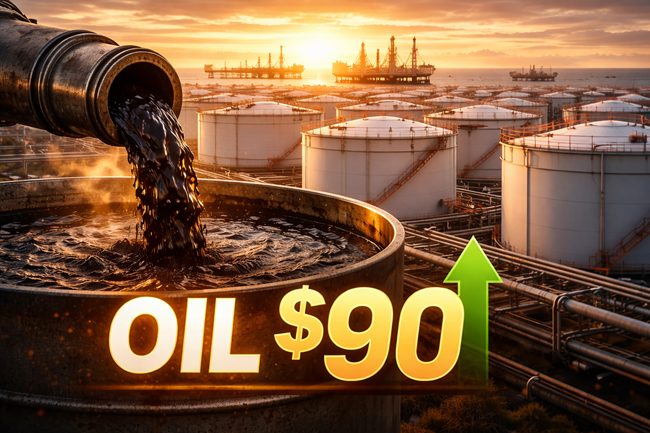
Global oil markets recorded their largest weekly gain in futures trading history on 7 March 2026, with West Texas Intermediate futures closing at $90.90 per barrel and Brent crude settling at $92.69 per barrel, as the effective suspension of commercial tanker traffic through the Strait of Hormuz by the Iranian Revolutionary Guard Corps pushed energy prices to levels not seen since 2024 and triggered warnings from Gulf governments about an imminent collapse in regional oil and gas export capacity.
West Texas Intermediate recorded a 35.63 percent weekly advance, the largest single-week gain in the history of the crude futures contract dating back to 1983. Brent crude rose approximately 28 percent over the same period, its steepest weekly performance since April 2020. The last time Brent crude traded above $90 per barrel was 16 April 2024, according to Dow Jones Market Data. During Friday trading, Murban crude, a benchmark heavily weighted toward Asian energy markets, approached $100 per barrel, reaching $99.60 per barrel, reflecting acute feedstock cost pressure on refiners across China, Japan, South Korea, and India.
Why did the Strait of Hormuz closure trigger the biggest oil price spike in decades and what does it mean for global energy supply?
The Strait of Hormuz is a narrow maritime corridor approximately 24 miles wide at its narrowest point, running along Iran’s coastline between the Persian Gulf and the Gulf of Oman. The Strait handles an estimated 20 percent of the world’s daily oil and gas shipments and serves as the sole maritime export route for crude oil, liquefied natural gas, and refined products produced by Saudi Arabia, Iraq, Kuwait, the United Arab Emirates, Qatar, and Bahrain. The Iranian Revolutionary Guard Corps formally closed the Strait to commercial traffic on 2 March 2026 following the launch of United States and Israeli military operations against Iran under the name Operation Epic Fury.
Iranian retaliatory drone and missile strikes damaged refinery and processing infrastructure across multiple Gulf Cooperation Council member states, prompting maritime insurers to withdraw war risk coverage from vessels transiting the corridor. At least 10 ships were struck during the first week of the conflict. More than 150 tankers were anchored in open waters near the Strait as of 6 March 2026. Vessel tracking data from Kpler confirmed that commercial oil companies, tanker operators, and major insurers had effectively withdrawn from the corridor, with limited traffic continuing only among Iranian-flagged and Chinese-flagged vessels.
Saudi Arabia and the United Arab Emirates began diverting very large crude carriers toward the Red Sea port of Yanbu, where Saudi Arabia increased crude loadings through the Trans-Arabian Pipeline as an alternative export mechanism. Analysts noted that existing overland pipeline capacity in the region could redirect only a fraction of normal export volumes, leaving the majority of Gulf production effectively trapped.
How quickly are Gulf oil producers running out of storage capacity, and which countries are closest to forced production shutdowns?
Gulf oil production infrastructure was designed and built under conditions of continuous tanker traffic. The major oil fields of Kuwait, Iraq, Saudi Arabia, the United Arab Emirates, and Qatar pipe crude directly to coastal export terminals with limited onshore storage relative to daily output volumes. When maritime export flows are interrupted, storage fills rapidly and production must eventually be curtailed to avoid well damage and costly restart procedures. Shutting in an oil well risks long-term damage to reservoir pressure, and restoring production after a shutdown can take days to weeks depending on the reservoir type and depth.
Kuwait became the first major Gulf crude producer to announce output reductions directly caused by storage constraints arising from the Hormuz closure. Kuwait, which produces approximately 2.5 million barrels per day, began reducing output at several oil fields after exhausting crude storage capacity, according to reporting by the Wall Street Journal citing individuals familiar with the matter. Kuwait was also reported to be discussing further curtailments to levels sufficient only for domestic consumption, with a formal decision expected within days. Iraq held the most precarious storage position among Gulf producers, with approximately six days of remaining capacity already approaching exhaustion. Iraq implemented production cuts of 1.5 million barrels per day, with officials warning of possible further reductions exceeding 3 million barrels per day within days.
Major storage facilities in Saudi Arabia and the United Arab Emirates were filling at an accelerating rate, with both countries expected to reach capacity limits within three weeks if export flows were not restored or substantially redirected. Analysts across bne IntelliNews and other outlets noted that if the conflict continued for a period of four weeks, Iraq, Kuwait, the United Arab Emirates, and Qatar could all be compelled to suspend production entirely. Kuwait’s production output of approximately 2.5 million barrels per day and the United Arab Emirates’ output of approximately 3.4 million barrels per day would fill standard storage facilities within quantifiable timeframes absent any export outlet access.
What exactly did Qatar’s energy minister warn about force majeure declarations and the risk of a $150-per-barrel oil price?
Qatar’s Energy Minister Saad al-Kaabi, who also serves as president and chief executive officer of QatarEnergy, told the Financial Times on 6 March 2026 that every Gulf energy exporter was expected to declare force majeure on export contracts within days if the conflict continued. Al-Kaabi forecast that crude oil could reach $150 per barrel within two to three weeks if tanker traffic through the Strait of Hormuz remained suspended. He also warned that natural gas prices could rise to $40 per million British thermal units, a level approximately four times pre-war pricing. Force majeure is the legal mechanism through which parties are released from contractual obligations arising from unforeseeable events beyond their control.
QatarEnergy had already declared force majeure on liquefied natural gas export contracts following an Iranian drone strike on the Ras Laffan industrial city, Qatar’s largest liquefied natural gas processing facility. QatarEnergy mobilised approximately 9,000 personnel from offshore platforms within 24 hours of the strike. As of 6 March 2026, only six or seven of Qatar’s fleet of 128 liquefied natural gas carriers were available near loading facilities. Al-Kaabi told the Financial Times that the situation could not be resolved quickly even if fighting stopped immediately, noting that it would take weeks to months to return to a normal export cycle and that no substitute supply of 77 million tonnes of liquefied natural gas existed in the global market to replace Qatar’s output.
Al-Kaabi also stated that Qatar’s North Field expansion programme, a $30 billion development intended to raise production capacity from 77 million tonnes to 126 million tonnes per year by 2027 with first production scheduled for the third quarter of 2026, would be delayed by the conflict. He rejected suggestions that invoking force majeure would damage Qatar’s reputation as a reliable liquefied natural gas supplier, stating that no counterparty would question the decision given that facilities were being actively bombed.
How is the United States government responding to the oil shock, and what financial measures are being considered to stabilise markets?
United States President Donald Trump on 6 March 2026 offered United States Navy escorts for commercial vessels transiting the Strait of Hormuz and announced additional insurance guarantees for shipping companies willing to enter the corridor. Qatar’s Energy Minister al-Kaabi responded publicly that those measures were unlikely to restore safe passage, given the proximity of the Strait to Iranian shorelines and the pattern of ongoing military strikes targeting vessels.
The United States Treasury Department was reported to be preparing financial market interventions to address oil price pressure tied to the conflict, with a senior White House official indicating that options related to the oil futures market were under active consideration. Such action would represent an unusual use of Treasury authority to influence energy prices through financial market mechanisms rather than through physical supply releases from the Strategic Petroleum Reserve.
The Treasury Department also issued waivers enabling companies to purchase sanctioned Russian crude oil stored aboard vessels in the Indian Ocean, Arabian Sea, and Singapore Strait, estimated at approximately 30 million barrels of floating supply. Indian refiners received the initial waivers and began purchasing Russian crude from offshore floating storage, reversing months of United States diplomatic pressure on those companies to halt Russian oil imports. The measure was intended to ease supply constraints that had forced Asian refineries to reduce processing rates.
President Trump also posted on social media on 6 March 2026 that he would accept no agreement with Iran other than full surrender, adding that such an outcome could lead to the selection of new Iranian leadership. The statement intensified market anxiety over the duration of the conflict and contributed to the final leg of the Friday price advance in crude oil.
How are Asian central banks and governments responding to the inflationary impact of the Gulf energy crisis?
Asian economies are the primary destination for Persian Gulf crude oil, liquefied natural gas, and petrochemical exports, making the region the most directly exposed to the current supply disruption. China, India, Japan, and South Korea collectively account for the majority of crude shipments transiting the Strait of Hormuz on a daily basis, according to the United States Energy Information Administration.
Bank of America analysis indicated that a prolonged Strait of Hormuz disruption could push Brent crude above $100 per barrel and European natural gas above 60 euros per megawatt hour. Goldman Sachs modelling projected that Asian regional inflation could rise by approximately 0.7 percentage points under a scenario involving a six-week closure with crude prices rising from $70 to $85 per barrel. The Philippines and Thailand were identified as the most vulnerable economies in the region, while China was expected to experience a more modest inflationary impact.
Economists at Nomura stated in a published note that the conflict was solidifying the case for central banks in the region to hold interest rates steady, complicating trajectories that had been pointing toward reductions. Bank Indonesia and the Monetary Authority of Singapore both stated on 2 March 2026 that they were closely monitoring financial markets and assessing the domestic economic impact of the conflict. Nomura’s analysis indicated that Asian governments would likely deploy fiscal measures as the first line of consumer protection, including fuel price controls, higher subsidies, petroleum excise tax reductions, and lower crude import tariffs. The Philippines, which imports approximately 90 percent of its petroleum supply, had already recorded its eighth consecutive weekly gasoline price increase of the year as of 7 March 2026.
Rising energy costs were also affecting bond markets and equity markets in the United States, where yields moved higher and stocks declined on 6 March 2026 following the Kuwait storage reports. Analysts at UBS noted that while oil prices would need to remain elevated for several months before generating sustained macroeconomic damage, the simultaneous disruption to oil and liquefied natural gas supply represented a more severe combination than any single-commodity shock in recent decades.
Helima Croft of RBC Capital Markets described the situation as resembling the most severe energy crisis since the oil embargo of the 1970s, noting that Iran achieved a near-total withdrawal by commercial insurers and shipping companies from the Strait of Hormuz through drone strikes in the vicinity of the waterway rather than through a formal naval blockade. Energy economist Anas Alhajji, speaking on a webinar with UBS analysts on 5 March 2026, indicated that if the disruption lasted four weeks, energy market conditions would become entirely unmanageable.
Key takeaways: what the Gulf oil price crisis means for energy markets, Gulf producers, and the global economy
- Brent crude surged to $92.69 per barrel and West Texas Intermediate closed at $90.90 per barrel in the week ending 7 March 2026, with West Texas Intermediate recording a 35.63 percent weekly gain, the largest since futures trading began in 1983, as the Strait of Hormuz remained closed to commercial tanker traffic following Operation Epic Fury.
- Kuwait began curtailing oil production at several fields after exhausting crude storage capacity, with Iraq already cutting 1.5 million barrels per day and Saudi Arabia and the United Arab Emirates expected to face similar constraints within three weeks if export routes are not restored.
- Qatar’s Energy Minister Saad al-Kaabi warned on 6 March 2026 that all Gulf energy exporters would declare force majeure on export contracts within days if the conflict continued, forecasting crude prices of $150 per barrel within two to three weeks and natural gas prices of $40 per million British thermal units.
- QatarEnergy declared force majeure on liquefied natural gas exports following an Iranian drone strike on the Ras Laffan industrial complex, removing approximately 20 percent of global liquefied natural gas supply from the market and delaying Qatar’s North Field expansion programme.
- The United States Treasury Department issued waivers for sanctioned Russian crude oil purchases to ease Asian supply constraints, while preparing financial market interventions to stabilise oil prices, amid central bank concerns in Indonesia, Singapore, the Philippines, India, South Korea, and Japan about inflation and monetary policy trajectories.
Discover more from Business-News-Today.com
Subscribe to get the latest posts sent to your email.