

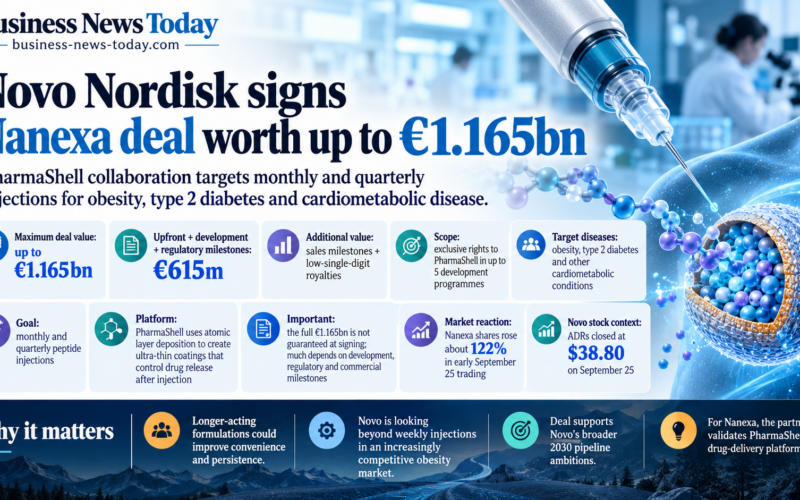
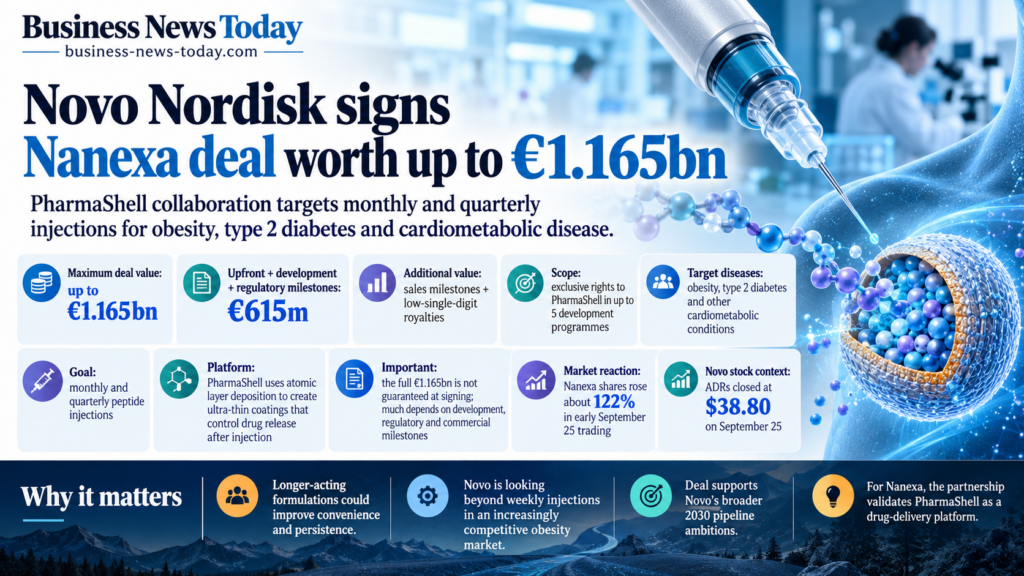
Novo Nordisk A/S (Nasdaq Copenhagen: NOVO-B; NYSE: NVO) has entered a global licensing and collaboration agreement with Swedish drug-delivery company Nanexa AB worth up to €1.165bn, gaining exclusive rights to use Nanexa’s PharmaShell technology in as many as five development programmes. The collaboration targets peptide medicines for obesity, type 2 diabetes and other cardiometabolic conditions, with monthly and quarterly injections identified as intended dosing profiles.
Nanexa is eligible for total payments of as much as €1.165bn. Of that potential value, €615m consists of upfront consideration and development and regulatory milestones, while the remaining contingent payments are linked to sales milestones. Nanexa could additionally receive low-single-digit royalties on worldwide sales of products developed through the collaboration.
The distinction between maximum deal value and guaranteed cash is crucial. Novo Nordisk has not agreed to write Nanexa a €1.165bn cheque at signing. Much of the economic value depends on development, regulatory and commercial achievements that may take years and are not guaranteed to occur.
What does Nanexa’s PharmaShell technology actually do?
PharmaShell uses atomic layer deposition to apply an extremely thin coating to drug particles. The coating is intended to control how quickly the medicine is released after injection, potentially allowing an active pharmaceutical ingredient that would otherwise require frequent dosing to remain effective for much longer.
That is commercially relevant in chronic diseases such as obesity and type 2 diabetes because patients may remain on medication for years. Weekly injections such as Wegovy and competing GLP-1 therapies have already shown that patients can accept injectable treatment at enormous scale. Moving some medicines from weekly administration toward once-monthly or even quarterly dosing could create another layer of differentiation.
Convenience alone does not prove that a long-acting formulation will become a better medicine. Drug exposure must remain within an appropriate therapeutic range, injection volume has to be manageable, manufacturing must be repeatable and clinical trials must demonstrate acceptable efficacy and safety. A formulation that lasts three months but produces undesirable peaks, insufficient exposure or difficult side effects would have limited commercial value.
The agreement is therefore best understood as a platform bet. Rather than licensing one finished monthly obesity medicine, Novo Nordisk has secured rights to test PharmaShell across as many as five programmes and determine where prolonged delivery creates the strongest clinical and commercial proposition.
Why does Novo Nordisk want monthly or quarterly obesity injections?
The global obesity market is moving rapidly beyond a simple competition over which drug produces the greatest percentage weight loss. Dosing convenience, tolerability, manufacturing capacity, oral formulations, preservation of lean mass, cardiovascular benefits and treatment of related diseases are becoming additional areas of competition.
Novo Nordisk faces particularly intense pressure from Eli Lilly and Company, whose obesity franchise has expanded rapidly. Other pharmaceutical groups including Amgen, Roche, Pfizer, AstraZeneca and several biotechnology companies are also developing differentiated obesity medicines, meaning today’s weekly injection standard may not remain the only commercially attractive format.
A monthly formulation could reduce a patient’s injections from roughly 52 a year to 12. A quarterly medicine could theoretically reduce that further to four, assuming the underlying pharmacology and clinical results support such intervals. That can matter for persistence, convenience and healthcare delivery, particularly if obesity increasingly becomes managed as a lifelong chronic condition.
There is also a manufacturing consideration. Longer dosing intervals could alter the quantity of finished injection devices required per patient, although the effect on active ingredient demand would depend on dose and formulation. Novo therefore has reasons to investigate long-acting delivery even if weekly and oral treatments remain successful.
How does the Nanexa deal fit Novo Nordisk’s 2030 pipeline strategy?
The agreement arrives only days after Novo Nordisk used its Capital Markets Day to set out an unusually explicit pipeline ambition. The company wants to launch more than five potential multi-blockbuster medicines by 2030 and generate more than DKK150bn of pipeline sales in 2035. It also aims to have at least five Phase 3 programmes in obesity and diabetes and at least five more in other therapeutic areas.
Those goals are strategically important because Novo Nordisk cannot rely indefinitely on semaglutide, the molecule underlying Ozempic and Wegovy. Patent expirations begin becoming increasingly relevant in the next decade, while Eli Lilly and other competitors are investing heavily in next-generation medicines.
Novo Nordisk is already preparing CagriSema and other new obesity candidates, but delivery technology can expand the differentiation available around new and existing peptides. PharmaShell could potentially become one component of that broader portfolio rather than a replacement for Novo’s internal research.
The timing also follows a difficult investor response to Novo Nordisk’s longer-term strategy presentation. Its US-listed ADRs fell 7.96% on September 21 as investors questioned pricing, pipeline timing and the path beyond the current semaglutide franchise. Management has indicated willingness to use business development alongside internal research to strengthen future growth.
Why did Nanexa shares more than double after the Novo Nordisk deal?
Nanexa shares rose about 122% in early September 25 trading, reaching their highest level in more than five years, according to Reuters. The reaction reflects the enormous relative scale of the agreement for a much smaller drug-delivery company and the validation implied by securing a global pharmaceutical partner for as many as five programmes.
The market is nevertheless valuing probabilities rather than €1.165bn of guaranteed revenue. Development milestones require programmes to progress, regulatory milestones require successful submissions or approvals, and sales milestones depend on products ultimately reaching substantial commercial thresholds.
Nanexa does receive a strategically valuable benefit even before maximum payments are considered. A large pharmaceutical company willing to build multiple programmes around PharmaShell can provide technical validation that may make the platform more credible to other potential partners.
Nanexa had already demonstrated that licensing is central to its model. Its 2025 annual report highlighted a separate agreement with Moderna containing a $3m upfront payment and as much as $500m of potential milestone payments and royalties. That history reinforces the idea that Nanexa is trying to monetise a delivery platform through multiple pharmaceutical relationships rather than developing every medicine independently.
What does the deal mean for Novo Nordisk stock after its recent sell-off?
Novo Nordisk’s New York-listed ADRs closed September 25 at $38.80, up 0.47% for the day and 1.18% on September 24, but still below the $43.24 closing level recorded on September 18. The September 21 Capital Markets Day decline therefore remained only partly recovered by the end of the week.
The muted Novo reaction compared with Nanexa is logical. Even the maximum €1.165bn transaction value is relatively small in the context of Novo Nordisk’s global business and will be paid largely only if programmes succeed. For Nanexa, the same agreement can transform perceptions of its technology and future cash flows.
Novo investors should instead focus on whether one or more PharmaShell programmes reach human trials, what molecules are selected, whether monthly or quarterly exposure is achievable and how the resulting products compare with weekly injections and emerging oral therapies.
The obesity market is becoming crowded enough that convenience can become a competitive weapon. Novo Nordisk is effectively paying for the option to find out whether Nanexa can stretch that weapon from one week to one month or even one quarter.
Discover more from Business-News-Today.com
Subscribe to get the latest posts sent to your email.