





NorthStar Group Services, Inc. has promoted Chief Financial Officer Jeffrey Adix to Chief Executive Officer and appointed him to the board, effective immediately, while Scott State moves from the top executive position to Executive Chairman. State, who has led NorthStar since 2010, will also remain Chief Nuclear Officer, preserving his direct responsibility for one of the company’s most safety-sensitive and technically demanding businesses. The succession gives Adix control of a private equity-backed environmental and infrastructure platform built through acquisitions, complex project execution and regulated waste-management capabilities. The central question is whether a finance-led chief executive and a technically focused executive chairman can accelerate growth without creating uncertainty over operating authority, nuclear accountability or capital allocation.
Why does promoting Chief Financial Officer Jeffrey Adix signal a new phase for NorthStar Group Services?
NorthStar’s decision to promote its finance chief rather than recruit an external operating executive suggests that the board sees financial discipline, integration and portfolio management as central priorities for the next stage.
Adix has served as NorthStar’s Chief Financial Officer since 2016. During that period, the company expanded through acquisitions, combined NorthStar Group Services with Waste Control Specialists and added capabilities spanning coal ash remediation, commercial deconstruction, emergency response and nuclear decommissioning.
The finance function would have been closely involved in funding those transactions, assessing project risk, managing insurance and bonding requirements, allocating capital across business units and reporting to NorthStar’s private equity owners.
This gives Adix a detailed understanding of the economics behind contracts that may run for several years and involve uncertain site conditions, regulatory milestones or substantial equipment requirements.
His earlier leadership experience at Fiserv, Veolia, ManpowerGroup and SC Johnson also gives him exposure to technology-enabled services, environmental operations, labour-intensive businesses and multinational corporate structures.
The strategic advantage is continuity. Adix already knows the company’s project portfolio, lenders, investors, operating executives and risk-management processes. He can begin making capital and organisational decisions without spending months learning how NorthStar generates revenue.
The risk is that financial expertise alone does not guarantee successful execution in nuclear decommissioning, hazardous-material management or emergency response. NorthStar’s projects require operational judgement, regulatory credibility and a safety culture that cannot be reduced to margin targets.
The board appears to have addressed that tension by keeping State directly involved in nuclear leadership rather than asking Adix to absorb every responsibility immediately.
Why will Scott State remain Chief Nuclear Officer after leaving the NorthStar CEO position?
State’s continued role is one of the most important elements of the succession because it separates overall corporate leadership from specialist nuclear accountability.
NorthStar operates in a sector where leadership continuity affects more than investor confidence. Nuclear decommissioning requires regulatory engagement, radiological controls, waste classification, worker protection and project sequencing that may extend across many years.
State has led NorthStar since 2010 and helped expand the business into nuclear decommissioning, waste management, coal ash remediation and large-scale infrastructure removal. Retaining him as Chief Nuclear Officer preserves experience and relationships that could be difficult to replace quickly.
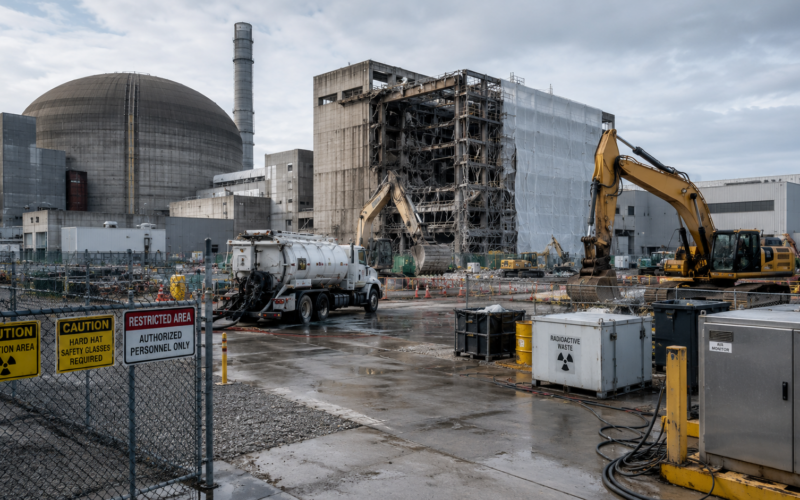
The structure also supports active projects. NorthStar and Orano USA operate Advanced Decommissioning Partners, which is carrying out decommissioning work at Crystal River Unit 3 in Florida. NorthStar separately took ownership of the 1,600-acre Vallecitos Nuclear Center in California for decontamination, decommissioning and environmental restoration.
These projects involve continuing interaction with the United States Nuclear Regulatory Commission, customers, state authorities, employees and local communities.
Keeping State as Chief Nuclear Officer can reassure those stakeholders that NorthStar is not changing technical leadership merely because the corporate chief executive role has transferred.
However, the arrangement must be governed carefully. Adix is now responsible for company-wide strategy, performance and resource allocation, while State remains responsible for nuclear oversight and serves as Executive Chairman.
The company will need clear escalation rules when commercial priorities and technical requirements conflict. Safety and regulatory decisions cannot become subjects of negotiation between two leadership centres.

How does J.F. Lehman & Company ownership shape Jeffrey Adix’s mandate as NorthStar CEO?
NorthStar is a portfolio company of J.F. Lehman & Company, a private investment firm focused on aerospace, defence, government, maritime, environmental and infrastructure businesses.
J.F. Lehman first invested in NorthStar Group Services in 2017 and acquired Waste Control Specialists in 2018. The businesses were combined in 2020, creating a broader platform across deconstruction, nuclear services, environmental services and emergency response.
In 2021, J.F. Lehman moved NorthStar into a single-asset continuation fund, allowing the investment firm and company management to remain owners while bringing in additional institutional capital.
A continuation structure typically signals that the sponsor believes the business has further growth potential beyond the life of the original private equity fund. It can provide additional time and capital for acquisitions, operating investment and eventual value realisation.
Adix therefore inherits a mandate shaped by both operating performance and shareholder expectations. He must strengthen cash generation, integrate acquired businesses and identify opportunities capable of generating returns above their financial and execution costs.
Private equity ownership can support faster decisions and provide access to acquisition capital. It can also create pressure to increase earnings, reduce costs and prepare the company for an eventual sale, recapitalisation or other ownership event.
NorthStar has not announced an exit process alongside the succession. The leadership change should not be presented as confirmation that a transaction is imminent.
However, promoting a finance executive with deep knowledge of the capital structure could make the organisation better prepared for additional acquisitions, refinancing or a future ownership transition.
What do the Trans Ash and Vallecitos transactions reveal about NorthStar’s growth strategy?
NorthStar’s expansion has combined conventional acquisitions with specialised transfers of regulated assets.
The 2023 acquisition of Trans Ash strengthened NorthStar’s position in coal combustion residuals, including ash-basin closure, landfill construction, civil works and ongoing support for utility customers.
Coal ash remediation is a long-duration infrastructure market driven by environmental obligations, plant retirements and the need for utilities to manage large volumes of combustion waste.
The transaction added capabilities adjacent to NorthStar’s existing demolition, remediation and power-sector services. It also demonstrated how the company can use acquisitions to broaden relationships with utilities that may require several forms of environmental work.
The Vallecitos transaction followed a different model. NorthStar took ownership of a former nuclear research and testing site from GE Vernova and GE Hitachi Nuclear Energy after regulatory approvals.
Ownership transfers more responsibility than a conventional contracting arrangement. NorthStar must manage decommissioning, environmental restoration and regulatory compliance while controlling project economics over an extended period.
This approach can create attractive returns when a specialist operator completes work more efficiently than the previous owner. It also places schedule, cost and regulatory risks directly on the company.
Adix’s finance and risk-management background could become particularly valuable when assessing similar opportunities. NorthStar must determine whether each proposed transaction includes sufficient funding, contingency protection and operational capability.
Acquisition-led growth will create value only when the company understands the liabilities it is accepting as clearly as the revenue opportunity it expects to gain.
Why is nuclear decommissioning a particularly difficult test for NorthStar’s new leadership structure?
Nuclear decommissioning combines construction, demolition, environmental remediation, waste transport and regulation within a single project.
Unlike an ordinary demolition contract, work cannot advance solely according to equipment availability and customer preference. Radiological surveys, waste classifications, licence conditions and regulator approvals determine what can be removed, transported or released.
Crystal River Unit 3 demonstrates the distinction between physical progress and regulatory completion.
Advanced Decommissioning Partners expected major dismantlement work to reach important milestones during summer 2026, with reactor-building demolition and site-restoration activities continuing through defined schedules. However, licence termination remains subject to Nuclear Regulatory Commission review, confirmatory surveys and formal regulatory processes.
A project can therefore appear substantially complete from an engineering perspective while remaining open from a regulatory perspective.
This creates revenue-recognition, cash-flow and risk-management complexities for the chief executive and finance team. Management must fund work, satisfy contract obligations and manage contingencies without assuming that every planned milestone will be approved automatically.
The dual structure may be useful here. State can concentrate on technical standards, regulatory relationships and nuclear safety, while Adix manages capital, commercial performance and broader corporate strategy.
The structure becomes dangerous if employees are uncertain whose direction takes priority. NorthStar must make clear that nuclear compliance and worker safety are operating requirements rather than variables to be balanced against financial targets.
What does the succession mean for NorthStar employees across nuclear, environmental and demolition operations?
NorthStar has not announced job cuts, plant closures or a workforce reduction in connection with the CEO transition.
The company instead emphasised investment in employees, safety and continued growth. The immediate employment effect should therefore centre on reporting relationships, leadership responsibilities and succession opportunities rather than broad redundancy risk.
Adix’s promotion may create additional senior finance responsibilities that need to be redistributed. NorthStar will need either to appoint a new Chief Financial Officer or divide elements of the finance mandate among existing leaders until a permanent decision is made.
The transition could create internal advancement opportunities across treasury, project finance, accounting, risk management and corporate development.
Operationally, demand remains strongest for specialised employees capable of working in regulated and hazardous environments. Radiation-protection professionals, project controls specialists, environmental scientists, heavy-equipment operators, demolition supervisors and waste-management experts are difficult to replace.
NorthStar must preserve this expertise while improving productivity. Experienced workers often possess knowledge of specific sites, regulatory commitments and operating conditions that cannot be reconstructed from manuals alone.
State’s continued nuclear role may support retention among technical teams that value continuity and clear safety leadership.
The next workforce test will be whether Adix strengthens the broader management bench. A private equity-backed platform spanning several acquired businesses needs leaders who can operate independently without routing every decision through the chief executive or executive chair.
Could keeping Scott State as Executive Chairman create confusion over Jeffrey Adix’s authority?
Executive-chair arrangements can preserve valuable experience, but they can also weaken a new chief executive when responsibilities are not defined precisely.
State has led NorthStar for approximately 16 years and remains closely associated with its growth, customer relationships and nuclear credentials. Employees and customers may continue approaching him on issues beyond his formal nuclear and board responsibilities.
Adix will need genuine authority over strategy, budgets, acquisitions, executive appointments and operational performance if the succession is to function as more than a title change.
State, meanwhile, must avoid becoming a parallel chief executive. His role should support long-term strategy, stakeholder relationships and nuclear oversight without encouraging teams to seek alternative decisions when they disagree with management.
The board is responsible for maintaining that separation. Reporting structures, committee responsibilities and approval thresholds should be visible internally.
The arrangement could become a competitive advantage when the two executives operate as complementary leaders. Adix can apply financial and organisational discipline while State protects technical continuity and customer confidence.
It could become a weakness when decisions require repeated negotiation or when accountability becomes unclear after a project misses a deadline or budget.
The first year will reveal whether NorthStar has executed a planned succession or created an extended transition.
How could Jeffrey Adix balance organic growth with further environmental services acquisitions?
NorthStar operates across markets benefiting from long-term infrastructure and environmental requirements. Ageing industrial facilities require demolition, utilities must remediate coal ash, and retired nuclear sites require specialised decommissioning and waste management.
These markets can support organic growth through additional contracts, geographic expansion and deeper relationships with government and commercial customers.
Acquisitions can accelerate that strategy by adding licences, specialised employees, equipment, customer relationships or regional coverage.
Adix must decide where ownership provides a genuine advantage. A target may have attractive revenue but bring environmental liabilities, contract disputes or underfunded project obligations.
NorthStar’s due diligence must therefore examine site conditions, regulatory history, insurance coverage, labour requirements and project contingencies, not merely earnings.
The company also needs to integrate acquired businesses effectively. Trans Ash, Waste Control Specialists and other operations carry distinct technical capabilities and customer cultures.
The strongest platform would allow customers to purchase several related services from one provider while maintaining specialist expertise inside each business.
The weakest version would create a collection of companies sharing financial ownership but failing to cooperate operationally.
Adix’s record will increasingly depend on whether he can turn NorthStar’s breadth into cross-selling, better asset utilisation and stronger project execution.
What should customers, regulators and NorthStar employees watch after the CEO transition?
The first indicator will be the appointment of a new Chief Financial Officer. The quality of that decision will show whether NorthStar has built a sufficiently strong internal succession pipeline and whether Adix intends to centralise or delegate financial control.
The second indicator will be progress at Crystal River Unit 3 and Vallecitos. Meeting physical, safety and regulatory milestones would demonstrate that leadership changes have not disrupted nuclear execution.
The third indicator will be acquisition activity. A new transaction would reveal how aggressively NorthStar intends to use its private equity backing and whether Adix is applying disciplined valuation standards.
The fourth indicator will be safety performance. Growth is commercially valuable only when NorthStar maintains the operational controls required across demolition, hazardous waste and nuclear work.
The fifth indicator will be management stability. Retaining experienced operating executives would support continuity, while multiple departures could indicate uncertainty under the dual leadership structure.
Customers should also watch whether NorthStar continues investing in equipment, technology and specialist employees rather than attempting to generate growth mainly through financial restructuring.
How should stakeholders judge Jeffrey Adix’s first phase as NorthStar chief executive?
NorthStar has improved leadership clarity by naming an internal successor with nearly a decade of company experience and broad knowledge of its financial and strategic development.
The decision reduces the disruption that could have followed an external search and keeps Scott State involved where his expertise is most valuable.
What remains unresolved is the boundary between the Chief Executive Officer, Executive Chairman and Chief Nuclear Officer roles. NorthStar must demonstrate that authority remains clear when project, capital and regulatory priorities intersect.
The next measurable proof points will come from nuclear project execution, the appointment of a new finance leader and any additional acquisition activity.
The strategic thesis would strengthen if NorthStar completes active decommissioning milestones, integrates its service lines and expands without weakening safety or cash discipline.
It would weaken if the leadership arrangement slows decisions, acquired businesses remain fragmented or financial pressure begins influencing technical risk management.
Promoting Adix gives NorthStar a chief executive equipped to evaluate capital and portfolio choices. Keeping State as nuclear chief preserves technical continuity. The success of the plan will depend on whether these strengths reinforce one another rather than compete for organisational control.
Key takeaways from NorthStar’s Jeffrey Adix CEO appointment and Scott State transition
- NorthStar Group Services promoted Chief Financial Officer Jeffrey Adix to Chief Executive Officer and appointed him to the board on July 14, 2026.
- Scott State moved to Executive Chairman after leading NorthStar since 2010 and will continue serving as Chief Nuclear Officer.
- The structure separates company-wide capital and operating leadership from specialist nuclear oversight.
- Adix has served as NorthStar’s finance chief since 2016 and previously held leadership roles at Fiserv, Veolia, ManpowerGroup and SC Johnson.
- NorthStar is owned by J.F. Lehman & Company and has expanded through acquisitions and regulated asset transfers.
- The company’s current portfolio includes deconstruction, environmental remediation, coal ash services, emergency response, nuclear decommissioning and waste disposal.
- Active nuclear work at Crystal River Unit 3 and the Vallecitos Nuclear Center makes technical and regulatory continuity particularly important.
- No job cuts or broad workforce restructuring were announced alongside the succession.
- The first major leadership test will be maintaining clear authority between Adix as CEO and State as Executive Chairman and Chief Nuclear Officer.
- Progress on nuclear milestones, the next CFO appointment and disciplined acquisition activity will provide measurable evidence of whether the succession is working.
Discover more from Business-News-Today.com
Subscribe to get the latest posts sent to your email.



