




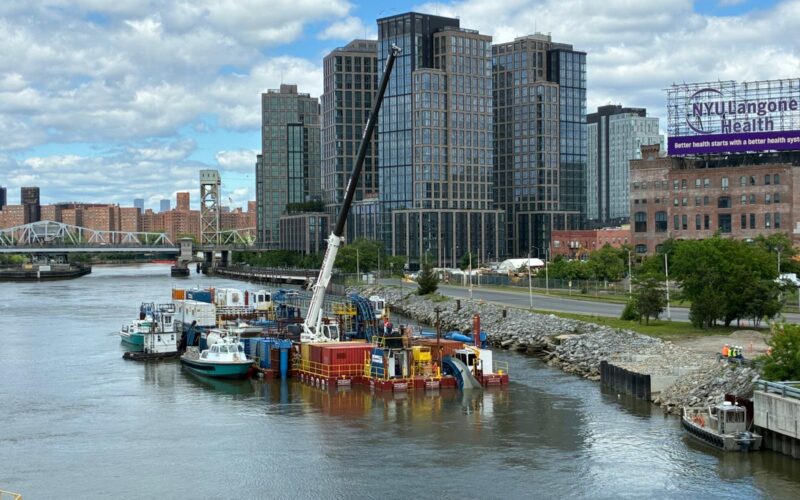
NKT A/S (Nasdaq Copenhagen: NKT) has completed its cable scope for the $6 billion Champlain Hudson Power Express, the 1,250 MW transmission corridor developed by Blackstone Inc. (NYSE: BX)-backed Transmission Developers Inc. and supplied with electricity by Hydro-Québec. The cross-border system entered commercial operation in May 2026 and was formally inaugurated in New York City on June 16, 2026. It can now deliver up to 10.4 terawatt-hours of renewable hydropower annually from Québec to the New York metropolitan area, equivalent to as much as 20% of New York City’s electricity needs. NKT engineered, manufactured and installed the 400 kV high-voltage direct-current cable system across underground and underwater sections of the route. The project gives NKT one of the most important operating references in North American transmission while demonstrating how long-distance grid infrastructure can connect reliable renewable generation with electricity-constrained urban markets.
Why does the Champlain Hudson Power Express matter more than another new transmission line?
The Champlain Hudson Power Express matters because it is not merely a connection between two substations. It creates a direct electricity corridor between Hydro-Québec’s large hydroelectric system and New York City, one of North America’s most constrained and fossil-fuel-dependent urban power markets.
The United States section extends approximately 339 miles from the Canadian border to Queens, while the complete link from the Hertel substation in Québec to New York City runs more than 600 kilometres. Around 60% of the route crosses waterways, including Lake Champlain and sections of the Hudson and Harlem rivers, while the remaining portion is buried along land corridors.
This routing reduces the visual and land-use impact associated with large overhead transmission lines. It also limits exposure to storms, falling trees and other hazards that can affect above-ground infrastructure. That resilience is particularly valuable as extreme weather increases the operational importance of protected electricity networks.
The project can transmit 1,250 MW into New York City, enough electricity to serve more than one million homes under typical consumption assumptions. More importantly, the contracted annual delivery of 10.4 terawatt-hours provides substantial energy volume rather than only occasional capacity during favourable conditions.
Hydropower has a different operating profile from wind and solar generation. Hydro-Québec can manage reservoir output to provide relatively consistent electricity and respond to fluctuations elsewhere in the grid. This gives New York a resource capable of complementing variable renewable generation and reducing dependence on thermal power plants during periods of high demand.
The project therefore addresses three problems simultaneously. It adds low-carbon electricity, strengthens regional grid interconnection and creates an alternative supply route into a market where building large generating assets is difficult and expensive.

How does the 400 kV HVDC cable system move Québec hydropower into New York City?
The Champlain Hudson Power Express uses high-voltage direct-current technology because direct current is generally more efficient and controllable for moving large volumes of electricity across long distances and through underwater cables.
Electricity from Hydro-Québec’s network enters the Hertel-New York transmission system in Québec. It is converted from alternating current into direct current before travelling through the buried and underwater cable corridor toward New York City.
At the southern end, an HVDC converter station in Astoria, Queens, converts the electricity back into alternating current so it can enter the New York power grid. Hitachi Energy supplied the converter technology, while Kiewit Corporation served as the principal contractor for the Astoria facility.
NKT’s role covered the engineering, manufacturing and installation of the 400 kV cable system, including joints and terminations. This is commercially significant because failures in high-voltage cables, joints or installation work can cause prolonged outages and expensive marine repair campaigns.
The project required several different installation methods. Cable sections were placed beneath rivers and Lake Champlain, while land sections were installed underground through transport and utility corridors. Contractors also had to manage environmentally sensitive waterways, shipping activity, sediment conditions and existing infrastructure.
NKT’s successful completion demonstrates more than manufacturing capacity. It confirms that the company can coordinate production, marine logistics, underground construction, jointing, testing and cross-border system integration within one turnkey project.
That capability is valuable because transmission customers increasingly prefer suppliers that can assume responsibility across the full cable lifecycle. A company that only manufactures cable transfers more interface risk back to the customer. NKT’s turnkey model allows it to capture additional revenue while making the company accountable for a much wider execution scope.
Why was burying the 339-mile route commercially useful despite higher construction complexity?
Buried and underwater transmission systems are generally more expensive and technically demanding than conventional overhead lines. However, the Champlain Hudson Power Express route helped the project avoid some of the political and permitting barriers that have delayed other interstate transmission developments.
Overhead transmission projects can face opposition from landowners, municipalities, conservation groups and communities concerned about landscape impact. These disputes can add years to development schedules and increase the risk that a project never reaches construction.
The Champlain Hudson Power Express instead follows waterways and existing transport corridors for much of its route. That approach reduces the need for a broad new overhead right of way and keeps most of the infrastructure out of public view.
The buried design also protects the cable from ice, wind, vegetation and accidental contact. It does not remove operational risk, because underwater cables can be damaged by anchors, construction activity, seabed movement or component defects. However, the system is less exposed to many of the weather-related hazards affecting overhead networks.
The project’s route required extensive environmental planning. Installation teams had to limit disruption to aquatic habitats, sediments, fisheries and river traffic. Concrete mattresses and other protection systems were used in selected areas to secure the cable and manage interactions with the riverbed.
This illustrates an important transmission-development lesson. Higher upfront engineering and installation costs can sometimes improve overall project viability if they reduce community opposition, shorten permitting disputes and protect long-term reliability.
The project was still far from quick. Transmission Developers Inc. began developing the concept more than a decade before construction started. The route nevertheless reached operation, while numerous less technically complex transmission proposals remain trapped between competing land-use interests.
What does commercial operation mean for NKT after years of manufacturing and installation work?
Commercial operation represents the end of NKT’s main construction phase and the transition from execution risk to operating-reference value. The company can now point to a functioning 1.25 GW cross-border system rather than an incomplete project in its order backlog.
That distinction is valuable when NKT competes for future interconnector, offshore wind and grid-expansion contracts. Transmission operators examine whether suppliers have delivered comparable voltage, distance, installation and environmental complexity under real conditions.
Champlain Hudson Power Express gives NKT a major North American reference in a market expected to require substantial grid investment. The United States must connect remote renewable resources, modernise ageing infrastructure and strengthen regional electricity transfers if power demand from data centres, manufacturing and electrification continues to rise.
The project also illustrates NKT’s ability to operate outside its traditional European base. North American contracting, labour, regulatory and environmental conditions differ from those in the North Sea or continental Europe. Successfully completing the system strengthens NKT’s credibility with United States and Canadian utilities.
There is a financial nuance, however. Completion means NKT will recognise less revenue from Champlain Hudson Power Express because the construction programme is winding down. The company already identified the project’s ramp-down as a reason its Transmission business reported lower revenue in the first quarter of 2026.
This is the familiar EPC paradox. Completing a large project validates the business model, but it also removes a major source of near-term revenue. NKT must continuously replace completed work with new orders to maintain factory and installation utilisation.
Fortunately, the company enters this transition with a large backlog. NKT reported a Transmission order backlog of €13.5 billion at the end of the first quarter of 2026 after securing major Scottish transmission awards.
The commissioning therefore reduces one risk while highlighting another. NKT has proved that it can deliver Champlain Hudson Power Express. It must now execute its much larger future backlog with the same schedule and margin discipline.
How does the project strengthen NKT’s position in the increasingly constrained HVDC cable market?
The high-voltage cable market has become one of the most capacity-constrained areas of the global energy supply chain. Offshore wind farms, cross-border interconnectors and national transmission corridors compete for limited factory capacity, cable-laying vessels and specialised engineering teams.
Only a small group of companies can manufacture and install the highest-voltage direct-current systems. NKT competes primarily with companies such as Prysmian, Nexans and Sumitomo Electric Industries for large and technically demanding projects.
This limited supplier base supports stronger pricing and long order visibility, but it also creates execution pressure. Customers increasingly reserve production slots years before cables are required because delaying procurement can postpone entire power projects.
Champlain Hudson Power Express strengthens NKT’s competitive case by combining underwater and underground installation in a single system. The route includes freshwater, river and urban environments rather than a relatively uniform offshore crossing.
The project also gives NKT practical experience with North American logistics and contractor coordination. That knowledge can reduce risk when the company evaluates additional United States projects, where local-content requirements, vessel regulations and permitting conditions can differ materially from Europe.
NKT is investing in manufacturing and installation capacity to address this demand. Its new high-voltage factory expansion in Karlskrona, Sweden, is expected to become operational in 2027, while the company is also expanding medium-voltage production and vessel capability.
These investments require substantial capital before the corresponding projects generate revenue. A large backlog provides visibility, but NKT must ensure that factory expansions remain on schedule and that project contracts compensate the company for raw-material inflation, engineering changes and installation risk.
Champlain Hudson Power Express offers evidence that the integrated model can work. It does not eliminate the possibility of losses on future contracts because every route has unique technical and commercial conditions.
Can Hydro-Québec reliably supply 10.4 TWh annually without creating new system constraints?
Hydro-Québec has committed to deliver approximately 10.4 terawatt-hours of electricity each year through the transmission corridor. That volume represents a high level of utilisation relative to the 1,250 MW line capacity.
The supply comes from Hydro-Québec’s existing system of reservoirs and hydroelectric plants. Reservoir storage gives the utility greater control over generation timing than weather-dependent renewable assets, allowing output to be adjusted around demand and system conditions.
However, the export obligation still creates operational trade-offs. Hydro-Québec must balance electricity demand in Québec, existing export contracts, reservoir levels, maintenance requirements and weather-driven changes in water availability.
Dry hydrological conditions could reduce flexibility, particularly if domestic demand is high at the same time. Conversely, periods of strong precipitation and reservoir inflows may allow Hydro-Québec to increase exports while preserving system reliability.
The transmission line is also not the only infrastructure required. The Canadian connection, converter equipment, New York cable route and Astoria station must all remain available for the complete system to deliver contracted electricity.
An outage at one converter station or a major cable fault could interrupt the entire transfer. This concentration risk is different from a portfolio of smaller power plants connected through multiple routes.
Long-term maintenance, monitoring and spare-component strategies will therefore be central to the project’s performance. High-voltage cable failures are uncommon when systems are properly designed and installed, but repairs can be complicated when faults occur under water or in densely developed areas.
The project gives New York a major source of dependable renewable electricity, but dependable does not mean invulnerable. Grid planners must continue building diverse generation, storage and transmission assets rather than assuming one interconnector can solve every reliability challenge.
What does the $6 billion project reveal about Blackstone’s private infrastructure model?
Transmission Developers Inc., the company behind Champlain Hudson Power Express, is backed by Blackstone Inc. The project illustrates the type of infrastructure opportunity that large private-capital managers increasingly pursue.
Transmission assets require heavy upfront investment, long development periods and complex stakeholder coordination. Once operational, however, they can generate contracted or regulated cash flows over decades.
That profile suits infrastructure funds seeking long-duration assets backed by essential services. The investor accepts construction and development risk in exchange for potential operating income after the project enters service.
Blackstone’s involvement began years before construction, meaning its capital was exposed through permitting, contracting, environmental review and political change. The project’s completion validates that patience, although detailed project-level returns have not been disclosed.
The structure also shows how private capital can work alongside public institutions. Hydro-Québec provides the electricity, NYSERDA supports procurement through New York’s Tier 4 programme, public regulators approved the route and Transmission Developers Inc. built the United States transmission asset.
This is not pure privatisation and it is not a conventional government-owned utility project. It is a hybrid infrastructure model in which public policy creates demand and private capital assumes significant development and construction responsibility.
The model could be applied to other transmission corridors, particularly where governments want infrastructure built without placing the entire upfront cost directly on public balance sheets.
However, investors require predictable contracts, clear regulation and confidence that projects will eventually reach operation. Champlain Hudson Power Express took many years to complete, which may discourage capital from entering projects with less mature permitting or weaker customer commitments.
How should investors interpret NKT and Blackstone share performance after commissioning?
NKT shares closed at DKK1,033 on June 19, 2026, gaining 2.38% during the session. The stock had risen approximately 5.4% over the five trading sessions from June 12 but was broadly unchanged from its May 19 level.
The shares were trading within a 52-week range of DKK479.40 to DKK1,135, leaving NKT roughly 9% below its annual high and more than twice the level of its 52-week low.
This performance indicates strongly improved longer-term sentiment toward the cable manufacturer, even though the one-month movement was relatively flat. Investors are focusing on high-voltage order growth, grid-investment demand and NKT’s ability to expand production capacity.
NKT reported record first-quarter order intake exceeding €4.2 billion from two large projects. First-quarter operational EBITDA rose to €97 million from €81 million, while the margin based on standard metal prices improved to 16%.
The company maintained its 2026 outlook for standard-metal revenue of approximately €2.63 billion to €2.78 billion and operational EBITDA of €360 million to €410 million. Those figures are driven by the broader backlog rather than Champlain Hudson Power Express alone.
Commissioning is strategically positive for NKT but should not be treated as a new order. Most project revenue has already been recognised during manufacturing and installation. The market benefit comes through reduced execution risk, stronger references and potential access to future North American contracts.
Blackstone shares closed at $123.79 on June 18, the latest completed United States trading session before the June 19 market holiday. The stock was up about 0.8% over five trading sessions and approximately 8.3% over one month, while remaining within a 52-week range of $101.73 to $190.09.
Champlain Hudson Power Express is strategically useful for Blackstone’s energy-transition infrastructure credentials, but it is not large enough to determine the investment manager’s share price. Blackstone’s valuation depends much more heavily on fundraising, asset realisations, fee-related earnings, credit markets and performance across its global portfolio.
What operating risks remain now that construction and commissioning are complete?
Commercial operation eliminates much of the construction risk, but it begins a multidecade period of operating responsibility. The most important requirement is maintaining high availability across the cable, converter stations and Canadian interconnection.
Cable monitoring systems must identify changes in temperature, electrical performance and physical conditions before they develop into failures. Preventive maintenance is especially important because underwater repair work can require specialist vessels and extended outage periods.
The Astoria converter station must also operate reliably. Converter equipment contains complex power electronics, transformers, cooling systems and digital controls. A failure within the station could restrict the full 1,250 MW transfer even if the cable remains undamaged.
Cybersecurity is another increasingly important risk. Cross-border transmission assets form part of critical national infrastructure and depend on digital control systems. Operators must protect the link against unauthorised access, software disruption and coordinated attacks.
Hydrology creates supply risk, while electricity-market conditions create economic risk. New York’s demand, local renewable generation and wholesale prices will change over the project’s operating life.
Policy risk remains relevant even after commissioning. Changes to renewable-energy procurement rules, cross-border trade policy or electricity regulation could affect future economics, although the existing contractual structure provides a degree of protection.
Environmental monitoring will continue along waterways and sensitive habitats. Operational infrastructure may have a smaller environmental footprint than construction activity, but regulators and project owners will still need to monitor cable protection and riverbed conditions.
The project has crossed its most visible milestone. Its ultimate success will be measured through years of reliable electricity delivery rather than the inauguration ceremony.
Could Champlain Hudson Power Express become a model for future North American interconnectors?
The project provides a credible template for linking remote low-carbon generation with major urban demand centres. It combines a contracted electricity supplier, a private transmission developer, institutional capital, public procurement support and a largely buried route.
Future interconnectors can learn from the decision to minimise overhead construction. Community opposition frequently becomes the largest obstacle to new transmission, even when the underlying need for electricity infrastructure is widely recognised.
The project also shows the importance of securing an anchor power-supply contract. Hydro-Québec’s long-term commitment gave the line a defined purpose and strengthened the financing case.
However, replication will not be easy. Suitable hydroelectric resources are limited, underwater routes are expensive and cross-border projects require coordination between multiple governments and regulators.
The construction cost also demonstrates why large transmission lines need strong utilisation. A $6 billion asset cannot depend on occasional power transfers. It requires predictable delivery volumes and long-duration commercial arrangements.
The most important lesson from Champlain Hudson Power Express is that transmission should be treated as a generation-enabling asset rather than a secondary grid upgrade. New York could not access Québec’s hydropower at this scale without the dedicated corridor.
For NKT, the project validates its integrated cable model. For Blackstone, it validates long-duration private infrastructure investment. For New York, the real test is whether 10.4 terawatt-hours of imported hydropower improves reliability, lowers emissions and complements local renewable development without creating excessive dependence on one supply route.
What are the key takeaways from the Champlain Hudson Power Express commissioning?
- Champlain Hudson Power Express can transmit 1,250 MW of hydropower from Québec to New York City.
- The $6 billion project entered commercial operation in May 2026 and was formally inaugurated on June 16.
- NKT delivered the 400 kV HVDC cable system across underground and underwater sections of the route.
- The system is expected to supply up to 10.4 terawatt-hours annually, equivalent to as much as 20% of New York City’s electricity demand.
- Burying the route reduced visual impact and exposure to weather but increased installation and repair complexity.
- Commercial operation gives NKT a major North American reference while reducing revenue from the completed construction programme.
- NKT shares gained about 5.4% over five trading sessions but were broadly flat over one month and roughly 9% below their 52-week high.
- Blackstone’s involvement demonstrates how private infrastructure capital can support multibillion-dollar transmission projects backed by public procurement.
- Cable reliability, converter availability, cybersecurity and Hydro-Québec’s supply flexibility remain the principal operating risks.
- Successful long-term performance could make the project a model for other buried interregional transmission corridors.
Discover more from Business-News-Today.com
Subscribe to get the latest posts sent to your email.

