

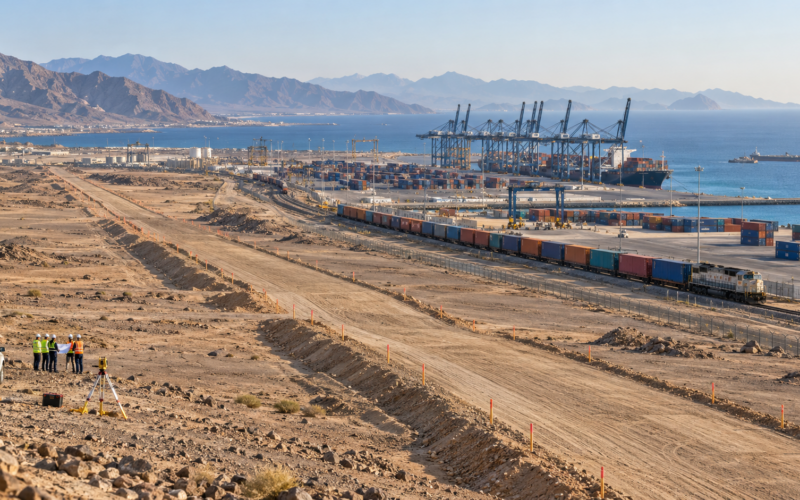
NEOM is advancing plans for a freight railway stretching more than 400 kilometres from its Oxagon industrial city and Red Sea port toward Saudi Arabia’s national railway network, creating a potential inland logistics corridor for one of the kingdom’s most ambitious industrial developments.
The project remains at an early planning stage. NEOM has sought expressions of interest from consultants for feasibility studies, route alignment and concept design, meaning no main construction contract has been awarded and no specific railway construction cost has been publicly established.
That status is particularly important because NEOM’s widely cited $500 billion development figure relates to the broader giga-project rather than this individual rail corridor. The railway may eventually require substantial capital given its length and terrain, but assigning the wider NEOM investment value to the proposed freight line would materially overstate the project’s current disclosed economics.
The strategic rationale is nevertheless becoming clearer. Port of NEOM currently handles around 250,000 twenty-foot equivalent units annually, while phased expansion is intended to lift capacity to approximately 1.5 million TEU by 2030 and turn the port into a more significant Red Sea gateway for Oxagon’s industrial tenants and Saudi trade.
Why could a 400km-plus freight railway become critical to Oxagon’s industrial model?
Ports create economic value only when cargo can move efficiently between ships and inland destinations. Road haulage can support early operations, project cargo and moderate container volumes, but a much larger port serving industrial manufacturing may eventually require rail capacity to move heavier and higher-volume freight over long distances.
Oxagon is being developed around advanced manufacturing, renewable-energy industries, digital infrastructure and supply-chain services. Those activities can require movement of equipment, raw materials and finished products between the Red Sea coast and customers or suppliers elsewhere in Saudi Arabia.
A direct railway connection into the existing national network could reduce dependence on long-distance trucking while giving industrial tenants access to inland logistics corridors extending toward the centre, north and east of the kingdom. Saudi Arabia Railways already operates a northern network extending approximately 2,750 kilometres, including freight infrastructure linking mining areas with processing and export facilities.
The proposed Oxagon connection would therefore not need to create an entirely new national rail system. Its value would come from joining NEOM’s Red Sea industrial base to infrastructure that already moves heavy freight across the country.
How does the railway plan fit Port of NEOM’s expansion from 250,000 to 1.5 million TEU?
Port of NEOM is already operating and handling containers, general cargo, bulk shipments, warehousing and RoRo services. Its new Terminal 1 is scheduled to launch during 2026, with 2027 expected to represent its first full operating year as activity ramps toward significantly larger container volumes.
The terminal includes a 900-metre quay wall, an 18.5-metre draft and infrastructure capable of receiving some of the world’s largest container vessels. NEOM has also introduced automated and remotely controlled cargo-handling equipment as part of a broader effort to make the port a highly digitalised logistics hub.
Increasing container capacity sixfold from approximately 250,000 TEU toward 1.5 million TEU changes the inland-transport requirement substantially. A port that handles a relatively modest regional cargo base can rely heavily on road transport, while a port processing more than a million containers annually needs more diversified logistics if cargo is to move efficiently without creating congestion and excessive trucking costs.
The proposed railway should consequently be assessed as part of the port’s future utilisation strategy rather than as an isolated transport project. Rail becomes economically valuable if terminal volumes, Oxagon manufacturing and external freight demand grow enough to use it.
Why does the feasibility stage matter before NEOM chooses a route?
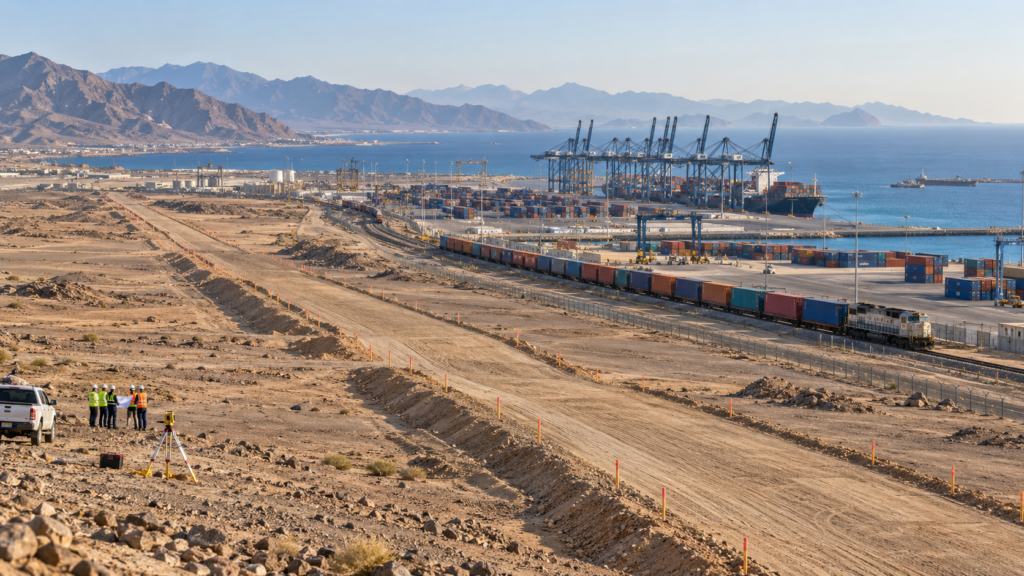
A railway exceeding 400 kilometres must resolve engineering, environmental, commercial and land-use questions long before physical construction begins. Consultants need to establish where freight demand originates, which alignment minimises difficult terrain and how the new line can connect technically with the existing Saudi network.
The study also needs to determine what kind of freight the corridor should be optimised to carry. Container traffic from Port of NEOM has different loading, terminal and scheduling requirements from bulk minerals or industrial project cargo, while future manufacturing tenants may create additional freight flows that do not yet exist.
Commercial feasibility is equally important. Building a railway for projected future traffic can create strategic capacity, but underused rail infrastructure can become an expensive fixed asset if industrial development or port volumes ramp more slowly than expected.
That is why the expression-of-interest stage should not be treated as evidence that a 400km-plus railway is about to enter construction. It represents NEOM beginning the technical work required to decide how the project should be configured and whether the expected logistics benefits justify the eventual capital commitment.
Could rail connectivity change Port of NEOM’s role beyond serving the giga-project itself?
NEOM has increasingly positioned its port as a regional trade gateway rather than an internal construction terminal serving only the development. The Red Sea location sits close to major Asia-Europe maritime routes and gives the port access to trade moving through the Suez corridor.
A connection with Saudi Arabia’s inland rail network could broaden that proposition. Cargo arriving at the Red Sea could potentially move by rail toward other Saudi industrial regions, while exports from inland producers could obtain another route to global shipping markets.
The commercial case strengthens if Port of NEOM begins handling freight for companies located outside Oxagon. That would allow the terminal and railway to benefit from national logistics flows rather than relying exclusively on the success of industrial tenants inside one development zone.
The challenge is competition. Saudi Arabia already has major Gulf and Red Sea ports with established rail, road and industrial connections, so Port of NEOM will need enough service reliability and freight economics to persuade shippers to alter existing routes.
What should happen next in the Oxagon freight rail project?
Consultant appointment is the first meaningful milestone because it would move the project from an expression of interest into a defined feasibility and concept-design programme. That work should provide better information on route length, connection points, freight forecasts and potential cost.
The next stage would involve deciding whether the railway proceeds into detailed design and procurement. Until those decisions are made, the project should remain classified as a proposed freight connection rather than an approved construction programme.
The timing is strategically useful because the port itself is becoming more operational. Terminal 1 is entering its launch phase, current capacity already supports approximately 250,000 TEU and Oxagon continues adding industrial and digital projects around the port.
NEOM therefore has time to determine whether rail becomes necessary before the port reaches its 1.5-million-TEU ambition. The project’s real importance will not be its length alone but whether it turns an increasingly capable Red Sea port into an inland logistics gateway connected with Saudi Arabia’s broader industrial economy.
Discover more from Business-News-Today.com
Subscribe to get the latest posts sent to your email.