


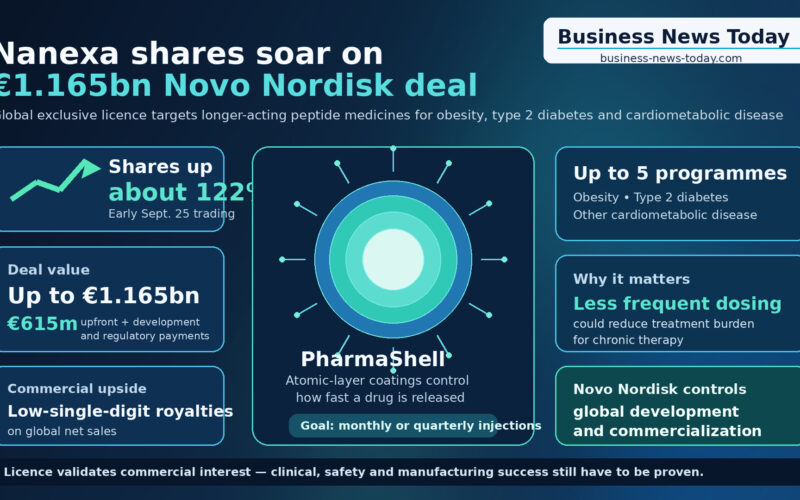
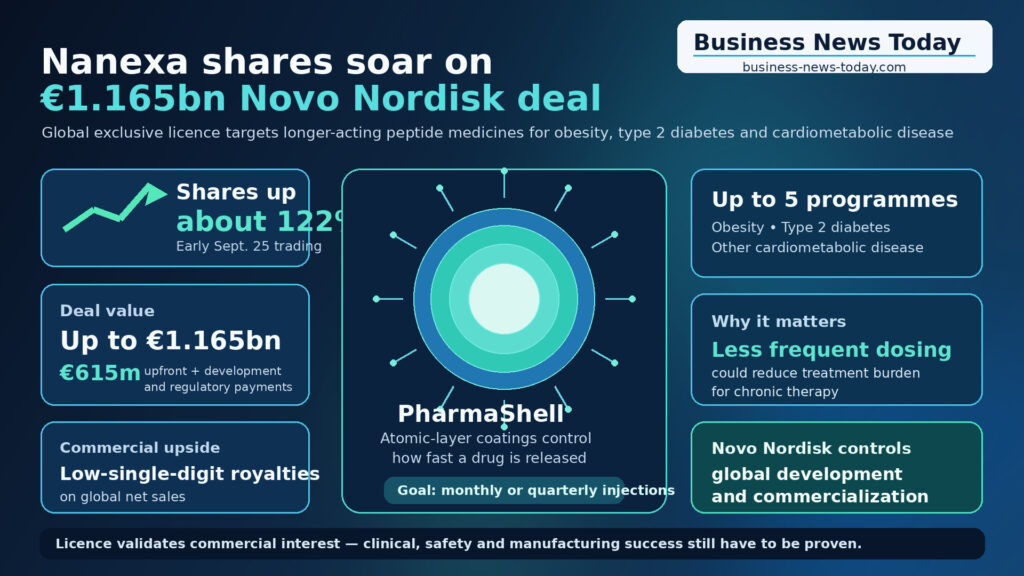
Nanexa AB (Nasdaq First North Stockholm: NANEXA) shares surged approximately 122% in early September 25 trading after Novo Nordisk A/S signed a global exclusive licence and collaboration agreement potentially worth €1.165 billion for Nanexa’s PharmaShell drug-delivery technology. The agreement covers as many as five development programmes targeting obesity, type 2 diabetes and other cardiometabolic diseases, transforming a small Swedish drug-delivery specialist into a potentially important partner for one of the world’s largest metabolic-disease companies.
The objective is commercially straightforward but technically significant: create versions of peptide medicines that can be injected monthly or quarterly rather than weekly. Nanexa will receive upfront, development and regulatory payments that together could reach €615 million, with additional sales milestones accounting for the remainder of the potential €1.165 billion value. The company is also entitled to low-single-digit royalties on global net sales of medicines developed through the partnership, while Novo Nordisk will control global development and commercialization.
How does Nanexa PharmaShell technology make injections last for months?
PharmaShell uses atomic layer deposition to apply extremely thin coatings around drug particles. Those coatings can be engineered to control how quickly the active pharmaceutical ingredient is released after injection, potentially creating long-acting formulations without requiring patients to administer the medicine as frequently.
Longer duration can be particularly valuable in chronic diseases where treatment adherence determines whether medicines achieve their full real-world benefit. Weekly obesity and diabetes injections have already become commercially successful, but monthly or quarterly dosing could reduce treatment burden considerably for patients who remain on therapy for years.
Nanexa also argues that PharmaShell can support high drug loading while keeping injection volumes relatively low. That matters because a formulation becomes less attractive if extending the dosing interval requires an impractically large injection.
The platform is not limited to metabolic disease. Nanexa has previously highlighted potential applications in oncology, cardiovascular medicine, psychiatry and other therapeutic areas, although the Novo Nordisk agreement is specifically focused on peptide-based medicines in obesity, diabetes and cardiometabolic conditions.
Why would monthly obesity injections matter to Novo Nordisk’s GLP-1 strategy?
Novo Nordisk built one of the most successful pharmaceutical franchises in history around semaglutide, the active ingredient used in medicines including Ozempic and Wegovy. Competition has intensified sharply, however, as Eli Lilly and a growing group of biotechnology companies develop injectable and oral obesity treatments with different dosing schedules.
Convenience is increasingly becoming a competitive variable alongside weight loss and tolerability. A patient choosing between medicines with comparable efficacy may prefer a tablet to an injection, while somebody comfortable with injections could prefer one dose every month or quarter rather than every week.
Longer-acting formulations can also create lifecycle-management opportunities around established molecules. Rather than relying entirely on discovering a completely new obesity drug, a pharmaceutical company can potentially extend the commercial usefulness of an existing active ingredient by creating a more convenient formulation.
Nanexa’s technology therefore addresses a strategic problem Novo Nordisk already faces: how to maintain differentiation as the obesity market becomes increasingly crowded and semaglutide eventually approaches patent expiration in major markets.
What does the €1.165 billion headline value actually mean for Nanexa?
The entire amount is not being paid immediately. Licensing transactions frequently combine upfront cash with development, regulatory and sales milestones that are triggered only if experimental programmes advance successfully.
Reuters reported that the upfront, development and regulatory portion can total €615 million, while remaining consideration depends on commercial milestones. Nanexa will also receive royalties calculated as a low-single-digit percentage of global sales if licensed products eventually reach the market.
For a company of Nanexa’s size, even a fraction of the potential milestone pool can be transformative. Before the agreement, Nanexa’s market capitalization was tiny compared with Novo Nordisk, making the economic value attached to the partnership several times greater than Nanexa’s standalone equity value before the share-price surge.
That explains why the stock reaction was so extreme. Investors were not simply responding to another research collaboration; they were repricing the probability that PharmaShell can become a commercially important drug-delivery platform backed by a pharmaceutical company capable of taking multiple products through global development.
Why did Nanexa shares rise more than 100% while Novo Nordisk moved modestly?
Scale provides the simplest explanation. A deal capable of creating enormous value for Nanexa can remain comparatively small for Novo Nordisk, whose metabolic-disease franchise generates tens of billions of dollars in annual revenue.
Nanexa shares climbed about 122% during early September 25 trading and reached their highest levels in more than five years, according to Reuters. Novo Nordisk’s stock response was much more restrained because investors evaluate the Danish company around a far larger portfolio of marketed drugs, pipeline assets, pricing trends and manufacturing investments.
The asymmetry is typical of biotechnology licensing. The smaller company gains financial validation and potentially years of funding, while the larger pharmaceutical company effectively purchases another technology option inside a much broader pipeline.
Novo Nordisk can also spread its risk across as many as five development programmes. If individual formulations fail, the broader collaboration may continue around other molecules.
What does the deal reveal about the next phase of the obesity-drug competition?
The first phase of the obesity market focused heavily on efficacy and manufacturing capacity. Companies needed medicines capable of generating meaningful weight loss and sufficient factories to produce enormous quantities of injectable pens.
The next phase is becoming more differentiated. Drugmakers are pursuing tablets, longer-acting injections, combinations designed to preserve muscle, medicines targeting different biological pathways and formulations intended to reduce side effects.
Nanexa’s deal places dosing interval directly into that competitive landscape. Monthly or quarterly injections could create a meaningful convenience advantage if they retain sufficient efficacy, tolerability and manufacturing economics.
The phrase “if” remains important because a licensing agreement validates commercial interest rather than clinical success. Formulations still have to demonstrate appropriate pharmacokinetics, safety, efficacy and manufacturing consistency before regulators will approve them.
Could PharmaShell eventually become more valuable than Nanexa’s own drug pipeline?
The agreement creates that possibility because platform licensing can scale across multiple products without requiring Nanexa to fund the entire global development programme itself. Novo Nordisk will lead development and commercialization of medicines covered by the partnership, allowing Nanexa to participate financially through milestones and royalties.
That model can produce attractive economics for a small biotechnology company if multiple licensed products reach the market. Nanexa avoids much of the enormous expense associated with Phase 3 trials, regulatory submissions and global commercialization while retaining participation in product revenue.
The company still carries technology risk. PharmaShell must work reliably across different peptides and at commercial manufacturing scale, and not every programme entering the partnership is likely to reach approval.
The September 25 market reaction nevertheless demonstrates how dramatically a platform company’s prospects can change when a major pharmaceutical partner moves from evaluation into a broad global licence. Nanexa spent years trying to establish PharmaShell as a credible long-acting formulation technology. Novo Nordisk has now attached a potential €1.165 billion price tag to that opportunity.
Discover more from Business-News-Today.com
Subscribe to get the latest posts sent to your email.