


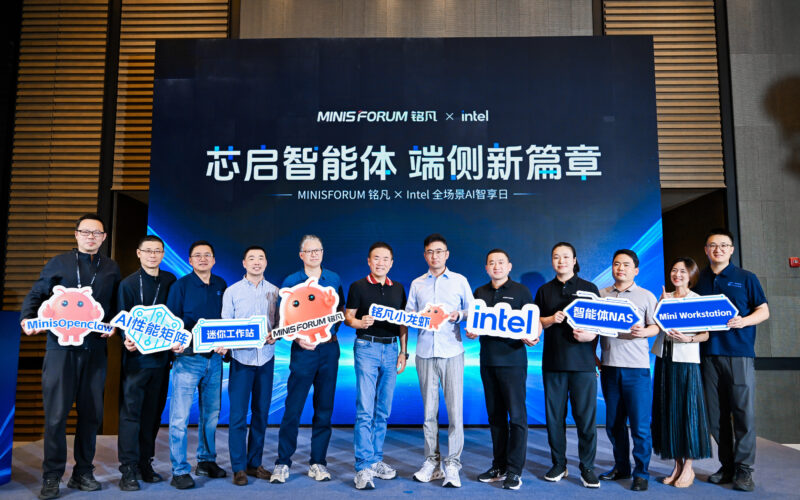
MINISFORUM and Intel Corporation have opened a new chapter in edge AI storage with the launch of two Agent NAS products, the All-Flash S5 and the 7-bay All-Flash S7, at a joint event in Xiamen, China. The devices are built around Intel Core Ultra Series 3 and Intel Core Series 3 processors, placing local artificial intelligence, high-speed storage, and private data management inside compact network-attached storage systems. The move matters because the NAS category is being pulled out of its old role as a passive file box and pushed toward becoming a small, always-on AI compute node for homes, creators, homelabs, small offices, and edge environments. For Intel Corporation, which trades on Nasdaq under the ticker INTC, the announcement also gives another practical channel for its edge AI silicon strategy at a time when investors are watching whether the company can convert processor launches into real platform adoption.
Why are MINISFORUM and Intel using Agent NAS to redefine edge AI storage?
The core shift in the MINISFORUM and Intel announcement is not simply that the companies have introduced new storage devices. It is that MINISFORUM is positioning network-attached storage as an active participant in local AI workflows, rather than a quiet box that sits on a shelf and waits for backup jobs. The phrase Agent NAS may sound like a product marketer found a fresh label and ran with it, but the underlying concept is more serious. As generative AI and agentic systems move closer to users, the question becomes where the data lives, how quickly it can be searched, and whether sensitive information has to leave the local environment.
The All-Flash S5 and All-Flash S7 are aimed at that gap. The S5 is designed around a compact, fanless, all-SSD architecture with five M.2 2280 PCIe 4.0 x1 SSD slots, while the S7 moves up the ladder with support for up to seven NVMe SSDs and a more workstation-like networking profile. That distinction gives MINISFORUM two entry points into the market. The S5 speaks to homes, creators, media users, and small teams that want silent, private, fast storage. The S7 speaks to homelab users, technically advanced buyers, small business administrators, and edge AI developers who need more bays, more networking, and more performance headroom.
Intel Corporation’s presence is strategically important because Agent NAS requires more than storage density. It needs compute that can support local inference, semantic search, media indexing, and possibly lightweight agent workflows without sending every request to the cloud. Intel has been positioning Intel Core Series 3 processors for edge intelligence and integrated AI acceleration, while Intel Core Ultra processors for edge are being pitched for generative AI and agentic AI use cases. That makes the MINISFORUM launch a useful proof point for Intel Corporation’s attempt to move AI beyond high-end servers and into distributed, practical edge devices.

How does the All-Flash S5 change the consumer and small office NAS proposition?
The All-Flash S5 is the more consumer-facing of the two products, but its strategic relevance should not be underestimated. Traditional NAS systems have often been built around hard disk drives, where capacity, price per terabyte, and redundancy were the primary selling points. MINISFORUM is flipping that equation by emphasizing all-flash storage, compact design, silence, lower idle noise, and local AI features. That reflects a broader category shift from cold storage to intelligent, frequently accessed personal data infrastructure.
The fanless design is more than a comfort feature. It makes the S5 plausible for home theaters, bedrooms, desks, studios, and small offices where a traditional disk-based NAS might be too noisy or visually intrusive. This matters because the next wave of private AI applications will not only live in server rooms. Photo libraries, family videos, creator archives, surveillance footage, work documents, and small business records are increasingly becoming AI-queryable datasets. If a device can sit quietly in a living space while indexing and serving that data locally, the adoption barrier becomes much lower.
MINISFORUM’s MinisOpenClaw AI agent is central to this proposition. The company is highlighting one-click installation and AI semantic photo search, including the ability to find images through natural language-style prompts. In practical terms, this shifts the NAS interface from folders and filenames toward intent-based search. That sounds modest until one remembers how much consumer and small business data is poorly organized. The real value of local AI storage may not be raw capacity, but rescuing users from their own digital chaos without forcing them to upload everything to a remote platform.
Why does the S7 matter for homelabs, creators, and edge AI workloads?
The S7 is the more technically ambitious device because it extends the Agent NAS idea toward higher-performance environments. Built from the MINISFORUM MS-03 workstation platform, the S7 supports up to seven NVMe SSDs and adds a serious networking mix that includes dual 10G SFP+ fiber ports, one 10G RJ45 port, one 2.5G RJ45 port, and two USB4 40Gbps ports. That is not casual backup hardware. It is a sign that MINISFORUM sees Agent NAS as part of a broader local infrastructure stack for users who want fast access, low latency, local AI tools, and flexible deployment.
For homelab users, the S7 could become a compact platform for experimenting with private cloud, media serving, containerized applications, AI indexing, and local model workflows. For creators, it could support large photo and video libraries where fast storage and semantic discovery are becoming increasingly important. For small businesses, the value proposition is more operational. Local storage that can perform intelligent search, maintain private datasets, and connect at 10-gigabit speeds could reduce dependency on cloud-only workflows for some use cases.
The risk is that the S7 enters a market where technically capable buyers will not be satisfied with slogans. They will want thermal stability, sustained NVMe performance, mature software, clear update policies, data protection features, power efficiency, and credible support. In other words, MINISFORUM can attract the homelab crowd with specifications, but it will need to retain that audience with execution. That audience is famously enthusiastic, but also famously allergic to half-baked software. One bug and the forum threads do the marketing in reverse.
What does the launch signal about Intel Corporation’s edge AI strategy?
For Intel Corporation, the MINISFORUM Agent NAS launch fits into a wider effort to push AI computing into more form factors. Intel has described its Core Ultra processors for edge as suited to generative AI and agentic AI workloads, combining computer vision, generative AI, and autonomous action in power-efficient edge deployments. Intel also said its Core Series 3 processors will support consumer, commercial, and edge systems beginning in 2026, with partner systems rolling out through the year.
That positioning matters because Intel Corporation is competing not only on chips, but on ecosystem credibility. NVIDIA Corporation dominates the high-end AI accelerator narrative, while Advanced Micro Devices, Inc. has been pushing aggressively into AI PCs, servers, and embedded computing. Intel Corporation’s opportunity is to make AI more ordinary by embedding acceleration into systems that users already understand, such as PCs, workstations, industrial edge boxes, and now AI-capable NAS devices. The Agent NAS category gives Intel Corporation a way to show that on-device AI is not limited to laptops running productivity features.
The investor angle is also worth watching. Intel Corporation shares were recently trading around $109.62, with a market capitalization of roughly $557.2 billion based on the latest available finance data. Yahoo Finance showed Intel Corporation’s 52-week range at $18.97 to $114.51, placing the stock close to its recent high and reflecting a market that has already repriced expectations around the company’s turnaround and AI exposure. The MINISFORUM launch alone is not enough to move the needle for Intel Corporation, but it supports the broader narrative that Intel Corporation is trying to seed AI-capable processors into many distributed hardware categories rather than betting only on blockbuster data center wins.
Can Agent NAS become a serious alternative to cloud-first AI data workflows?
The most important strategic question is whether Agent NAS can carve out a meaningful role between traditional NAS and cloud AI services. Cloud platforms still offer scale, collaboration, and managed AI capabilities that local devices cannot easily match. However, local AI storage has three advantages that are becoming harder to ignore: data privacy, latency, and recurring cost control. For users with large personal media libraries, sensitive business files, surveillance footage, or proprietary project archives, the idea of querying data locally has clear appeal.
This does not mean Agent NAS will replace cloud storage. The more likely outcome is a hybrid pattern. Local devices handle indexing, private search, fast access, and edge inference, while cloud services remain useful for off-site backup, collaboration, and larger model access. If MINISFORUM executes well, the S5 and S7 could sit in that middle layer, giving users a local AI command center for data that is too valuable, too bulky, or too sensitive to push entirely into third-party platforms.
The execution burden will sit heavily on software. Hardware buyers can understand all-flash storage, 10GbE networking, USB4, and NVMe bays. Agentic workflows are harder to explain and harder to support. MINISFORUM will need to make MinisOpenClaw feel practical rather than ornamental. If AI semantic search is fast, accurate, private, and reliable, Agent NAS becomes a real category. If it is slow, confusing, or limited to demo-friendly use cases, the product risks being seen as a high-spec NAS with AI stickers attached.
What should competitors in NAS, mini PCs, and edge computing watch next?
The MINISFORUM and Intel launch creates pressure across several overlapping markets. Traditional NAS vendors will have to decide whether AI features should remain cloud-connected add-ons or become native local capabilities. Mini PC vendors will need to consider whether storage-rich AI nodes become a distinct category rather than a niche variation of compact workstations. Edge computing suppliers will have to watch whether smaller, prosumer-friendly devices start pulling workloads away from more expensive industrial boxes.
The competitive response may come from several directions. Established NAS companies can lean on software maturity, backup features, enterprise trust, and ecosystem depth. Mini PC challengers can move quickly on hardware design and processor options. Cloud platforms can argue that local AI is limited without large-scale models and centralized management. The winner may not be the company with the most dramatic AI branding, but the one that best combines storage reliability, local compute, privacy controls, and simple user experience.
For MINISFORUM, the strategic prize is category expansion. The company has built recognition around mini PCs, AI mini workstations, and compact computing devices. Agent NAS gives it a way to move from device supplier to edge infrastructure brand. That is a more valuable position, but also a more demanding one. Storage users expect reliability over years, not just impressive launch specifications. In this market, trust is not a feature. It is the product.
Key takeaways on what the MINISFORUM and Intel Agent NAS launch means for edge AI storage
- MINISFORUM is using the All-Flash S5 and S7 to move beyond compact PCs into local AI storage infrastructure, where compute, data management, and privacy converge.
- Intel Corporation gains another edge AI deployment channel, supporting its broader effort to push AI-capable processors into distributed devices beyond laptops and servers.
- The All-Flash S5 targets silent, compact, consumer-friendly AI storage, making local semantic search and private media indexing more accessible for home and small office users.
- The All-Flash S7 is aimed at higher-performance users, including homelabs, creators, and small businesses that need NVMe density and 10-gigabit networking.
- The launch reflects a broader market shift from passive network-attached storage toward intelligent storage nodes that can understand and organize local data.
- Software execution will determine whether Agent NAS becomes a real category or remains a hardware refresh wrapped in AI language.
- Traditional NAS vendors may face pressure to accelerate local AI features, especially around semantic search, media indexing, and private data workflows.
- Intel Corporation’s stock strength near its 52-week high suggests investors are already pricing in higher expectations for AI and platform execution, making real-world adoption channels increasingly important.
- The hybrid future of AI storage is likely to combine local inference and private search with cloud backup and larger-scale model access.
- MINISFORUM’s biggest opportunity is to turn its compact hardware reputation into a stronger edge computing platform identity.
Discover more from Business-News-Today.com
Subscribe to get the latest posts sent to your email.