


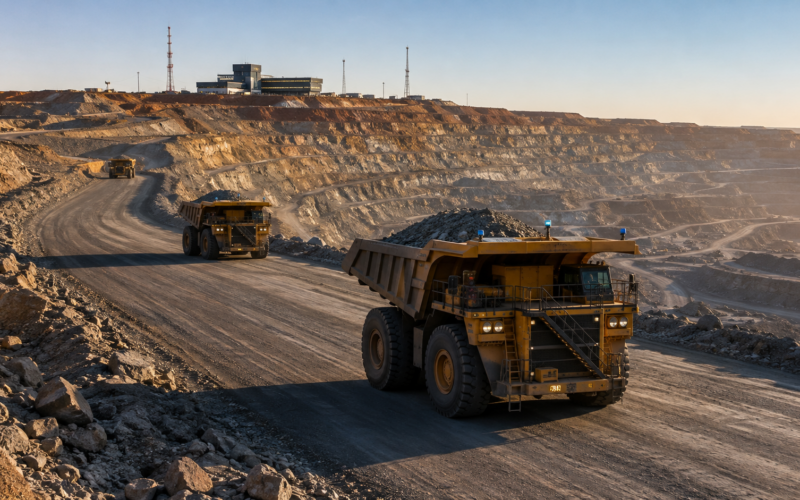
In April 2026, Komatsu commissioned its 1,000th ultra-class autonomous haul truck equipped with the FrontRunner Autonomous Haulage System. The milestone vehicle was a 930E-5AT electric-drive truck with a 290-metric-ton payload deployed at Nevada Gold Mines in the United States. Komatsu said FrontRunner customers had collectively moved more than 11.5 billion metric tonnes of material since the system entered commercial service in 2008, while more than 500 autonomous trucks from the 930E family were deployed across customer operations.
Those numbers make autonomous mining difficult to describe as experimental. Rio Tinto says approximately 90% of the haul-truck fleet across its Pilbara operations is autonomous. BHP’s South Flank primary haul fleet consists of 41 autonomous Komatsu 930E trucks, while Fortescue says more than 200 autonomous haul trucks now operate across its Pilbara network and collectively move roughly 500 million tonnes of material a year.
What is changing commercially is therefore larger than the disappearance of a driver from a truck cab. Haulage is becoming a software-orchestrated production system in which central controllers decide where trucks travel, which loading equipment they serve, how they queue and when they report for maintenance. As battery-electric trucks enter trials, that software layer may also have to determine when and where hundreds of tonnes of mobile equipment receive energy without disrupting mine output.
What are autonomous mining trucks and how do they work?
An autonomous haul truck combines the mechanical platform of an ultra-class mining truck with positioning, sensing, communications and fleet-management technology capable of operating the vehicle without a driver onboard. The truck still performs the familiar mine cycle of travelling to loading equipment, receiving material, moving to a crusher or waste dump and returning for another load, but those movements are controlled through an autonomous haulage system rather than individual driver decisions.
Komatsu’s FrontRunner architecture combines vehicle controllers, precision GPS, radar and laser-based obstacle detection with a wireless communications network. The vehicle control system uses a detailed digital map containing haul roads, loading areas, dump points, refuelling facilities and maintenance locations, while a central controller assigns routes to individual trucks. Loading-equipment operators can see autonomous vehicles through integrated displays and position arriving trucks for loading.
Caterpillar’s MineStar Command for hauling follows the same system-level principle. Autonomous trucks can respond to calls from loading equipment, position themselves, travel to assigned dump points and even report for maintenance without an operator onboard. Caterpillar says the software also manages the broader haulage ecosystem to reduce idle time, bunching around loaders, unnecessary empty travel and wasted fuel.
This is why autonomous haulage increasingly resembles an industrial software platform expressed through enormous machines. Payload, truck reliability and mechanical performance still matter, but production increasingly depends on how effectively software coordinates every truck with excavators, crushers, roads, maintenance and other vehicles.

How widely are autonomous haul trucks already being used in mining?
Western Australia’s Pilbara has become one of the clearest demonstrations of autonomous mining at industrial scale. Rio Tinto says around 90% of the haul truck fleet across its Pilbara sites operates autonomously, while its Perth Operations Centre allows trucks, trains, plants and drills across the company’s mining, port and rail network to be operated or monitored from approximately 1,500 kilometres away.
Gudai-Darri shows how multiple autonomous systems can operate inside one mine. Rio Tinto currently lists 26 Caterpillar 793F autonomous haul trucks and five autonomous drills at the operation, all monitored remotely from Perth. The site also uses autonomous water carts, automated ore sampling and Rio Tinto’s wider AutoHaul autonomous heavy-haul railway system.
BHP completed the original autonomous-haulage conversion at South Flank in 2023. All 41 Komatsu 930E trucks in its primary haul fleet became autonomous, with around 185 pieces of ancillary equipment able to operate around them across five autonomous operating zones. The conversion required network upgrades, operating-zone infrastructure and almost 3,000 training modules for employees working around the autonomous system.
Fortescue provides another indication of maturity. The company says more than 200 autonomous haul trucks are coordinated through its Hive integrated operations centre in Perth, with roughly 500 million tonnes moved autonomously each year across the Pilbara. Caterpillar separately renewed an agreement in March 2026 to continue supplying and operating MineStar Command for hauling across three Fortescue mining operations, extending a commercial technology relationship that began in 2012.
How much can autonomous haul trucks reduce mining costs?
The economic case for autonomous haulage starts with utilisation. Driver-operated trucks are affected by shift changes, breaks and differences in driving behaviour. Autonomous systems can run with more consistent acceleration, braking, routing and cycle times, while central dispatch can attempt to minimise queues and unnecessary movement.
BHP provides one of the clearest operator-reported examples. The company said its Jimblebar autonomous haulage fleet increased truck utilisation and reduced haulage costs by about 20%. In later reporting, BHP described Jimblebar as its benchmark site for haulage costs and said the operation had achieved a 20% reduction compared with other Western Australia Iron Ore sites following autonomous-haulage implementation. That remains a site-specific result rather than evidence that every mine will achieve a 20% saving.
Komatsu currently markets FrontRunner as capable of delivering cost savings of up to 15%. It also reports an average 40% improvement in tyre and brake life and a 13% reduction in overall maintenance when autonomous trucks operate inside the system’s design envelope. These are manufacturer-reported performance claims and should not be interpreted as independently established industry averages.
The more important metric for a miner is ultimately cost per tonne moved. Even relatively small improvements in utilisation, queuing, cycle consistency and equipment life can compound across fleets performing thousands of haul cycles every week.
Why is mining haulage becoming a software business?
A mine does not maximise output simply by making every truck move faster. Loading equipment must remain productive, crushers cannot be overloaded, haul roads become congested and trucks need to be directed toward the locations where they create the most value.
That gives dispatch and fleet-management software an increasingly important role in determining physical production. Caterpillar says MineStar Command can reduce idle time, loader bunching and unnecessary empty travel. Komatsu integrates FrontRunner with its DISPATCH fleet-management system to optimise truck assignments and support real-time operating decisions.
Rio Tinto has taken this model beyond haul trucks. Its Perth Operations Centre connects autonomous trucks with trains, drills, processing infrastructure, rail and port operations across an integrated Pilbara supply chain. Fortescue’s Hive similarly coordinates autonomous haulage, processing plants, rail, ports, scheduling and energy systems using real-time operational data.
The competitive implication for equipment manufacturers is significant. Caterpillar and Komatsu still sell extraordinarily valuable physical machines, but the relationship with the customer increasingly extends into fleet software, autonomy, data, communications and long-term system integration.
What infrastructure does an autonomous mine need?
Autonomous trucks remove drivers from cabs, but they increase dependence on digital infrastructure. Reliable positioning, mine maps, wireless coverage, obstacle detection, traffic-management rules and control systems all become part of the production chain.
BHP’s South Flank conversion required upgrades to network infrastructure and the construction of autonomous operating zones alongside extensive employee training. Komatsu’s FrontRunner system similarly depends on a dedicated communications network connecting vehicles, central control and loading equipment.
The consequences of failure are not theoretical. WorkSafe Western Australia has documented a serious near miss involving autonomous haul trucks after reduced wireless coverage and confusion during recovery operations. The regulator identified limited communications redundancy, misunderstanding of vehicle operating modes and the ability to override critical safety controls among the contributing factors.
WorkSafe Western Australia also published a new road and traffic management code of practice on August 4, 2026. It requires mine operators to manage risks associated with road design, mobile equipment, traffic interaction, operating procedures, training and maintenance. An earlier dedicated autonomous-mining code remains listed as a transitional code and is currently under review, making it important not to describe the older document as the sole current regulatory framework for autonomous haulage.
Are autonomous mining trucks safer than conventional haul trucks?
One of autonomy’s strongest arguments is that it removes people from a repetitive activity involving machines weighing hundreds of tonnes, long shifts and interaction with other heavy equipment.
BHP’s current Jimblebar information says truck automation at Jimblebar and Newman has resulted in a 90% reduction in heavy-vehicle safety risks. Earlier BHP reporting also said significant truck-related events at Jimblebar had fallen by more than 90% after autonomous haulage was introduced.
Caterpillar reported in September 2024 that trucks using MineStar Command had autonomously hauled more than 8.6 billion tonnes without reported injuries resulting from the trucks operating autonomously. That remains a Caterpillar-reported safety record rather than an independent industry statistic, and autonomous mine sites can still experience incidents involving communications, manually operated equipment and personnel.
Autonomy therefore changes the risk profile rather than eliminating risk. Mines need robust traffic management, communications redundancy, training and clearly understood procedures for situations where employees must enter autonomous operating zones or recover stopped vehicles.
What happens to mining jobs when haul trucks become autonomous?
Autonomous haulage removes the requirement for a driver to sit inside each operating truck, but large autonomous mines still employ people to supervise, maintain and support the system. The workforce mix shifts toward mine controllers, field officers, service technicians, communications specialists and employees working in remote operations centres.
When BHP approved autonomous haulage at South Flank, it expected up to 60 specialist roles including autonomous-haulage controllers, field officers and service technicians. Existing employees were offered opportunities to move into new roles, and the later full conversion involved almost 3,000 training modules.
Rio Tinto and Fortescue illustrate the geographical shift as well. Significant elements of Pilbara mining operations can now be coordinated from Perth rather than exclusively from mine sites more than 1,000 kilometres away. The employment question is therefore not simply how many truck-driving positions disappear, but which technical capabilities become more valuable as mines rely more heavily on software, networking and automation.
Can autonomous mining trucks also become battery-electric?
Autonomous diesel haulage is already operating at industrial scale. Battery-electric ultra-class haulage remains much earlier in its development.
BHP, Rio Tinto and Caterpillar launched a mine-site trial in June 2026 involving two Cat 793 XE Early Learner battery-electric haul trucks at BHP’s Jimblebar operation. The trucks had arrived late in 2025 after controlled testing at Caterpillar’s Tucson Proving Ground. By June, the programme had completed more than 100 operating hours and more than 200 test laps. Jimblebar hosts two of only seven Caterpillar Early Learner battery-electric haul trucks being tested globally.
The programme remains a trial intended to assess technical readiness, infrastructure requirements and commercial feasibility. High-powered static and dynamic charging are being evaluated, with a subsequent phase planned to test an energy-transfer system capable of charging trucks while they are moving. Dynamic charging should therefore not yet be described as an established commercial operating capability at Jimblebar.
This is where autonomy and electrification begin to converge. Caterpillar has said future MineStar capabilities are being developed to orchestrate energy and production across mine sites because battery-electric fleets must balance charging requirements with production targets. Komatsu has already demonstrated an autonomously operated electric-drive haul truck receiving power while connected to a dynamic trolley line, although that 2025 achievement was a technology milestone rather than a broad commercial deployment.
An autonomous diesel fleet-management system primarily optimises where trucks move. A future battery-electric autonomous system may also need to know every truck’s energy state, charging requirements, available electrical infrastructure and the production cost of taking a machine temporarily out of the haul cycle.
Why will autonomous haulage not work equally well at every mine?
The economics favour large, long-life mines where the cost of communications, control infrastructure, fleet conversion and specialist skills can be spread across very high material volumes. Smaller operations may find it harder to justify the same investment, although Caterpillar is already extending autonomous haulage into quarry applications, suggesting the minimum viable scale may fall as the technology matures.
Brownfield conversion creates another hurdle. Autonomous trucks must operate alongside loaders, dozers, maintenance vehicles and people, sometimes while part of the fleet remains manually controlled. South Flank’s phased rollout across five autonomous operating zones shows why major miners tend to introduce autonomy progressively rather than switching an entire mine at once.
Supplier dependence may become strategically important as well. Once a mine’s dispatch, safety logic, fleet management and eventually energy orchestration are built around a technology platform, changing suppliers can involve substantially more than replacing one truck with another. Interoperability, software support and control of operational data could consequently become more important procurement considerations.
Is autonomous haulage turning mining into a software and energy-management business?
The strongest evidence of maturity is no longer a single truck completing a driverless circuit. It is the scale and repetition of commercial operations.
Komatsu has commissioned 1,000 ultra-class autonomous haul trucks and says FrontRunner customers have moved more than 11.5 billion metric tonnes. Rio Tinto says around 90% of its Pilbara haul fleet is autonomous. Fortescue operates more than 200 autonomous trucks moving roughly 500 million tonnes a year, while BHP has progressed from its long-established Jimblebar deployment to fully autonomous primary haulage at South Flank.
The next stage is harder because mines are beginning to ask the control system to optimise more than vehicle movements. Battery-electric haulage introduces charging time, electrical capacity, battery state and energy infrastructure into the production equation. A truck waiting for power is unavailable in much the same way as a truck stopped for a driver change, which means poorly coordinated electrification could surrender some of the utilisation benefits autonomy was designed to capture.
That creates a potentially important shift in where competitive advantage sits. The mine of the future may still buy trucks from companies such as Caterpillar and Komatsu, but productivity will increasingly depend on the software layer coordinating those machines with loaders, roads, maintenance, processing plants and the electricity system.
Mining’s largest trucks have already demonstrated that they can operate without drivers. The more difficult engineering and commercial challenge is making hundreds of machines behave as one continuously optimised production system.
Discover more from Business-News-Today.com
Subscribe to get the latest posts sent to your email.