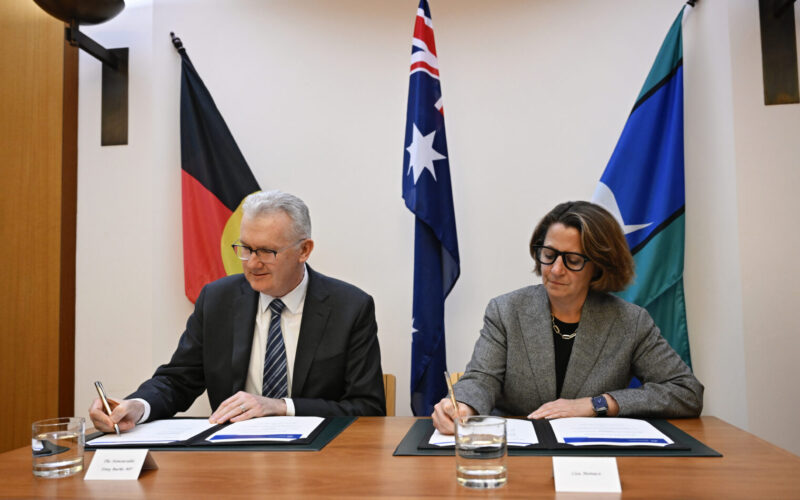
Microsoft Corporation (NASDAQ: MSFT) has signed a new memorandum of understanding with the Australian Government to deepen cooperation on secure cloud infrastructure, cybersecurity, artificial intelligence adoption and critical digital infrastructure resilience. The agreement, signed in Canberra in June 2026, gives Microsoft a more formal role in Australia’s national digital resilience agenda at a time when governments are treating cloud capacity, cyber defence and artificial intelligence infrastructure as strategic assets. The move builds on Microsoft’s A$25 billion commitment to expand AI and cloud infrastructure, strengthen cybersecurity and support digital skills in Australia by the end of 2029. For investors, the announcement reinforces Microsoft’s long-term enterprise cloud thesis, even as MSFT shares trade well below their 52-week high and markets continue to question the payback period on Big Tech’s artificial intelligence spending cycle.
Why does Microsoft’s Australia digital resilience MOU matter for enterprise cloud and AI infrastructure strategy?
Microsoft’s agreement with the Australian Government matters because it pushes cloud infrastructure further into the national security conversation. The memorandum is not simply about selling software subscriptions or expanding a public-sector account. It places secure cloud, cybersecurity, artificial intelligence adoption and critical infrastructure resilience inside a structured public-private framework, which is increasingly how governments are approaching digital sovereignty.
For Australia, the logic is straightforward. Artificial intelligence workloads need secure compute capacity, trusted data flows, resilient connectivity networks and a clear response mechanism when cyber threats escalate. That makes hyperscale cloud providers more important to national economic security than they were during the previous software-as-a-service cycle. The uncomfortable reality for governments is that much of the infrastructure needed for sovereign digital capability is built, operated or secured by private technology giants.
For Microsoft, the agreement strengthens its position as an embedded infrastructure partner rather than a commodity cloud vendor. That distinction matters. Cloud competition against Amazon Web Services, Google Cloud and sovereign cloud alternatives is not only about price or performance. It is increasingly about whether a provider can satisfy government expectations around control, resilience, incident response, artificial intelligence governance and local policy alignment. In that context, Australia gives Microsoft a useful template for other advanced economies that want artificial intelligence capacity without losing control of sensitive digital systems.

How does the Australia agreement connect to Microsoft’s A$25bn cloud and AI investment plan?
The memorandum should be read alongside Microsoft’s A$25 billion Australia investment commitment rather than as a standalone policy gesture. That investment is intended to expand in-country computing and artificial intelligence capacity by the end of 2029, support Azure AI supercomputing and cloud infrastructure, strengthen cybersecurity collaboration and train millions of Australians in artificial intelligence skills. The new MOU gives that capital plan a sharper strategic wrapper.
This is important because hyperscale cloud investment is becoming harder to judge from the outside. Investors see large capital expenditure numbers, but they want evidence that those investments are tied to durable demand, government relationships and higher-value workloads. A national resilience agreement helps Microsoft argue that its Australian spend is not speculative capacity for uncertain artificial intelligence demand. It is linked to public-sector priorities, critical infrastructure needs and long-cycle enterprise adoption.
The risk, however, is that strategic alignment does not automatically produce attractive returns. Data centres require heavy upfront spending, access to power, networking capacity, cooling infrastructure, land, regulatory approvals and skilled workers. Artificial intelligence infrastructure also compresses the timeline between investment and obsolescence because chips, model architectures and customer workloads are evolving quickly. Microsoft’s challenge is to convert sovereign AI enthusiasm into high-margin, recurring cloud revenue before infrastructure intensity weighs too heavily on free cash flow sentiment.
What does the MOU signal about Australia’s approach to cybersecurity and sovereign digital control?
Australia’s approach reflects a broader shift among developed economies: cybersecurity is no longer being treated as a narrow technical function. It is becoming part of industrial policy, national resilience and economic security. The Microsoft agreement focuses on areas such as critical connectivity networks, data centre resilience, threat information sharing, incident response, secure artificial intelligence adoption in government and support for critical infrastructure providers.
That breadth is the point. A serious cyber incident today can affect public services, banks, energy systems, telecom networks, hospitals, logistics and small businesses in the same chain of disruption. As artificial intelligence is added to government and enterprise systems, the attack surface becomes more complex. The MOU suggests Canberra wants a deeper operating relationship with a major technology provider before, not after, the next major cyber event.
The sovereign control language is also commercially meaningful. Governments want the benefits of global cloud platforms, but they also want assurance that essential services remain under domestic policy control. That is a tricky balance. Too much dependence on foreign technology vendors can create political risk. Too much insistence on national self-sufficiency can slow deployment and raise costs. Microsoft is positioning itself in the middle of that tension, presenting Azure, cybersecurity tooling and artificial intelligence infrastructure as global-scale systems that can still support national control.
Why should MSFT investors watch this deal despite limited immediate revenue disclosure?
MSFT investors should watch the Australia pact because it supports the company’s strategic narrative at a time when artificial intelligence infrastructure spending is under sharper market examination. Microsoft shares recently traded at about $390.74, with a market value of roughly $2.91 trillion. The stock was down about 5.10% over five trading days and 7.74% over one month, while trading within a 52-week range of $356.28 to $555.45.
That market context matters. The stock’s retreat from its 52-week high suggests investors are not simply rewarding every artificial intelligence or cloud announcement without scrutiny. Microsoft remains one of the world’s most profitable enterprise technology platforms, but the market is asking a harder question: how quickly will artificial intelligence infrastructure spending translate into incremental revenue, margin durability and defensible customer lock-in?
The Australia agreement does not answer that question by itself. It does, however, strengthen the non-consumer side of Microsoft’s artificial intelligence story. Government, regulated industry and critical infrastructure customers are likely to adopt artificial intelligence more slowly than consumer apps, but they can also produce stickier, compliance-heavy revenue streams. For Microsoft, the most attractive outcome is not a headline partnership. It is a multi-year pathway where Azure, cybersecurity products, Copilot services and artificial intelligence infrastructure become embedded in national and enterprise operating systems.
How could Microsoft’s Australia strategy affect cloud rivals and local technology providers?
Microsoft’s deeper Australian government relationship raises the competitive bar for other hyperscale providers. Amazon Web Services and Google Cloud remain formidable cloud infrastructure competitors, but Microsoft is linking cloud capacity, cybersecurity, artificial intelligence skills, public-sector cooperation and national digital resilience into one strategic package. That kind of bundled positioning can be difficult to displace once government workflows and operating forums are established.
For local technology providers, the effect is mixed. On one hand, Microsoft’s investment could expand the broader Australian artificial intelligence and cloud ecosystem by creating demand for systems integrators, cybersecurity specialists, managed service providers, data centre contractors, energy suppliers and training partners. On the other hand, deeper hyperscaler involvement can concentrate influence around a small number of global platforms, potentially limiting room for smaller sovereign cloud or software firms unless procurement frameworks deliberately preserve supplier diversity.
There is also a policy risk for Microsoft. The more central the company becomes to national digital infrastructure, the more scrutiny it may face over outages, cybersecurity incidents, data governance, pricing, vendor lock-in and compliance with local expectations. Strategic trust is valuable, but it comes with heavier expectations. In public-sector technology, becoming indispensable can be profitable, but it also means being blamed when systems fail, even when the root cause is messier than a procurement slide.
What could happen next if Australia becomes a model for sovereign AI partnerships?
If the Australian model succeeds, Microsoft could use it as a reference architecture for other governments seeking to combine artificial intelligence infrastructure, cloud security and critical infrastructure resilience. Many countries want domestic AI capacity but lack the scale to build a full sovereign technology stack from scratch. Partnerships with hyperscalers may become the practical middle path, especially for allies looking to balance innovation, security and cost.
The next phase will likely depend on execution rather than announcement quality. Microsoft will need to show that its infrastructure investment can expand capacity, improve resilience, support secure artificial intelligence adoption and deliver measurable benefits to public and private customers. Australia, meanwhile, will need to ensure that deeper cooperation with Microsoft strengthens national capability rather than simply deepening dependence on one foreign provider.
The bigger industry signal is that cloud infrastructure is becoming geopolitical infrastructure. Artificial intelligence has accelerated that shift because compute capacity, model access, cybersecurity and data governance now sit inside the same strategic conversation. Microsoft is betting that governments will prefer trusted, regulated partnerships with established cloud providers over fragmented national alternatives. That is a reasonable bet, but it is not a risk-free one.
Key takeaways on what Microsoft’s Australia AI and cybersecurity pact means for cloud infrastructure and MSFT investors
- Microsoft’s Australia MOU strengthens its position as a national digital resilience partner, not merely a cloud infrastructure vendor competing on capacity and price.
- The agreement gives Microsoft’s A$25 billion Australia investment a clearer policy and security context, which may help justify heavy infrastructure spending to enterprise customers and investors.
- Australia is treating secure cloud, artificial intelligence adoption and cybersecurity as economic security priorities, creating a larger role for hyperscale technology providers in national planning.
- MSFT’s recent stock weakness shows that investors still want proof that artificial intelligence infrastructure spending can produce durable revenue growth and margin resilience.
- The pact may raise competitive pressure on Amazon Web Services and Google Cloud by combining infrastructure, cyber defence, public-sector cooperation and artificial intelligence skills into one strategic offering.
- Local Australian technology providers could benefit from ecosystem expansion, although supplier concentration and vendor lock-in will remain important policy concerns.
- Microsoft’s deeper role in critical infrastructure also increases reputational and regulatory exposure if outages, cyber incidents or governance disputes arise.
- The agreement could become a template for other allied economies seeking sovereign artificial intelligence capacity without building a full domestic cloud stack.
- The main execution test will be whether Microsoft can convert strategic cooperation into measurable Azure, cybersecurity and artificial intelligence services revenue.
- For the broader technology sector, the deal reinforces a major shift: cloud infrastructure is no longer just enterprise IT, it is becoming national strategic infrastructure.
Discover more from Business-News-Today.com
Subscribe to get the latest posts sent to your email.