


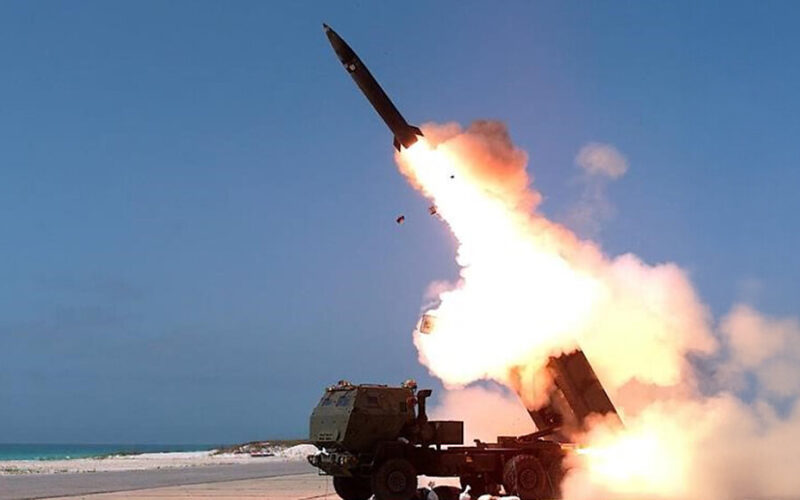
Lockheed Martin Corporation (NYSE: LMT) has secured an indefinite-delivery, indefinite-quantity contract worth up to $1.2 billion from the US Army for Precision Strike Missile Increment 2 (PrSM 2), moving the enhanced missile from flight testing toward initial production.
The contract covers initial procurement, future orders, follow-on production and continued development. Its $1.2 billion ceiling should not be interpreted as an immediate $1.2 billion revenue booking because actual value will depend on individual orders issued under the IDIQ structure.
PrSM Increment 2 adds a multimode seeker designed to engage moving maritime targets and relocatable targets on land, expanding the mission set beyond the baseline Precision Strike Missile. Lockheed Martin completed a first Increment 2 flight test in March and a second in August, with additional testing planned during 2027 as production and system maturation proceed in parallel.
The timing also connects directly with Lockheed Martin’s industrial strategy. The company says it is expanding capacity to quadruple PrSM output, making the latest award as much a manufacturing story as a missile-development milestone.
What does PrSM Increment 2 add that the original missile cannot do?
The baseline Precision Strike Missile is designed to provide long-range precision fires from HIMARS and M270 launchers against fixed or known targets. Increment 2 adds a seeker capable of finding and guiding the missile toward targets that may move after launch.
That changes the operational challenge considerably. A fixed command post or radar can be targeted using known coordinates, while a ship or mobile land system can change position during the missile’s flight.
The multimode seeker is designed to give Increment 2 greater ability to update the final engagement rather than relying solely on the original target location. Technologies developed through Lockheed Martin’s Strigo family have also contributed to elements of the guidance package.
For the Army, that creates a land-based maritime-strike option alongside conventional long-range fires. The capability could allow ground formations to influence operations well beyond the immediate land battlefield without requiring a separate launcher family.
Why is the second 2026 flight test important to the production award?
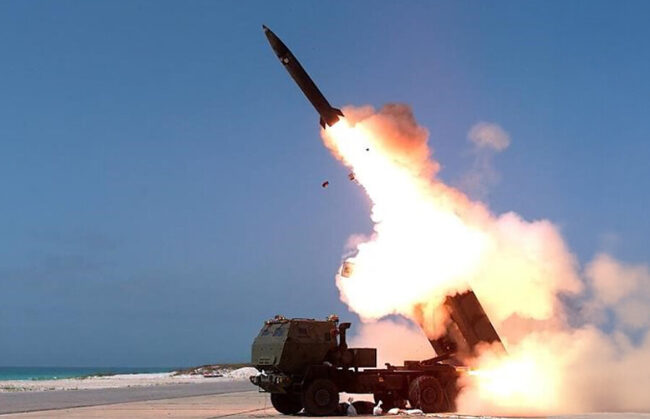
The first Increment 2 test in March involved a roughly 350-kilometre flight and demonstrated major elements of the seeker and guidance architecture. Lockheed Martin says the second flight in August again launched from a HIMARS and generated additional performance information while engaging a moving maritime target.
Two successful test events do not mean development is complete. The Army and Lockheed Martin intend to continue testing during 2027, which is why the IDIQ contract combines initial procurement with continued maturation.
Starting limited production before the entire test programme ends can shorten fielding timelines when a customer is sufficiently confident in the underlying design. It also creates risk because later testing can reveal problems that need to be incorporated into weapons already moving through production.
The Army is effectively accepting some concurrency in exchange for speed. Lockheed Martin must manage that process carefully enough that later engineering changes do not create expensive rework.
How large is the opportunity if Lockheed Martin quadruples PrSM production?
Lockheed Martin has not disclosed a simple annual unit number in the latest announcement, so the fourfold capacity target should be interpreted as industrial expansion rather than a guaranteed fourfold increase in near-term deliveries.
The company needs additional supplier output, tooling, labour and production flow to create that capacity. Missile manufacturing can be constrained by propulsion, electronics, energetic materials and specialised components whose suppliers cannot always increase production immediately.
The advantage of a larger manufacturing base is flexibility. If US Army procurement rises or international customers become eligible for additional PrSM variants, Lockheed Martin can respond without starting a fresh multi-year factory expansion from a much lower baseline.
The capital risk is that installed capacity runs below potential if orders do not materialise at the expected pace. The $1.2 billion Increment 2 ceiling and broader Army interest provide demand visibility, but an IDIQ ceiling is not equivalent to guaranteed utilisation.
How does the new contract fit Lockheed Martin’s missile backlog?
Lockheed Martin’s Missiles and Fire Control backlog reached approximately $87.9 billion at the end of the second quarter of 2026, up from $46.7 billion at the end of 2025. The increase reflects exceptionally strong demand across air and missile defence, tactical missiles and long-range strike programmes.
That backlog gives Lockheed Martin substantial revenue visibility but creates an execution challenge. Winning more contracts provides limited benefit if manufacturing throughput cannot rise fast enough to turn those awards into deliveries.
PrSM Increment 2 therefore joins programmes such as PAC-3, THAAD and other missile systems competing for engineering talent, supplier capacity and capital investment. Production expansion becomes a central earnings variable rather than merely an operational detail.
The fourfold PrSM capacity plan suggests management expects the missile family to become an enduring production programme rather than a low-volume specialist weapon.
Could PrSM Increment 2 increase the addressable market beyond the US Army?
Compatibility with HIMARS and M270 launchers creates a potentially important installed base. Several US allies operate one or both systems, although foreign access to a particular PrSM configuration depends on government approvals and individual procurement decisions.
Moving-target capability may increase interest because the weapon can address a broader set of missions than fixed-target strike alone. Coastal defence and mobile-target engagement could be particularly relevant to countries seeking long-range precision capability without developing entirely new launcher fleets.
No foreign Increment 2 customer has been announced in the current contract. Potential allied demand therefore remains an opportunity rather than booked revenue.
For Lockheed Martin, the commercial value of the family lies partly in that modularity. A common missile architecture can support successive increments while customers preserve launcher and logistics infrastructure.
What should investors watch as Increment 2 enters production?
The first issue is order conversion under the $1.2 billion IDIQ ceiling. Actual task orders and procurement quantities will show how quickly the ceiling becomes funded production.
The second is testing during 2027. Additional flight events need to confirm that seeker performance remains reliable across moving maritime and land targets rather than only the specific conditions demonstrated during the 2026 campaign.
The third is factory throughput. Lockheed Martin’s fourfold expansion will be meaningful only when suppliers and assembly lines can support materially higher annual deliveries.
The Army has already moved Increment 2 across an important threshold by authorising production after the first two flight tests. Lockheed Martin now has to prove that a more capable PrSM can be produced at the speed and volume implied by a $1.2 billion contract ceiling and a rapidly expanding long-range fires portfolio.
Discover more from Business-News-Today.com
Subscribe to get the latest posts sent to your email.