

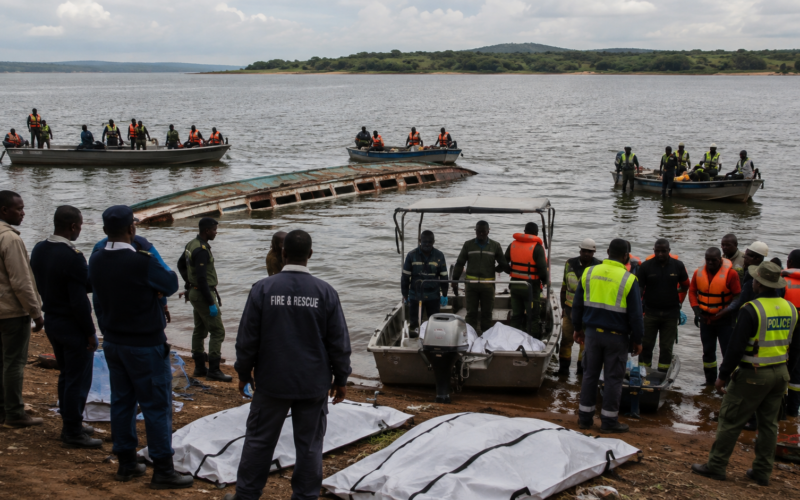
The death toll from Zimbabwe’s Lake Kariba ferry disaster has risen to 68 after rescuers recovered another 22 bodies on August 15, intensifying scrutiny of why an apparently overloaded government-operated passenger vessel was allowed to cross one of Africa’s largest lakes during dangerous weather.
Zimbabwe Republic Police confirmed the revised casualty figure four days after the ferry capsized on August 11. Investigators believe the vessel was overloaded when it overturned during heavy winds on Lake Kariba, which forms part of Zimbabwe’s northern border with Zambia.
Eighteen children are now among the confirmed dead, according to Associated Press reporting based on police information. Sixteen of those children were aged 10 or younger, and the youngest victim was only one year old. The scale of the child casualties had not been apparent during the first hours of the emergency because young children below ticketing age were not necessarily included in passenger records.
The precise number of people aboard remains uncertain. Zimbabwe’s Civil Protection Unit initially identified 114 ticketed adult passengers and five crew members, already exceeding the ferry’s stated capacity of 90. One surviving crew member responsible for ticketing later said he counted 153 people aboard when infants and other passengers were included.
Authorities say 77 people were rescued. With 68 confirmed deaths, those figures account for 145 people, leaving the final passenger manifest and the number, if any, still missing unresolved if the higher 153-person estimate proves correct.
What happened to the passenger ferry on Lake Kariba before 68 people were confirmed dead?
The ferry was travelling from the town of Kariba towards isolated rural and fishing communities around the enormous reservoir when it encountered increasingly rough conditions on August 11.
The vessel provides an important transport connection for communities where roads are poor and conventional public transport is limited. The journey across Lake Kariba can take around five hours, making the ferry considerably more than a recreational boat for residents who depend on it to reach Kariba town and settlements scattered around the lake.
Survivor accounts indicate that the situation deteriorated after departure. Anyway Chambati, one of two surviving crew members, told Zimbabwe’s state broadcaster that passengers raised concerns as water entered the vessel and goods began falling into the lake. He said some passengers urged the crew to turn back as conditions worsened.
The ferry eventually overturned in strong waves. Some survivors managed to remain on the upturned hull, while emergency footage showed rescue boats approaching the vessel and a helicopter operating above the lake. A specialist underwater rescue team was subsequently deployed as authorities realised that the initial death toll substantially understated the scale of the disaster.
Police initially reported a much smaller number of deaths, but body recoveries drove the toll to 44 by August 12. Two days later it reached 46, and the recovery of another 22 bodies announced on August 15 pushed the confirmed toll to 68.

How overloaded was the Lake Kariba ferry and why is the true passenger count still uncertain?
The available figures indicate that the ferry was carrying substantially more people than its stated design capacity.
Authorities say the vessel was built to accommodate 90 people. The Civil Protection Unit could confirm 114 adult passengers through ticket sales, plus five crew members, meaning at least 119 people were known to have boarded even before unticketed children were considered.
Chambati provided a significantly higher estimate. As the crew member responsible for ticketing, he said he counted 153 people aboard when crew members and infants were included. AP reported on August 15 that estimates still placed the possible number aboard as high as 153.
If that figure is correct, the vessel would have been carrying around 63 people above its 90-person capacity, equivalent to approximately 70% more people than its stated limit.
The precise figure remains difficult to verify because children below ticketing age were not necessarily represented in passenger records. That became particularly consequential after authorities established that 18 children were among those who died.
The uncertainty also complicates determining when the search can conclusively end. Authorities know how many bodies have been recovered and how many survivors have been identified, but without a definitive passenger manifest they cannot simply subtract those figures from an agreed total to determine how many people remain unaccounted for.
Why are the deaths of 18 children becoming a central part of the Zimbabwe ferry investigation?
The child casualty figure reveals one of the most serious weaknesses in the passenger-accounting system exposed by the disaster.
AP reported that police records identified 18 children among the dead. Sixteen were 10 years old or younger, including a one-year-old child.
During the initial response, officials had explicitly warned that they did not know how many children had been aboard because passengers below ticketing age could be absent from the formal ticket count. That meant the official figure of 114 adult passengers and five crew members never represented a complete manifest.
The problem is significant beyond determining the death toll. Accurate passenger manifests are crucial during maritime emergencies because rescuers need to know how many people they are searching for. When large numbers of children or other passengers are not recorded, authorities can struggle to determine whether everyone has been accounted for even after survivors and bodies have been recovered.
The eventual investigation will therefore have to examine not only whether the vessel exceeded its physical passenger capacity but also how boarding was controlled and how passenger numbers were recorded before departure.
Did passengers warn the ferry crew about the dangerous waves before the Lake Kariba capsize?
Survivor testimony indicates that concerns were raised before the vessel overturned.
Chambati said passengers became alarmed as the ferry began taking on water, with water entering the engine-room area and goods falling overboard. He said people called for the vessel to turn back as the conditions deteriorated.
Another survivor account reported by AP described passengers pleading with the captain to reverse course because of the increasingly powerful waves. The captain ultimately died in the disaster, meaning investigators will have to reconstruct his decisions from surviving crew members, passengers and available operational records.
Local lawmaker Mutsa Murombedzi had also shared footage recorded before departure in which people on shore appeared concerned about whether the ageing ferry could cope with the conditions on the lake.
These accounts raise serious questions, but they do not by themselves establish the legal or technical cause of the accident. Zimbabwe Republic Police says its investigation indicates that the vessel was overloaded and capsized during heavy winds. Determining whether overloading, weather, vessel condition, operational decisions or a combination of factors caused the loss will require a fuller investigation.
Why was a ferry designed for 90 people carrying at least 119 and possibly 153 passengers?
That question is likely to become one of the central accountability issues after the recovery operation.
The ferry was operated by Zimbabwe’s Rural Infrastructure Development Agency, or RIDA, and served communities that have limited transport alternatives. AP described roads serving some rural and fishing settlements as damaged and public transportation as scarce.
Those conditions can create unusually heavy dependence on scheduled ferry services. When residents have few alternatives for reaching Kariba town, pressure can build to accommodate more passengers than a vessel would safely carry.
That explains why demand may have been high but does not answer why an overloaded departure was permitted.
The confirmed ticket records already appear to have exceeded capacity without counting younger children. If 114 adult passengers and five crew members were officially known to be aboard a vessel designed for 90, the potential overloading should not have depended on discovering unticketed passengers after the accident.
Investigators will therefore need to determine who had responsibility for enforcing the capacity limit, whether the vessel had been inspected before departure and whether operational personnel possessed the authority to refuse additional passengers.
How many people survived the Lake Kariba ferry disaster and could more victims still be missing?
The latest Civil Protection Unit figure reported by AP is 77 rescued people.
An earlier police update cited by Reuters had said 67 people were rescued and taken to a primary school for medical attention. The later disaster-management figure is higher, indicating that subsequent rescue accounting identified additional survivors.
Combining 77 survivors with 68 confirmed deaths produces 145 accounted-for people.
That is fewer than the 153 people Chambati said were aboard, which leaves an apparent difference of eight if his count proves accurate. Authorities have not announced that exactly eight people remain missing, however, because the total passenger count itself has not been conclusively established.
This distinction matters. It would be premature to calculate an official missing-person figure simply by treating the 153 estimate as a final manifest.
Search and recovery teams have therefore continued working on the lake as police reconcile passenger information with bodies and survivors.
Why did President Emmerson Mnangagwa declare the Lake Kariba accident a state of disaster?
President Emmerson Mnangagwa declared the accident a state of disaster after the magnitude of the casualties became apparent.
The declaration allows the Zimbabwean government to mobilise extraordinary resources for rescue, recovery and support for affected families. It followed a recommendation from the Civil Protection Unit as the number of people confirmed dead and missing rose sharply after the initial response.
The scale of the operation helps explain the decision. Lake Kariba is enormous, stretching for more than 200 kilometres and reaching approximately 40 kilometres across in some areas. Underwater searching across such an environment requires specialist divers, boats, aviation support and coordination between multiple agencies.
Authorities also face the logistical challenge of supporting survivors and families living in remote communities. Many of the same transport limitations that make residents dependent on the ferry can make emergency response and victim identification more difficult after an accident.
A memorial service has already been held for victims, with images showing rows of coffins as the country confronts what has become one of its deadliest transport disasters in recent years.
Why is Lake Kariba so important to Zimbabwe and Zambia despite its difficult boating conditions?
Lake Kariba is one of southern Africa’s most important pieces of infrastructure as well as a vast inland transport environment.
The reservoir was created when the Zambezi River was dammed during the late 1950s and early 1960s. It is widely described as the world’s largest human-made lake by volume and stretches along the Zimbabwe-Zambia border.
The Kariba Dam is central to electricity generation for both countries, while fishing, tourism and transport support communities along its shoreline and islands.
Its scale also means conditions can resemble those on a much larger natural lake. Strong winds can generate substantial waves, particularly dangerous for overloaded or inadequately maintained vessels.
Lake Kariba has experienced previous fatal boating accidents. In 2014, 26 people, including 24 children, died when a boat capsized on the Zambian side of the lake. Five people drowned in another incident on the Zimbabwean side in 2021, while three people were feared dead following a 2023 capsize.
The August 2026 disaster is substantially deadlier and is likely to renew questions about passenger-vessel regulation on both heavily travelled and more remote lake routes.
What will investigators need to determine after the death toll reached 68?
Zimbabwe Republic Police has already said preliminary investigation points to overloading and heavy winds, but several critical questions remain unanswered.
Authorities need to establish exactly how many passengers boarded, why the vessel exceeded its stated capacity, whether the crew received weather information before departure and what condition the ferry and its safety equipment were in.
Investigators will also need to determine whether adequate life jackets or other flotation devices were available for everyone aboard. Public reporting available by August 15 had not established how many life jackets the vessel carried or whether every passenger had access to one.
Another issue will be the response to deteriorating conditions. Survivor testimony indicates that water entered the boat and passengers requested a return to shore before the ferry capsized. Establishing how long the difficulties continued, whether distress communications were transmitted and whether turning back remained possible will be important to reconstructing the final stage of the voyage.
The government must also examine the broader operating system that permitted more ticketed adults and crew aboard than the vessel’s stated capacity even before additional children were counted.
What are the key takeaways from Zimbabwe’s Lake Kariba ferry disaster as the death toll reaches 68?
- Zimbabwe Republic Police says the confirmed death toll from the August 11 Lake Kariba ferry disaster has reached 68 after another 22 bodies were recovered on August 15.
- Eighteen children are among those killed. Police information reported by AP shows 16 of the child victims were aged 10 or younger, with the youngest only one year old.
- The passenger ferry had a stated capacity of 90 people, but authorities could confirm at least 114 ticketed adult passengers and five crew members aboard. A surviving crew member estimated the actual total at 153 once infants and other passengers were included.
- Zimbabwe’s disaster-management authorities say 77 people were rescued. The final number missing remains uncertain because officials still do not have a definitive passenger manifest.
- Investigators believe the ferry was overloaded when it capsized during heavy winds and strong waves while travelling from Kariba town towards rural and fishing communities around Lake Kariba.
- Survivors said passengers became alarmed as water entered the vessel and urged the crew to turn back before it overturned. The captain was among those who died.
- President Emmerson Mnangagwa declared the incident a state of disaster, allowing additional national resources to be mobilised for the response and support for victims.
- The investigation is now likely to focus on passenger-capacity enforcement, the lack of a complete manifest, the vessel’s condition, weather decisions and whether the ferry had sufficient safety equipment for everyone aboard.
Why the Lake Kariba disaster is increasingly becoming an accountability story rather than only a weather tragedy
Strong winds provide part of the explanation for what happened on Lake Kariba, but the casualty figures emerging four days later make it increasingly difficult to treat the accident simply as an unpredictable encounter with bad weather.
The ferry was designed for 90 people. Authorities already knew from ticket sales that 114 adults and five crew members were aboard, while one surviving crew member puts the actual total at 153 once children and others were included. Even the lower confirmed figure therefore points to a vessel operating well above its stated capacity before it encountered the conditions that ultimately overwhelmed it.
The 18 child deaths make the absence of a complete passenger manifest particularly consequential. Children below ticketing age were not necessarily recorded, leaving emergency teams uncertain about how many people they were searching for after the capsize.
Survivor accounts create a second accountability issue. Passengers reportedly recognised that the situation was deteriorating and urged the crew to turn back as water entered the ferry. Investigators will now have to determine whether there was a realistic opportunity to reverse course and, if so, why that did not happen.
The ferry’s importance to isolated communities also deserves attention. Residents who rely on a five-hour lake journey because roads and public transportation are inadequate may have little practical ability to reject an overcrowded sailing and simply wait for another service.
That turns transport infrastructure into part of the disaster story. Safety regulations are effective only if communities have viable alternatives and operators have enough capacity to move passengers without routinely facing pressure to overload vessels.
With 68 people now confirmed dead, the immediate priority remains recovering any remaining victims and supporting survivors and families. Yet the scale of the loss means Zimbabwe will also face a longer-term question about preventability.
Heavy winds may have capsized the ferry. The investigation must establish why a vessel built for 90 people was apparently allowed onto Lake Kariba with potentially more than 150 aboard when dangerous conditions were already raising concern.
Discover more from Business-News-Today.com
Subscribe to get the latest posts sent to your email.