




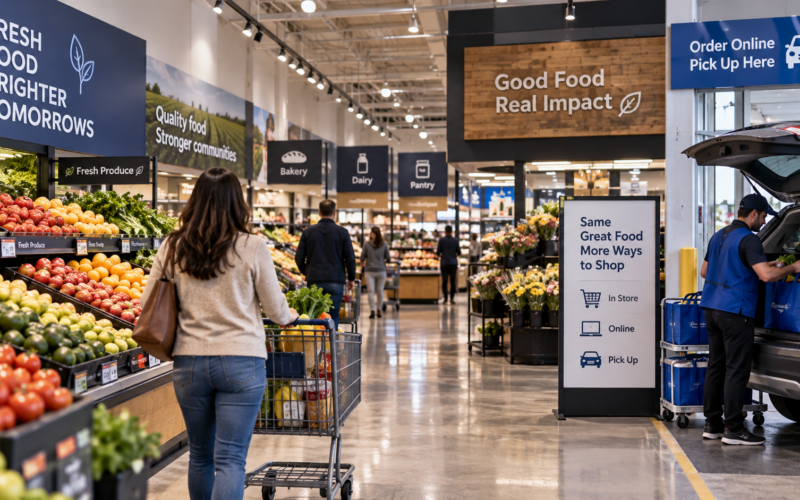
The Kroger Co. (NYSE: KR) has cut its full-year 2026 identical-sales growth forecast excluding fuel to 0.2% to 0.8%, down from the previous 1% to 2% range, after second-quarter identical sales increased only 0.2%. The grocery retailer nevertheless reaffirmed its adjusted earnings and FIFO operating-profit guidance after adjusted earnings per share rose 5% to $1.09, while operating profit increased to $971 million from $863 million a year earlier. Adjusted eCommerce sales increased 20% and Kroger Precision Marketing profit grew 24%, providing two faster-growing profit pools as traditional comparable sales weakened. The tension is therefore less about whether Kroger’s stores are growing quickly and more about whether digital, alternative profit streams and cost controls can preserve earnings while consumers become increasingly cautious.
Total quarterly sales were approximately $34.6 billion, while adjusted FIFO operating profit was $1.076 billion compared with $1.091 billion a year earlier. That means adjusted operating profit actually declined by roughly 1.4% despite the improvement in adjusted EPS, highlighting the contribution from share repurchases and other below-operating-line factors to per-share growth. Kroger also repurchased $1 billion of stock during the quarter and $1.2 billion year to date, leaving approximately $800 million under the board’s existing authorization.
How severe is Kroger’s 2026 sales guidance reduction when viewed through the midpoint?
The old 1% to 2% identical-sales range carried a midpoint of 1.5%, while the new 0.2% to 0.8% range has a midpoint of just 0.5%. On that basis, Kroger has reduced the midpoint of its annual comparable-sales expectation by one full percentage point, or roughly two-thirds. That is a meaningful reset for a business where small changes in same-store sales can materially affect operating leverage across thousands of locations.
The second-quarter result also represents a substantial deceleration from the 3.4% identical-sales growth recorded a year earlier. Kroger said the quarter included an unfavorable 138-basis-point impact from Inflation Reduction Act-related pharmacy changes, while management also cited weaker consumer spending, lower egg prices and disruption linked to a cyclospora outbreak. The combination shows that the slowdown is not attributable to one variable alone, which makes the path back toward stronger comparable growth less straightforward than simply lapping one temporary event.
Chief Executive Officer Greg Foran has made improving sales momentum a priority while simultaneously emphasizing price investment and expense discipline. That creates a difficult retail equation because lowering prices can support traffic but pressure margin if productivity improvements do not offset the investment. Kroger’s decision to retain earnings guidance effectively tells investors that management believes cost and alternative-profit improvements can absorb a weaker sales environment.
The burden of proof now shifts to the second half. Kroger does not need comparable sales to return immediately to 2025 levels to protect guidance, but it needs the new lower range to prove conservative enough that additional consumer weakness does not trigger another reset.
Why are eCommerce and Kroger Precision Marketing becoming more important to the equity story?
Adjusted eCommerce growth of 20% is dramatically faster than the 0.2% increase in identical sales, meaning Kroger continues to shift a larger portion of customer activity into digital channels even as aggregate grocery demand remains restrained. The company has also spent several years restructuring fulfillment around its stores after stepping back from parts of its centralized automated-delivery strategy. If store-based fulfillment can sustain digital growth with better unit economics, eCommerce can become a contributor to margin rather than a permanent drag.
Kroger Precision Marketing offers a different type of economics. Retail media allows brands to pay Kroger for advertising and customer targeting based on shopping data, creating a revenue stream that does not require the same inventory, distribution and store-labor costs as selling another physical grocery item. Profit growth of 24% therefore matters disproportionately even though Kroger does not disclose enough segment detail to value the business independently.
This is why weak comparable sales do not automatically translate into equivalent earnings deterioration. Kroger increasingly operates as a combination of food retailer, digital fulfillment platform, pharmacy network and retail-media business, with each component carrying a different margin profile.
The risk is that alternative profits cannot compensate indefinitely for weak core retail. Grocery traffic and customer loyalty still provide the data and shopping activity on which Kroger’s higher-margin businesses depend, so sustainable value creation requires both sides of the model to remain healthy.
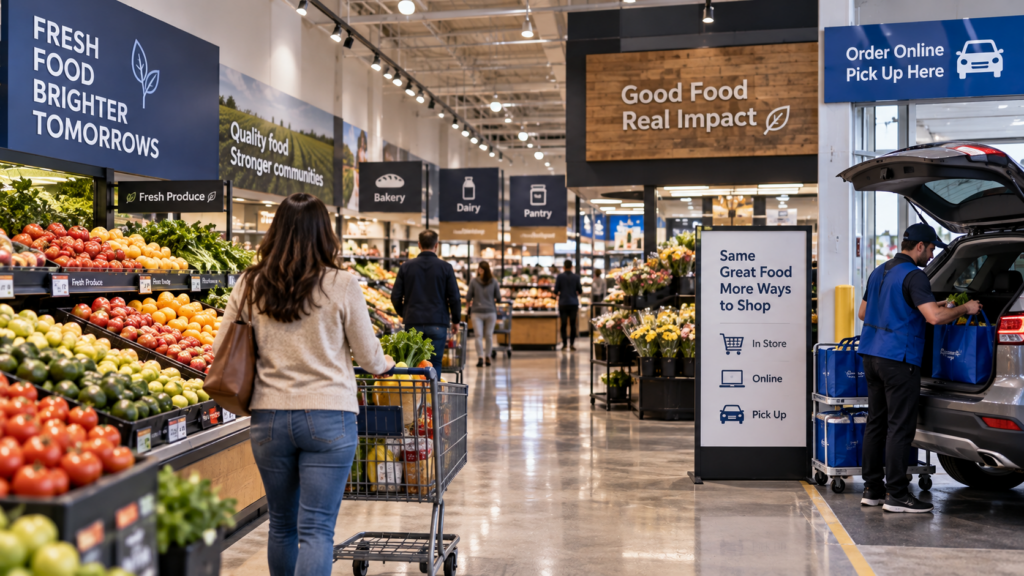
How much financial flexibility does Kroger retain after $1.2 billion of year-to-date buybacks?
Kroger ended the quarter with net total debt to adjusted EBITDA of 1.91 times, up from 1.63 times a year earlier but still below management’s target range of 2.3 to 2.5 times. That leaves the company operating with less leverage than its stated long-term framework even after substantial share repurchases.
Management increased the dividend by 11% earlier in the year, marking a twentieth consecutive annual increase, while simultaneously buying back $1 billion of shares during the second quarter. The remaining $800 million repurchase authorization is expected to be completed during fiscal 2026, creating another potential source of EPS support even if absolute operating income remains relatively flat.
There is nevertheless a capital-allocation tension. Every dollar spent on buybacks cannot also fund store renovation, pricing investment, digital technology or acquisitions, and a lower share count is most valuable when underlying earnings remain durable.
Kroger’s current leverage provides room to continue balancing those priorities. A further deterioration in sales or margins, however, would make aggressive shareholder returns harder to justify without weakening the financial cushion.
Why did Kroger shares recover despite the weaker sales forecast?
Kroger shares initially weakened before the market opened after investors saw the lower comparable-sales forecast, but the stock subsequently moved higher as the session progressed. Reuters reported a roughly 3% gain as investors focused on the adjusted EPS beat, unchanged profit outlook and evidence that cost discipline was containing the impact of weaker consumer demand.
The reaction is revealing because guidance cuts normally pressure retail stocks. In Kroger’s case, the market appears to have distinguished between weaker revenue momentum and a deterioration in earnings capacity.
That interpretation will be tested quickly. If Kroger can maintain $5.0 billion to $5.2 billion of adjusted FIFO operating profit despite comparable sales near the bottom of the revised range, the company will have demonstrated a more resilient earnings model. If profit guidance eventually follows sales guidance lower, the September share response may prove premature.
The next two quarters therefore become an operating-discipline test for Greg Foran. Investors have effectively given Kroger some credit for protecting earnings through a difficult sales quarter, but stronger traffic and basket trends will still be needed to make the recovery sustainable.
Key takeaways on Kroger’s second-quarter 2026 results
- Kroger’s identical sales excluding fuel increased only 0.2%.
- Full-year identical-sales guidance was lowered from 1% to 2% to 0.2% to 0.8%.
- The midpoint therefore fell from 1.5% to 0.5%, a reduction of roughly two-thirds.
- Adjusted EPS increased 5% to $1.09.
- Adjusted FIFO operating profit was $1.076 billion, slightly below the prior-year period.
- Adjusted eCommerce sales increased 20%.
- Kroger Precision Marketing profit increased 24%.
- Kroger repurchased $1 billion of stock during the quarter and $1.2 billion year to date.
- Net leverage was 1.91 times versus a 2.3 to 2.5 times target range.
- Profit protection and sales reacceleration are now the two separate tests facing management.
Discover more from Business-News-Today.com
Subscribe to get the latest posts sent to your email.


