

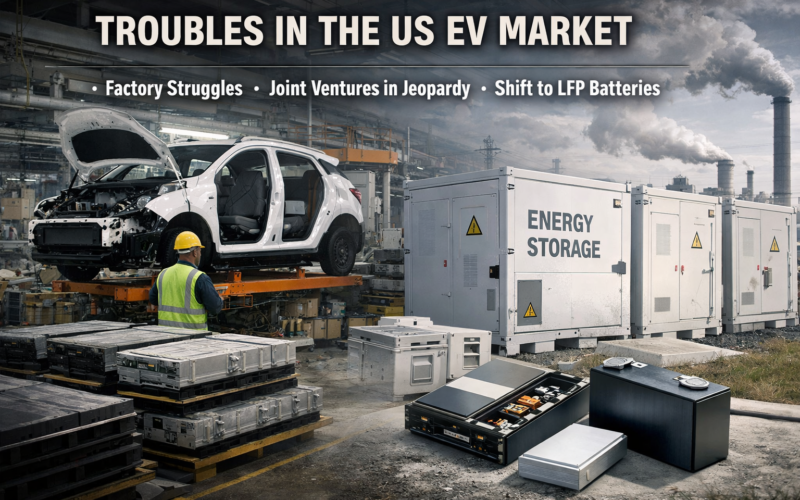
South Korea’s three dominant battery manufacturers — LG Energy Solution (KRX: 373220), Samsung SDI (KRX: 006400), and SK On, the battery subsidiary of SK Innovation (KRX: 096770) — are executing a structural pivot in their North American operations as the collapse of the US battery electric vehicle market forces a fundamental reassessment of the combined US$45 billion investment programme the trio committed to the region between 2021 and 2025. US BEV sales fell by an estimated 28 percent in the first two months of 2026 to around 135,000 units, following the discontinuation of the consumer tax credit worth up to US$7,500 per purchase at the end of September 2025. S&P Global Mobility data showed American EV registrations in January 2026 were down 41 percent over January 2025, as the loss of federal incentives and weakening consumer interest pushed automakers back toward petrol and hybrid platforms. The Korean trio entered this downturn carrying enormous fixed-cost burdens from newly built North American giga-factories and are now pursuing a three-pronged survival strategy: dissolving or restructuring loss-making joint ventures with US automakers, converting idle EV production lines to battery energy storage systems (ESS), and accelerating entry into lithium iron phosphate chemistry to compete in the grid storage market that Chinese rivals have long dominated.
Why the dissolution of Korean battery joint ventures with US automakers signals a structural rather than cyclical reset
A significant proportion of the financial charges announced by US automakers relate to reducing their exposure to battery manufacturing, mainly by exiting joint ventures with South Korean companies or by transferring ownership of jointly owned plants to their partners. The scale of those charges is without precedent in the modern automotive industry. Ford announced over US$19 billion in special charges as it cut back its BEV programme; GM booked a US$8 billion charge to scale back its US BEV operations; Stellantis announced a US$26 billion charge for the second half of 2025 to reverse its aggressive BEV strategy; and Honda announced a US$16 billion charge mostly to cover restructuring costs after cancelling three BEV models. For the Korean manufacturers, the unravelling of these joint ventures arrives at the worst possible time: plants built to serve anchor customers are now operating at sharply reduced utilisation rates, accelerating cash consumption at firms already absorbing losses through the slower-than-expected EV ramp.
The joint venture unwinding follows distinct paths for each Korean firm. GM agreed last December to sell its share in a near-completed Lansing, Michigan plant back to LG Energy Solution, and has also reduced its purchasing commitments from the Ultium Cells joint venture, though the Indiana Samsung SDI joint venture remains in place in scaled-back form. Ford and SK On agreed to dissolve their BlueOval SK battery joint venture, dividing the assets, with Ford taking control of two plants in Kentucky and SK On retaining the Tennessee facility. Honda is looking to dissolve its L-H Battery Company joint venture with LG Energy Solution after significantly cutting its BEV programme. The consequence of these dissolutions is that Korean manufacturers now hold full ownership or operating control of additional large-format North American plants with no committed anchor customer to fill them, a liability that simultaneously represents both a solvency risk and, if redirected effectively, a competitive asset in the emerging ESS market.
How grid-scale energy storage is absorbing the capacity that the US BEV market can no longer fill
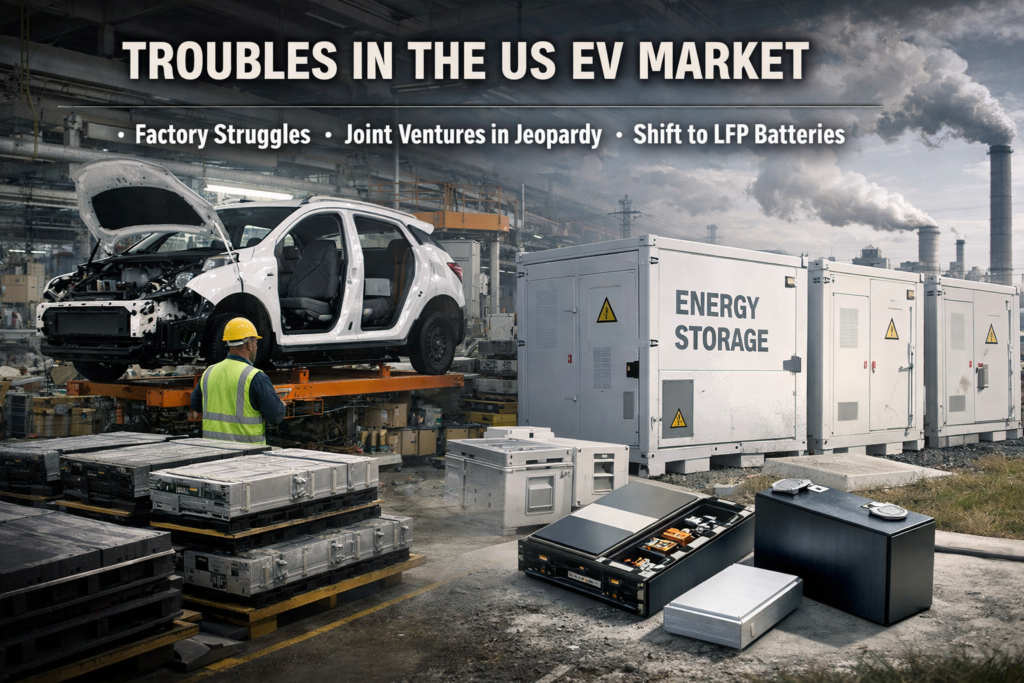
The pivot to ESS is not a theoretical hedge; it is now the primary operational priority for all three Korean firms. LG Energy Solution recorded an operating loss of KRW 122 billion for the October to December 2025 period, an improvement from a KRW 226 billion loss in the same quarter of 2024, driven by robust BESS sales in North America. The company noted that without Inflation Reduction Act tax credits, its loss would have widened to KRW 455 billion. That dependency on IRA manufacturing credits, distinct from the consumer purchase credits that expired, remains a structural support for Korean manufacturers, though one that carries its own policy risk under the current administration. LG Energy Solution expects global ESS installations to grow more than 40 percent in 2026, with North America accounting for roughly half of total battery demand, and aims to secure more than 90 GWh in new ESS orders primarily through large-scale, long-term contracts with key utilities and developers. To meet this demand, the company plans to increase global ESS production capacity to over 60 GWh, with more than 80 percent located in North America, scaling up standalone facilities in Holland and Lansing, Michigan, while temporarily utilising production lines from joint ventures with Stellantis and Honda for ESS output.
Samsung SDI announced it will convert some EV production lines at its Indiana plant to produce ESS batteries, responding to sharp drops in battery demand from Stellantis. LG Energy Solution signed a US$4.3 billion agreement with Tesla Energy in 2025 to supply LFP cells through 2030 for Megapack battery storage systems. SK On locked in 7.2 GWh with Flatiron Energy Development for containerised storage units starting late 2026. US grid-storage installations hit 5.6 GW in Q2 2025, a quarterly record, and Chinese battery imports face tariffs and regulatory scrutiny, giving Korean manufacturers, which have factories on American soil and existing customer relationships, a structural opening they did not have when competing purely in the EV supply chain.
Why the LFP chemistry transition represents the hardest part of the Korean pivot
The move into lithium iron phosphate production is where the Korean manufacturers face their most acute structural challenge. LG Energy Solution and Samsung SDI plan to install LFP production lines at their respective US plants co-owned with General Motors, marking the Korean battery makers’ foray into LFP production after years of focus on high-nickel-cobalt-manganese chemistries. The move reflects mounting pressure from GM to lower EV costs, with analysts suggesting it could redefine the market’s structure into a two-tiered system: LFP for mass-market vehicles and NCM for premium offerings. The chemistry shift is commercially logical; LFP cells are cheaper to produce, thermally safer, and better suited to stationary storage applications where energy density is less critical than cycle life and cost per kilowatt-hour. The problem is that the entire LFP supply chain, from cathode precursors to manufacturing equipment, was built in China over decades by Chinese firms that have no incentive to transfer it.
Beijing’s export controls, introduced in 2025, restrict shipments of advanced cathode materials and some manufacturing equipment used to produce LFP cells. Korean cell plants opening in 2025 and 2026 need cathode material now to ramp production and fulfil customer commitments, but most non-Chinese cathode projects will not reach volume production until 2027 or 2028. SK On signed a memorandum of understanding with L&F for LFP cathode supply to North America. LG Chem is building LFP cathode capacity in Morocco through a joint venture, targeting phosphate rock from local mines, though it will need to demonstrate FEOC compliance. These arrangements are necessary but insufficient: they address the supply question in principle without resolving the timeline mismatch between when Korean plants need cathode material and when non-Chinese sources can reliably provide it at scale.
What the SNE Research global market share data reveals about the Korean competitive position
SNE Research data covering the first ten months of 2025 showed the combined market share of LG Energy Solution, Samsung SDI, and SK On fell to 16.0 percent, a 3.5 percentage point decline year on year. LG Energy Solution experienced growth from strong Kia EV3 and Chevrolet EV model sales but faced headwinds from declining Tesla-related battery usage. SK On benefited from steady Hyundai, Volkswagen, and Ford EV sales, while Samsung SDI struggled with reduced demand from Rivian and competition from Gotion’s LFP batteries. Against this, CATL retained its top position with 355.2 GWh usage, growing 36.6 percent year on year, supported by partnerships with Tesla, BMW, and Mercedes-Benz. The market share erosion compounds the financial pressure: Korean firms are simultaneously absorbing charges from JV dissolutions, carrying underutilised fixed-cost capacity, and watching Chinese rivals strengthen their hold on the fastest-growing battery segment globally.
The Korea Times reported that all three Korean battery manufacturers are estimated to have posted operating losses in the fourth quarter of 2025, as drastic declines in capacity utilisation rates at US plants weighed on earnings. The scale of those losses varies by firm and by the exposure each had to the specific US OEM relationships that have since collapsed, but none of the three is in a position to absorb extended losses without accelerating the ESS and LFP pivots to generate revenue from the capacity they have already built.
How the hybrid vehicle surge complicates the Korean recovery thesis
A consequence of the BEV contraction that receives insufficient attention is what the shift toward hybrid vehicles means for Korean battery economics. While demand has shifted significantly to hybrid electric vehicles, these vehicles use batteries that are much smaller and less critical than those used for BEVs. Conventional hybrid market share reached 13.9 percent in Q1 2026, up 1.7 percentage points year on year, with hybrid sales volume increasing 7.8 percent over the same period. Hybrids represent volume without value for large-format cell manufacturers. A BEV may carry 60 to 100 kWh of battery capacity; a conventional hybrid typically carries between 1 and 2 kWh. The revenue per vehicle for a Korean cell supplier drops by an order of magnitude, meaning that even a substantial increase in hybrid sales cannot compensate for the BEV volumes lost. This dynamic reinforces the strategic logic of the ESS pivot: grid storage requires large-format cells in high volumes, preserving the manufacturing economics that Korean firms built their North American capacity around.
S&P Global Mobility projects a notable downshift in BEV sales and market share through the first half of 2026, with BEV share of sales estimated at 5.2 percent in March 2026. Cox Automotive expects 2026 EV sales to reach approximately 1.3 million units at around 8.5 percent market share, roughly flat year on year, suggesting the demand floor has been found but that meaningful recovery is not imminent. For Korean battery manufacturers whose North American investment case was built on a trajectory to far higher BEV penetration, that forecast represents a prolonged period of structural overcapacity with no near-term resolution.
Key takeaways: What the Korean battery pivot means for North American energy supply chains in 2026 and beyond
- LG Energy Solution, Samsung SDI, and SK On committed a combined US$45 billion to North American battery production between 2021 and 2025, a bet now fundamentally challenged by the collapse of the US BEV market following the removal of federal purchase incentives.
- US BEV registrations fell 28 percent year on year in Q1 2026 to 212,600 units, with the market contraction broadly attributed to the expiry of the US$7,500 consumer tax credit at the end of September 2025.
- The JV unwinding between Korean battery firms and US automakers, encompassing LG Energy Solution with GM and Honda, SK On with Ford, and Samsung SDI with GM, transfers plant ownership and financial risk back to Korean balance sheets while removing committed anchor customer volume.
- LG Energy Solution is targeting more than 90 GWh in new ESS orders in 2026, with North America representing more than 80 percent of its planned ESS production capacity expansion.
- Samsung SDI is converting Indiana EV lines to ESS production; LG Energy Solution has secured a US$4.3 billion LFP cell supply agreement with Tesla Energy for Megapack systems; SK On has locked in a 7.2 GWh ESS supply deal with Flatiron Energy Development.
- Beijing’s 2025 export controls on LFP cathode materials and manufacturing equipment create a critical supply gap for Korean firms whose new LFP production facilities need cathode inputs before non-Chinese sources reach volume production in 2027 or 2028.
- The combined global EV battery market share of the three Korean firms fell to 16.0 percent in January to October 2025, a 3.5 percentage point year-on-year decline, as CATL extended its dominance with 36.6 percent growth over the same period.
- The hybrid vehicle surge, while substantial, does not compensate for lost BEV revenue given the order-of-magnitude difference in battery capacity between a BEV and a conventional hybrid, reinforcing the strategic necessity of the ESS pivot.
- IRA manufacturing tax credits remain the critical financial bridge for Korean manufacturers: LG Energy Solution’s Q4 2025 operating loss would have been nearly four times larger without them, making the credits’ survival under the current administration a key variable in the recovery timeline.
- The Korean battery situation exemplifies a broader structural triangulation in global battery competition: the US wants domestic production but lacks the industrial base; China has the most efficient supply chain but faces regulatory and tariff barriers; Korea has manufacturing capacity and customer relationships but depends on Chinese materials and faces a compressed timeline that no single policy can fully resolve.
Discover more from Business-News-Today.com
Subscribe to get the latest posts sent to your email.