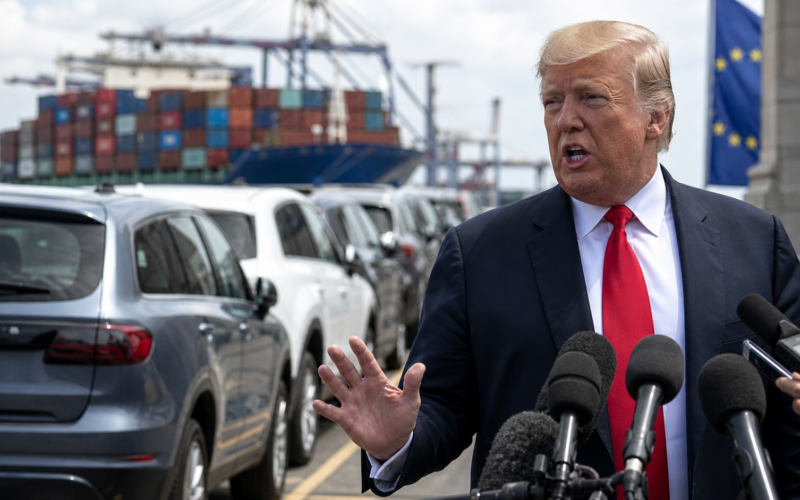
United States President Donald Trump announced on Friday, May 1, 2026, that he will increase tariffs on cars and trucks imported from the European Union to 25 per cent from next week, accusing the European Union of failing to comply with the bilateral trade agreement signed between the two sides in July 2025. The announcement was made through a post on the social media platform Truth Social and confirmed in remarks to reporters as Donald Trump departed the White House for Florida. The move would raise the existing 15 per cent tariff ceiling on European Union autos and parts by ten percentage points and reopen one of the most contested fronts in transatlantic trade.
What did Donald Trump announce in the Truth Social post on European Union car and truck tariffs?
In the Truth Social post, Donald Trump stated that based on the fact that the European Union was not complying with the fully agreed trade deal, he would be increasing tariffs charged to the European Union for cars and trucks coming into the United States, and that the tariff would be increased to 25 per cent. Donald Trump added that automakers producing cars and trucks in plants located inside the United States would face no tariff, and claimed that more than 100 billion United States dollars was currently being invested in new American automobile and truck manufacturing plants, calling it a record expansion in the sector. Donald Trump did not specify what tariff authority he intended to invoke and did not provide detailed examples of how the European Union had failed to comply with the existing trade framework. Speaking to reporters before departing the White House, Donald Trump said that the European Union, as usual, was not adhering to the trade framework agreed last year and added that the shift to higher tariffs would force European Union automakers to move their factory production to the United States much faster.
The announcement signals an escalation in a tariff regime that has shifted multiple times since Donald Trump returned to office in January 2025, and it sits inside a wider American policy push to use import duties as a permanent lever of industrial policy rather than as a temporary negotiating tool. The European Union has now been pulled into the same uncertainty that Canada, Mexico, and several Asian trading partners have faced over the past year, where headline trade frameworks coexist with the unilateral right of the White House to alter rates by social media post.

How does the Turnberry Agreement signed by Donald Trump and Ursula von der Leyen frame the current dispute?
Donald Trump and European Commission President Ursula von der Leyen agreed to the bilateral trade framework in July 2025, with the deal struck at Trump Turnberry, Donald Trump’s golf course on the west coast of Scotland. The agreement, known as the Turnberry Agreement, set a tariff ceiling of 15 per cent on most goods exported from the European Union to the United States, including cars and parts, and was presented at the time as a comprehensive reset of transatlantic trade relations. The 15 per cent rate represented a reduction from the 25 per cent Section 232 tariff that the Trump administration had imposed on foreign autos in March 2025 under Section 232 of the Trade Expansion Act of 1962, which allows the United States Secretary of Commerce to recommend tariff adjustments on imports judged to threaten national security.
The Turnberry Agreement covered a much wider trade relationship than autos alone. Several contentious issues, including steel duties, green industrial subsidies, and electric vehicle incentives, were left unresolved at signing and have remained sources of friction throughout the implementation phase. The agreement was widely viewed at the time as a temporary compromise rather than a permanent settlement, with European officials privately describing it as a holding measure designed to remove an immediate tariff threat while a more durable framework was negotiated. The 15 per cent ceiling applied to a trading relationship of significant scale: according to Eurostat, the European Union statistics agency, the value of European Union and United States trade in goods and services amounted to 1.7 trillion euros in 2024, equivalent to 2 trillion United States dollars, or an average of 4.6 billion euros a day. The European Union had said it expected the bilateral deal would save European automakers between 500 million and 600 million euros a month, equivalent to between 585 million and 700 million United States dollars.
How has the European Commission responded to Donald Trump’s tariff escalation announcement?
The European Commission responded to the announcement through a spokesperson who said the European Union has been implementing its commitments in line with standard legislative practice and has been keeping the United States administration fully informed throughout the process. The spokesperson said the European Union remains fully committed to a predictable, mutually beneficial transatlantic relationship, but added that should the United States take measures inconsistent with the Joint Statement, the European Union will keep its options open to protect European Union interests. The spokesperson also said the European Union maintains close contact with United States counterparts as it seeks clarity on United States commitments. The phrasing about keeping options open to protect European Union interests is the standard formulation Brussels uses to signal that retaliatory tariffs or other countermeasures remain on the table without committing to specific action.
A White House official said in a separate statement on Friday that the European Union has failed to make substantial progress on its agreed-upon commitments under the trade agreement between the two sides. The official added that the White House has always been clear that the president reserves the right to adjust tariff rates if trade deal partners fail to abide by their commitments. The two statements together establish a familiar pattern in transatlantic trade disputes: each side publicly insisting it has met its obligations and accusing the other of bad faith implementation, while the underlying technical disagreements over exact compliance benchmarks remain unspecified in public communications.
The European Commission had previously stated in February 2026, following the United States Supreme Court ruling on Donald Trump’s tariff authority, that a deal is a deal, and that as the largest trading partner of the United States, the European Union expected the United States to honour its commitments set out in the Joint Statement. Bernd Lange, a German Member of the European Parliament who chairs the European Parliament’s trade committee and is leading negotiations on the implementation of the deal with European Union member states, criticised Donald Trump’s announcement as showing clear unreliability. Bernd Lange accused the United States of repeatedly breaking its commitments in trade relations with the European Union, citing the expanded 50 per cent metals tariffs introduced in August. Bernd Lange indicated that the European side remained on track to ratify the trade deal, with the European Parliament expected to complete its work on the agreement in June.
Why did the United States Supreme Court ruling in February 2026 destabilise the Turnberry Agreement?
The status of the Turnberry Agreement had first been cast into doubt earlier in 2026 after the United States Supreme Court ruled in February that Donald Trump lacked the legal authority to declare an economic emergency and impose tariffs on European Union goods under the International Emergency Economic Powers Act. The Supreme Court ruling struck down a significant portion of Donald Trump’s tariff agenda, forcing the administration to identify alternative legal authorities to maintain duties on imports. Following the Supreme Court ruling, the Trump administration imposed a 10 per cent blanket global tariff under Section 122 of the Trade Act of 1974, and the original 15 per cent tariff ceiling on European Union goods was effectively reduced to 10 per cent for the categories where Section 122 applied.
The Trump administration is currently in the middle of investigations on trade imbalances and national security risks with a view to imposing a new tariff regime, and these investigations are widely expected to provide the legal basis for the 25 per cent auto tariff announcement. Section 232 of the Trade Expansion Act of 1962, which allows for duties on national security grounds, has become the preferred instrument for the Trump administration since the Supreme Court ruling, because it survives the legal scrutiny that defeated the International Emergency Economic Powers Act framework. The legal uncertainty has created a structural problem for European Union ratification: each time Brussels prepares to finalise its side of the agreement, the legal basis on the United States side shifts, leaving the European Parliament negotiating with a moving target.
Which European automakers face the largest exposure to a 25 per cent United States tariff on cars and trucks?
The European automakers expected to be most affected by the increased tariff rate are Volkswagen Group, BMW Group, and Mercedes-Benz Group, all of which import a significant percentage of vehicles sold in the United States from production plants in Europe. Germany would likely be hit hardest by a sharp tariff on cars and parts, as Germany is responsible for a significant amount of European Union auto exports to the United States. Luxury brands and premium vehicle manufacturers face the most concentrated exposure, because many high-end models sold in the United States are still imported from Europe rather than built locally. The Mercedes-Benz C-Class and Mercedes-Benz S-Class are European-built models sold in the United States, and the BMW 7 Series is also imported from Germany.
The timing is particularly difficult for BMW Group, which is preparing to launch the all-new BMW iX3 electric crossover. The BMW iX3 is built at the new BMW plant in Debrecen, Hungary, which began operations last year as the company’s most advanced production facility. Hungary is a European Union member state, which places the BMW iX3 directly within the scope of the new tariff. The BMW iX3 50 xDrive starts at approximately 70,900 euros in Germany following a recent price adjustment, and BMW Group is scheduled to announce United States pricing for the BMW iX3 on May 6, 2026. A 25 per cent tariff applied to a vehicle in the 60,000 United States dollar range, where the BMW iX3 is expected to be positioned, represents a substantial cost increase that BMW Group will have to absorb, pass through to buyers, or split between the two.
Volkswagen Group, BMW Group, Mercedes-Benz Group, and Volvo Cars all operate large manufacturing plants inside the United States, which provides partial insulation from the new tariff. BMW Group manufactures the BMW X5, BMW X6, BMW X7, and BMW XM at its Spartanburg plant in South Carolina. Volkswagen Group is also building a new facility in Blythewood, South Carolina, to produce the Scout Terra truck and the Scout Traveler sport utility vehicle under the revived Scout Motors brand. The Ineos Grenadier, by contrast, imports all its vehicles from France, leaving the brand with no domestic production buffer. Donald Trump told reporters on Friday that he believed the shift to higher tariffs would force European Union automakers to move their factory production to the United States much faster, although industry analysts have noted that constructing new automotive plants typically takes several years and that increased import costs are most likely to be passed on to consumers in the short term.
What broader economic and geopolitical context surrounds the new 25 per cent United States tariff on European Union cars and trucks?
The tariff announcement arrives at a particularly fragile moment for the global economy. The Iran war, which began with United States and Israel strikes at the end of February 2026, has crushed expectations of economic growth and pushed inflation higher, as oil and natural gas prices have risen sharply due to the effective closure of the Strait of Hormuz. A 25 per cent tariff on European Union autos applied on top of a war-driven energy shock is expected to compound inflationary pressure in the United States, where European-built vehicles command a meaningful share of the premium and luxury segments.
The escalation also comes against a backdrop of sharply deteriorating diplomatic ties between Donald Trump and several European leaders. On Thursday, Donald Trump renewed criticism of German Chancellor Friedrich Merz, telling Friedrich Merz to focus on ending the Ukraine war rather than interfering on Iran. Donald Trump also referred to European allies Spain and Italy as absolutely horrible for refusing to participate in the Iran war. The auto tariff announcement followed within twenty-four hours of those remarks, and the timing has reinforced the perception in European capitals that trade decisions are being driven by broader geopolitical disagreements rather than narrow technical compliance issues. The Trump administration has previously imposed 25 per cent Section 232 tariffs on foreign autos in March 2025 before lowering them under the Turnberry Agreement framework, and the current threat effectively returns the relationship to the pre-Turnberry tariff posture while leaving the wider deal nominally in place.
The cumulative tariff burden across the global automotive industry has become substantial. Tariffs on imported vehicles and auto parts have cost automakers tens of billions of United States dollars since their implementation in 2025, with major Japanese, European, and Detroit-based manufacturers each absorbing significant impacts. A further 25 per cent rate on European Union autos would push the cost burden higher at a moment when the industry is also navigating the electric vehicle transition, the post-Supreme Court tariff refund process, and supply chain relocations triggered by earlier rounds of trade policy.
What are the key takeaways from Donald Trump’s 25 per cent tariff announcement on European Union cars and trucks?
- Donald Trump announced on May 1, 2026 that tariffs on European Union cars and trucks will rise from 15 per cent to 25 per cent from next week, citing alleged non-compliance with the Turnberry Agreement.
- The European Commission responded that the European Union has been implementing its commitments in line with standard legislative practice and warned it will keep options open to protect European Union interests.
- Volkswagen Group, BMW Group, and Mercedes-Benz Group carry the largest exposure to the new tariff, with Germany responsible for a significant share of European Union auto exports to the United States.
- The Turnberry Agreement signed by Donald Trump and Ursula von der Leyen in July 2025 set a 15 per cent ceiling on most European Union goods, but was destabilised after the United States Supreme Court struck down the International Emergency Economic Powers Act tariff authority in February 2026.
- The European Parliament, with Bernd Lange leading negotiations, remains on track to ratify the trade deal in June, even as the United States moves to raise auto tariffs through Section 232 of the Trade Expansion Act of 1962.
Discover more from Business-News-Today.com
Subscribe to get the latest posts sent to your email.