




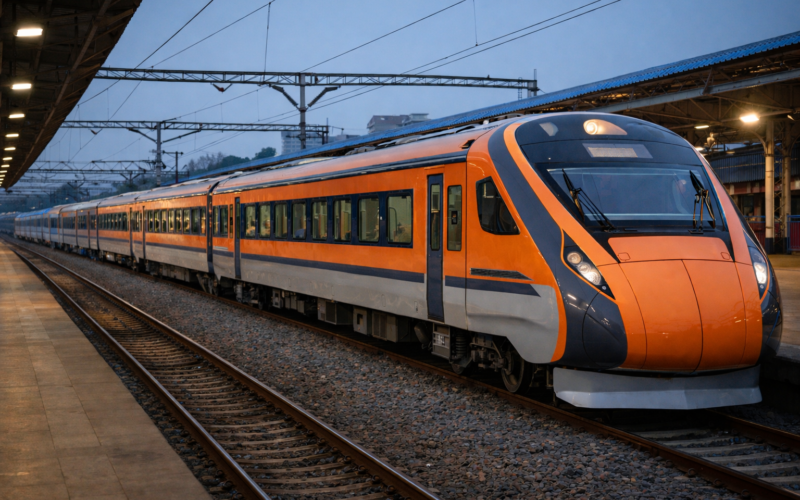
Indian Railways has approved a new Vande Bharat sleeper train between KSR Bengaluru and Chhatrapati Shivaji Maharaj Terminus, marking a planned expansion of premium overnight rail travel between two of India’s largest economic centres. The approval was communicated in a letter dated April 5 by Railway Minister Ashwini Vaishnaw to P. C. Mohan, and multiple reports said the full schedule, route details, stoppages, fare structure, and launch timeline are still to be announced.
Why does the Bengaluru-Mumbai Vande Bharat sleeper approval matter for Indian Railways now?
The approval matters because it extends the Vande Bharat brand further into the long-distance overnight segment, where Indian Railways is trying to combine speed, premium amenities, and higher passenger comfort on routes that have historically depended on slower mail and express services. Reports on the new service described it as the second Vande Bharat sleeper corridor in the country, after the first sleeper service began operating earlier in 2026 between Howrah and Kamakhya. Official and media reporting also linked the Bengaluru-Mumbai approval to a broader railway push to scale up sleeper trainsets by the end of 2026.
That wider context matters because the Bengaluru-Mumbai corridor is not just another city-pair announcement. Bengaluru and Mumbai are major business, technology, financial, and logistics hubs, and overnight rail connectivity between them carries significance for both routine passenger demand and the symbolic expansion of India’s modern train programme. The route sits in a category where the railway system is no longer competing only on basic mobility. It is also competing on time compression, predictability, and the quality of the travel experience.

What exactly has Indian Railways confirmed on the Bengaluru-Mumbai Vande Bharat sleeper route so far?
What is confirmed is narrower than the headline excitement might suggest. Current reporting indicates that the approved service will run between KSR Bengaluru and Chhatrapati Shivaji Maharaj Terminus, and that the approval was formally conveyed in writing by Ashwini Vaishnaw after discussions regarding a sleeper train between Bengaluru and Mumbai. Reports also said the train is likely to be operated and maintained by the South Western Railway zone.
What has not yet been officially detailed in public reporting is just as important. The exact route alignment, intermediate stops, total journey time, launch date, and fare structure have not been finalised in the reports now in circulation, or at least have not yet been publicly disclosed. Some reports suggested a likely operating time of around 16 to 18 hours, while others cited 17 to 18 hours, but those figures remain tentative until Indian Railways releases a formal timetable.
That distinction is worth making clearly. Approval of a service and operational notification of a service are not the same thing. For passengers, the difference is simple: the train now exists as an approved project, but not yet as a fully scheduled booking option. That sounds obvious, but in rail coverage it is the difference between policy movement and travel reality. Right now, Indian Railways has crossed the first threshold, not the last one.
How could the Bengaluru-Mumbai Vande Bharat sleeper change travel time on this corridor?
The case for the new service rests heavily on time savings. Current services between Bengaluru and Mumbai generally take much longer than the tentative travel-time estimates now being discussed for the Vande Bharat sleeper. Times of India reported that the Udyan Express takes 23 hours and 35 minutes from Bengaluru to Mumbai and 21 hours and 50 minutes on the return run, while other services that pass through Bengaluru also remain materially slower than the proposed sleeper timeline. Hindustan Times said current mail and express trains typically take about 20 to 22 hours, while reports around the new service suggested the sleeper could reduce the trip to roughly 16 to 18 hours.
If those estimates hold once the schedule is published, the result would be more than a modest trimming of journey duration. It would reposition rail travel on this corridor closer to the logic of business overnight mobility rather than traditional long-haul endurance travel. That does not mean the train will replace air travel. It does mean Indian Railways would be offering a more credible premium overnight alternative for passengers who value city-centre access, sleep time, and train comfort over airport transfer cycles and hotel-night calculations. That inference follows from the reported time comparisons and the overnight design of the service.
What do reports suggest about route options, stops, and onboard features on the new train?
Reporting on the likely route remains provisional. Hindustan Times cited a railway official as saying a tentative alignment could run from Mumbai via Pune, Solapur, Wadi, Kalburgi and onward to Bengaluru, while Deccan Herald said the route may be considered either via Kalaburagi or via Hubballi, with travel time likely in the 17 to 18 hour range. Because the exact route and stops are still pending, these descriptions should be treated as reported possibilities rather than final operational facts.
What appears more consistent across reports is the trainset profile itself. Multiple outlets described the service as a 16-coach sleeper configuration with capacity for 823 passengers. Reported onboard features include ergonomically designed berths, automatic doors with vestibules, advanced suspension intended to reduce jerks and vibrations, modern toilets, improved soundproofing, and other premium design elements associated with the Vande Bharat sleeper format. Reports also said the train is designed for higher-speed overnight operation, with references ranging up to 160 kilometres per hour in some reports and up to 180 kilometres per hour in others. That variation reflects the difference between designed capability and likely operating conditions, and it underlines why the final timetable will be more meaningful than headline speed claims.
Why is Indian Railways expanding Vande Bharat sleeper services beyond the first corridor?
The Bengaluru-Mumbai approval fits a broader pattern in Indian Railways policy. Official Press Information Bureau material said Indian Railways had already introduced Vande Bharat sleeper service in January 2026, and government-linked reporting around the current story said the railway system aims to roll out more sleeper trainsets by December 2026. Indian Express reported Vaishnaw as saying 12 Vande Bharat sleeper trains, comprising six rakes on each side, are expected to be rolled out by the end of 2026.
The strategy is fairly clear even when stripped of promotional language. Chair-car Vande Bharat trains established the brand in daytime intercity travel. Sleeper variants extend that brand into longer-distance corridors where the selling point is not only faster travel but a more controlled overnight environment. In policy terms, the sleeper model lets Indian Railways test whether premium rail can move from flagship demonstration into broader network relevance. Bengaluru-Mumbai is an important test of that ambition because demand on the corridor is large, diversified, and commercially visible.
There is also a practical lesson from the first corridor. Hindustan Times reported that passengers on the first Vande Bharat sleeper service had raised complaints about food quality and that Indian Railway Catering and Tourism Corporation had sought better onboard meal arrangements, including consideration of a pantry car. That matters because scaling a premium overnight train is not only about sleek interiors and faster timing. It is about whether the service model works for real passengers over long distances.
What remains uncertain before the Bengaluru-Mumbai Vande Bharat sleeper can begin commercial operations?
Several operational unknowns remain. The first is timetable finalisation, which will determine whether the train can truly deliver the projected time reduction while fitting into an already busy network. The second is route choice, especially if competing alignments offer different trade-offs between speed, track capacity, and regional coverage. The third is service design, including catering, fares, and maintenance planning, all of which will shape whether the train is seen as a premium success or merely an expensive badge on a familiar corridor.
There is also the question of how quickly approval converts into launch. Reports currently say the schedule and other details will be released soon, but they do not establish a firm start date. Until Indian Railways publishes that information, passengers and state-level stakeholders can point to a real policy clearance, but not yet to a final service calendar. In other words, the green signal is real, but the platform announcement is still missing. Rail stories do enjoy this particular genre of suspense.
What are the key takeaways on what this Bengaluru-Mumbai rail development means?
- Indian Railways has approved a Vande Bharat sleeper service between KSR Bengaluru and Chhatrapati Shivaji Maharaj Terminus, making it the reported second Vande Bharat sleeper corridor in India.
- The exact route, stops, travel time, fare structure, and launch date have not yet been formally disclosed in public reporting, even though approval has been confirmed.
- Reported travel-time expectations of about 16 to 18 hours would materially reduce the duration versus many current Mumbai-Bengaluru rail options if the final schedule reflects those estimates.
- The new service fits a larger Indian Railways effort to expand Vande Bharat sleeper operations after the first corridor launched in January 2026 and as more sleeper trainsets are planned by the end of 2026.
- The success of the corridor will depend not only on approval but on the eventual timetable, onboard service quality, and whether the final operating plan delivers the premium overnight value now being promised.
Discover more from Business-News-Today.com
Subscribe to get the latest posts sent to your email.



