



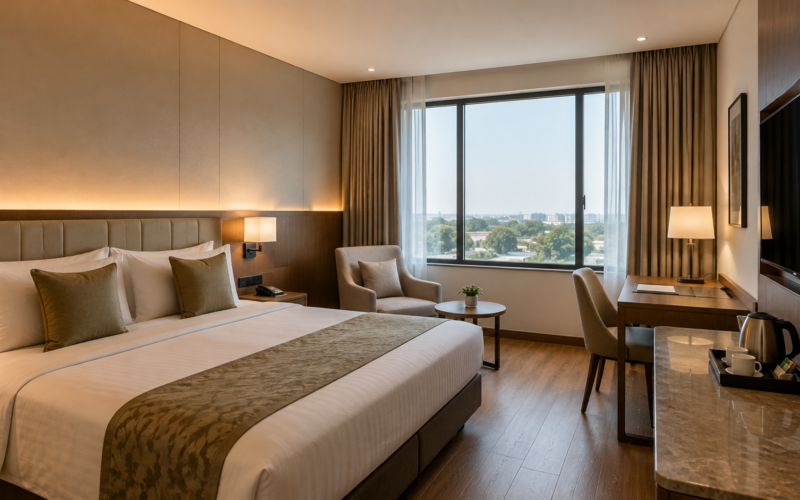
Kamat Hotels (India) Limited (NSE: KAMATHOTEL) has opened IRA by Orchid Hotel in Bhavnagar, Gujarat, adding a 50-room leased property to a portfolio that now spans 24 operating hotels and more than 1,950 rooms. The property includes Deluxe, Executive and Suite accommodation, an all-day dining restaurant, 24-hour in-room dining, a gym and five banquet and meeting venues capable of accommodating up to 500 guests.
The Bhavnagar opening is relatively small in isolation but fits a much larger expansion programme. Kamat Hotels has more than 620 additional rooms in its disclosed pipeline across properties in Gwalior, Dehradun, Dwarka, Nashik, Rishikesh, Mandavi Kutch and Puri, while Q1 FY27 operational income increased roughly 10% and consolidated profit improved sharply. The combination means management is expanding room inventory at a time when operating performance from the existing portfolio is becoming stronger.
How does IRA by Orchid Bhavnagar fit Kamat Hotels’ 1,950-room portfolio?
The 50-key Bhavnagar hotel increases Kamat Hotels’ presence in Gujarat and targets several overlapping demand segments. Bhavnagar has industrial and commercial activity, while the broader Saurashtra market also attracts pilgrimage, family and leisure travel. The hotel’s large banquet capacity gives it exposure to weddings, social events and corporate gatherings beyond conventional overnight room demand.
The property operates under Kamat Hotels’ IRA by Orchid brand, which sits below the company’s larger Orchid positioning and allows management to address markets where a more compact full-service format may be commercially appropriate.
Kamat Hotels currently operates 24 properties with more than 1,950 keys across nine states or union territories and five brands. A 50-room addition therefore increases existing room inventory by only around 2.5%, which explains why the Bhavnagar hotel is strategically useful without being transformational on its own.
Its significance is better understood as part of a repeated opening strategy. Kamat Hotels has been adding properties in destinations including Hyderabad, Goa, Rishikesh, Panchgani and Gujarat while using a mix of leased, managed and revenue-sharing structures.

Why does Kamat Hotels’ leased Bhavnagar model carry more earnings upside and capital risk?
IRA by Orchid Bhavnagar is a leased property rather than a management-only hotel. Under a leased structure, Kamat Hotels generally assumes greater operating exposure and can retain more of the upside from successful hotel performance, but it also carries lease obligations and a greater share of operating risk.
That differs from a management contract where a property owner generally provides the underlying real-estate capital while the hotel operator earns fees. Kamat Hotels’ expansion pipeline deliberately uses several models, allowing the company to balance capital intensity against the earnings potential of each market.
Bhavnagar was originally shown in earlier investor material as a 61-room property scheduled for opening in May 2026, while the final opening announcement confirms 50 operating rooms. The completed 50-key figure should therefore take precedence when describing the property as launched, illustrating why development pipelines can change before commissioning.
For investors, that is a useful reminder when evaluating the broader pipeline. Announced future room counts are development targets until individual properties actually open.
What do Kamat Hotels’ Q1 FY27 occupancy and profit gains say about operating leverage?
Kamat Hotels entered the expansion phase with stronger Q1 performance. Consolidated revenue was approximately ₹90.54 crore, up 9.6% year on year, while profit after tax rose to about ₹9.40 crore from ₹3.64 crore. Operating profit before depreciation, interest and other adjustments also increased substantially, with operating profitability improving faster than revenue.
Operational indicators provide a clearer explanation. Group occupancy improved to around 66% from 55% a year earlier, while average room rate was approximately ₹5,678. Higher occupancy allowed more revenue to flow through a largely fixed hotel cost base, supporting margin expansion.
This is particularly useful while new hotels are being introduced. Fresh properties normally take time to build distribution, reviews, corporate relationships and repeat customers, so an expanding portfolio can initially dilute average room rates or occupancy before individual hotels mature.
Kamat Hotels has already experienced some of that effect within the IRA portfolio, where changes in the property mix and the closure of IRA Mumbai affected comparisons. Management’s challenge is to ramp new openings quickly enough that the operating leverage visible in Q1 is not diluted by a growing number of immature hotels.
Can Kamat Hotels add more than 620 rooms without rebuilding the debt burden it worked to reduce?
The future pipeline includes more than 620 rooms, with upcoming properties such as a 50-room leased Orchid in Gwalior, a 96-room leased hotel in Dehradun, a 63-room managed Orchid in Dwarka and a 57-room managed hotel in Nashik. Longer-dated developments include 44 rooms in Rishikesh, 155 in Mandavi Kutch and 156 in Puri.
The mix is important because management contracts require less direct hotel real-estate capital than leased assets. Expanding through multiple commercial structures therefore gives Kamat Hotels a route to increase the number of rooms carrying its brands without funding the entire portfolio like a conventional owner-developer.
Balance-sheet progress creates some room to expand. Debt has fallen from roughly ₹200 crore in FY24 to around ₹104.5 crore by Q1 FY27, while cash and fixed deposits were approximately ₹66.2 crore, leaving implied net debt near ₹38 crore.
That is a materially different financial position from a highly leveraged hotel expansion model. The remaining risk is that an aggressive leased-property programme can recreate fixed obligations even when headline borrowings remain controlled.
The best outcome would combine managed hotels, selective leased properties and stronger occupancy, allowing room growth to outpace capital employed. Whether the 620-key pipeline produces that result will depend on individual property ramp-up rather than merely how quickly hotels are signed.
Why did Kamat Hotels shares jump nearly 9% even after a weak one-year performance?
Kamat Hotels shares finished August 21 around ₹207.66, rising approximately 8.8% during the session. The move followed a period of substantial underperformance: the stock had been down more than 30% over the preceding year and remained well below its 52-week high near ₹369.
No single new company disclosure fully explains the August 21 rally, so it would be inappropriate to attribute the entire move to Bhavnagar or Q1 results. The stronger earnings numbers, higher occupancy and expanding hotel pipeline nevertheless provide a fundamentally improved backdrop compared with periods when debt and slower property ramp-up dominated the investment case.
Kamat Hotels now presents a different strategic question from several years ago. The company has reduced leverage, rebuilt profitability and assembled an increasingly asset-light development pipeline, but it is simultaneously taking on selected leased hotels where execution risk remains higher.
Bhavnagar is a relatively modest 50-room addition. Its broader relevance is that it demonstrates the expansion engine is actually producing operating hotels rather than merely signing future properties. The next test is whether the 620-plus rooms still in development can open on schedule while maintaining the 66% occupancy and stronger margins that made Q1 FY27 materially more profitable.
Discover more from Business-News-Today.com
Subscribe to get the latest posts sent to your email.