

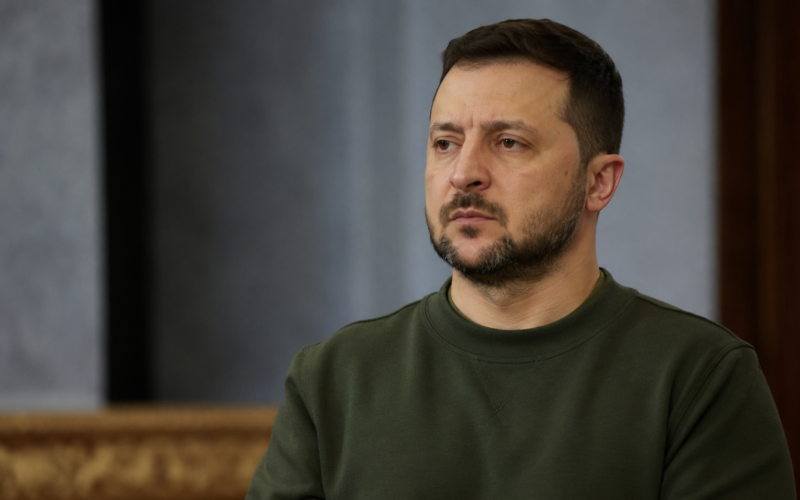
Ukrainian President Volodymyr Zelenskyy has rejected a renewed call for national elections while the country remains at war with Russia, warning on August 23, 2026 that a wartime vote could fracture Ukrainian society at a time when the government argues national unity remains essential to survival.
The dispute was triggered by former defence minister Mykhailo Fedorov, whose removal from government generated political controversy and who has since argued that Ukraine should consider allowing voters to renew the country’s political mandate despite continuing martial law.
Ukrainian law currently prevents presidential and parliamentary elections during martial law, and the practical barriers are extraordinary. Millions of Ukrainians live abroad or have been internally displaced, large numbers of citizens serve in the armed forces, and substantial areas of Ukrainian territory remain under Russian occupation.
Why is Ukraine debating an election while the war is still underway?
Ukraine would ordinarily have held presidential elections during the period in which the country has instead remained under martial law because of Russia’s invasion.
That has provided Moscow and critics of Zelenskyy with an argument that his democratic mandate has expired, although Ukraine’s constitution and wartime legislation provide continuity for the presidency while elections cannot lawfully be conducted.
Fedorov’s intervention moves the debate beyond Russian political messaging because it comes from a prominent Ukrainian political figure rather than an adversary.
His call taps into growing political pressure after years of wartime governance, cabinet changes and public disagreements over military strategy, corruption, mobilisation and the pace of the conflict.
Zelenskyy’s response is that introducing a competitive election under those conditions could redirect political energy towards internal rivalry at precisely the moment Russia continues attacking Ukrainian cities and infrastructure.
Could Ukraine legally hold an election during martial law?
Not under the existing legal framework.
Ukraine prohibits national elections while martial law remains in force. Parliament would therefore need to change the law or martial law would need to end before a conventional national vote could proceed.
The security challenge would remain even if lawmakers created a legal mechanism. Thousands of normal polling places are unavailable because communities have been destroyed, occupied or evacuated.
Military personnel deployed across the front would need secure voting arrangements, while Ukrainians living elsewhere in Europe and beyond would require an unprecedented overseas voting system.
A vote conducted without credible participation from soldiers, refugees and residents displaced from occupied territories could itself face legitimacy challenges.
Why does Zelenskyy say an election could divide Ukraine?
Wartime politics has largely suppressed the normal intensity of party competition because opposition and government politicians have operated under the overriding pressure of national defence.
An election would immediately change that environment. Candidates would campaign on decisions involving mobilisation, military leadership, foreign assistance, negotiations with Russia and the economic burden of the war.
Those are legitimate democratic questions, but they are also emotionally and strategically divisive.
Zelenskyy argues that Russia could exploit the resulting political competition through information operations and attacks intended to disrupt voting.
Polling cited by Reuters indicates that a majority of Ukrainians still favour delaying elections until the fighting ends, although attitudes could shift if the war continues indefinitely.
Why is the political dispute emerging now?
Ukraine is approaching another difficult phase of a war that has lasted far longer than many expected when Russia launched its full-scale invasion in February 2022.
Civilian casualties remain high, infrastructure attacks continue and the country’s military depends heavily on foreign ammunition and air-defence supplies.
At the same time, prolonged emergency rule naturally creates pressure for democratic renewal. Governments exercising extraordinary wartime powers cannot indefinitely avoid questions about accountability simply by citing security conditions.
That creates a genuine democratic dilemma rather than an easy choice between elections and authoritarianism. Holding a vote under conditions incapable of ensuring equal participation can weaken democracy, while repeatedly postponing elections can eventually weaken confidence in democratic institutions.
Could Ukraine eventually design a credible wartime election?
Possible mechanisms have been discussed, including expanded overseas voting, electronic systems, military polling arrangements and special procedures for displaced citizens.
Every solution introduces security, secrecy and verification problems. Electronic voting could become a major cyber target, while physical voting near the front presents obvious dangers.
International observation would also be necessary if Ukraine wants a future election to retain broad credibility among its allies.
Zelenskyy has previously indicated that he is not opposed in principle to elections if security and participation can be guaranteed. His August 23 position is that those conditions do not presently exist.
The political significance of Fedorov’s challenge lies in the fact that the wartime-election question is now becoming part of Ukraine’s internal political debate rather than remaining principally an argument advanced from outside the country.
Discover more from Business-News-Today.com
Subscribe to get the latest posts sent to your email.