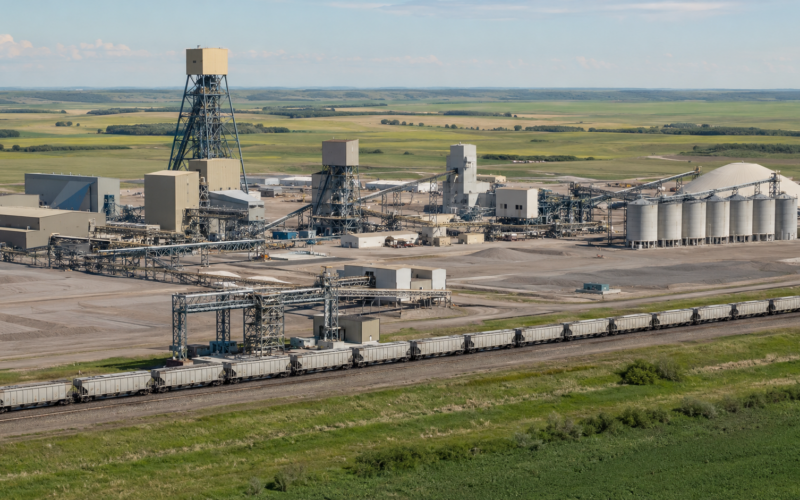
The Jansen Potash Project is being developed by BHP in Saskatchewan, Canada, about 140 kilometres east of Saskatoon. The site is fully owned by BHP and is designed as a long-life underground potash mine that could eventually become one of the world’s largest sources of the crop nutrient.
BHP reported in January 2026 that Jansen Stage 1 was 75% complete, while its June 2026 update said Stage 1 remained on track for mid-2027 first production. Stage 1 is planned to produce about 4.15 million tonnes per year. Jansen Stage 2 was 16% complete as of the end of May 2026, with first production now estimated in late FY2031 and planned output of about 4.36 million tonnes per year.
Together, the first two stages are expected to deliver about 8.5 million tonnes per year after ramp-up, equivalent to roughly 10% of total global potash production. BHP also sees longer-term expansion potential for Jansen to reach 16 million to 17 million tonnes per year, subject to further studies and approvals.
Jansen matters because BHP is using the project to enter potash at scale, diversify beyond iron ore, copper and metallurgical coal, and gain exposure to long-term food-security demand. The 2026 story is more complicated than a simple construction update. BHP has confirmed higher capital estimates for both stages, with Stage 1 now estimated at US$8.4 billion and Stage 2 at US$6.9 billion, making Jansen one of the clearest tests of whether a mining major can build a new Tier 1 fertiliser platform from scratch.
Where is the Jansen Potash Project located and what is being built in Saskatchewan?
The Jansen Potash Project is located in east-central Saskatchewan, about 140 kilometres east of Saskatoon. Saskatchewan is already one of the world’s most important potash-producing regions, and Jansen gives BHP a major entry point into that established mining and fertiliser basin.
The project is an underground potash mine and processing complex. It includes mine shafts, underground development, processing facilities, storage, product handling systems, rail connections, workforce infrastructure and export logistics. Unlike brownfield expansions at existing mines, Jansen is a large greenfield development being built as a new operating platform.
The site has two approximately 1,000-metre-deep shafts, which BHP completed before full Stage 1 execution accelerated. Those shafts are critical because they provide access to the underground orebody and support the transition from surface construction into underground mine development.
Jansen is being developed in stages. Stage 1 is the initial production platform, while Stage 2 is already under construction to expand the mine’s capacity after Stage 1. Future stages could lift the mine to 16 million to 17 million tonnes per year, but those later expansions remain subject to studies, approvals, capital allocation and market conditions.
The project’s location gives it access to Canada’s potash geology, skilled mining workforce, engineering base and rail links to export ports. At the same time, the inland location means logistics are central to the project’s economics, because potash must be moved from Saskatchewan to coastal export terminals before reaching global customers.

Who owns and operates the Jansen Potash Project?
Jansen is 100% owned by BHP. The project is being developed through BHP Canada Inc., a wholly owned BHP subsidiary, and is central to the group’s long-term strategy in potash.
This ownership structure is different from many recent mega projects that involve multiple equity partners, state companies or customer-investors. Jansen is a BHP-controlled platform, which gives the company full exposure to construction risk, operating upside and long-term expansion decisions.
Potash is a new commodity for BHP, and Jansen is the company’s flagship entry into the sector. BHP has framed the project as a long-life, low-cost, expandable asset tied to future-facing demand from population growth, rising food needs and more efficient use of arable land.
The project also makes Saskatchewan a major growth centre for BHP. The company says Jansen could create around 5,500 workforce opportunities during construction and about 900 full-time roles once operational. It has also highlighted contract opportunities for local and Indigenous businesses and agreements with First Nations communities.
Jansen therefore carries significance beyond BHP’s commodity portfolio. It is also a major Canadian industrial project, a Saskatchewan mining investment and a long-term export asset tied to global fertiliser demand.
What is the planned capacity of the Jansen Potash Project?
Jansen Stage 1 is expected to deliver approximately 4.15 million tonnes per year of potash production. First production is planned for mid-2027 after BHP reverted the schedule to the original mid-calendar-2027 target in its January 2026 update.
Jansen Stage 2 is expected to add approximately 4.36 million tonnes per year. BHP’s June 2026 update confirmed that Stage 2 first production is now estimated in late FY2031, after a two-year extension previously shifted timing from FY2029 to FY2031.
Once both stages are ramped up, combined output from Jansen is expected to be about 8.5 million tonnes per year. BHP says that would represent approximately 10% of total global potash production and make Jansen one of the world’s largest potash mines.
The long-term growth option is even larger. BHP says Jansen’s resource endowment provides potential for future expansions that could lift output to 16 million to 17 million tonnes per year, although those expansions are not part of the current sanctioned Stage 1 and Stage 2 delivery base.
The capacity numbers should be read carefully. Stage 1 and Stage 2 have different schedules, and Stage 2 will require a ramp-up period after first production. The full 8.5Mtpa combined capacity is therefore a post-ramp-up target, not a 2027 operating level.
How will Jansen mine and process potash?
Jansen is an underground potash mine. Ore is accessed through deep shafts, mined underground and brought to the surface for processing. The processing plant will separate, size, dry and prepare potash product for storage and shipment.
The project includes wet mill and dry mill areas, raw ore handling, product storage, loadout systems, tailings and reagent areas, and supporting utilities. These systems are essential because potash mining is not only about extracting ore. The product must be processed into a marketable fertiliser ingredient that can be transported efficiently and meet customer specifications.
BHP has said Jansen is designed with improved sustainability performance compared with the average potash mine in Saskatchewan. The company says the mine is expected to use around 60% less fresh water and generate around 50% less operational Scope 1 and Scope 2 greenhouse gas emissions per tonne of product compared with the provincial average.
Those claims should be understood as operational intensity comparisons, not as a statement that the project has no environmental impact. Jansen remains a large underground mine with surface facilities, water use, energy demand, waste-management needs, rail movement and community impacts.
The processing and logistics design is also tied to future expansion. Because Jansen is being built in stages, some infrastructure decisions are intended to support later capacity additions. That makes capital intensity high upfront, but it also gives BHP a platform to scale if potash demand and project economics support additional phases.
Which companies and contractors are supporting the Jansen Potash Project?
Jansen has a broad contractor ecosystem across engineering, construction management, underground development, mill construction, heavy haulage, civil works, emergency services, camp services, rail logistics and port handling.
The Hatch-Bantrel Joint Venture has been involved in engineering, procurement, construction management and commissioning services for Jansen Stage 1. Hatch describes the project as involving complete EPCM services from 2016, including engineering, procurement and contracts, construction and commissioning.
Worley and WorleyCord have construction roles at Jansen, including work connected with construction services and dry mill area structural, mechanical, piping, electrical and instrumentation packages. Wicehtowak Aecon Industrial LP has been linked to wet mill area work, while Aecon Industrial Management has been named in foundation and piling packages.
Sandvik has also been selected for the Jansen Stage 2 underground mining system. BHP said the contract, valued at approximately C$280 million, covers delivery of two mining systems and extends the company’s collaboration with Sandvik for the second stage.
The contract base also includes local and specialist contractors. BHP’s awarded-contract disclosures name companies such as Mammoet Canada Western for wet mill heavy haul, Lafarge Canada for concrete and aggregate supply, Athabasca Basin Security for site security, Haztech Energy for emergency response, and Wicehtowak Frontec Services for camp management and catering.
The contractor spread shows the scale of the project. Jansen is not a single-package mine build. It is a large construction programme combining underground mining, surface processing, heavy modules, site services, logistics, workforce accommodation and future operating readiness.
How will Jansen potash reach global customers?
Jansen’s export chain is one of the project’s most important 2026 developments. In June 2026, BHP Canada Inc. signed rail transportation agreements with Canadian National Railway and Canadian Pacific Kansas City to move Jansen potash to Westshore Terminals in Vancouver.
The agreements give Jansen dual rail access through the Jansen Access Spur, connecting the mine to both CN and CPKC mainlines. This dual-access model is designed to improve reliability and give BHP flexibility in moving product to customers around the world.
Under the agreements, both CN and CPKC will operate unit trains between Jansen and Westshore Terminals. The initial term is approximately four years, supporting Jansen Stage 1 production, with future arrangements expected to align with later phases of the project.
Westshore Terminals is also part of the export strategy. The Vancouver-area terminal is being modified to handle potash as part of BHP’s Jansen development. Westshore has described an $800 million potash project designed to introduce potash exports at the terminal and ship up to 4.5 million tonnes per year of Canadian potash.
This logistics chain is critical because Jansen is an inland mine. Its commercial value depends on reliable movement from underground mine to processing plant, from Saskatchewan to Vancouver by rail, and from Westshore to international fertiliser markets by ship.
How did Jansen move from long preparation to major construction?
Jansen has been under consideration for many years, with BHP investing in shafts and early infrastructure before approving full Stage 1 development. The company approved Jansen Stage 1 in August 2021 with an initial investment cost estimate of US$5.7 billion.
Stage 1 marked BHP’s formal move into potash development at scale. The decision came after years of preparation and reflected the company’s view that potash could become a long-term growth commodity driven by food security, population growth and improving living standards.
The project passed an important physical milestone in 2022 with completion of the two approximately 1,000-metre-deep shafts. BHP described the shaft work as one of the largest such completions in Saskatchewan and noted the use of mechanised shaft-sinking and artificial ground freezing.
In late 2024, Jansen transitioned from shaft development into underground mine development, with the project cutting potash outwards from the production shaft station. That milestone was significant because it marked the movement from access construction toward actual mine development.
Stage 2 was approved in October 2023 with an investment estimate of US$4.9 billion. Since then, BHP has continued construction while reviewing cost and schedule assumptions for both stages. Those reviews are now central to the 2026 project story.
What are the latest Jansen Project updates in 2026?
The latest 2026 updates show Jansen advancing but at a higher capital cost than originally expected. In January 2026, BHP confirmed that Jansen Stage 1 was 75% complete, first production was planned for mid-CY2027, and the Stage 1 total investment estimate had increased to US$8.4 billion including contingencies.
BHP said the Stage 1 cost increase reflected inflationary and real cost escalation pressures, design development, scope changes and lower productivity outcomes. The company also said it had implemented a response plan to improve productivity, strengthen project management and enhance oversight of execution contracts.
In June 2026, BHP confirmed that Jansen Stage 2’s total investment estimate had increased from US$4.9 billion to US$6.9 billion including contingencies. First production for Stage 2 is estimated in late FY2031, and the stage was 16% complete at the end of May 2026, with engineering 83% complete.
The Stage 2 update also confirmed that Jansen Stage 1 was achieving the critical path milestones set in the January 2026 schedule and that first production remained on track for mid-CY2027. This makes the 2026 position mixed but clear: the schedule for Stage 1 remains intact, while the project’s capital intensity has increased materially.
BHP also said it expected to recognise an impairment charge of approximately US$2.3 billion in relation to the Jansen project because higher forecast capital intensity had reduced the value a market participant would attribute to the asset base. That does not stop development, but it makes cost discipline and execution performance more important.
Why does Jansen matter for global fertiliser and food-security markets?
Jansen matters because potash is a key fertiliser ingredient used to improve crop yield, plant health and soil productivity. As the world’s population grows and arable land becomes more constrained, demand for fertilisers that improve agricultural output remains a long-term structural theme.
Canada is already one of the world’s most important potash exporters, and Saskatchewan is the core of that industry. Jansen adds a large new source of supply from a politically stable jurisdiction with deep mining expertise and established export infrastructure.
The scale of the project is what makes it globally relevant. A combined 8.5Mtpa from Stage 1 and Stage 2 would represent a major new supply source in the potash market. If future stages lift capacity toward 16Mtpa to 17Mtpa, Jansen would become even more influential in global fertiliser trade.
For BHP, potash also provides portfolio diversification. The company has long been heavily exposed to iron ore, copper, coal and other mining commodities. Jansen gives BHP exposure to agricultural demand, which is shaped by food consumption, land use, soil quality and fertiliser affordability rather than only steelmaking or electrification.
The project will also affect competition in the potash industry. Large new supply can improve long-term availability, but it can also influence pricing, market share and producer discipline. Jansen’s low-cost ambition is therefore strategically important for both BHP and existing potash producers.
What environmental, community and workforce issues shape Jansen?
Jansen is being developed in a region where mining, agriculture, Indigenous participation and local employment all intersect. For the Jansen mine itself, the key local context is Saskatchewan, First Nations engagement, long-term regional employment, supplier participation and mine-related environmental management.
BHP says its Canadian potash and related logistics activities operate across multiple Indigenous territories and communities. For Jansen specifically, the company has highlighted opportunities agreements with six First Nations communities, Indigenous procurement, workforce participation and local business engagement as part of its Saskatchewan development model.
The company has stated a target of 20% Indigenous employee participation at Jansen by FY2026 and has emphasised gender balance in its potash workforce. These targets matter because Jansen is not only a mining project. It is a long-term regional employer that will require training, recruitment and retention beyond the construction period.
Workforce development is central because Jansen requires thousands of workers during construction and hundreds of long-term operating roles. BHP says the project will create about 5,500 workforce opportunities during construction and around 900 full-time BHP roles once operational.
Environmental performance will remain closely watched. BHP’s claims on lower water use and lower operational greenhouse gas emissions per tonne are important, but the project will still need to manage water, tailings, land disturbance, energy use, rail movement, dust, safety and long-term closure obligations.
The community challenge is therefore two-sided. Jansen can bring jobs, contracts, training and revenue, but it must also maintain trust through safety, environmental management, Indigenous participation, transparent procurement and long-term local benefits.
What could limit the Jansen Potash Project’s delivery or performance?
The most obvious limitation is capital execution. Stage 1 and Stage 2 have both undergone cost resets, and BHP has already flagged higher construction hours, material quantities, escalation, design development and lower productivity as key contributors to higher estimates.
Schedule risk remains important even though Stage 1 is still on track for mid-2027 first production. Mine development, processing plant construction, commissioning, workforce readiness, rail arrangements and port systems all need to align before Jansen can move from construction to reliable production.
Ramp-up is another risk. First production is not the same as full production. Stage 1 will need to ramp toward stable output, while Stage 2 is not expected to begin production until late FY2031 and will then need its own ramp-up period.
Market risk also matters. Potash demand is supported by long-term food-security fundamentals, but fertiliser prices can be volatile. If prices weaken, the payback profile and future expansion decisions could be affected, especially after the capital-cost increases.
Logistics are also a practical constraint. Jansen depends on rail reliability, Westshore export capacity, port operations and shipping availability. The CN and CPKC agreements reduce risk, but they do not eliminate exposure to rail congestion, weather, labour disruption or port bottlenecks.
What is the future outlook for the Jansen Potash Project?
The future outlook for the Jansen Potash Project is constructive but clearly execution-sensitive. BHP has built a major new potash platform in one of the world’s leading potash regions, Stage 1 is progressing toward mid-2027 first production, and rail export agreements are now in place.
The project’s biggest strength is scale. Stage 1 and Stage 2 are expected to deliver about 8.5Mtpa after ramp-up, and BHP says the asset has the potential for future expansions to 16Mtpa to 17Mtpa. That gives Jansen long-term optionality that few new fertiliser projects can match.
The biggest challenge is cost. The revised Stage 1 estimate of US$8.4 billion and Stage 2 estimate of US$6.9 billion mean Jansen now carries a much larger capital burden than originally presented. The project can still become a Tier 1 asset, but it now has to prove that its operating cost position, mine life and future expansion potential can justify the upfront investment.
For Saskatchewan and Canada, Jansen could become a major export and employment platform. The mine, rail access and Westshore export chain tie inland fertiliser production to global agricultural markets, reinforcing Canada’s role as a major potash supplier.
For BHP, the 2026 question is no longer whether Jansen is strategically attractive. It is whether the company can turn a costly construction reset into a reliable, low-cost potash business. If Stage 1 starts production in mid-2027 and ramps effectively, Jansen could become one of BHP’s most important growth assets outside its traditional iron ore and copper base.
Discover more from Business-News-Today.com
Subscribe to get the latest posts sent to your email.