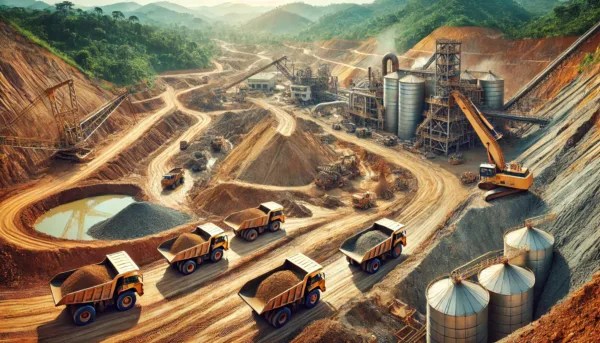



Equinox Gold Corp. (TSX: EQX; NYSE American: EQX) has signed 20-year land access agreements with Carrizalillo, Mezcala and Xochipala, removing the principal community access constraint that kept the Los Filos Mine in Guerrero, Mexico, suspended. The company has begun preparations for a gradual restart of heap leach operations while advancing engineering, permitting and economic work on longer-term expansion options. Los Filos remains outside Equinox Gold’s 2026 production guidance of 700,000 to 800,000 ounces, meaning the agreements reduce strategic risk without creating an immediate earnings contribution. The development nevertheless restores a large mineral endowment and a previously studied 280,000-ounce annual production platform to the company’s active growth pipeline. For investors, the key question has shifted from whether Equinox Gold can regain access to whether it can restart safely, rebuild operating stability and allocate capital without stretching an already ambitious portfolio.
Why do the 20-year Los Filos land access agreements materially change Equinox Gold’s Mexico strategy?
The agreements matter because community access was not a secondary operating issue at Los Filos. It was the condition that determined whether the mine could operate at all. Equinox Gold suspended Los Filos indefinitely on April 1, 2025, after its previous agreement with Carrizalillo expired, even though new arrangements had already been reached with Mezcala and Xochipala. Securing aligned 20-year terms with all three host communities therefore removes the immediate obstacle that had prevented management from committing capital, rehiring workers or providing a credible restart pathway.
The duration of the agreements is equally important. A short extension could have supported temporary production while leaving the company exposed to recurring negotiation risk, but a 20-year framework is more consistent with the long investment horizon required for mine development, fleet replacement, underground work and a possible new processing plant. It also gives Equinox Gold a more stable foundation for evaluating whether Los Filos should remain a heap leach operation or be repositioned as a larger, higher-recovery production complex.
The arrangements extend beyond surface access. Equinox Gold and the communities have also established a broader policy covering labour and supply services, two areas that can determine whether a restart proceeds smoothly or becomes trapped in disputes over jobs, contractors and local economic participation. That policy creates a clearer framework, but it will be tested through implementation rather than press-release language. Community agreements in mining are living operating systems, not documents that can be filed away once the signatures are dry.
For Equinox Gold, the strategic gain is the return of optionality. Los Filos holds approximately 5.4 million ounces of proven and probable gold reserves, 7.9 million ounces of measured and indicated resources excluding reserves, and 3.2 million ounces of inferred resources based on the June 2022 estimate. A deposit of that scale cannot generate value while access remains uncertain. The agreements convert Los Filos from a stranded asset back into a restart and expansion candidate, although considerable technical and financial work remains.
What must Equinox Gold complete before Los Filos can return to commercial gold production?
Equinox Gold is preparing for a gradual restart of the existing heap leach operation rather than promising an immediate return to full production. The restart programme includes environmental remediation, permitting, workforce rehiring and retraining, supplier negotiations and the restoration of operational systems that have been inactive during the suspension. Each activity carries its own schedule, cost and execution risk, particularly when equipment, contractors and skilled workers may have been redeployed elsewhere.
The absence of Los Filos production from 2026 guidance is the clearest signal that management does not yet have sufficient certainty to commit to a commercial restart date. Investors should therefore distinguish between access being restored and ounces being produced. Heap leach operations also have longer cash conversion cycles than conventional milling because ore must be mined, stacked, irrigated and leached before gold is recovered. Even after mining resumes, the operation may require several months before it generates a normalised production and cash flow contribution.
Rebuilding the workforce could be more complicated than simply calling former employees back. Equinox Gold must confirm which skills remain available locally, retrain workers on operating and safety procedures, rebuild supervisory capacity and align hiring with the new labour framework. Supplier contracts may also need to be renegotiated at different prices after more than a year of inflation, commodity volatility and changing demand across the mining sector.
Permitting and environmental work create another layer of uncertainty. Existing infrastructure provides Equinox Gold with a meaningful advantage compared with developing a greenfield mine, but restarting an idled operation still requires regulatory readiness, equipment integrity reviews and remediation work. Management will need to demonstrate that the operation can return without allowing the urgency to recover lost production to weaken environmental or safety discipline.
A credible restart would therefore involve a sequence of measurable milestones. These would include completion of remediation, confirmation of permits, workforce mobilisation, supplier awards, initial mining activity, ore stacking and the first recovered gold. Until those milestones are disclosed, Los Filos should be treated as a de-risked growth option rather than a near-term production asset.
Could a larger carbon-in-leach plant turn Los Filos into a major growth engine for Equinox Gold?
The longer-term value proposition centres on whether Equinox Gold proceeds with a carbon-in-leach processing plant that would operate alongside the existing heap leach facilities. A 2022 feasibility study evaluated a 10,000-tonne-per-day plant capable of processing higher-grade open-pit and underground ore more efficiently. That study estimated average annual production of 280,000 ounces, peak annual production of approximately 360,000 ounces, a 14.5-year mine life and average all-in sustaining costs of US$1,081 per ounce.
The processing difference is strategically significant. The earlier plan assumed average recovery of roughly 55% from heap leaching and 88% from the carbon-in-leach facility. Directing higher-grade and metallurgically complex ore to the plant could increase recoveries, improve the value extracted from each mined tonne and make underground development more economically attractive. The plant was also projected to add more than 1.1 million ounces to life-of-mine production compared with a heap leach-only scenario.
However, the 2022 study should not be confused with a current construction plan. Its production schedule is outdated, its initial capital estimate of US$318 million requires updating, and several years of labour, equipment, steel, energy and construction inflation may have altered the cost base. The previous 18-month construction and commissioning assumption must also be reassessed against present permitting, procurement and infrastructure conditions.
The gold-price environment could materially improve the revenue side of the equation. The earlier feasibility study used a base-case gold price of US$1,675 per ounce, while the reserve estimate used a more conservative long-term assumption of US$1,450 per ounce. Equinox Gold realised an average gold price of US$4,604 per ounce across its operations during the first quarter of 2026. That gap creates room for stronger project economics, but higher gold prices do not make capital inflation, community commitments or operating complexity disappear.
Equinox Gold is also evaluating whether the envisioned plant should have greater throughput than the previous 10,000-tonne-per-day design. A larger plant could lift annual production and improve economies of scale, but it would require additional capital, power, water, mining capacity and supporting infrastructure. Bigger is not automatically better if the company cannot consistently supply the plant with the correct ore blend or if the expansion competes with higher-return projects elsewhere in the portfolio.
The sensible approach is therefore phased. Restarting heap leach operations can establish workforce stability, rebuild community confidence and generate operating data before the company commits to a major processing investment. A final construction decision should be based on updated reserves, recoveries, capital costs, permitting requirements and an integrated mine plan rather than simply applying a higher gold price to an old feasibility study.
How does the Los Filos restart fit with Equinox Gold’s pending combination with Orla Mining?
Los Filos has become more strategically relevant because Equinox Gold is simultaneously pursuing an at-market combination with Orla Mining Ltd. The planned transaction is expected to create a North American gold producer with approximately 1.1 million ounces of annual production and a potential pathway to more than 1.9 million ounces through multiple development and expansion projects. Los Filos forms part of that growth pathway alongside Valentine Phase 2, Castle Mountain, South Railroad and the Camino Rojo underground opportunity.
The expanded portfolio offers greater flexibility, but it also creates a demanding capital-allocation puzzle. Management must decide which projects receive engineering resources, development spending and construction capital first. Los Filos may benefit from existing infrastructure and a large mineral endowment, while other projects may offer lower stakeholder risk, clearer permitting visibility or stronger returns on incremental capital.
The community agreements strengthen Los Filos in that internal competition. An asset without durable land access would struggle to secure capital within a portfolio containing multiple alternatives. With 20-year agreements in place, management can compare Los Filos against other projects using economics, execution risk and strategic contribution rather than treating community access as an overriding disqualifier.
Los Filos also provides geographic diversification inside the combined growth pipeline. Equinox Gold’s current strategy places significant emphasis on Canadian production through Greenstone and Valentine, while Orla Mining contributes operating and development assets across Canada, Mexico and the United States. A successful Los Filos restart would expand the group’s Mexican production exposure while reducing dependence on any single operating region.
That diversification is valuable only if the operating model remains manageable. Integrating Orla Mining, ramping up Canadian mines and developing several projects at once could strain management attention even if the balance sheet can support the spending. The portfolio may contain substantial embedded value, but shareholders receive that value only when projects are sequenced rather than pursued as a corporate version of opening every browser tab at once.
What do Equinox Gold’s balance sheet and cash flow say about funding the Los Filos restart?
Equinox Gold enters the restart planning process with a stronger financial position than it had during earlier stages of Los Filos expansion analysis. The company produced 197,628 ounces of gold across all operations during the first quarter of 2026 and generated US$341 million of cash flow before changes in non-cash working capital. Mine-site free cash flow before working-capital changes reached US$408.9 million, supported by strong realised gold prices.
The sale of Equinox Gold’s Brazilian operations also enabled the company to repay approximately US$988.6 million of debt during the quarter. By the end of April, Equinox Gold reported approximately US$923 million of available liquidity and net debt of US$77 million excluding convertible debentures. This materially reduces the balance-sheet risk associated with funding remediation, mobilisation and the early stages of a heap leach restart.
A restart should require substantially less upfront capital than constructing the carbon-in-leach plant because much of the mine’s core infrastructure already exists. The immediate spending burden is more likely to involve working capital, equipment maintenance, contractor mobilisation, workforce costs, remediation and the preparation of mine areas for renewed activity. Equinox Gold has not disclosed a restart budget, making cost transparency one of the most important items for future updates.
The carbon-in-leach decision is a different question. Even before updating the 2022 estimate for inflation or a larger plant design, the previous study required US$318 million of initial plant capital and more than US$1 billion of total sustaining and non-sustaining capital across the mine life. Equinox Gold could potentially fund development through internal cash generation, but the company is also contemplating spending on Valentine Phase 2, Castle Mountain and the growth assets associated with Orla Mining.
Capital discipline will therefore matter more than absolute liquidity. A high gold price can produce large cash inflows, but mining companies have a long history of converting commodity windfalls into crowded project pipelines and disappointing returns. Equinox Gold’s stronger balance sheet gives it choices. The next test is whether management uses those choices to sequence projects based on risk-adjusted value rather than production ambition alone.
Why has EQX stock remained weak despite the strategic value of the Los Filos agreements?
Equinox Gold shares were trading near US$9.41 on the NYSE American following the Los Filos announcement. The stock had declined approximately 10.5% over five trading days and 30.5% over one month, while its 52-week range extended from US$5.61 to US$18.96. The Los Filos news therefore arrived during a period of substantial share-price weakness rather than reinforcing an established upward trend.
The muted reaction suggests investors are treating the agreements as a necessary de-risking event rather than an immediate change to earnings forecasts. That interpretation is reasonable because Los Filos remains outside 2026 guidance, no restart date has been provided and no revised capital estimate is available. The market can recognise the strategic value of an asset while still declining to pay for production that has not yet restarted.
The share-price weakness cannot be attributed to Los Filos alone. Investors are also assessing the planned Orla Mining combination, potential dilution, integration complexity, project sequencing and the large amount of development capital embedded across the proposed combined portfolio. Even with elevated gold prices and improved liquidity, the market may require evidence that Equinox Gold can translate scale into per-share value rather than simply becoming a larger company.
Los Filos could support a re-rating if the company delivers a transparent restart plan, achieves early operating milestones and publishes updated economics that remain attractive after cost inflation. Conversely, repeated delays or rapidly rising capital requirements would reinforce the valuation discount associated with execution risk. The next meaningful stock catalyst is therefore unlikely to be another general statement of intent. Investors will want dates, costs, permitting progress and evidence of physical activity at the mine.
What could still derail the Los Filos restart after Equinox Gold secured community access?
The first risk is that the long-term agreements create formal access without eliminating operational friction. Labour allocation, local procurement, contractor selection and community benefits can remain sensitive throughout the life of a mine. Equinox Gold will need consistent engagement with Carrizalillo, Mezcala and Xochipala, particularly as hiring and supplier spending begin to flow again.
The second risk is cost escalation. The restart budget remains undisclosed, and the 2022 expansion study cannot be relied upon as a current capital estimate. If equipment rehabilitation, remediation or supplier mobilisation costs are higher than expected, the economics of restarting heap leach production could weaken even before the larger plant is considered.
Technical risk also remains. Los Filos contains multiple open-pit and underground deposits with different grades, metallurgical characteristics and processing routes. Restarting one part of the operation does not automatically prove that the integrated expansion plan will achieve the production rates or recoveries assumed in earlier studies. Updated drilling, mine planning and metallurgical work will determine how much of the resource can support a commercially robust plan.
Permitting and infrastructure requirements could affect the expansion schedule. A larger processing plant would require additional power, water, tailings capacity and supporting systems. Any delay in those approvals could leave Equinox Gold operating a lower-recovery heap leach business for longer than expected, reducing the speed at which Los Filos contributes to corporate growth.
The final risk is portfolio competition. Los Filos may prove economically attractive but still be deferred if other projects offer superior returns, faster permitting or lower execution risk. Securing land access does not guarantee immediate investment. It gives Equinox Gold the ability to make an investment decision based on economics rather than being prevented from making one at all.
The most credible interpretation is that Equinox Gold has solved the defining access problem at Los Filos but has not yet solved the restart. The agreements are a significant strategic achievement because they restore a large gold asset to the company’s active opportunity set. Shareholder value will depend on what follows: disciplined mobilisation, updated engineering, credible economics and a capital plan that respects the limits of management attention.
What are the key takeaways from Equinox Gold’s Los Filos land access agreements and restart plan?
- The 20-year agreements with Carrizalillo, Mezcala and Xochipala remove the immediate community access barrier that kept Los Filos suspended.
- Los Filos remains outside Equinox Gold’s 2026 guidance, so the agreements do not create an immediate production or earnings contribution.
- A gradual heap leach restart provides a lower-risk pathway for rebuilding operations before committing to a major processing expansion.
- The proposed carbon-in-leach plant could materially improve gold recovery and restore Los Filos as a potential 280,000-ounce annual production asset.
- The 2022 feasibility study is no longer a current development schedule, and its US$318 million initial capital estimate requires updating.
- Strong gold prices and Equinox Gold’s improved liquidity strengthen the investment case, but capital and operating inflation could absorb part of that benefit.
- The planned Orla Mining combination increases Los Filos’s strategic relevance while also creating greater competition for capital and management resources.
- EQX share-price weakness shows that investors are waiting for restart dates, budgets and physical milestones rather than valuing the agreements as immediate cash flow.
- Community access must now be converted into durable labour, supplier and operating stability across the Los Filos Mine.
- The next valuation catalyst will be a detailed restart roadmap followed by updated technical and economic studies for the expansion.
Discover more from Business-News-Today.com
Subscribe to get the latest posts sent to your email.