


Climate risk is beginning to create a financial problem that reaches well beyond insurance companies. Rising exposure to floods, wildfires, storms and other weather hazards can increase insurance premiums or make coverage harder to obtain, but the consequences do not necessarily stop with the homeowner’s annual insurance bill. Once insurance becomes expensive or unavailable, the effects can move into mortgage underwriting, household mobility, collateral values and ultimately the liquidity of local housing markets.
Recent developments across the United States, United Kingdom and Australia suggest that regulators and financial researchers are increasingly examining precisely that transmission mechanism. Federal Reserve staff research has found expected weather losses reflected in Florida home prices, the United Kingdom’s Financial Conduct Authority is explicitly warning that physical climate risk can make mortgage finance harder to obtain, and Australia’s prudential regulator has stress-tested how declining insurance coverage could transmit losses toward households and banks.
California provides another part of the picture. State regulators are simultaneously trying to expand insurance availability in wildfire-exposed communities while examining how mortgage lenders handle insurance proceeds after homes are destroyed. The common thread is becoming difficult to ignore: insurance increasingly functions not only as protection against property damage but as part of the financial infrastructure that allows residential real estate to remain financeable.
Why could an insurance problem eventually become a mortgage-market problem?
Property insurance and mortgage finance are tightly connected because lenders need the homes securing their loans to remain protected against major losses. In the United States, Fannie Mae and Freddie Mac mortgage standards require qualifying properties to maintain appropriate property insurance, while lenders and servicers are responsible for verifying that required coverage remains in place.
That relationship is straightforward when insurance is widely available and affordable. A homeowner pays a premium, the property remains covered, and the lender’s collateral is protected if a major insured event causes damage.
The economics become more complicated when premiums increase rapidly or insurers withdraw from high-risk areas. A homeowner may technically be able to afford mortgage principal and interest while struggling with the additional cost of insurance. In more extreme cases, obtaining an acceptable policy can itself become difficult.
That creates a transmission channel from physical risk into credit markets. If lenders become less comfortable financing properties where insurance is unreliable or unaffordable, the pool of eligible buyers can shrink. Fewer financeable buyers can weaken transaction liquidity, and reduced liquidity can eventually influence what buyers are prepared to pay.
The important distinction is that this mechanism does not require a home to be destroyed by a disaster. Expectations about future losses and future insurance costs can begin affecting financial decisions before the damage occurs.
Is climate risk already being reflected in what homebuyers pay?
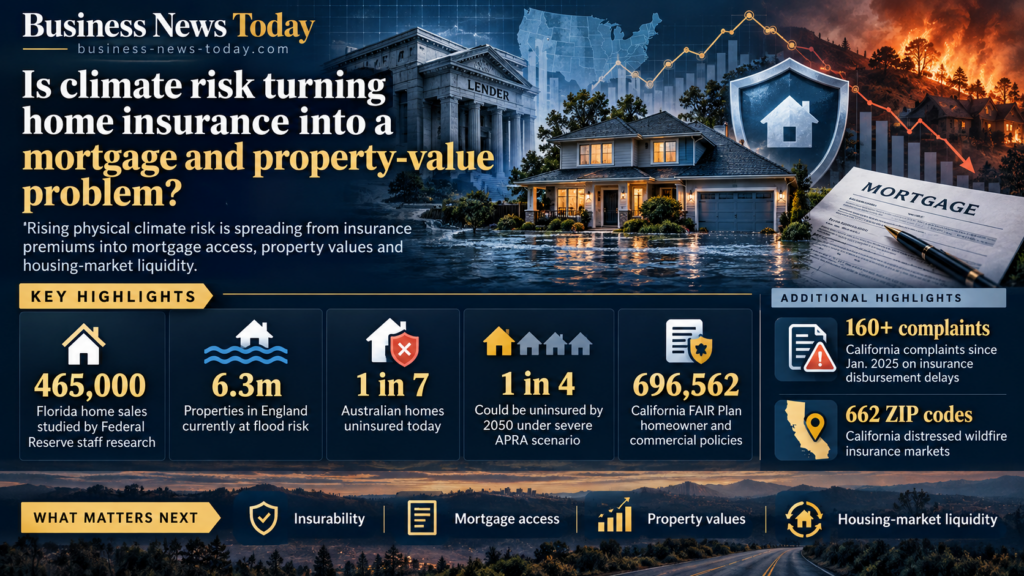
Federal Reserve staff research published in September 2026 provides unusually detailed evidence from Florida. Researchers examined approximately 465,000 residential property sales spanning 12 years and evaluated how prices related to expected weather losses, insurance premiums and recent hurricane exposure.
The study found negative relationships between home prices and all three measures after accounting for geography, property characteristics and transaction factors. Expected property-level weather losses showed the strongest association with prices, while insurance premiums had a statistically significant but more modest relationship.
That difference is analytically important. Buyers appear capable of responding not merely to today’s insurance bill but to expectations about future physical losses associated with the property. In other words, the market may already be discounting some homes because of anticipated future weather risk.
Recent hurricane exposure had a much smaller effect in the analysis. The researchers suggested one possible explanation is that hurricane risk is already well understood in Florida, meaning another storm may provide relatively little new information about the underlying long-term exposure of a property.
The research should not be interpreted as an official Federal Reserve policy conclusion, and Florida is an unusually exposed housing market. It nevertheless offers evidence for a mechanism that could become increasingly relevant elsewhere: physical risk can migrate into property valuations before an individual home experiences a catastrophic loss.
Why is the United Kingdom regulator connecting flood insurance directly with mortgages?
The Financial Conduct Authority is now explicitly treating climate adaptation as an issue spanning both property insurance and mortgage markets. It says approximately 6.3 million properties in England are currently exposed to flood risk, with that figure potentially reaching 8 million by 2050.
The regulator also points to rising use of Flood Re, the scheme designed to help households in higher-risk properties obtain affordable flood insurance. Around 346,200 home insurance policies entered the programme during 2024/25, representing a 20% increase from the previous year.
Those numbers do not mean millions of British properties are becoming unfinanceable. They do show why regulators are increasingly thinking about insurance and mortgage access as interconnected markets rather than separate financial products.
The Financial Conduct Authority has specifically warned that where physical climate risks affect property values or insurability, mortgage availability may also be affected. Lenders may become less willing to finance properties in higher-risk locations, particularly when adequate insurance becomes unavailable or unaffordable.
Existing owners can then face a second problem. A household may continue servicing an existing mortgage without difficulty but discover that refinancing, remortgaging or selling becomes harder because prospective lenders or buyers view the property’s risk differently.
That creates the possibility of a housing-market liquidity problem rather than simply an insurance-affordability problem. A property does not have to become worthless to create financial stress. It only needs to become meaningfully harder to finance or sell.
Could Australia’s insurance protection gap eventually increase bank credit risk?
Australia provides perhaps the clearest prudential examination of how the problem can spread through the financial system. The Australian Prudential Regulation Authority worked with five of the country’s largest general insurers to stress-test how the home insurance protection gap could evolve through 2050 under two severe but plausible climate-related scenarios.
APRA estimates that around one in seven Australian households are currently without home insurance protection. Under both stress scenarios, that share could reach around one in four by 2050, equivalent to approximately one million additional households lacking adequate coverage.
Those figures are stress-test outcomes rather than forecasts. APRA deliberately uses severe but plausible scenarios to understand where vulnerabilities could emerge, and the exercise assumes no additional policy measures or physical adaptations beyond those embedded in the scenarios.
The financial transmission mechanism is nevertheless important. When insured homes suffer damage, losses can be absorbed partly by insurers and reinsurers. When homes are uninsured or underinsured, more of that financial loss stays with households, lenders or governments.
APRA therefore warns that a widening protection gap could increase bank credit risk, particularly in highly exposed regions. Under its higher physical-risk scenario, expected annual weather-related losses increase from around A$7 billion currently to more than A$16 billion by 2050.
Regional exposure is even more significant. APRA’s stress testing suggests the insurance protection gap could exceed 40% in rural areas under both scenarios, potentially leaving precisely the communities with fewer financial alternatives carrying higher concentrations of uninsured property risk.
Why does the insurance protection gap matter to mortgage lenders?
A mortgage lender has two principal protections against borrower default. The first is the borrower’s ability to keep making payments. The second is the underlying property serving as collateral.
A major uninsured loss can damage both simultaneously. A household may face the cost of rebuilding or repairing a home while continuing to service its mortgage, weakening its financial capacity at the same time that the collateral protecting the lender has lost value.
Insurance normally transfers much of that property-loss risk to insurers and ultimately reinsurers. As the protection gap widens, more of the risk effectively migrates back toward household and bank balance sheets.
That does not mean banks immediately stop lending across entire high-risk regions. Lenders can respond through underwriting standards, loan-to-value limits, insurance requirements, pricing, portfolio diversification and other risk controls.
The deeper issue is whether climate exposure begins influencing mortgage terms systematically. Once lenders start differentiating financing availability or pricing based partly on the future insurability of individual properties, physical climate risk becomes embedded directly in mortgage economics.
What does California reveal about the relationship between insurance and housing finance?
California demonstrates how the transmission chain can operate both before and after a disaster. The state’s homeowners insurance market has experienced considerable stress in wildfire-exposed areas, contributing to greater reliance on the California FAIR Plan, the insurer-of-last-resort mechanism for properties unable to secure conventional coverage.
California’s insurance-market snapshot, updated on October 7, showed 696,562 FAIR Plan homeowner and commercial policies as of June 2026 and 662 ZIP codes classified as distressed. Those numbers illustrate the scale of the coverage challenge but do not tell the whole story.
There is meaningful counterevidence to the idea that insurance availability can only deteriorate. California says 12 homeowners insurance groups are expanding under its Sustainable Insurance Strategy, compared with none in 2025, as new rules seek to encourage insurers to write more business in wildfire-distressed regions.
The strategy is specifically designed to reduce reliance on the FAIR Plan over time. That matters because regulatory reform, risk-based pricing, mitigation spending and greater insurer participation could interrupt the chain from physical risk to declining insurability.
California therefore represents both the warning and the potential policy response. Insurance markets can become stressed as physical risk rises, but financial outcomes are not predetermined if pricing, mitigation and market capacity adapt.
Why do mortgage lenders control part of the recovery even after an insurer pays?
California has also exposed another less obvious connection between mortgages and insurance. After a severely damaged mortgaged property generates an insurance payout, the homeowner may not immediately receive all of that money directly because lenders can have an interest in ensuring that insurance proceeds are used to restore the collateral securing their loans.
On October 15, California ordered financial institutions to provide information about how they were handling insurance proceeds for survivors of the Los Angeles fires. Regulators are examining allegations involving delayed disbursements, inadequate appeal processes and funds that remained held even after loans had been fully repaid.
Since January 2025, the California Department of Financial Protection and Innovation has received more than 160 confidential consumer complaints involving delays or other problems with insurance disbursements. Many have been resolved, but the intervention illustrates how deeply lenders can become involved in the post-disaster recovery process.
This creates a financial bottleneck that exists after an insurer has accepted a claim. The speed at which money flows from insurer to lender to homeowner can influence reconstruction timelines, contractor payments and the eventual restoration of the property’s value.
Housing recovery therefore depends on more than claims being approved. It also depends on whether the mortgage and servicing system can convert those insurance proceeds into reconstruction without creating unnecessary delays.
Could adaptation spending protect both insurance availability and property values?
The emerging relationship between climate risk and housing finance does not imply that property values in every exposed area must decline. Physical adaptation can change the economics.
Flood barriers, wildfire-resistant construction, stronger roofs, drainage upgrades, vegetation management and community-scale infrastructure can reduce expected losses. If insurers incorporate those improvements into underwriting and pricing, better resilience could support continued insurance availability.
The same logic can flow into mortgage markets. A property with demonstrably lower expected damage may remain easier to insure and therefore easier to finance than a nearby property facing the same broad regional hazard but weaker physical protection.
This creates a potentially important investment cycle around residential resilience. Spending on adaptation has traditionally been framed primarily as a way to reduce disaster damage. Increasingly, it may also protect access to financial services.
APRA explicitly identifies stronger housing resilience, protective infrastructure, retrofitting and risk-based land-use planning as tools that could reduce future insurance pressure. The Financial Conduct Authority is similarly encouraging financial firms to consider how adaptation can support resilience.
If the connection becomes sufficiently measurable, insurers and lenders could eventually create stronger financial incentives for adaptation. Premium reductions, preferential mortgage terms or improved valuations for more resilient homes would transform adaptation from an environmental expense into an investable property characteristic.
Could property markets begin separating into insurable and harder-to-insure assets?
The most consequential long-term possibility is not a universal climate discount across housing. It is greater divergence between properties.
Two homes in the same region can face materially different physical risks depending on elevation, construction, drainage, vegetation, roof design and proximity to hazards. As catastrophe modelling becomes more granular, insurers and lenders can increasingly distinguish those differences at individual-property level.
That could make insurance availability and cost a more important part of property due diligence. Buyers already compare taxes, maintenance costs, school districts and commuting access. In highly exposed markets, expected insurance costs and long-term insurability may increasingly become part of the same purchasing decision.
The Federal Reserve research from Florida suggests the valuation mechanism may already be emerging. Importantly, expected weather losses had a stronger association with home prices than current premiums, implying markets may look beyond today’s insurance price toward the underlying physical exposure.
If that behaviour spreads, properties could face different financing and valuation outcomes even within the same city. Resilient homes may preserve broader buyer pools, while properties with persistent insurance problems could experience weaker liquidity.
That would make climate adaptation increasingly relevant not just to insurers and governments, but to developers, mortgage lenders, real estate investors and individual homeowners.
What could prevent climate risk from becoming a wider mortgage and property-value problem?
Insurance markets can adapt. Higher premiums can attract new underwriting capacity when prices become sufficient to compensate insurers for risk, while catastrophe bonds, reinsurance and improved risk modelling can expand the amount of capital available to absorb losses.
Government programmes can also preserve insurance availability. California’s reforms demonstrate an attempt to bring conventional insurers back into stressed markets, while the United Kingdom’s Flood Re programme spreads flood risk in a way intended to keep coverage accessible.
Households and communities can reduce physical vulnerability through adaptation. Better building codes, stronger infrastructure and improved land-use decisions can materially change expected future losses, weakening the connection between rising hazard and declining property financeability.
There is also a danger of overgeneralisation. Florida hurricane exposure, Australian rural insurance affordability and English flood risk are very different problems governed by different insurance, mortgage and regulatory systems.
That is why the emerging pattern should still be described as a developing Signal rather than a universal structural shift. The evidence shows credible transmission channels from physical risk through insurance and into housing finance, but the scale and speed of those effects will vary substantially between markets.
What evidence would confirm that insurability is becoming a determinant of housing value?
The clearest confirmation would be increasing evidence that comparable properties receive different valuations based on expected physical losses and insurance conditions. Replication of the Florida findings across wildfire, flood, cyclone and coastal markets would materially strengthen the thesis.
Mortgage underwriting provides another measurable test. If lenders increasingly adjust loan-to-value limits, pricing or eligibility based on insurance availability or property-level physical-risk information, the transmission from insurer underwriting into credit would become explicit.
Transaction volumes should also be watched. Properties in stressed insurance markets may not immediately experience dramatic price declines, but longer selling periods, higher failed-transaction rates or reduced mortgage approval could reveal declining liquidity before headline valuations change materially.
Insurance availability remains central. California’s FAIR Plan policy counts, insurer re-entry into distressed areas, Flood Re usage in the United Kingdom and Australia’s protection gap provide measurable indicators of whether coverage problems are worsening or easing.
Adaptation outcomes may prove equally important. Evidence that resilient homes receive lower premiums, maintain stronger insurance availability or command better financing would show that the financial system is beginning to reward reduced physical vulnerability.
Finally, bank losses will matter. Rising mortgage defaults or collateral losses directly attributable to uninsured weather damage would represent the clearest transmission into financial stability, but that is also the outcome policymakers are trying to prevent.
The larger change is therefore not that climate risk suddenly determines every home’s value. It is that insurance can no longer be treated simply as another household expense in the most exposed property markets.
Insurance protects the collateral on which mortgage lending depends. Once that protection becomes uncertain, the consequences can move through lenders, buyers and sellers until they eventually influence how liquid a property is and what the market is prepared to pay for it.
The next phase of climate finance may therefore be much less abstract than carbon markets or corporate disclosure rules. It may appear directly in one of the largest assets most households ever own, through a deceptively simple question: can this home still be insured on terms that allow the next buyer to finance it?
Discover more from Business-News-Today.com
Subscribe to get the latest posts sent to your email.