


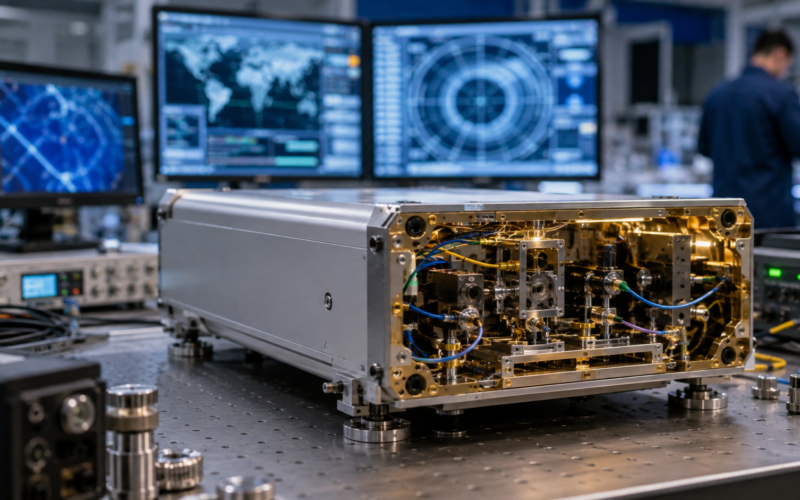
IonQ, Inc. (NYSE: IONQ) has secured a $28 million contract extension from the Defense Advanced Research Projects Agency to expand production of its Evergreen-05 optical atomic clocks and deliver 125 units to United States government customers. The August 6 award moves IonQ deeper into quantum sensing and precision timing just ten months after the company completed its acquisition of Vector Atomic. IonQ will separately invest $15 million in production space, manufacturing and testing equipment, and supporting personnel to fulfil the programme. The strategic question is therefore shifting from whether IonQ can acquire advanced quantum technologies to whether it can manufacture and deploy them at meaningful scale.
The contract falls under DARPA’s It’s About Time programme and represents more than another research award for a company traditionally associated with trapped-ion quantum computers. IonQ is expected to deliver 125 Evergreen-05 clocks for applications including radar, secure communications and precision geolocation, creating a tangible production programme around one of the technologies acquired with Vector Atomic.
That distinction matters. Much of the quantum industry remains valued on technical roadmaps, future computing capacity and expectations of eventual commercial advantage. Atomic clocks already have identifiable operational uses, particularly where precise timing must continue when Global Positioning System signals are degraded, unavailable or vulnerable to interference.
For IonQ, the DARPA contract therefore provides an opportunity to demonstrate that its expanding quantum portfolio can produce hardware for real-world government missions while the much larger commercial promise of fault-tolerant quantum computing continues to develop.
Why does IonQ’s $28 million DARPA atomic clock contract matter beyond the headline value?
A $28 million contract is modest relative to IonQ’s roughly $15.9 billion market capitalisation at the August 6 close, but the strategic significance lies in the nature of the work rather than its immediate financial scale. IonQ is being asked to expand production capability and deliver a defined quantity of hardware rather than simply demonstrate a laboratory concept.
DARPA’s support for the underlying clock technology dates to 2019, when the agency funded Vector Atomic while it was still an early-stage company in Pleasanton, California. The Evergreen-05 technology was originally developed through DARPA’s Robust Optical Clock Network programme before moving into the current production phase.
IonQ acquired Vector Atomic in October 2025 as part of a wider strategy to extend beyond quantum computing into quantum sensing. Vector Atomic brought precision atomic clocks, inertial sensors and synchronisation hardware, along with experience in positioning, navigation and timing applications across defence and space environments.
The DARPA award consequently gives investors an early way to judge whether that acquisition is producing operational programmes rather than simply broadening IonQ’s technology catalogue.
The contract also fits an important theme in defence procurement. Quantum technologies do not need to replace classical computing before they begin generating strategic value. Precision timing, sensing and navigation are separate technology markets in which quantum effects can potentially improve capabilities that governments already purchase today.

What makes the Evergreen-05 optical atomic clock relevant to defence and GPS-denied operations?
IonQ describes Evergreen-05 as a fully integrated optical atomic clock occupying about five litres, roughly the size of a shoebox. The company says the device can achieve timing stability of 50 femtoseconds at one second and nanosecond-level holdover over ten days, with a projected timing error of less than one second over approximately 30 million years.
The more commercially important feature may be its combination of precision and size. According to IonQ, Evergreen-05 occupies roughly one-seventy-fifth of the volume of an active hydrogen maser while providing stronger short-term stability and phase-noise characteristics alongside comparable long-term drift.
Precise clocks matter because modern military and civilian infrastructure depends heavily on synchronised timing.
Radar networks need accurate timing to coordinate observations. Secure communication systems rely on synchronisation. Navigation systems depend on the relationship between time and position. Telecommunications, financial networks and electricity grids also rely extensively on timing references derived from satellite infrastructure.
DARPA has spent decades trying to reduce dependence on satellite-based timing by shrinking high-performance atomic-clock technology and making it sufficiently rugged for operational environments. The agency has specifically identified reliance on Global Positioning System timing signals as a national-security vulnerability because terrestrial and airborne systems can lose access to satellite references through natural disruption or hostile activity.
A clock capable of maintaining extremely accurate timing locally for longer periods can therefore increase resilience when satellite signals cannot be trusted or received.
That is particularly relevant as electronic warfare and Global Positioning System jamming become more prominent concerns for armed forces. Evergreen-05 is intended to extend precision timing across land, maritime and airborne environments rather than confining optical-clock performance to controlled laboratories.
How does the DARPA programme change the investment case for IonQ’s Vector Atomic acquisition?
IonQ completed its acquisition of Vector Atomic on October 7, 2025, bringing quantum sensing into a business that had already expanded beyond computing through networking and other quantum infrastructure investments. Vector Atomic contributed more than 75 employees and technology spanning atomic clocks, inertial sensors and synchronisation systems.
At the time, IonQ positioned the transaction as part of its attempt to assemble an integrated quantum technology platform covering computing, networking and sensing.
The risk inherent in such a strategy is straightforward. Buying technologies can expand addressable markets faster than organically developing each capability, but acquisitions only create durable economic value if IonQ can integrate the teams, convert technology into contracts and eventually produce acceptable margins.
The new DARPA award begins to address the second part of that equation.
IonQ is not merely inheriting Vector Atomic’s research portfolio. It is allocating an additional $15 million toward dedicated manufacturing space, advanced manufacturing equipment, testing capability and personnel supporting Evergreen-05 production.
That investment introduces another operational requirement. Scaling precision quantum hardware from specialised production into repeatable manufacturing requires quality control, component availability, calibration capacity and manufacturing processes capable of preserving extremely demanding performance characteristics.
Delivering 125 units therefore provides a more revealing test than a single prototype.
If IonQ can execute the programme successfully, Vector Atomic begins to look less like an adjacent technology acquisition and more like a functioning production business inside IonQ’s broader platform.
Could quantum sensing become commercially important before fault-tolerant quantum computing arrives?
The timing of the DARPA announcement strengthens this question because IonQ reported second-quarter 2026 financial results only one day earlier.
Revenue reached a record $80.1 million for the quarter ended June 30, up 287% from the corresponding period and 20% above the midpoint of its previous guidance range. IonQ raised full-year 2026 revenue guidance to between $280 million and $290 million while maintaining its expectation of approximately 100% organic revenue growth for the year.
Management also said approximately 25% of second-quarter revenue came from multi-product customers, while around 60% was commercial and approximately half originated internationally. These figures suggest the company is attempting to diversify the revenue base before its long-term quantum computing roadmap reaches its ultimate technical objectives.
Quantum sensing offers one possible route toward that diversification.
The distinction is important because the economics and adoption timeline for sensing do not necessarily depend on the arrival of a fully fault-tolerant universal quantum computer. Governments can deploy precision clocks, inertial sensors and related positioning technologies within existing defence, aerospace and communications systems.
That potentially creates an earlier commercialisation path.
However, investors should distinguish a promising addressable market from demonstrated economics. IonQ still has to show how sensing revenue scales, what gross margins mature production can support, how frequently government programmes convert into follow-on orders and whether demand broadens beyond specialised federal customers.
The 125-unit DARPA programme should begin producing useful evidence on those questions.
Does IonQ have enough financial capacity to fund its rapidly expanding quantum platform?
IonQ’s financial resources give it significant flexibility to pursue manufacturing investment alongside its acquisition-heavy expansion strategy.
The company reported $3.0 billion of cash, cash equivalents and investments at June 30, 2026. After adjusting for cash used in the acquisition of SkyWater Technology, IonQ placed its pro forma cash, cash equivalents and investments at approximately $2.0 billion.
Against that liquidity base, a $15 million production investment for Evergreen-05 is manageable.
The more consequential issue is IonQ’s wider expenditure profile.
The company reported a second-quarter GAAP net loss of approximately $1.87 billion, although that figure was heavily affected by accounting items. Adjusted EBITDA loss was $120.3 million. Excluding spending associated with the SkyWater relationship, IonQ said adjusted EBITDA loss would have been $95.6 million.
IonQ is consequently operating from a position of substantial liquidity while simultaneously spending aggressively to build capabilities across computing, semiconductor manufacturing, networking, sensing and security.
That makes revenue quality increasingly important.
A government production programme tied to deliverable hardware may not transform the financial profile by itself, but repeated programmes of this type would provide stronger commercial evidence than technology announcements alone.
Why is manufacturing becoming as important as quantum research for IonQ’s broader strategy?
IonQ’s strategy has become progressively more vertically integrated.
The company has expanded through acquisitions including Oxford Ionics, Vector Atomic and SkyWater Technology, while also developing quantum networking and related infrastructure capabilities. The result is an organisation increasingly different from the pure-play trapped-ion quantum computing company investors originally encountered.
The strategic argument is that controlling more of the technology stack could accelerate development, improve integration and capture more value if quantum adoption expands.
The counterargument is that every new capability creates additional execution requirements.
Manufacturing atomic clocks demonstrates this tension well.
The underlying physics may be sophisticated, but commercial success will increasingly depend on more conventional industrial disciplines such as procurement, production yields, testing throughput, reliability, delivery schedules and cost control.
DARPA’s order for 125 Evergreen-05 clocks effectively pushes IonQ further into that industrial phase.
The progression resembles an earlier DARPA pattern. The agency’s Chip-Scale Atomic Clock programme eventually helped move miniaturised atomic-clock technology into commercially available products after achieving significant reductions in size and power consumption.
Evergreen-05 is not the same technology or programme, but the historical precedent illustrates DARPA’s broader objective: moving advanced timing technology from research into practical deployment.
What does IonQ’s latest stock performance say about investor sentiment after earnings and the DARPA award?
IonQ shares closed at $39.72 on August 6, down 0.53% for the session, after trading between $39.66 and $41.88. The stock had nevertheless gained about 9% over the preceding five trading days.
The longer-term picture remains substantially less straightforward.
IonQ was down approximately 7.3% over one month, 19.3% over three months and 11.5% in 2026 through the August 6 close. Its 52-week trading range extended from $25.89 to $84.64, illustrating the unusually wide valuation swings surrounding publicly traded quantum-computing companies.
At the August 6 close, IonQ carried a market capitalisation of approximately $15.86 billion. That valuation remains large relative to current annual revenue, meaning investors continue to assign substantial value to anticipated future growth across the company’s quantum portfolio rather than its present earnings base alone.
Recent retail discussion also reflects that tension. Some investors have focused on rapid revenue growth, government exposure and the expanding technology portfolio, while more cautious participants continue to question valuation, spending requirements and how quickly the company’s acquisitions will translate into sustainable economics.
The DARPA contract is unlikely to resolve that debate by itself.
It does, however, add another measurable operating catalyst. Investors can eventually assess production investment, delivery progress and follow-on demand rather than relying exclusively on long-dated expectations surrounding quantum computing performance.
Key takeaways from IonQ’s DARPA Evergreen-05 atomic clock contract and quantum sensing expansion
- IonQ received a $28 million DARPA contract extension under the It’s About Time programme.
- The company is expected to deliver 125 Evergreen-05 optical atomic clocks to United States government customers.
- IonQ will invest another $15 million in manufacturing space, equipment, testing capability and personnel.
- Evergreen-05 is designed for applications including radar, secure communications and precision geolocation.
- The programme provides an early operational test of IonQ’s October 2025 acquisition of Vector Atomic.
- Quantum sensing could generate practical government applications independently of the timeline for fault-tolerant quantum computing.
- IonQ reported second-quarter revenue of $80.1 million, up 287% year on year, immediately before announcing the DARPA award.
- Full-year 2026 revenue guidance has been raised to $280 million to $290 million.
- IonQ retains substantial liquidity, but its expanding acquisition and development strategy also carries significant spending requirements.
- The next meaningful evidence will come from IonQ’s ability to manufacture, deliver and potentially secure follow-on demand for Evergreen-05 at scale.
What will show whether IonQ can turn DARPA-backed quantum timing technology into a durable business?
The DARPA contract strengthens IonQ’s argument that its future does not depend on a single moment when quantum computers suddenly become commercially transformative. The company is constructing parallel businesses around computing, networking, sensing, security and manufacturing, some of which may reach practical deployment on different timelines.
Evergreen-05 provides one of the clearest near-term opportunities to test that strategy.
IonQ now has a defined customer, a defined production requirement, a defined manufacturing investment and a defined quantity of hardware to deliver. That makes execution measurable.
The contract also demonstrates why Vector Atomic could become strategically significant. Precision timing is already relevant to defence systems, communications and navigation resilience, while demand for alternatives to vulnerable satellite-based timing references could increase as electronic warfare becomes more sophisticated.
What remains unresolved is economics.
A $28 million contract against a multibillion-dollar valuation does not materially validate IonQ’s current market value. Nor does a government programme automatically establish a large commercial market.
The stronger evidence would be successful delivery of the 125 clocks, additional production orders, adoption across multiple platforms and indications that quantum sensing can develop into a recurring revenue stream with attractive margins.
If those milestones emerge, IonQ’s acquisition strategy will increasingly look like an attempt to build an industrial quantum technology company whose revenue opportunities begin well before universal quantum computing reaches maturity.
If they do not, the company will still possess an unusually broad quantum technology portfolio, but investors will have fewer reasons to assume that breadth automatically translates into economic scale.
The Evergreen-05 programme therefore matters less because of its $28 million headline value than because it gives IonQ something the quantum sector frequently lacks: a near-term, physical and measurable test of commercial execution.
Discover more from Business-News-Today.com
Subscribe to get the latest posts sent to your email.