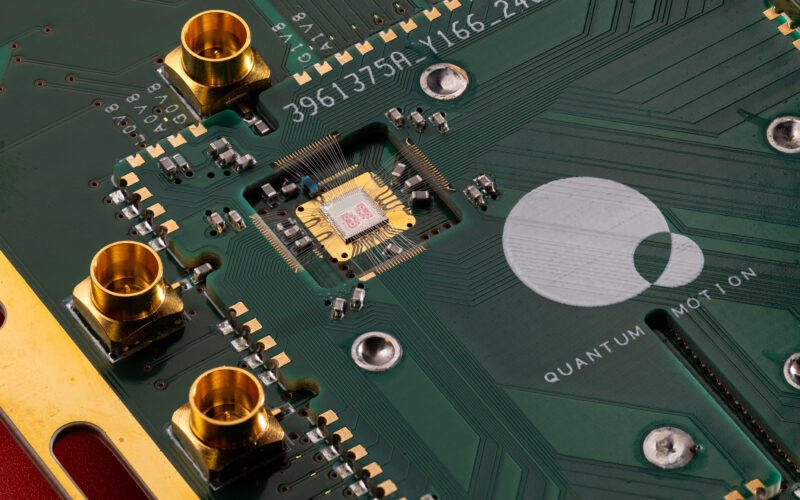
Quantum Motion has raised $160 million in Series C financing to commercialise its silicon transistor-based quantum computing architecture, strengthening its position as the best-funded quantum computing company in the United Kingdom. The round was co-led by DCVC and Kembara, with participation from the British Business Bank and Firgun, alongside existing investors including Oxford Science Enterprises, Inkef, Bosch Ventures, Porsche Automobil Holding SE and Parkwalk Advisors. The funding gives Quantum Motion fresh capital to advance utility-scale quantum computers designed to fit into standard data-centre racks rather than requiring bespoke industrial-scale infrastructure. For the wider quantum computing market, the raise signals that investors are increasingly looking beyond laboratory milestones and asking which architectures can actually scale into commercially deployable systems.
Why does Quantum Motion’s $160 million Series C matter for scalable quantum computing?
Quantum Motion’s latest financing lands at a moment when quantum computing is shifting from scientific promise to infrastructure question. The issue is no longer whether quantum systems can demonstrate impressive physics in controlled environments. The harder question is whether those systems can be manufactured, cooled, powered, maintained and deployed in ways that fit the economics of enterprise computing.
That is where Quantum Motion is trying to differentiate itself. Its architecture is based on silicon transistor technology, the same broad semiconductor foundation that underpins modern smartphones, laptops and data-centre chips. By tying quantum computing to a mature manufacturing ecosystem, Quantum Motion is betting that the industry’s most credible route to scale will come from adapting existing semiconductor supply chains rather than inventing every layer of the stack from scratch.
The $160 million raise also reflects a subtle but important change in investor expectations. Quantum companies can no longer rely only on high-level claims about future computational advantage. Capital is beginning to move toward platforms that can answer practical questions around cost, footprint, energy usage and manufacturability. Quantum Motion’s pitch is that quantum computing will only become commercially relevant if it can avoid becoming another massive infrastructure burden at the exact moment when artificial intelligence data centres are already testing power grids, real estate markets and utility planning.

How does Quantum Motion’s silicon transistor architecture change the quantum data-centre equation?
Quantum Motion claims its silicon transistor-based approach can reduce cost and space requirements by 100 times and energy consumption by 1,000 times compared with alternative quantum computing approaches. Those figures are striking, but their strategic importance lies less in the headline ratios and more in the deployment model they imply. A quantum computer that can fit into standard data-centre racks has a very different commercial pathway from one that requires purpose-built facilities, unusual operating environments and industrial-scale power planning.
This distinction matters because enterprise technology adoption is often won or lost at the infrastructure layer. Customers may be excited by quantum applications in cryptography, materials science, chemistry, optimization and artificial intelligence. However, enthusiasm can quickly fade if deployment requires new facilities, specialist operating teams and unpredictable energy economics. Quantum Motion is therefore positioning silicon quantum computing as an infrastructure-compatible path rather than a futuristic science project waiting for bespoke real estate.
The architecture also places Quantum Motion closer to the semiconductor industry’s learning curve. If silicon-based qubits can be manufactured using processes related to existing chipmaking, the company may benefit from decades of industrial discipline around yield, miniaturization, reliability and process control. That does not make the technology easy. Quantum computing still involves demanding physics and engineering constraints. But it does mean Quantum Motion is making a scale argument that executives and infrastructure investors can understand: use a proven industrial base, shrink the physical footprint and make deployment feel more like data-centre expansion than national-lab construction.
Why is Quantum Motion’s GlobalFoundries partnership strategically important for quantum manufacturing?
Quantum Motion’s deepened manufacturing partnership with GlobalFoundries is one of the more consequential elements in its roadmap because it connects the company’s quantum ambitions with commercial semiconductor production infrastructure. In quantum computing, manufacturing is not a side issue. It is the bridge between experimental devices and repeatable systems that can be delivered to customers at meaningful scale.
Many quantum competitors continue to focus public messaging on qubit counts, scientific breakthroughs or roadmap targets. Quantum Motion is taking a more industrial route by emphasizing manufacturability and integration into existing supply chains. That strategy may prove attractive to investors who have watched other deep-tech sectors struggle when prototypes failed to translate into scalable production economics.
The GlobalFoundries link also helps Quantum Motion frame silicon quantum computing as part of a broader technology sovereignty narrative. Governments in the United Kingdom, the United States, Europe and Asia are treating semiconductors, artificial intelligence and quantum computing as strategic infrastructure. A quantum architecture that can align with commercial chipmaking capacity could carry policy advantages as well as technical ones. It gives Quantum Motion a story that speaks not only to customers and investors, but also to governments looking to anchor next-generation computing capability within trusted industrial ecosystems.
What does the UK’s National Quantum Computing Centre deployment signal about commercial readiness?
Quantum Motion’s deployment of a full-stack silicon CMOS quantum computer at the United Kingdom’s National Quantum Computing Centre in 2025 is important because it moves the company beyond the language of future ambition. A system placed inside a national quantum facility gives Quantum Motion a reference point for technical validation, ecosystem credibility and customer education.
The deployment does not mean utility-scale quantum computing has arrived in everyday enterprise workflows. That threshold remains difficult across the entire sector. What it does show is that Quantum Motion is trying to prove its architecture in a setting designed to evaluate real quantum systems rather than isolated components. For a field crowded with long timelines and heavy claims, that distinction matters.
The National Quantum Computing Centre deployment also gives Quantum Motion a platform from which to engage potential partners, policymakers and technical users. Quantum adoption will not happen through hardware alone. It will require software layers, application development, benchmarking, error correction progress and customer confidence. A visible deployment inside a national facility helps Quantum Motion participate in that broader ecosystem while building credibility around its silicon-first thesis.
How could Quantum Motion’s funding reshape competition among quantum computing architectures?
Quantum Motion’s financing adds pressure to a quantum computing market already split across competing architectures, including superconducting qubits, trapped ions, photonics, neutral atoms and silicon spin-based approaches. Each architecture has its champions, trade-offs and technical bottlenecks. The market is still too early for a single winner to be declared, which makes capital allocation especially important.
The new funding gives Quantum Motion more room to convert its architectural thesis into engineering progress. That matters because quantum computing is a capital-intensive race where timelines are long and investor patience can be tested. Companies that can secure large funding rounds gain not only technical runway, but also commercial credibility with partners that do not want to build around platforms that may run out of capital before reaching scale.
For competitors, Quantum Motion’s raise sharpens the debate around practical deployment. If the company can demonstrate that silicon quantum systems are materially easier to manufacture, power and deploy, rivals may face tougher questions about infrastructure economics. Conversely, if alternative architectures deliver stronger error rates, faster progress toward logical qubits or earlier application advantage, Quantum Motion’s silicon efficiency story may not be enough on its own. The next phase of competition will likely be less about which company has the most compelling vision and more about which architecture can produce usable, reliable and economically viable quantum systems.
Why are investors connecting quantum computing with artificial intelligence infrastructure pressure?
Quantum Motion’s funding narrative is closely tied to a broader infrastructure tension: artificial intelligence has already turned compute into a power, cooling and real estate problem. Data-centre operators, utilities and governments are grappling with how to support rapidly expanding AI workloads. If quantum computing follows a similarly resource-heavy path, the next wave of compute could intensify the same bottlenecks before the current ones are solved.
That context makes Quantum Motion’s energy-efficiency argument commercially relevant. A quantum system that requires multi-megawatt infrastructure may be viable for governments, hyperscalers or national research labs, but it would face a narrower adoption curve. A system that can fit into standard data-centre racks could, in theory, reach a much broader customer base over time.
Investors are therefore not just funding a quantum hardware company. They are funding a view of how advanced computing infrastructure should evolve. Quantum Motion’s argument is that quantum computers should integrate into the data-centre world, not force that world to rebuild itself around quantum hardware. That is a powerful claim, but it also raises the bar. The company must now show that its technical architecture can deliver not only compactness and efficiency, but also the performance, reliability and error-management capabilities that real quantum advantage will demand.
What execution risks could challenge Quantum Motion after its $160 million raise?
Quantum Motion’s opportunity is significant, but the execution risks remain substantial. Quantum computing is still one of the most technically demanding areas of advanced technology, and silicon compatibility does not automatically solve the core challenges of qubit quality, control, error correction and system integration. The company’s industrial thesis is credible only if the underlying quantum performance advances in parallel with manufacturability.
There is also a commercialization risk. Even if Quantum Motion builds more compact and energy-efficient systems, customers will need compelling use cases that justify adoption. Quantum computing has long promised major advantages in fields such as drug discovery, materials science, logistics and cryptography, but commercial buyers will require measurable outcomes rather than theoretical future value. The company will need to help close the gap between hardware capability and application-level usefulness.
Capital intensity is another factor. A $160 million Series C round is large, but quantum computing roadmaps can absorb enormous amounts of capital before revenue maturity. Quantum Motion must balance research progress, hardware development, manufacturing partnerships, international expansion and commercial engagement without losing focus. The company’s ability to prioritize milestones will be just as important as the strength of its architecture.
What happens next if Quantum Motion’s silicon quantum strategy succeeds?
If Quantum Motion succeeds, the implications could extend well beyond one private company. A scalable silicon quantum architecture would reinforce the idea that quantum computing’s future may depend on compatibility with the semiconductor industry rather than separation from it. That could reshape investment flows, government funding priorities and partnership strategies across the sector.
A successful silicon route could also make quantum computing more accessible to conventional data-centre operators. That would not make quantum systems ordinary overnight, but it could shorten the distance between research infrastructure and enterprise deployment. For industries that need advanced simulation, optimization or cryptographic resilience, a more compact and energy-efficient quantum platform could accelerate experimentation and eventual adoption.
The bigger strategic consequence is that Quantum Motion is trying to define quantum computing as an industrial infrastructure market, not just a scientific race. That is a more demanding arena because it requires performance, economics, supply-chain maturity and customer trust. But it is also where the largest commercial opportunity sits. Quantum computing will not become foundational because it looks impressive in a laboratory. It will become foundational only if it can be manufactured, deployed and operated at scale. Quantum Motion’s $160 million raise is a major bet that silicon can turn that ambition into something the computing industry can actually build around.
Key takeaways on how Quantum Motion’s $160 million raise could shape quantum computing infrastructure
- Quantum Motion’s Series C financing strengthens its claim to be one of the most closely watched private quantum computing companies in the United Kingdom.
- The company’s silicon transistor-based architecture is strategically important because it links quantum computing to established semiconductor manufacturing logic.
- The core commercial argument is not just better quantum performance, but lower cost, lower energy use and compatibility with standard data-centre racks.
- Quantum Motion’s partnership with GlobalFoundries gives its roadmap a manufacturing dimension that many early-stage quantum competitors still need to prove.
- The deployment at the United Kingdom’s National Quantum Computing Centre gives Quantum Motion a valuable validation platform, although it does not remove the broader technical hurdles facing the sector.
- The funding round reflects growing investor preference for quantum companies that can explain infrastructure economics, not just scientific potential.
- Quantum Motion’s approach could pressure rival quantum architectures to demonstrate credible answers on power consumption, facility footprint and manufacturing scalability.
- The company still faces major execution risks around qubit performance, error correction, system reliability and commercial use-case development.
- If successful, Quantum Motion could help shift quantum computing from bespoke research infrastructure toward deployable enterprise and data-centre systems.
- The next test is whether the company can convert a strong funding narrative into measurable technical and commercial milestones.
Discover more from Business-News-Today.com
Subscribe to get the latest posts sent to your email.