IonQ, Inc. (NYSE: IONQ) completed its $1.8 billion acquisition of SkyWater Technology, Inc. (NASDAQ: SKYT) on 31 July 2026, closing the deal within days of receiving final regulatory clearance and immediately after the U.S. Federal Trade Commission published statements revealing that its two sitting members had split 1-1 on whether to attach behavioural conditions to the transaction. The completion positions IonQ as the only quantum hardware company in the world with in-house ownership of a Pentagon-accredited semiconductor foundry, and it lands three trading days before the combined company hosts its Q2 2026 earnings call on 5 August. The central tension is straightforward. IonQ has secured a domestic foundry that its chairman calls essential to the quantum roadmap, but it has done so while its Q1 revenue base sits near $65 million a quarter, its full-year 2026 adjusted EBITDA loss is guided to between $310 million and $330 million, and the acquired foundry business brings its own capex intensity into a P&L that is already deeply unprofitable.
What did the FTC’s 1-1 split on the IonQ-SkyWater merger actually decide and why does it matter for the quantum sector?
The Federal Trade Commission granted early termination of its investigation on 28 July 2026, allowing the merger to close without conditions. According to statements released by the agency on 31 July, Chairman Andrew Ferguson had proposed a settlement that would have required IonQ to guarantee fair access to SkyWater’s foundry services for rival quantum computing firms with existing contracts, and to erect information barriers preventing IonQ from viewing those rivals’ competitively sensitive designs. Commissioner Mark Meador issued a separate statement saying he did not believe the merger would materially lessen competition, and that the concerns raised by some commentators about the deal had been overstated. Because Andrew Ferguson and Mark Meador could not agree on an order imposing conditions, the agency permitted the transaction to proceed unconditionally. Andrew Ferguson framed the outcome directly in his statement, describing it as the “next-best option” once the two commissioners could not converge.
The practical consequence is that IonQ inherits an existing SkyWater customer book that includes quantum computing companies IonQ competes with. The FTC’s own statements acknowledged that concern without imposing a remedy. That leaves the market to price the risk that rival quantum hardware developers relying on SkyWater’s Bloomington facility for chip fabrication, packaging or advanced development services now have a competitor sitting at the top of their supply chain. Whether that risk becomes a commercial issue will depend on how SkyWater’s merchant foundry model is managed post-close and how the combined company chooses to describe its customer commitments at the 8 September investor day.
How does the $15 cash plus 0.4883 IonQ share consideration structure change the economics of the transaction for SkyWater shareholders?
The original definitive agreement, signed on 25 January 2026, set the headline price at $35.00 per SkyWater share, delivered as $15.00 in cash and $20.00 in IonQ common stock, subject to a collar mechanism. The stock portion was to be valued at $20.00 per SkyWater share based on the 20-day volume-weighted average price of IonQ shares three business days before close. Above an IonQ VWAP of $60.13, the exchange ratio was capped at 0.3326 IonQ shares per SkyWater share. Below $37.99, the exchange ratio was floored at 0.5265. Between those bookends, the ratio adjusted to deliver the fixed $20 stock value.
The final consideration paid on 31 July 2026 came in at $15.00 in cash plus 0.4883 IonQ shares per SkyWater share. That fixed exchange ratio implies that IonQ’s reference VWAP sat within the collar corridor, and it locks the actual stock value each SkyWater holder received to IonQ’s post-close share price rather than the $20 reference. At IonQ’s recent trading range near $34-$36, the 0.4883 ratio translates to roughly $16.60-$17.60 of stock value, or a combined per-share payout of approximately $31.60-$32.60, below the $35 headline. That gap is a function of the collar working as intended after IonQ’s shares came off their late-May high above $72 and drifted lower through July. SkyWater shareholders now own between 4.4% and 6.7% of the combined company under the collar range disclosed when the deal was announced. SkyWater also repaid and terminated its revolving credit facility at closing without material early termination penalties, cleaning up the balance sheet IonQ has now consolidated.
Why does the Pentagon-accredited Category 1A Trusted Foundry position give IonQ a defence pipeline advantage over Quantinuum, Rigetti and D-Wave?
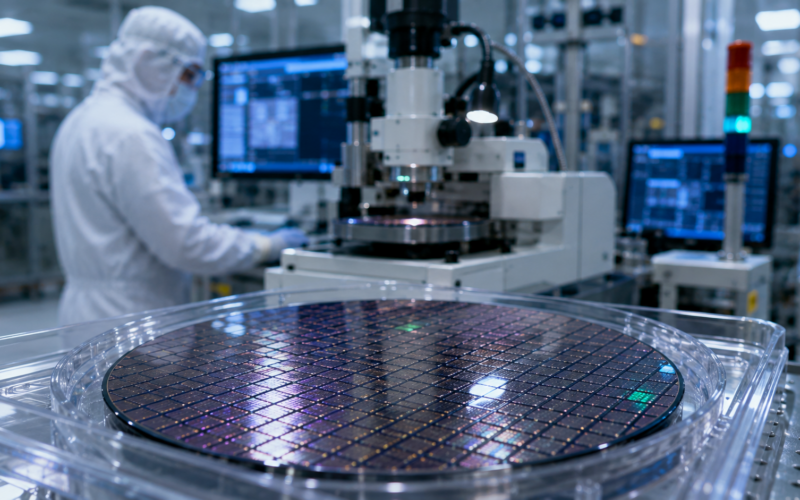
SkyWater describes itself as the largest exclusively U.S.-based, pure-play semiconductor foundry, headquartered in Bloomington, Minnesota, with additional facilities in Florida and Texas. The Bloomington fab is DMEA-accredited as a Category 1A Trusted Foundry, a designation issued by the Defense Microelectronics Activity that qualifies the site to fabricate parts for sensitive U.S. government programmes without additional facility clearances. Under the closed transaction, SkyWater’s three U.S. sites are being designated as Regional Quantum Production Hubs while SkyWater continues to serve its full commercial and defence customer base as a wholly owned subsidiary operating under its existing name and led by chief executive Thomas Sonderman.
The strategic significance for IonQ is that its trapped-ion quantum computing peers do not have equivalent in-house U.S. foundry capability. Quantinuum has publicly relied on Germany’s Infineon for chip fabrication, and other listed U.S. quantum names including Rigetti Computing (NASDAQ: RGTI), D-Wave Quantum (NYSE: QBTS) and Quantum Computing Inc. (NASDAQ: QUBT) operate without a Pentagon-accredited domestic foundry backbone. For U.S. Department of War procurement, National Security Agency contracting and Intelligence Community programmes where quantum hardware is increasingly relevant to sensing, networking and cryptographic use cases, a Trusted Foundry status is often more than a marketing line. It shortens the accreditation timeline for classified work and simplifies the paperwork on any programme that touches export-controlled designs. That is the moat IonQ has bought, and it is why chairman and chief executive Niccolo de Masi has framed the acquisition as crystallising IonQ’s ambition to be both a technology leader and an ecosystem enabler across the quantum industry.
What does the vertical integration actually mean for IonQ’s fault-tolerant quantum computing roadmap and merchant foundry model?
IonQ has publicly stated a goal of testing a 200,000-qubit processor by 2028 and building toward fault-tolerant quantum computing. Fault tolerance in trapped-ion systems requires industrial-scale chip fabrication and packaging capable of producing microfabricated ion-trap components with tight tolerances at repeatable yields. Owning the foundry allows IonQ to run design-manufacture cycles internally rather than negotiating throughput and priority with an external partner, and to iterate on advanced packaging where hybrid quantum-classical integration will become an increasing bottleneck. That is the theoretical case for vertical integration. It is also the case IonQ has to prove operationally.
The counterpoint is that SkyWater still needs to run as a merchant foundry to preserve utilisation, and Thomas Sonderman’s statement at signing emphasised that SkyWater remains fully committed to all its foundry customers, including those it will continue to serve as the “quantum merchant supplier of choice.” Those two commitments, prioritising IonQ’s internal roadmap while preserving external customer relationships, are not automatically in conflict, but they will require disciplined capacity allocation. The FTC’s proposed but unenforced access remedy has now been replaced by market accountability. If IonQ is seen to be favouring its own quantum programmes at the expense of external quantum customers, those customers can migrate, and the merchant foundry economics that underpin SkyWater’s revenue base can erode. The 8 September investor day is likely to be the first structured opportunity for management to describe how capacity, pricing and IP boundaries between the two businesses will be governed.
How does the SkyWater foundry business layer onto IonQ’s $260 million revenue base and $310 million adjusted EBITDA loss guide for full-year 2026?
IonQ raised its full-year 2026 revenue guidance to $260 million to $270 million after reporting Q1 2026 revenue of $64.7 million, a 755% year-on-year increase. The company also guided to a full-year adjusted EBITDA loss of $310 million to $330 million and disclosed a remaining performance obligation backlog of approximately $470 million, up around 554% year-on-year. Cash and equivalents stood at $493.54 million in the most recent reported period, with total debt of $30.44 million and a broader liquidity position that Wall Street summaries have described as roughly $3.1 billion after the completion of prior financing rounds. BlackRock disclosed a 5.3% stake in IonQ on 29 July 2026, one of several institutional positioning signals ahead of the closing.
Adding SkyWater to that base changes several lines at once. Revenue from foundry services becomes an incremental contributor, but foundry gross margins historically sit well below software or quantum-as-a-service margins, and SkyWater’s own historical operating trajectory has been closer to break-even than to earnings accretion. Capex intensity rises because the foundry requires ongoing tool and process investment. Working capital rises because a fab carries inventory and receivables. Depreciation and amortisation charges rise because a manufacturing plant is a heavy fixed-asset business. And the goodwill and intangibles created by paying roughly $1.8 billion in equity value for a company with tangible assets well below that number will now sit on IonQ’s balance sheet, exposing it to future impairment testing if the strategic thesis takes longer to convert than management expects. The 5 August combined earnings call is the first opportunity for chief financial officer Thomas Kramer, or whoever fronts the numbers on the day, to walk investors through pro-forma economics rather than the two entities being modelled separately.
Where does the August 5 combined earnings call and September 8 investor day leave the near-term IONQ setup for institutional and retail investors?
IonQ shares closed the July 31 trading session near $36 after a difficult June and July in which the stock retreated roughly 27% from its 26 June close of $49.31, and more than half from its 29 May 2026 peak of $72.07. The 52-week range now spans $25.89 to $84.64, and the market capitalisation sits around $12 billion depending on the reference session. The sell-side has stayed constructive despite the drawdown. Oppenheimer, Wolfe Research and Sanford C. Bernstein all initiated coverage on 30 July, Rosenblatt Securities reiterated a buy, and Wedbush publicly described the SkyWater deal as “sensible.” Consensus 12-month price targets have clustered in the high $60s, with individual targets running above $70, though the wide dispersion between initiation ratings, one at outperform, one at peer perform, one at market perform, is a reminder that Wall Street has not converged on a single view of what a vertically integrated quantum platform is actually worth.
The 5 August print now carries the weight of three separate expectations. It has to demonstrate revenue momentum on the standalone IonQ business relative to the $66.4 million Yahoo Finance is showing as consensus for the quarter. It has to give investors a first read of how SkyWater will be reported inside IonQ’s financial framework. And it has to prepare the ground for the 8 September investor day, at which management will be expected to lay out the fault-tolerant roadmap milestones, the customer commitments SkyWater is honouring, and the capital deployment path that turns $3.1 billion of headline liquidity into a defensible competitive position. Between the FTC’s split decision, the collar-driven consideration adjustment and the arrival of a capital-intensive manufacturing business inside a company still generating substantial EBITDA losses, the near-term investment case has more moving parts than it did at the January signing.
What should investors track as IonQ integrates SkyWater into the August 5 earnings call and September 8 investor day setup?
- IonQ completed its $1.8 billion acquisition of SkyWater Technology on 31 July 2026 after the Federal Trade Commission granted early termination and allowed the deal to close without conditions.
- The FTC’s own statements confirmed a 1-1 split, with Chairman Andrew Ferguson proposing fair-access and information-barrier remedies and Commissioner Mark Meador concluding that no material lessening of competition would result.
- Final consideration was $15.00 cash plus 0.4883 IonQ shares per SkyWater share, with the collar-driven fixed exchange ratio implying a combined per-share value below the $35 headline given IonQ’s recent trading range.
- SkyWater continues to operate as a wholly owned subsidiary under its existing name and leadership, with Thomas Sonderman reporting to IonQ chairman and chief executive Niccolo de Masi.
- The Bloomington DMEA-accredited Category 1A Trusted Foundry, together with the Florida and Texas facilities designated as Regional Quantum Production Hubs, gives IonQ a defence-grade domestic manufacturing base its trapped-ion peers do not currently match.
- Quantinuum’s continued reliance on Germany’s Infineon, and the absence of comparable in-house U.S. fab capability at Rigetti Computing, D-Wave Quantum and Quantum Computing Inc., reinforces the strategic asymmetry IonQ has now purchased.
- The foundry business adds revenue but layers capex, working capital, depreciation and goodwill onto a company already guiding to a $310 to $330 million adjusted EBITDA loss for FY 2026 on a $260 to $270 million revenue base.
- Institutional signalling around the close has been mixed to constructive, with BlackRock disclosing a 5.3% stake on 29 July 2026 and Oppenheimer, Wolfe Research, Sanford C. Bernstein and Rosenblatt Securities all issuing or reiterating coverage in the days before completion.
- The next measurable proof point is the 5 August combined Q2 earnings release and call, which is the first opportunity for management to describe pro-forma economics and to address the FTC-flagged question of how SkyWater’s rival-quantum customers will be treated.
- The follow-on catalyst is the 8 September 2026 investor day, at which the fault-tolerant roadmap toward a 200,000-qubit processor by 2028, the capacity allocation framework between IonQ-internal and merchant foundry work, and the capital deployment path against roughly $3.1 billion of liquidity will need to be spelled out in more operational detail than the closing announcement provided.
Discover more from Business-News-Today.com
Subscribe to get the latest posts sent to your email.