



INDO-MIM Limited will open its ₹3,811.21 crore initial public offering on July 23, 2026, at a price band of ₹461 to ₹485 per share, with the proposed BSE and National Stock Exchange of India listing scheduled for July 30. The latest unofficial grey market premium stood at ₹194 on July 22, representing 40% of the upper price band and indicating an estimated listing price of ₹679 if that premium holds. The offer combines a fresh issue with a substantially larger offer for sale, meaning only a limited portion of the money committed by IPO investors will enter the company. The central question is whether Indo-MIM Limited’s strong growth, global manufacturing footprint and high returns justify an upper-band valuation of nearly 45 times diluted post-offer fiscal 2026 earnings before any grey market enthusiasm is added.
Why has the Indo-MIM IPO GMP held near 40% before the ₹3,811 crore offer opens?
The Indo-MIM IPO grey market premium was quoted at ₹194 per share on July 22, implying an estimated price of ₹679 against the upper end of the IPO price band. At the minimum retail application size of 30 shares, that unofficial premium translates into a theoretical gain of ₹5,820 per lot.
That is an indication of pre-listing demand, not a forecast backed by the Securities and Exchange Board of India, BSE Limited or the National Stock Exchange of India Limited. Grey market transactions occur outside the recognised exchanges, can involve limited liquidity and may move sharply when the institutional book, broader market conditions or final subscription numbers change.
The recent GMP pattern itself provides a useful reminder. The premium was reported at ₹168 on July 18, climbed to ₹213 on July 19 and subsequently settled around ₹194. The movement still reflects strong interest, but it also shows that the implied listing price is not fixed.
Anchor investors are scheduled to bid on July 22, one day before the public offer opens. The composition and scale of the anchor allocation will offer an initial institutional demand signal, while category-wise subscription figures between July 23 and July 27 will provide better evidence than grey market quotations alone.
For investors evaluating the Indo-MIM IPO, the GMP is best treated as a sentiment indicator. The underlying investment case still rests on earnings growth, margin durability, debt reduction and the valuation being paid for those attributes.
How much of the Indo-MIM IPO will strengthen the company rather than fund shareholder exits?
The Indo-MIM IPO comprises a fresh issue of approximately 1.03 crore shares and an offer for sale of 6.83 crore shares. At the upper price band, the fresh component is designed to raise up to ₹500 crore before accounting for the employee discount, while the offer for sale is valued at approximately ₹3,312.11 crore.
Eligible employees are being offered a discount of ₹45 per share. After accounting for that discount, the reported aggregate offer size at the upper end is approximately ₹3,811.21 crore, while the fresh-issue contribution is approximately ₹499.10 crore.
This means roughly 87% of the total offer value represents shares being sold by existing holders, while about 13% represents new capital for Indo-MIM Limited. The distinction matters because offer-for-sale proceeds go to the selling shareholders and do not strengthen the company’s cash position.
Green Meadows Investments Ltd is offering up to 6.05 crore shares, while Anuradha Koduri is selling up to 54.59 lakh shares. Indian Institute of Technology Madras is offering up to 23.08 lakh shares.
A large offer for sale is not automatically a negative signal. It can create public ownership, provide liquidity and establish price discovery for a company that has operated privately for decades. However, it means the IPO should not be described primarily as a major growth-capital raise. The transaction is principally a partial shareholder monetisation combined with a smaller balance-sheet intervention.
Indo-MIM Limited intends to allocate ₹400 crore from the net fresh-issue proceeds toward repayment or prepayment of certain outstanding borrowings. The balance will be used for general corporate purposes, subject to the disclosed limit.
The company reported total borrowings of ₹1,090.49 crore at March 31, 2026. Applying ₹400 crore toward debt could materially reduce leverage and finance costs, although the precise post-offer position will depend on issue expenses, repayment timing and subsequent capital requirements.
Do Indo-MIM’s FY26 growth, cash generation and returns support a premium IPO valuation?
Indo-MIM Limited enters the public market with a stronger financial record than many manufacturing IPO candidates. Revenue from operations increased 25.93% to ₹4,192.99 crore in fiscal 2026, compared with ₹3,329.58 crore in fiscal 2025 and ₹2,870.40 crore in fiscal 2024.
Profit after tax rose to ₹533.54 crore from ₹423.73 crore in fiscal 2025 and ₹283.73 crore in fiscal 2024. That represents a two-year compound annual profit growth rate of approximately 37%, comfortably ahead of the corresponding revenue growth rate of about 21%.
Operating cash generation also improved substantially. Net cash generated from operating activities increased to ₹1,077.24 crore in fiscal 2026 from ₹506.27 crore in the previous year. That cash conversion strengthens the quality of the reported earnings and suggests that growth has not depended entirely on working-capital expansion or external financing.
Return on capital employed reached 26.60%, up from 23.51% in fiscal 2025, while return on net worth improved to 21.26% from 19.94%. Net debt to EBITDA declined to 0.65 times from 1.15 times, indicating that leverage was already becoming more manageable before the proposed IPO repayment.
The area requiring closer attention is operating margin. EBITDA increased 14.83% to ₹1,070.92 crore, but the EBITDA margin declined to 25.54% from 28.01%. The 247-basis-point contraction means revenue and profit growth should not be interpreted as evidence that every operating metric improved.
Profit after tax margin was broadly stable at 12.72%, compared with 12.73% in fiscal 2025. That resilience is encouraging, but future earnings growth will need support from scale, product mix, pricing and operating efficiency if the company is to sustain a premium valuation.
The financial record therefore supports a credible industrial growth story. It does not eliminate the need to examine how much future success has already been incorporated into the IPO price.
What does Indo-MIM’s global manufacturing footprint reveal about resilience and concentration?
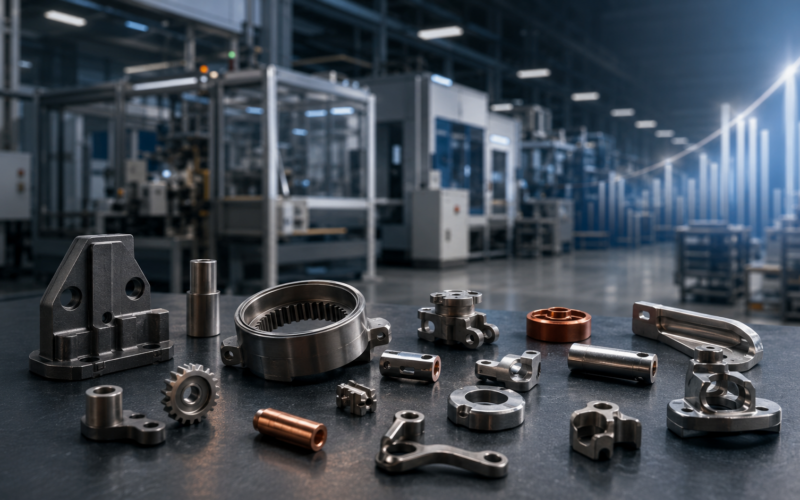
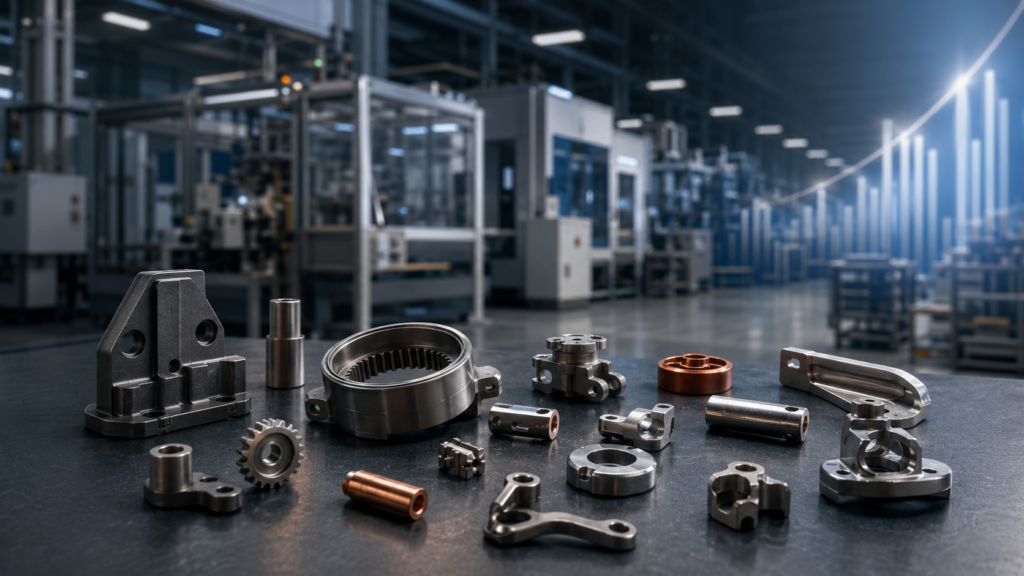
Indo-MIM Limited manufactures precision engineering components using metal injection moulding technology, combining tooling, mould design, finishing and assembly. The company manufactured more than 9,000 product types during fiscal 2026 and supplied customers across automotive, defence, medical devices, consumer products and aerospace markets.
The company operates 15 manufacturing facilities, including six in India, six in the United States, two in the United Kingdom and one in Mexico. It supplied products to customers in 55 countries over the past three financial years.
A Frost & Sullivan industry report included with the offer documents identified Indo-MIM Limited as the largest global manufacturer of precision engineering components using metal injection moulding technology by revenue, with an estimated 6.8% market share in calendar 2025. The report estimated the global metal injection moulding market at approximately $4 billion.
Diversification is visible across end markets. Automotive contributed 24.61% of fiscal 2026 revenue, while defence accounted for 18.69%, medical products 18.08%, aerospace 11.96% and consumer products 10.80%. Other revenue, including powder, tools and traded products, contributed 15.86%.
The mix nevertheless changed significantly during fiscal 2026. Defence revenue declined from ₹892.31 crore to ₹783.68 crore, while medical, aerospace, consumer and other revenue increased. This suggests that the company’s broader portfolio helped offset weakness in one important end market.
Geographically, North America remained the largest contributor at 43.68% of fiscal 2026 revenue, followed by India at 22.80% and Europe at 19.97%. India’s contribution increased from 10.08% in fiscal 2025, reducing the share of revenue earned outside India to 77.20% from 89.92%.
That shift provides some geographic balancing, but Indo-MIM Limited remains export-oriented. Currency movements, trade restrictions, customer production cycles and economic conditions in overseas markets can therefore affect revenue and margins.
The top five customers contributed 28.95% of revenue, while the top ten accounted for 38.41%. These percentages are not exceptionally concentrated for a specialised component manufacturer, but they remain financially relevant. The company also generally operates through purchase orders rather than customer agreements containing firm long-term purchase commitments.
Raw-material exposure adds another layer. Imports represented 60.95% of total raw-material purchases during fiscal 2026. Metal powder and polymer availability, commodity-price movements, currency volatility and import restrictions could consequently influence costs and production continuity.
Is Indo-MIM’s ₹485 upper price band reasonable before factoring in the grey-market premium?
At ₹485 per share, Indo-MIM Limited would have a post-offer equity value of approximately ₹23,981 crore, based on the anticipated post-issue share count. Using fiscal 2026 profit after tax without assuming future earnings growth, the diluted post-offer earnings per share works out to approximately ₹10.79.
That places the upper price band at about 44.95 times fiscal 2026 earnings. The valuation is substantial for an industrial manufacturing company, even one reporting strong revenue growth, cash conversion and returns on capital.
The ₹194 grey market premium implies a price of ₹679. At that level, the corresponding post-offer equity valuation would rise to approximately ₹33,574 crore, equivalent to almost 63 times fiscal 2026 earnings on the same static calculation.
These figures do not establish that Indo-MIM Limited is overvalued or undervalued. They reveal the degree of future growth embedded in the price. A valuation close to 45 times trailing earnings can remain supported if revenue continues expanding at a strong rate, margins stabilise and debt reduction improves earnings quality. The implied grey market valuation demands an even more ambitious performance trajectory.
Direct peer comparison is complicated because Indo-MIM Limited combines metal injection moulding, precision engineering, global manufacturing and exposure to multiple end markets. Its profitability and market position distinguish it from conventional component suppliers. That distinction may justify a premium, but it does not make valuation irrelevant.
The most important tension is therefore not whether Indo-MIM Limited is a good business. The available financial evidence indicates a profitable, cash-generative manufacturer with a global operating footprint. The harder question is whether the IPO valuation leaves sufficient room for slower growth, margin volatility or fluctuations across export markets.
Which milestones will decide whether Indo-MIM IPO optimism survives the July 30 listing?
The public offer will remain open from July 23 through July 27. The basis of allotment is expected to be finalised on July 28, followed by refunds and credit of shares on July 29. Trading on BSE Limited and the National Stock Exchange of India Limited is scheduled to begin on July 30.
The first test will be institutional demand, beginning with the anchor allocation and followed by qualified institutional buyer subscription. Retail and non-institutional demand may strengthen the sentiment picture, but institutional participation can provide a more useful signal about how professional investors view the valuation.
The listing price will then show whether the reported GMP translated into recognised market demand. Even a strong debut would primarily establish the opening valuation, not validate the company’s longer-term earnings trajectory.
After listing, the more durable proof points will be quarterly revenue growth, EBITDA margin stability, operating cash generation and confirmation that the planned debt repayment has been completed. Investors will also need to assess whether faster-growing medical, aerospace, consumer and Indian revenue streams can compensate for volatility in defence, automotive and export markets.
Indo-MIM Limited has improved its financial scale, cash flow and return profile ahead of the IPO. What remains unresolved is whether those gains can compound fast enough to support a valuation approaching 45 times trailing earnings at the offer price, or almost 63 times at the current GMP-implied price. The decisive test will be sustained earnings growth without further material margin erosion after the initial listing excitement fades.
What are the key takeaways from the Indo-MIM IPO GMP, valuation and listing outlook?
- The ₹3,811.21 crore Indo-MIM IPO opens on July 23 at a price band of ₹461 to ₹485 per share.
- A ₹194 grey market premium represents 40% of the upper price band and implies an unofficial estimated price of ₹679.
- Approximately 87% of the offer value is an offer for sale, while about 13% represents fresh capital for the company.
- Indo-MIM Limited plans to use ₹400 crore of the net fresh proceeds to repay or prepay borrowings.
- Fiscal 2026 revenue grew 25.93% to ₹4,192.99 crore, while profit after tax increased to ₹533.54 crore.
- Operating cash flow more than doubled to ₹1,077.24 crore, strengthening the quality of reported earnings.
- EBITDA margin declined by 247 basis points to 25.54%, creating an important post-listing performance test.
- The upper price band implies a post-offer valuation of nearly ₹23,981 crore and approximately 45 times fiscal 2026 earnings.
- The GMP-implied ₹679 price would value the company at approximately ₹33,574 crore and almost 63 times fiscal 2026 earnings.
- Anchor participation, final subscription, debt reduction and quarterly margin performance will determine whether the early optimism proves durable.
Discover more from Business-News-Today.com
Subscribe to get the latest posts sent to your email.

