




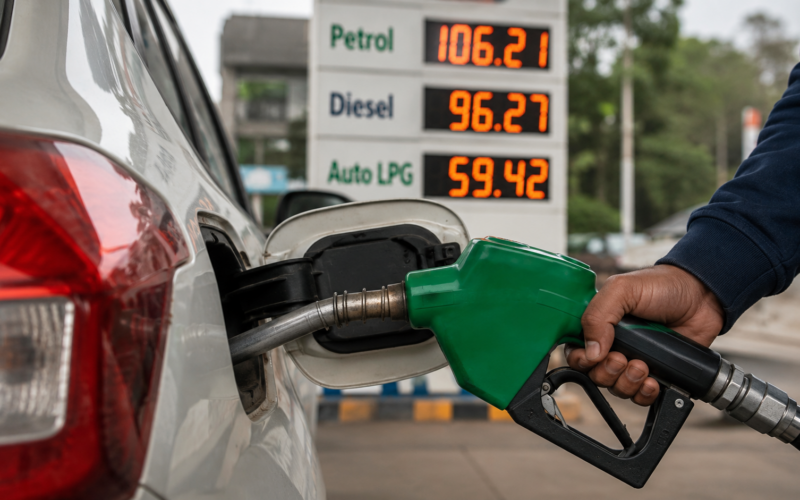
India’s latest petrol and diesel price hikes have turned into a fresh economic policy test for the Union government and the Reserve Bank of India, as higher fuel costs begin to feed into household budgets, transport costs, business margins and inflation expectations.
State-run oil marketing companies raised petrol and diesel prices again on May 25, 2026, marking the fourth fuel price increase in less than two weeks. Petrol was raised by around ₹2.61 per litre and diesel by around ₹2.71 per litre in the latest revision, taking the cumulative rise since mid-May to nearly ₹7.5 per litre in several markets.
The fuel price increases come against the backdrop of the West Asia conflict, higher crude oil prices, pressure on India’s oil import bill and concern over foreign exchange outflows. India is one of the world’s largest crude oil importers, making domestic inflation and fiscal planning highly sensitive to global energy shocks.
Union Finance Minister Nirmala Sitharaman has urged attention to what she described as the “3Fs”: fuel, fertiliser and foreign exchange. The message reflects the government’s concern that external shocks could affect household costs, food production, currency stability and the wider macroeconomic balance.
The Reserve Bank of India now faces a complicated policy setting. A fuel price rise directly affects inflation through petrol and diesel components, but the larger impact comes through transport costs, logistics, manufactured goods, food distribution and services. That makes the current price cycle more than a retail fuel issue. It is a test of whether India can absorb an imported energy shock without derailing growth, consumption or inflation control.
Why are India’s latest petrol and diesel price hikes creating a wider inflation challenge?
India’s latest petrol and diesel price hikes create a wider inflation challenge because fuel prices affect almost every layer of the economy. Petrol and diesel are not only consumer fuels. Diesel is deeply embedded in freight movement, agriculture logistics, construction, small business operations and the distribution of essential goods.
The confirmed development is that fuel prices have been raised repeatedly in May 2026, with the May 25 increase becoming the fourth hike in less than two weeks. The institutional concern is that the Union government and the Reserve Bank of India must manage the pass-through from global crude oil prices into domestic inflation without choking growth.
The broader consequence is that fuel inflation rarely stays confined to the pump. Higher diesel prices can raise trucking costs. Higher trucking costs can raise wholesale and retail prices for vegetables, grains, packaged goods, building materials and consumer products. Higher petrol prices reduce disposable income for households that rely on two-wheelers, cars and taxis for daily mobility.
This is why the latest price cycle matters. India’s inflation debate is moving from food and core inflation to imported energy pressure. If crude oil prices stay elevated because of West Asia tensions, India may face a longer period of fuel-related cost pressure rather than a one-time price adjustment.

How does the Reserve Bank of India face a policy dilemma after the fuel price hikes?
The Reserve Bank of India faces a difficult dilemma because fuel-driven inflation is not easily controlled through interest rates alone. Monetary policy can influence demand, credit growth and inflation expectations, but it cannot directly reduce global crude oil prices or lower India’s oil import bill.
The confirmed macroeconomic issue is that higher fuel prices can complicate inflation management. The institutional role of the Reserve Bank of India is to maintain price stability while supporting growth. If fuel costs push inflation higher, the Reserve Bank of India may need to reassess the inflation outlook, but it also has to avoid overreacting to an external supply shock.
The broader consequence is that monetary policy may become more cautious. If fuel costs keep rising, the Reserve Bank of India may find it harder to ease policy even if growth indicators show stress. At the same time, if the Reserve Bank of India tightens too much in response to fuel-led inflation, it could hurt consumption, borrowing, small businesses and investment.
This is the classic policy trap created by imported inflation. The central bank can anchor expectations, but fiscal policy and external trade management become equally important. That is why the current fuel price cycle is not only an Reserve Bank of India story. It is a joint test of monetary policy, fiscal policy and energy security.
Why does the Union government face a fiscal trade-off over petrol and diesel prices?
The Union government faces a fiscal trade-off because it can soften fuel price pain through excise duty cuts, but such cuts reduce revenue. Fuel taxes have long been an important revenue source for the government, and cutting duties during a global oil shock can create pressure on budget calculations.
The confirmed government position is that fuel, fertiliser and foreign exchange are now central areas of concern. Union Finance Minister Nirmala Sitharaman has also linked the fuel debate to revenue considerations, including the potential cost of reducing duties. The institutional challenge is to balance consumer relief with fiscal stability.
The broader consequence is that fuel prices become politically and economically sensitive at the same time. If the government allows global crude prices to pass through fully to consumers, households and businesses feel the pain directly. If the government absorbs too much of the shock through tax cuts or subsidies, the fiscal deficit and public spending priorities may come under pressure.
Fertiliser adds another layer to the problem. Higher energy prices can raise fertiliser costs, and fertiliser prices affect agriculture. If fertiliser costs rise, the government may face pressure to increase subsidies. That links the fuel shock to food security, rural incomes, farm input costs and inflation expectations.
How could fuel price hikes affect households, small businesses and consumption in India?
Fuel price hikes affect households first through daily mobility and then through the price of goods and services. For urban households, higher petrol prices raise commuting costs. For rural and semi-urban households, higher diesel prices can affect transport, farm operations and local goods movement.
The confirmed price movement has already lifted petrol and diesel costs by several rupees per litre in less than two weeks. The institutional concern is that repeated fuel hikes can weaken consumer confidence and reduce spending on non-essential goods. Lower disposable income can affect retail trade, travel, restaurants, discretionary purchases and small service businesses.
Small businesses are especially exposed because many operate with thin margins and limited pricing power. Transport operators, delivery firms, small manufacturers, traders and food businesses may face higher input costs. Some may pass costs to consumers. Others may absorb the hit and accept lower margins.
The broader consequence is that fuel price increases can act like a tax on consumption. Even when household incomes do not change, higher fuel costs reduce the money available for other expenses. In a large domestic market like India, that matters because private consumption is a major driver of growth.
Why are West Asia tensions and crude oil prices central to India’s fuel price problem?
West Asia tensions are central because India depends heavily on imported crude oil, and global energy markets respond quickly to conflict risk in major producing and transit regions. When geopolitical tension raises crude prices, India’s import bill rises and oil marketing companies face pressure to adjust domestic fuel prices.
The confirmed backdrop is that fuel price hikes in India have followed a period of heightened West Asia risk and rising international crude prices. The institutional response has included government messaging on conserving fuel and managing foreign exchange pressures. The Reserve Bank of India must also monitor how higher crude prices affect inflation and currency stability.
The broader consequence is that India’s domestic fuel economy remains tied to global geopolitics. Even if domestic demand remains stable, an external shock can raise prices. If the rupee weakens at the same time, the imported cost of crude rises further. That can worsen the fuel price pass-through.
This is why foreign exchange is part of the government’s “3Fs” concern. Oil imports require dollars. Higher crude prices can increase dollar demand, widen the trade deficit and put pressure on the rupee. A weaker rupee can then make imports more expensive, creating a feedback loop that affects inflation.
What could the latest fuel price cycle mean for India’s inflation and growth outlook?
The latest fuel price cycle could make India’s inflation path more uncertain over the coming months. The direct impact of petrol and diesel prices may be measurable in headline inflation, but the second-round impact through freight, food and services could be more important if fuel prices stay elevated.
The confirmed pattern is repeated price increases in May 2026. The institutional concern is whether the Reserve Bank of India will need to revisit inflation assumptions and whether the government will need to consider relief measures if the price shock becomes politically or economically difficult.
The broader consequence is a more complex growth-inflation balance. India’s economy has shown resilience, but fuel price increases can slow household spending and increase business costs. If inflation rises while consumption weakens, policymakers face a harder trade-off than in a normal demand-driven inflation cycle.
The risk is not only higher inflation. The risk is policy compression. The Reserve Bank of India may become less flexible on interest rates, the Union government may become constrained on tax cuts, and businesses may become cautious about expansion if input costs remain volatile.
What happens next as India manages fuel inflation, fiscal pressure and energy security?
The next phase depends on crude oil prices, the rupee, government tax policy and how oil marketing companies adjust retail prices. If global crude prices ease, the fuel price cycle may stabilise. If West Asia tensions deepen, further pressure on petrol and diesel prices cannot be ruled out.
The institutional response will likely involve close monitoring by the Ministry of Finance, the Ministry of Petroleum and Natural Gas, the Reserve Bank of India and state-run oil marketing companies. Each institution handles a different part of the problem. The Ministry of Finance manages fiscal space. The Ministry of Petroleum and Natural Gas engages with fuel supply and pricing. The Reserve Bank of India monitors inflation and monetary conditions. Oil marketing companies manage retail price transmission.
The broader consequence is that fuel prices have become an early warning signal for India’s exposure to global shocks. A large economy can manage temporary volatility, but repeated fuel hikes raise pressure on households, businesses, inflation forecasts and public finances.
For now, the key policy challenge is balance. India must protect consumers without weakening fiscal stability, control inflation without hurting growth and manage energy security without assuming that global oil markets will remain calm.
What are the key takeaways from India’s fuel price hikes and inflation policy challenge?
- India has seen repeated petrol and diesel price hikes in May 2026. The May 25 increase was the fourth hike in less than two weeks and raised petrol and diesel prices by around ₹2.6 to ₹2.7 per litre.
- The cumulative increase since mid-May has reached nearly ₹7.5 per litre in several markets. This has increased pressure on household budgets, transport costs and business input expenses.
- The Reserve Bank of India faces a harder inflation-management problem because fuel inflation is partly imported. Interest rates cannot directly control global crude oil prices, making fiscal and energy policy equally important.
- Union Finance Minister Nirmala Sitharaman has highlighted fuel, fertiliser and foreign exchange as key areas of concern. These three pressures connect energy costs with agriculture, inflation, currency stability and India’s external balance.
- West Asia tensions remain a major source of uncertainty for India’s oil import bill. Higher crude prices and foreign exchange pressure can increase the cost of petrol, diesel and other imported inputs.
- The next policy test will depend on whether fuel prices stabilise or continue rising. Further increases could affect consumption, inflation expectations, small business margins and the Reserve Bank of India’s policy flexibility.
Discover more from Business-News-Today.com
Subscribe to get the latest posts sent to your email.