Pixxel, the Bengaluru and Los Angeles based hyperspectral imaging company, has announced a strategic partnership with Sarvam to design, build, launch, and operate Pathfinder, billed as India’s first orbital data centre satellite. The 200 kilogram class spacecraft is targeted for launch as early as the fourth quarter of 2026 and will host data centre class GPUs alongside Pixxel’s flagship hyperspectral imaging camera. Sarvam, the Bengaluru based foundation model company selected under the IndiaAI Mission to build a sovereign large language model, will provide the AI backbone, running training and inference workloads directly on board the satellite. The mission is intended as a technology demonstrator for a new category of space infrastructure, where data is processed where it is produced rather than downlinked to ground stations, and it places two privately funded Indian deep tech companies inside a global race that already includes Starcloud, Google, SpaceX, Axiom Space, and Lonestar Data Holdings.
How does Pathfinder fit into the global race to build orbital data centres for AI workloads?
The Pixxel and Sarvam announcement lands at a moment when orbital compute has moved from concept paper to commercial product. Starcloud, the Y Combinator backed company formerly known as Lumen Orbit, placed an Nvidia H100 GPU in orbit aboard its Starcloud-1 satellite in November 2025 and ran Google’s Gemma model and a nanoGPT training job in space in December 2025. The company closed a 170 million dollar Series A at a 1.1 billion dollar valuation in March 2026, has filed with the United States Federal Communications Commission for a constellation of up to 88,000 orbital data centre satellites, and has signed a deployment agreement with Crusoe to offer GPU capacity from orbit. SpaceX, now merged with xAI into a roughly 1.25 trillion dollar entity, has separately filed for a one million satellite distributed compute constellation. Google’s Project Suncatcher, Aetherflux, Aethero, Axiom Space’s ODC T1, Lonestar’s lunar storage tests, and a Chinese state-linked 2,800 satellite computing constellation seeded by ADA Space and Zhejiang Lab are all in various stages of deployment.
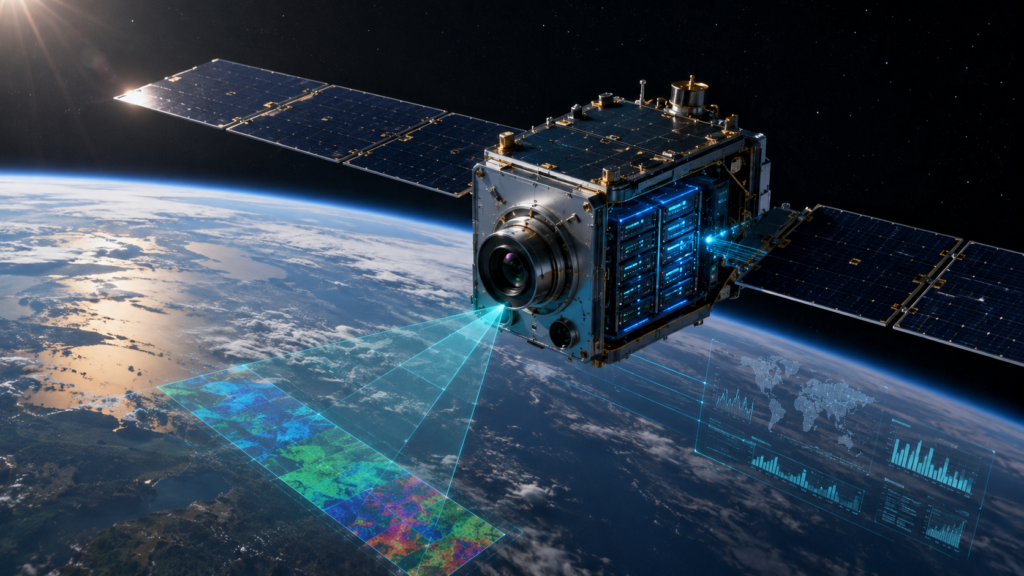
Within that field, Pathfinder is small in absolute terms but strategically dense. It is a single 200 kilogram class demonstrator, not a constellation, and the Q4 2026 timeline puts Pixxel into the second wave of operational orbital compute platforms rather than the first. The differentiator is the dual payload. Most early orbital data centre satellites are pure compute experiments, with imagery sourced from third party constellations like Capella Space. Pathfinder couples a frontier class GPU stack with Pixxel’s own hyperspectral imaging sensor on the same bus, which removes the downlink step that has historically bottlenecked Earth observation economics. Hyperspectral satellites generate large volumes of raw data across hundreds of spectral bands, and most of that data is discarded or delayed because ground processing capacity cannot keep pace. Running foundation models on the same satellite that captures the imagery shifts the value proposition from selling pixels to selling decisions.
What does the Pathfinder satellite actually carry, and why does the GPU choice matter?
Pixxel and Sarvam have been deliberate in their hardware framing. Conventional satellite computing has historically relied on radiation tolerant, low power edge processors optimised for survival in the orbital environment rather than for raw compute throughput. Pathfinder is being positioned as a departure from that pattern, hosting GPUs of the same generation that powers terrestrial AI training and inference clusters. The companies have not publicly named the silicon vendor, but the reference to data centre class hardware aligns Pathfinder with the Nvidia Hopper and Blackwell class GPUs that Starcloud has already flown and is preparing to fly on Starcloud-2 alongside an AWS server blade. The technical implication is significant. Running an H100 or Blackwell class GPU in orbit forces solutions to thermal dissipation in vacuum, single event upset tolerance, and continuous high power draw that the standard satellite design playbook does not address. Starcloud has openly acknowledged that an Nvidia A6000 it flew on an earlier mission failed during launch, and that the H100 itself is not architecturally optimised for space. Pathfinder will inherit those engineering challenges and will need to demonstrate that thermal radiators, power budgeting, and software level fault tolerance can keep frontier silicon alive across a meaningful operational window.
The Sarvam side of the payload is equally pointed. Sarvam has been building a full stack sovereign AI platform, including its own Indic language foundation models trained under the IndiaAI Mission selection. Putting those models on Pathfinder means India built models will run on India built satellites without any dependency on a foreign hyperscaler for either the compute layer or the model weights. That framing is consistent with the broader sovereign AI push that has emerged in Europe, the Gulf states, and Southeast Asia, where governments are increasingly uncomfortable with frontier inference being routed through three or four United States cloud providers. For Sarvam, Pathfinder is a public proof point that its inference platform can run in the harshest possible deployment environment, which is a credible marketing asset for terrestrial sovereign cloud sales as well.
Why is Pixxel pivoting from pure hyperspectral imaging into orbital infrastructure?
Pixxel has raised approximately 95 million dollars across its funding history, with a 60 million dollar Series B that closed in December 2024 backed by Google, Radical Ventures, Lightspeed, M&G Catalyst, and Glade Brook Capital Partners. The company has six operational Firefly hyperspectral satellites in orbit following the Transporter-12 launch in January 2025 and the NAOS Falcon 9 mission in August 2025, and it has been awarded a five year contract by the United States National Reconnaissance Office under the Strategic Commercial Enhancements Broad Agency Announcement for Commercial Hyperspectral Capabilities. Within the Indian regulatory ecosystem, Pixxel leads an IN-SPACe Earth Observation public private partnership consortium, holds an iDEX SPARK grant for hyperspectral and mid-wave infrared payloads for the Indian Air Force, and is developing the Honeybee follow-on satellites with extended short wave infrared capability.
Pathfinder represents a deliberate widening of the addressable market. A pure Earth observation business is bounded by the willingness of customers to pay for pixels and analytics, a market currently estimated by Tracxn to include 310 active competitors. By layering compute as a service on top of imaging, Pixxel positions itself to monetise the same satellite asset twice, once for hyperspectral data and once for orbital inference and storage capacity sold to third parties. It also creates an option on the Indian government and defence market, where sovereign in orbit compute is a more defensible procurement story than buying hyperspectral pixels off a global merchant constellation. The Gigapixxel facility, Pixxel’s upcoming production line designed to scale up to 100 satellites, becomes more financially rational under a dual revenue model, since orbital data centre customers can absorb production capacity that would be hard to fill with imaging demand alone.
What economic assumptions does the orbital data centre thesis depend on?
The case for orbital compute rests on three load bearing assumptions, and Pathfinder will test all of them in production. The first is launch cost. Starcloud has publicly modelled cost parity with terrestrial data centres at launch costs near 100 dollars per kilogram against the roughly 2,700 dollars per kilogram that Falcon 9 currently delivers, a price point that depends on SpaceX’s Starship reaching commercial cadence in the 2028 to 2029 window. The second is solar conversion efficiency, with the bull case requiring panels above 40 percent efficiency to deliver the headline kilowatt hour economics. The third is hardware lifetime, with five year operational survival of frontier GPUs in low Earth orbit radiation conditions a number that has not yet been demonstrated.
Skeptics, including engineers at Varda Space Industries, have published calculators suggesting orbital compute currently costs roughly three times more per watt than terrestrial alternatives once realistic launch and lifetime assumptions are applied. Proponents counter with energy cost projections as low as 0.005 dollars per kilowatt hour for solar in orbit and zero water cooling requirements, against 5 cents per kilowatt hour for the cheapest terrestrial power. Pathfinder is not designed to settle this debate, since a single demonstrator cannot prove unit economics, but it is designed to generate the empirical data on thermal performance, power management, and workload throughput that will inform whether a follow on commercial constellation makes financial sense. For Pixxel and Sarvam, the strategic question is whether they can capture early customers in sovereign government, defence, and regulated industry segments where data residency and latency considerations outweigh raw cost per inference.
How does Pathfinder change the competitive picture for Indian space and AI infrastructure?
The partnership has implications well beyond the two companies. For the Indian space sector, Pathfinder establishes a private operator credible enough to credibly sell orbital infrastructure services into a market currently dominated by United States and Chinese players. ISRO has run early space based computing experiments and has talked publicly about a national orbital compute roadmap, but a privately funded, commercially operated demonstrator launching in 2026 puts India ahead of most government programmes in Europe and the Gulf, and behind only the United States and China in operational orbital compute capacity. For Sarvam, the partnership is a sovereignty narrative that will be useful in conversations with the Ministry of Electronics and Information Technology, the IndiaAI Mission, and defence procurement bodies that are actively writing requirements around Indian model weights running on Indian infrastructure.
For competitors, the Pathfinder announcement narrows the window in which Starcloud, Google, SpaceX, and Axiom can claim category leadership without a credible Indian challenger. It also creates a pull factor for Indian semiconductor packaging, satellite component, and ground systems suppliers who can plug into Gigapixxel’s production roadmap. The execution risk is real. A 2026 launch on a 200 kilogram class bus with frontier GPUs is an aggressive timeline, and any failure of the thermal, power, or radiation tolerance subsystems would set back not just the partnership but the broader Indian orbital compute thesis. Both companies are privately held, which means the financial cost of a missed launch window is contained within their cap tables rather than visible in public market reaction, but the reputational cost of being seen to overpromise on a sovereignty marketing campaign would be material.
What signals should investors, policy advisers, and enterprise buyers watch from here?
The next twelve to eighteen months will produce a series of measurable milestones that will determine whether Pathfinder is a genuine commercial inflection point or a high quality demonstrator with limited follow through. The first is the silicon disclosure, since the GPU vendor and generation will signal both the partnership’s technical ceiling and its export control exposure. The second is the launch vehicle selection, with SpaceX, ISRO, and emerging Indian launch providers all plausible candidates and each carrying different cost and sovereignty implications. The third is Sarvam’s model deployment specifics, including which model classes will run on board, what fine tuning workflows will be exposed to customers, and how inference pricing will be structured against terrestrial cloud benchmarks. The fourth is the customer pipeline, particularly any Indian government, defence, or regulated industry contracts that monetise Pathfinder before a commercial constellation is built. The fifth is Pixxel’s next funding round, since extending Gigapixxel and scaling beyond a single demonstrator will require fresh capital that benchmarks against Starcloud’s 1.1 billion dollar valuation rather than Pixxel’s earlier hyperspectral peer set.
Key takeaways on what this development means for Pixxel, Sarvam, and the orbital compute industry
- The Pixxel and Sarvam Pathfinder partnership puts India into the first cohort of countries with a privately operated orbital data centre satellite, alongside the United States and China, with a Q4 2026 launch target on a 200 kilogram class bus.
- Pathfinder’s combination of frontier class GPUs and Pixxel’s hyperspectral camera differentiates it from pure compute demonstrators by integrating data capture and AI inference on the same satellite, which compresses the value chain from pixels to decisions.
- The mission positions Pixxel to monetise its satellite assets through both Earth observation and orbital compute as a service, materially widening the addressable market and improving the fill rate justification for the Gigapixxel production facility scaling to 100 satellites.
- For Sarvam, running its sovereign foundation models on board provides a public proof point for its inference platform and reinforces its positioning under the IndiaAI Mission, which is increasingly relevant for Indian government, defence, and regulated industry procurement.
- Pathfinder enters a race led by Starcloud, which has already flown an Nvidia H100, raised 200 million dollars in total funding at a 1.1 billion dollar valuation, and filed for an 88,000 satellite constellation, alongside SpaceX, Google’s Project Suncatcher, Axiom Space, Lonestar, and a Chinese state backed 2,800 satellite computing programme.
- The economic case for orbital compute remains contingent on Starship reaching commercial launch cadence and pricing near 100 dollars per kilogram, on solar panel efficiency exceeding 40 percent, and on five year hardware survival in low Earth orbit, none of which is yet proven at scale.
- Skeptical analysis from Varda Space Industries suggests current orbital compute costs roughly three times more per watt than terrestrial alternatives, which means early commercial demand will likely be concentrated in sovereign, defence, and regulated industry segments where data residency and latency outweigh raw cost.
- Execution risk is concentrated around thermal management, radiation tolerance, and power budgeting for frontier silicon in vacuum, with Starcloud already publicly noting that an Nvidia A6000 failed during launch on an earlier mission and that the H100 architecture is suboptimal for space.
- The partnership accelerates pressure on ISRO and Indian space policy to formalise an orbital compute regulatory and spectrum framework, since a privately operated data centre satellite raises data residency, jurisdictional, and dual use questions not addressed under the 1967 Outer Space Treaty.
- Investor and enterprise buyer attention should focus on the silicon vendor disclosure, the launch vehicle selection, the customer pipeline beyond the demonstrator phase, and Pixxel’s next funding round, which will benchmark Indian orbital compute valuations against the Starcloud comparable and set the ceiling for follow on Indian entrants.
Discover more from Business-News-Today.com
Subscribe to get the latest posts sent to your email.