


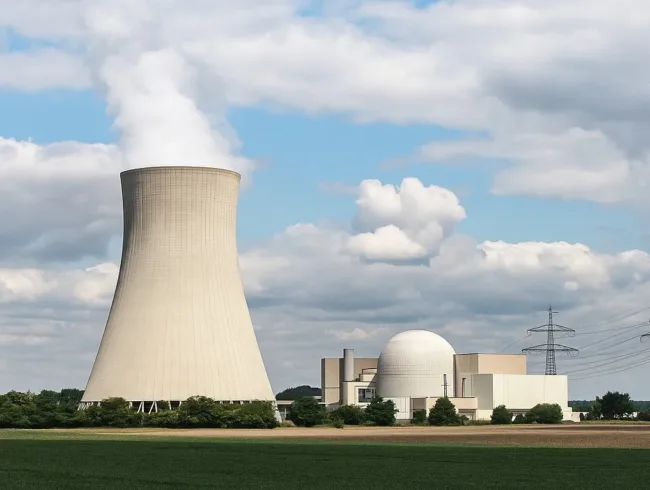
India’s attempt to transform nuclear power from a largely state-controlled industry into a major destination for private and international investment is confronting an early regulatory test, with draft rules under the country’s new nuclear framework raising concerns that imported reactor technologies could face additional approval requirements that slow deployment and weaken investor interest.
The Department of Atomic Energy has opened the draft SHANTI rules and regulations for public consultation until September 4, allowing companies, institutions, experts and other stakeholders to propose changes before the framework is finalised. The consultation follows legislation intended to widen participation in a sector historically dominated by government entities and domestic technology.
The stakes are unusually large because India wants nuclear capacity to reach approximately 100 gigawatts by 2045, almost ten times its present scale. Reuters estimates the industry could require about $210 billion of investment to meet that ambition, making regulatory treatment of foreign reactor vendors, private Indian developers and newer technologies such as small modular reactors central to whether the target is commercially achievable.
Why are foreign reactor suppliers concerned about India’s draft SHANTI regulations?
The core concern is that foreign reactor designs may need certifications or approvals beyond those already obtained from regulators in their home jurisdictions, potentially adding another layer of time and uncertainty before a project can move from commercial negotiation into actual construction. Nuclear regulation is necessarily stringent because safety failures have consequences far beyond ordinary industrial projects, but investors distinguish between rigorous oversight and duplication that does not materially improve safety.
Foreign vendors typically develop reactor designs through years of licensing in their principal markets, involving extensive assessment of containment systems, cooling arrangements, materials, emergency response and accident scenarios. If India requires significant parts of that technical process to be repeated rather than recognising established international approvals where appropriate, the result could increase engineering costs and extend project schedules before construction begins.
The issue becomes particularly important for technologies that are commercially promising but still relatively new. Small modular reactors are being promoted globally because factory manufacturing and standardised construction could reduce some of the cost and schedule problems associated with traditional large reactors, yet few designs have accumulated long operating histories. A regulatory framework demanding evidence that only mature reactor fleets can provide could unintentionally favour older domestic technologies over emerging international systems.
India therefore has to solve a delicate problem. Weak standards would undermine public confidence and safety, while excessive duplication could neutralise the very private and foreign participation that the reform was designed to attract.
How important is foreign technology to India’s 100 GW nuclear power target?
India has substantial domestic nuclear expertise and an established reactor programme, but reaching 100 GW within roughly two decades would require construction at a pace far beyond the historical rate of domestic deployment. Nuclear Power Corporation of India Limited is already pursuing a large expansion using Indian reactor designs, yet Reuters reports that the programme currently under development represents only about 14 GW of additional capacity.
Closing the gap would therefore require several channels operating simultaneously. Large Indian conglomerates could become developers or investors, public-sector companies could accelerate domestic projects, foreign vendors could introduce additional designs and international finance could supplement Indian capital.
Foreign involvement also matters because different reactor technologies can serve different grid and industrial requirements. Large conventional reactors offer substantial baseload generation, while smaller reactors may eventually be better suited to industrial clusters, replacement of retiring coal plants or areas where grid capacity cannot accommodate very large units.
The strategic value of having multiple technologies is diversification rather than dependence on one foreign supplier. India’s challenge is to preserve regulatory sovereignty while giving investors enough predictability to justify projects whose capital is committed for decades before the final electricity is sold.
Why does India need nuclear power when renewable capacity is expanding rapidly?
Solar and wind are growing much faster than nuclear power and will continue to provide a major share of India’s new electricity capacity, but their output varies with sunlight, weather and time of day. A power system attempting to reduce coal dependence therefore needs dispatchable low-carbon sources capable of generating when renewable output falls.
Nuclear power offers that characteristic because reactors can operate for long periods at high capacity factors without direct carbon emissions from electricity generation. Hydropower, energy storage, gas and demand management can perform complementary roles, but nuclear provides another route for reducing reliance on coal without depending entirely on batteries or imported gas.
The issue is becoming more pressing as electricity demand rises through industrialisation, air conditioning, electric transport, data centres and manufacturing. India must add enough generation to support economic growth while simultaneously reducing the emissions intensity of a grid still heavily dependent on coal.
That makes nuclear policy an energy-security question as much as a climate policy. A diversified system combining renewables, storage, nuclear, hydro and flexible thermal generation can be more resilient than one attempting to replace coal with a single alternative technology.
Why could tariffs and investment returns matter more than reactor technology?
Even a technically approved reactor will not be built if investors cannot determine how they will recover tens of billions of rupees committed to construction. Nuclear projects have high upfront costs, long development periods and relatively low fuel costs once operating, making financing terms and electricity pricing unusually important to commercial viability.
Private developers will need clarity on who buys the electricity, how tariffs are determined, how construction delays are allocated and whether government guarantees or other mechanisms protect projects against regulatory changes. Liability rules also matter because nuclear accidents create risks that private companies cannot price in the same manner as ordinary plant failures.
Foreign companies considering India will compare those arrangements with opportunities elsewhere. A rapidly growing electricity market is attractive, but capital can still move towards jurisdictions offering simpler licensing, clearer returns or stronger contractual protection.
The draft SHANTI process therefore cannot be judged only by the technical requirements written into reactor approval clauses. Its real test is whether the combined regulatory and commercial architecture makes private nuclear generation investable.
What happens before India finalises the new nuclear rules?
Stakeholders have until 8 pm on September 4 to submit feedback to the Department of Atomic Energy, which says appropriate suggestions will be considered before the rules and regulations are finalised. The consultation gives Indian and foreign nuclear companies an opportunity to identify provisions they believe could create unintended barriers while allowing regulators to preserve safeguards considered essential for Indian conditions.
The coming months will show whether the final framework moves towards recognition of established foreign certifications, creates special pathways for newer technologies or retains the more demanding structure reflected in the draft. Investors will also watch for greater clarity on tariffs, liability and qualification requirements before making major capital commitments.
India’s nuclear ambition is already large enough on paper. The harder task is creating a regulatory system that can convert that ambition into reactors commissioned on time without weakening standards established to protect people and the environment.
Discover more from Business-News-Today.com
Subscribe to get the latest posts sent to your email.