



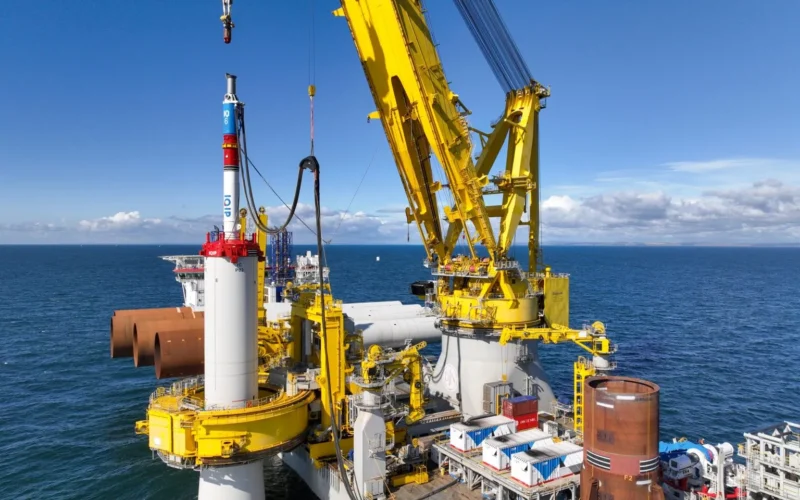
Inch Cape Offshore Wind Farm has completed installation of all 54 monopile foundations at its 1.1GW offshore wind project off Scotland’s east coast, marking a major construction milestone for one of the United Kingdom’s most closely watched offshore wind developments. The project, jointly owned by ESB and Red Rock Renewables, is expected to produce first power in late 2026 and move toward full commercial operation in 2027. The milestone matters because Inch Cape is advancing at a time when offshore wind developers across Europe are under pressure from higher capital costs, supply-chain bottlenecks, grid constraints and tighter scrutiny of project execution. The completion of the monopile campaign reduces one layer of construction risk, but the project still has to complete jacket foundations, transition pieces, turbine installation, cable works, grid integration and commissioning before its strategic value becomes operational reality.
Why does Inch Cape’s monopile foundation milestone matter for Scotland’s offshore wind pipeline?
The completion of all 54 monopile foundations matters because foundations are among the highest-risk, highest-visibility phases of offshore wind construction. They must be manufactured, transported, staged at port, installed within workable weather windows and aligned with downstream installation schedules. When a project completes this phase, it removes a major construction uncertainty and gives owners, suppliers, lenders and policymakers more confidence in the delivery path.
For Scotland, the milestone is strategically important because the country’s offshore wind ambitions depend on projects moving from consent and contract awards into real physical build-out. Offshore wind targets can sound impressive on government documents, but progress is ultimately measured in steel installed at sea, cables laid and turbines energised. Inch Cape’s monopile progress shows that the Scottish pipeline is not just waiting in the planning queue.
The milestone also has a supply-chain signalling effect. The project has relied on major offshore construction coordination involving heavy-lift vessels, port logistics and foundation transport from the Port of Leith. That creates a practical case study for how Scottish and United Kingdom port infrastructure must support larger turbine-era offshore wind projects. The next wave of projects will not be smaller or simpler. If anything, the engineering trend is moving in the other direction, because offshore wind prefers scale even when the supply chain occasionally asks for a cup of tea and a lie-down.

How does the 1.1GW Inch Cape project fit into the United Kingdom’s energy-security strategy?
Inch Cape fits into the United Kingdom’s energy-security strategy because offshore wind remains central to reducing exposure to imported gas, volatile wholesale power prices and carbon-intensive generation. A 1.1GW offshore wind project can materially contribute to electricity supply once operational, especially in a market where electrification, data centres, industrial demand and heat transition policies are increasing pressure on the grid.
The project also reinforces the strategic role of the North Sea as an energy basin in transition. For decades, the North Sea was primarily associated with oil and gas production. Offshore wind projects such as Inch Cape are part of a wider shift in which seabed, port, vessel and engineering capabilities are being repurposed toward low-carbon electricity generation. That does not mean oil and gas expertise disappears. In many cases, the same marine skills, safety systems and offshore logistics disciplines are being redirected.
However, offshore wind’s energy-security contribution depends on timely connection and grid readiness. A wind farm can be built at sea, but its value is constrained if power cannot be exported efficiently to onshore networks. Inch Cape’s export cable activity and grid connection schedule therefore matter as much as the foundation milestone. The United Kingdom’s offshore wind bottleneck is no longer only about building turbines. It is increasingly about building the electrical system around them.
Why are foundations and offshore logistics becoming a bigger issue for wind developers?
Foundations and offshore logistics are becoming more important because offshore wind projects are physically larger and commercially less forgiving than earlier generations of wind farms. Monopiles for modern turbines are heavy, complex and dependent on specialised vessels. Installation requires precise weather planning, port readiness and coordination between multiple contractors. Any delay can ripple across vessel schedules, turbine installation slots and commissioning timelines.
Inch Cape’s completion of the monopile campaign shows the value of locking in capable installation capacity. Jan De Nul’s heavy-lift vessel Les Alizés has been central to the monopile installation work, and the use of specialised equipment highlights a wider sector issue: the offshore wind industry needs enough vessels capable of handling increasingly large foundations and turbine components. A shortage of the right vessels can become a hidden constraint on project delivery.
The logistics issue also affects costs. Offshore construction delays are expensive because vessels, crews, ports and fabrication schedules do not wait patiently for spreadsheets to recover. Developers that manage installation sequencing well can protect project economics. Those that misjudge logistics can see capital discipline erode quickly. Inch Cape has cleared one major execution hurdle, but the next installation phases will remain just as important.
What construction risks still remain before Inch Cape reaches first power?
The most obvious remaining risk is that foundation completion is only one part of the construction chain. Inch Cape still needs to install 18 jacket foundations, progress transition piece work, complete export and inter-array cable activities, install turbines and finalise offshore commissioning. Each step carries its own technical and weather-related risk, and delays in one area can push out first power or full commercial operation.
Grid integration is another critical variable. Offshore wind projects must synchronise offshore assets with onshore substations, transmission infrastructure and system operator requirements. Inch Cape’s onshore connection at the former Cockenzie power station site is strategically useful, but grid works still require careful coordination. The United Kingdom’s power system is already under pressure from renewables growth, electrification and data-centre demand, making connection discipline increasingly important.
There is also commercial risk. Offshore wind projects across Europe have faced higher interest rates, supply-chain inflation and tougher contract economics. Inch Cape’s construction progress is positive, but the broader industry context remains challenging. Investors and policymakers will want to see whether the project reaches operation without the cost problems that have damaged confidence in some offshore wind markets.
How could Inch Cape strengthen Scotland’s offshore wind supply-chain credibility?
Inch Cape could strengthen Scotland’s offshore wind supply-chain credibility by demonstrating that large-scale projects can be supported through Scottish port infrastructure and regional marine services. The Port of Leith’s role in foundation logistics is particularly important because ports are becoming strategic assets in the offshore wind economy. Ports that can handle heavy components, large vessels and complex staging operations can capture long-term industrial value.
This matters because Scotland wants offshore wind to create more than clean electricity. The political and economic case also depends on jobs, fabrication, logistics, operations and maintenance activity. While many components in global offshore wind projects still come from international suppliers, successful construction campaigns can build confidence in local service capacity and future investment in port upgrades.
The risk is that Scotland and the wider United Kingdom may still not capture enough of the manufacturing value chain. Offshore wind deployment can grow while domestic industrial content remains uneven. Inch Cape’s progress is useful, but policymakers will likely judge the sector on whether future projects create deeper local supply chains in blades, foundations, cables, substations and installation services. Clean power is good. Clean power with domestic industrial depth is better.
Why does Inch Cape matter for ESB and Red Rock Renewables’ offshore wind positioning?
For ESB, Inch Cape offers exposure to a major offshore wind asset outside Ireland and supports the company’s strategy to expand renewable generation across the United Kingdom and Europe. As a state-owned utility, ESB has a long-term infrastructure profile and can treat offshore wind as part of a broader transition from conventional generation toward low-carbon power. Inch Cape gives ESB a significant stake in a market where offshore wind scale matters.
For Red Rock Renewables, the project strengthens its position in the Scottish renewable energy market and adds credibility in large offshore development. The company already has a portfolio focus across wind, solar and battery storage, but Inch Cape is a different level of complexity. Offshore wind requires patience, capital, contractor coordination and regulatory navigation, all at industrial scale.
The partnership structure also reflects the way offshore wind risk is now shared. Large projects increasingly require owners with complementary capital, development and operating capabilities. No serious offshore wind developer wants to carry every risk alone if it can avoid it. Inch Cape’s ownership model fits that trend, but it also means execution discipline must be maintained across partners, contractors and lenders.
Can Inch Cape help reset confidence in offshore wind after Europe’s cost inflation shock?
Inch Cape can help rebuild confidence in offshore wind if it continues to hit construction milestones and reaches operation close to schedule. The sector needs visible delivery examples after several years of cost resets, contract renegotiations and delayed investment decisions in major markets. Completing the monopile campaign is not enough to reset sentiment by itself, but it gives the industry a positive datapoint.
The broader offshore wind market remains caught between strong policy demand and difficult project economics. Governments want more offshore wind to support decarbonisation and energy security, but developers need contract terms that reflect higher equipment, financing and installation costs. Projects that are already in construction are therefore watched closely because they reveal whether the industry can execute under real-world cost conditions.
Inch Cape’s importance is partly symbolic. If the project progresses toward first power in late 2026 and full operation in 2027, it will support the argument that large offshore wind remains deliverable despite turbulence. If delays or cost issues emerge, critics will use it as another example of an industry stretched by ambition. For now, the monopile milestone gives the project a stronger delivery narrative.
What happens next as Inch Cape moves from foundations to power generation?
The next phase is about turning foundation completion into a functioning power asset. That means progressing jacket foundation installation, transition piece work, turbine installation, offshore electrical systems, export cable completion and grid energisation. The project’s first-power target in late 2026 will require disciplined sequencing across all those workstreams.
Stakeholders will also watch how the project manages community, marine and environmental obligations during construction. Offshore wind projects operate in shared marine spaces involving fisheries, shipping, ecology and coastal communities. Construction progress must therefore remain aligned with consent requirements and stakeholder expectations. A project can be technically strong and still face reputational friction if local concerns are mishandled.
A neutral reading suggests Inch Cape has cleared a major hurdle, but not the decisive one. The monopile campaign proves that a large part of the offshore civil works package has been delivered. The decisive test now is whether ESB, Red Rock Renewables and their contractor base can convert that progress into first power, reliable commissioning and a fully operating wind farm by 2027.
Key takeaways on Inch Cape’s monopile milestone and Scotland’s offshore wind build-out
- Inch Cape Offshore Wind Farm has completed installation of all 54 monopile foundations at its 1.1GW offshore wind project off Scotland’s east coast.
- The milestone reduces a major construction risk, but the project still needs to complete jacket foundations, turbine installation, cable works and commissioning.
- The project is jointly owned by ESB and Red Rock Renewables, giving both companies major exposure to the United Kingdom offshore wind market.
- First power is expected in late 2026, while full commercial operation is expected in 2027 if remaining construction and grid integration milestones stay on track.
- Inch Cape strengthens Scotland’s offshore wind delivery narrative at a time when policymakers want more evidence that major clean-power projects can move from planning to construction.
- Port logistics and specialised vessels remain crucial because modern offshore wind projects depend on the ability to handle larger foundations and turbine components.
- The Port of Leith’s role highlights how port infrastructure is becoming a strategic industrial asset in the offshore wind supply chain.
- The project’s success could support confidence in offshore wind after several years of sector-wide pressure from inflation, interest rates and supply-chain constraints.
- Grid connection and export cable completion remain central because offshore generation only creates full value when power can reach the onshore system reliably.
- Inch Cape’s next test is execution discipline as the project moves from installed foundations toward first power and full operation.
Discover more from Business-News-Today.com
Subscribe to get the latest posts sent to your email.