



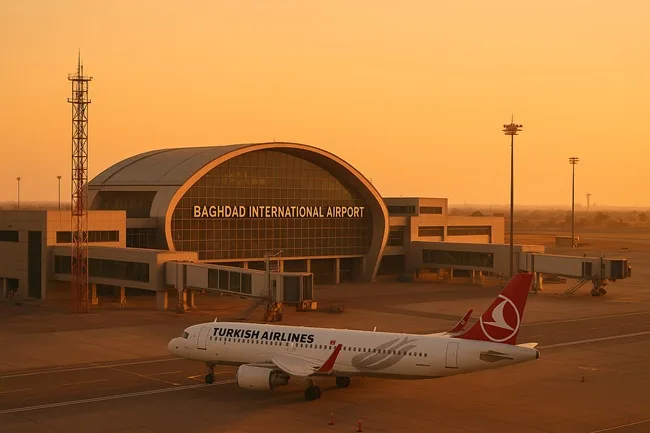
Iraq’s Ministry of Transport has confirmed that it has received three international bids for the Baghdad International Airport public-private partnership (PPP) project — a milestone that marks one of the country’s most significant aviation infrastructure initiatives in two decades. The project, managed by the Iraqi Civil Aviation Authority (ICAA) in collaboration with the International Finance Corporation (IFC), aims to transform the Baghdad International Airport (BIAP) into a modern regional hub under a long-term concession framework.
The Ministry said that three international consortia have submitted bids for the Baghdad International Airport project. The first consortium comprises Saudi Arabia’s Asyad Holdings and Top International Engineering Corporation Arabia, a subsidiary of China’s Shaanxi Construction Engineering Group, working in partnership with Turkey’s YDA İnşaat (YDA Group), Bahrain’s Lamar Holding, and Ireland’s daa (Dublin Airport Authority).
The second consortium includes the United Kingdom’s ERG International UK, which has joined forces with Terminal Yapı and ERG İnşaat from Turkey to deliver a joint proposal focused on terminal rehabilitation and ground infrastructure.
The third consortium is led by Luxembourg-based Corporación América Airports (CAAP)—one of the world’s largest private airport operators—partnering with Amwaj International of Iraq to bring a blend of global operational expertise and local development capabilities to the project.
The government stated that financial offers will be opened on 16 October 2025, after which the preferred bidder will be selected. The winning consortium will be responsible for rehabilitating existing infrastructure, constructing a new passenger terminal, and managing operations and maintenance under a 25-year build-operate-transfer (BOT) concession.
What does the Baghdad Airport PPP include, and why is it central to Iraq’s Vision 2030 strategy?
The Baghdad Airport PPP forms part of Iraq’s Vision 2030 diversification strategy, which seeks to attract private capital into transport, energy, and logistics infrastructure to reduce pressure on public finances. The project is expected to cost between $400 million and $600 million, or roughly IQD 525–790 billion, fully funded by the private partner without public loans or sovereign guarantees.
Under the agreement, the investor will handle terminal operations, logistics, and the commercial development of surrounding land, while the state retains control over customs, immigration, air-traffic control, and security. The development will expand BIAP’s capacity from around nine million to fifteen million passengers per year, supported by a new terminal, airfield upgrades, and a workforce-training program to modernize service quality.
Transport Minister Razzaq Muhaibis al-Saadawi has described the PPP model as essential for “rebuilding Iraq’s aviation backbone” and ensuring that major national assets operate on sustainable commercial principles.
How IFC’s involvement strengthens credibility and transparency in Iraq’s PPP process
The International Finance Corporation (IFC), a member of the World Bank Group, has served as Iraq’s lead transaction advisor since September 2023, under a consultancy agreement designed to improve governance and international investor confidence. The IFC is providing legal, technical, and financial support for the tender, preparing feasibility studies, bid documents, and transparent evaluation criteria.
The IFC’s consultancy fee is capped at $500,000 (IQD 655 million), with no public expenditure incurred so far. Its participation has been widely seen as a vote of confidence in Iraq’s emerging PPP ecosystem and a template for future deals in energy and transport.
The PPP project is also expected to generate over 12,000 direct jobs, while boosting airport-linked economic activity across hospitality, cargo, and logistics.
Which international players are shaping Iraq’s airport redevelopment and what sets them apart?
The inclusion of high-profile operators such as daa (Dublin Airport Authority) and Corporación América Airports (CAAP) underscores the project’s global visibility. DAA’s experience managing Dublin and Cork airports gives it a strong reputation for passenger-centric operations, while CAAP’s global footprint across Latin America and Europe could bring advanced commercial-airport models to Iraq.
The participation of Asyad Holdings from Saudi Arabia and Lamar Holding from Bahrain also signals deepening Gulf investment in Iraq’s infrastructure revival, aligning with broader regional economic integration. Meanwhile, the Chinese component through Shaanxi Construction Engineering Group aligns with Belt and Road priorities in West Asia, reflecting Baghdad’s ability to attract capital from multiple geopolitical blocs simultaneously.
How does the PPP model reshape Iraq’s infrastructure investment landscape?
The Baghdad Airport PPP is part of a new generation of projects following Iraq’s 2023 Public-Private Partnership Law, which offers foreign investors enhanced legal protections and revenue-sharing clarity. The model shifts the financial burden away from the state, allowing private investors to fund, build, and manage strategic assets while the government collects an annual revenue share from airport operations.
Economists at regional think tanks estimate that if executed successfully, Iraq’s PPP pipeline — now exceeding $10 billion across aviation, ports, and energy — could reduce fiscal dependence on oil by 10–15 percent by 2030.
What is the institutional and investor sentiment toward Iraq’s aviation PPP program?
Market analysts describe sentiment as “cautiously optimistic.” The presence of IFC oversight, coupled with the participation of seasoned airport developers, has reassured both sovereign investors and lenders. Several Gulf-based funds have reportedly expressed interest in co-financing adjacent logistics facilities and bonded cargo zones at Baghdad Airport once the concessionaire is chosen.
Both the IFC and European Bank for Reconstruction and Development (EBRD) have hinted at using this project as a model to replicate across Iraq’s other airports — particularly Basra, Najaf, and Mosul — in future phases.
What could this mean for regional air-traffic competition and Iraq’s geopolitical positioning?
Iraq’s renewed aviation ambitions come amid aggressive regional investment. Saudi Arabia is advancing the $30-billion King Salman International Airport, the UAE continues expanding Al Maktoum International Airport, and Turkey’s Istanbul Airport has become one of the world’s busiest.
Baghdad International Airport’s expansion seeks to capture a slice of that competitive corridor by positioning itself as a transit hub between the Levant, the Gulf, and Europe. Its central geography — within a few hours’ flight from most major Middle Eastern capitals — makes it an attractive logistics and passenger gateway if operational bottlenecks are resolved.
Can the Baghdad Airport PPP set the tone for Iraq’s next phase of infrastructure modernization and aviation growth?
Experts believe the Baghdad Airport PPP will be a litmus test for Iraq’s PPP credibility and a blueprint for future infrastructure privatizations. If executed transparently and efficiently, it could trigger broader investor confidence across sectors ranging from energy grids to port logistics.
Analysts also note that a successful outcome could symbolize Iraq’s transition from a post-conflict reconstruction economy to a competitive regional player, capable of attracting both Gulf and Western capital under unified governance standards.
Discover more from Business-News-Today.com
Subscribe to get the latest posts sent to your email.