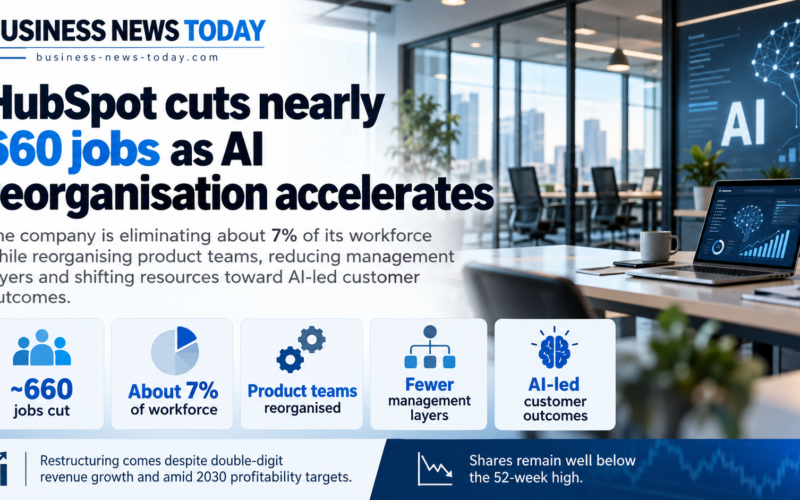
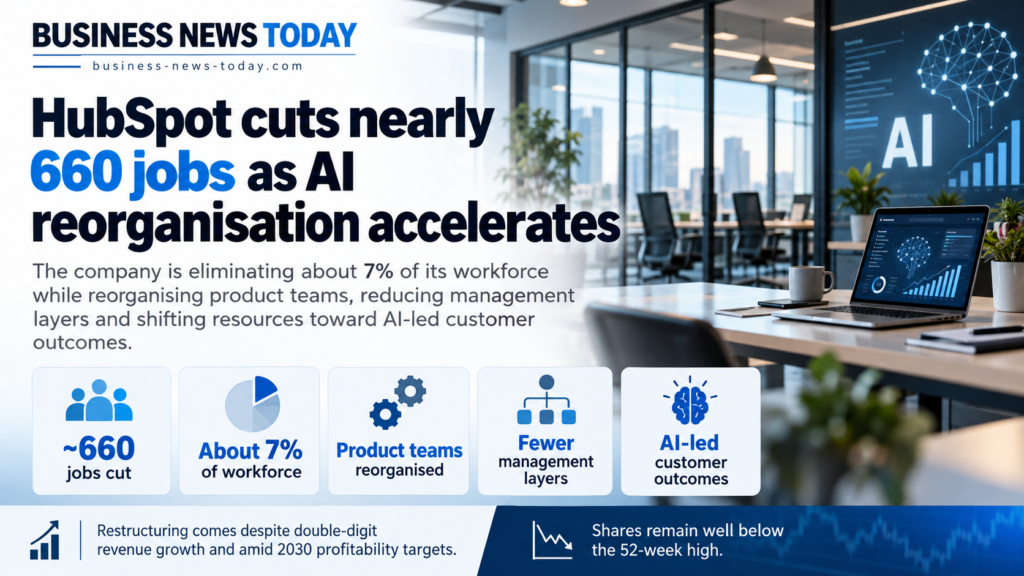
HubSpot, Inc. (NYSE: HUBS), the Cambridge, Massachusetts-based customer software company now positioning itself as an agentic customer platform, is eliminating nearly 660 positions, equivalent to approximately 7% of its workforce, as Chief Executive Officer Yamini Rangan restructures the organisation around AI-driven customer outcomes. The board authorised the plan on October 1, with the company expecting most role eliminations to be substantially completed by the end of the first quarter of 2027 and associated cash payments largely finished by June 30. HubSpot expects restructuring charges of approximately $65 million to $75 million, mainly for severance, notice periods, employee transition costs and benefits. The strategic tension is unusual: HubSpot is reducing its workforce while reaffirming 2026 guidance, protecting long-term margin targets and continuing to invest in AI rather than responding to an immediate revenue or liquidity crisis.
HubSpot had 9,016 full-time employees at June 30, 2026 and more than 306,000 customers across over 135 countries, meaning the announced reduction represents a meaningful reset of an organisation that had still been expanding during the first half of the year. The company reported second-quarter revenue of $911.7 million, up 20% year over year, while non-GAAP operating income increased 44% to $185.3 million and non-GAAP operating margin reached 20.3%. This is therefore not a conventional restructuring driven by collapsing sales. It is a reallocation decision intended to change how HubSpot develops products, manages teams and turns AI capabilities into measurable customer outcomes while maintaining operating leverage.
The distinction matters because Rangan has explicitly rejected the idea that internal AI productivity directly caused the layoffs. HubSpot instead says its move from selling software functionality toward delivering outcomes with AI requires a different organisational structure, including fewer management layers, less fragmented ownership and product teams organised around customer goals rather than individual Hubs. AI is consequently central to the strategy but should not be treated as a simple one-for-one substitute for the roughly 660 departing employees. The more important question is whether HubSpot can operate with fewer organisational layers while directing a greater share of spending toward engineering, AI products and revenue-generating capabilities.
Why is HubSpot cutting about 660 jobs when revenue and operating margins are still expanding?
HubSpot’s financial position makes the timing of the cuts more strategically revealing. Second-quarter revenue increased 20% to $911.7 million, customer count rose 14% to 306,446 and GAAP operating income reached $43.3 million compared with a loss in the prior-year period. Non-GAAP operating margin improved to 20.3%, while operating cash flow increased to $222.8 million and non-GAAP free cash flow reached $167.9 million. Those figures indicate that HubSpot is restructuring from a position of growth and improving profitability rather than trying to prevent an immediate financial deterioration.
The pressure instead comes from where HubSpot wants its economics to go next. At its September Analyst Day, HubSpot outlined expectations for non-GAAP operating margin of 23% to 24% in 2027 and raised its longer-term ambition to approximately 30% by 2030, alongside a GAAP operating margin target of about 20%. Reaching those levels while continuing to invest heavily in AI requires operating expenses to grow considerably more slowly than revenue over time. Flattening management and concentrating product ownership can therefore serve two objectives simultaneously: accelerate decisions and create the cost leverage needed to fund continued product investment without sacrificing future margins.
HubSpot has also reaffirmed its existing third-quarter and full-year 2026 financial guidance despite the restructuring. Full-year revenue remains expected at approximately $3.678 billion to $3.686 billion, representing about 18% reported growth, with non-GAAP operating income between $762 million and $766 million and an operating margin around 21%. The restructuring expenses will affect GAAP results but are excluded from HubSpot’s applicable non-GAAP guidance, making it important to distinguish the one-time transition cost from the underlying profitability targets.
How is HubSpot changing product teams and management layers around customer outcomes?
The organisational redesign goes further than eliminating positions. HubSpot plans to reorganise product teams around customer outcomes such as generating demand, winning deals, serving customers and scaling growth rather than structuring teams primarily around individual software Hubs. Each team is intended to own more of the customer journey, reducing the need for work to move repeatedly between functions before a product decision can be implemented.
That model reflects an important change in software competition. Customers increasingly care less about how a vendor divides its internal product portfolio and more about whether the combined platform produces measurable improvements in sales productivity, marketing conversion, customer service or revenue growth. AI accelerates that shift because autonomous or semi-autonomous agents are valuable only when they can operate across customer data and workflows rather than remaining trapped inside individual application boundaries.
HubSpot is also reducing management layers and pushing decision-making closer to employees doing the underlying work. Fewer layers can improve speed and lower recurring costs, but the model creates execution risk if spans of control become too wide or if specialised expertise is removed faster than teams can absorb additional responsibility. The success of the restructuring will therefore depend less on the headline reduction of 660 jobs than on whether the remaining organisation genuinely becomes faster rather than simply leaner.
Why does HubSpot insist its workforce reduction is not being caused directly by AI efficiency?
Rangan’s distinction between an AI-driven strategy and AI-driven job replacement deserves careful treatment because the two ideas are related but not identical. HubSpot says it continues to expect AI to improve employee productivity, but management has stated that the current reduction was determined by the roles, capabilities and organisational structure required for the company’s strategy rather than by calculating how many existing jobs AI could automate. The company assessed roles against factors including strategic necessity, management layers, revenue capacity, capabilities, scale requirements and leadership needs.
That does not make AI irrelevant. HubSpot’s strategic pivot is explicitly built around AI, and a company organised around agentic customer outcomes may require different skills and fewer organisational handoffs than a software company structured around conventional applications. AI can therefore influence workforce composition indirectly even when a company does not claim that software is directly replacing individual employees.
The distinction will become increasingly important across enterprise software. Companies such as Salesforce, ServiceNow and Atlassian are simultaneously developing AI agents, changing product architectures and reassessing how human teams should be organised around them. HubSpot’s approach suggests the next phase of software workforce transformation may involve not only automation of individual tasks but also a redesign of management structures, product ownership and the number of people required to coordinate work between teams.
What does HubSpot’s latest AI strategy mean for Smart CRM, engagement Hubs and agentic products?
HubSpot’s latest official disclosures describe the business as an agentic customer platform built around three connected layers: AI-powered agents and engagement Hubs, Smart CRM and an ecosystem of integrations, partners, community resources and educational content. Its engagement portfolio includes Marketing, Sales, Service, Operations, Content and Revenue, while Smart CRM acts as the context and data layer connecting customer information with AI. That current portfolio description matters because HubSpot is no longer positioning AI as an optional feature added to a traditional CRM suite.
The commercial model is also evolving. HubSpot has been experimenting with outcome-based and consumption-based pricing for AI capabilities, lowering barriers to adoption and allowing customers to scale usage as agents demonstrate value. The company has acknowledged that these changes can temporarily lengthen sales cycles as customers assess newer products and pricing structures, but management believes the model can produce more durable growth if customers connect spending directly to measurable outcomes.
This creates an important execution challenge for the workforce restructuring. Reorganising product teams during a major pricing and architecture transition can accelerate innovation if responsibilities become clearer, but it can also disrupt roadmaps and customer support if institutional knowledge disappears too quickly. HubSpot will need to demonstrate that fewer layers produce faster delivery without weakening the reliability and integration that customers expect from a platform containing critical sales and customer data.
How do HubSpot’s 2026 financial results change the interpretation of the workforce reset?
HubSpot’s latest financial performance makes a purely defensive interpretation difficult. The company moved from a second-quarter GAAP operating loss in 2025 to $43.3 million of GAAP operating income in 2026, while non-GAAP operating income increased substantially faster than revenue. Cash and investments stood at approximately $1.4 billion at June 30, and HubSpot repurchased roughly $531.9 million of stock during the quarter before its board authorised an additional repurchase programme of up to $1 billion.
Those figures indicate that HubSpot has enough financial flexibility to retain a larger workforce if management believed every existing position offered sufficient strategic value. The decision to cut 7% while authorising substantial share repurchases makes the restructuring primarily a capital-allocation and organisational-efficiency choice. Management is effectively choosing to concentrate labour spending on areas believed to improve AI product capability, customer outcomes and future revenue rather than preserving the existing structure.
There is nevertheless a risk that aggressive margin expectations begin to influence product decisions too heavily. A software company can often increase operating margins relatively quickly by restraining headcount, but durable value depends on continuing to innovate while maintaining customer service and sales capacity. HubSpot’s own second-quarter commentary showed weaker-than-expected customer additions and greater buyer hesitation, reinforcing the need to protect growth capabilities even as costs are tightened.
What does the HubSpot restructuring signal about the changing economics of enterprise software?
The broader enterprise software market is navigating a fundamental question: does generative AI expand the value of established platforms or make parts of traditional software easier to replicate? Recent market performance suggests investors have become less convinced that AI will simply destroy incumbent software economics, particularly as large vendors demonstrate that they can incorporate AI into existing customer relationships. Software companies are nevertheless under pressure to show that large AI investments translate into either faster growth or structurally better margins.
HubSpot sits in an especially interesting position because its core market includes scaling businesses that may be more price-sensitive than the largest multinational enterprises. Smaller customers can benefit disproportionately from AI agents if those tools reduce the number of manual tasks required across marketing, sales and service, but they can also scrutinise software spending aggressively if AI creates cheaper alternatives. HubSpot therefore needs its agents to make the broader platform more valuable rather than allowing AI to commoditise individual CRM capabilities.
The workforce reset can be interpreted as preparation for that competition. Fewer management layers and product teams built around customer outcomes could allow HubSpot to respond faster to AI-native challengers while preserving the distribution advantage of more than 306,000 customers. The strategic risk is that competitors make similar organisational improvements while HubSpot absorbs the disruption associated with reducing approximately 7% of its staff.
How has HUBS stock responded to the layoffs and what does the valuation signal about investor expectations?
HubSpot shares closed at $231.84 on October 8, up 5.25% for the session, after gaining 1.46% on October 7. The stock had fallen 1.6% on October 6, the day the restructuring was publicly disclosed, making it difficult to argue that the market initially treated the layoffs as an obvious positive catalyst. Over the five trading days measured through October 8, the shares were up roughly 6.6%, but they remained about 3.6% below their September 8 close.
The more consequential context is the 52-week range. At $231.84, HUBS remained far below its 52-week high of $497.96, although comfortably above the $169.63 low. That gap indicates that the recent rebound has not erased the market’s broader concerns about software valuations, AI disruption, future growth rates and HubSpot’s ability to translate its AI investment into durable revenue expansion.
The restructuring may help the margin side of that equation, but valuation recovery is unlikely to depend on job cuts alone. Investors will need evidence that agentic products improve customer acquisition, expansion and retention while HubSpot moves toward its 23% to 24% non-GAAP operating margin target in 2027 and ultimately the 30% ambition for 2030. If revenue growth slows materially while margins rise, the market may conclude that HubSpot is becoming more efficient but not necessarily building a larger competitive opportunity.
What are the biggest execution risks as HubSpot completes its workforce reduction by early 2027?
The first risk is organisational disruption. HubSpot expects the role eliminations to be substantially complete by the end of the first quarter of 2027, but local employment laws and consultation requirements mean the process will occur at different speeds across countries. Product and management responsibilities may therefore be changing while some employees remain in transition, creating potential uncertainty over ownership, customer relationships and project execution.
The second risk is talent retention. Employees who remain after a significant workforce reduction may reassess workloads, career progression and the stability of their own roles, especially when management layers are being compressed. HubSpot has said departing employees will generally receive 20 weeks of base pay plus one additional week for each year of service, capped at 30 weeks, along with transition support and benefits that vary by geography. The quality of that process matters because HubSpot continues to compete for engineers, AI specialists, product managers and go-to-market talent in a highly competitive technology labour market.
The third risk is strategic concentration. Directing more resources toward the largest AI opportunities can improve returns if management identifies those opportunities correctly, but it can create blind spots if established products or customer groups receive insufficient attention. HubSpot will need to show that a customer-outcome structure improves accountability without weakening the individual capabilities that made its engagement Hubs useful in the first place.
What should employees and shareholders watch after HubSpot completes the 7% workforce reduction?
The most important near-term financial checkpoint is whether HubSpot delivers the guidance it reaffirmed alongside the restructuring. Because management left its third-quarter and full-year revenue and non-GAAP profitability targets unchanged, a later miss would raise questions about whether the organisational transition disrupted sales or customer execution more than expected. Conversely, meeting guidance while implementing the cuts would strengthen management’s argument that the company can become leaner without sacrificing near-term operating momentum.
The second checkpoint is the 2027 operating margin. HubSpot’s target of 23% to 24% non-GAAP operating margin requires another meaningful step up from the approximately 21% expected for 2026, and the workforce reset should contribute to that leverage once restructuring expenses and transition effects subside. Investors should therefore separate the one-time $65 million to $75 million charge from the recurring expense structure that remains after the programme is completed.
The third checkpoint is customer growth and AI monetisation. HubSpot’s long-term investment case depends on more than lowering operating expenses because customer acquisition, average subscription revenue and adoption of AI agents need to demonstrate that the company is expanding the economic value of its platform. The stronger strategic outcome would be simultaneous revenue growth and margin expansion, not profitability achieved primarily through repeated reductions in staffing.
HubSpot’s restructuring ultimately exposes the more difficult side of the software industry’s AI transition. The company is growing, profitable on both adjusted and recent GAAP measures, cash generative and continuing to invest, yet management has concluded that its existing organisational structure is no longer appropriate for the next stage of competition. Cutting nearly 660 jobs is therefore not the end of the transformation; it is a test of whether a flatter HubSpot can innovate faster, generate stronger margins and prove that established software platforms can become beneficiaries of agentic AI rather than casualties of it.
What are the key takeaways from HubSpot’s 660-job restructuring and AI operating model reset?
- HubSpot is eliminating nearly 660 roles, approximately 7% of its workforce, with most reductions expected to be completed by the end of the first quarter of 2027.
- The company expects approximately $65 million to $75 million of restructuring charges, largely tied to severance, notice periods and employee transition costs.
- HubSpot says the cuts are not the result of AI directly replacing the affected employees, although its wider strategic shift is explicitly centred on AI-driven customer outcomes.
- Product teams will be organised more around customer outcomes and less around individual Hubs, while management layers are being reduced.
- Second-quarter revenue still grew 20% to $911.7 million, showing that the workforce reset is not being undertaken during an immediate revenue collapse.
- HubSpot reaffirmed full-year 2026 revenue guidance of approximately $3.68 billion and a non-GAAP operating margin around 21%.
- The company is targeting 23% to 24% non-GAAP operating margin in 2027 and approximately 30% by 2030, making operating leverage a major part of the restructuring logic.
- HUBS closed at $231.84 on October 8 after a 5.25% daily rise, but the shares remain substantially below their $497.96 52-week high.
- The central execution risk is whether fewer layers actually accelerate product development and customer decisions without weakening innovation, support or employee retention.
- The deeper industry signal is that AI is changing not only software products but also the organisational architecture and capital allocation models of established SaaS companies.
Discover more from Business-News-Today.com
Subscribe to get the latest posts sent to your email.