




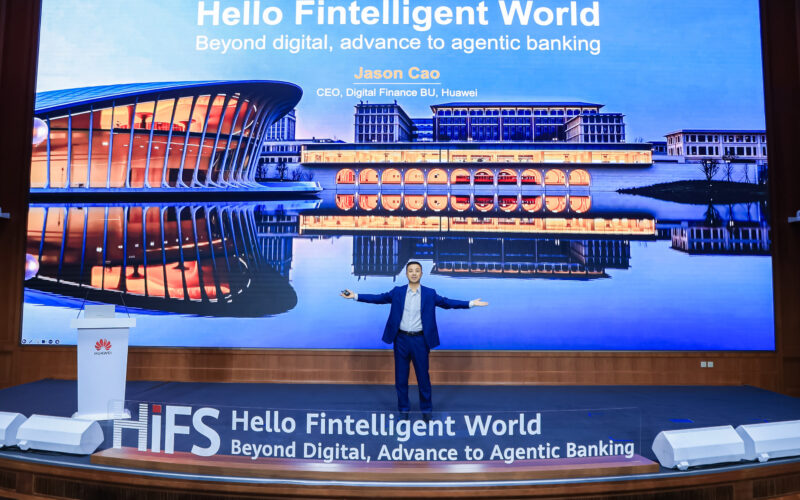
Huawei Technologies Co., Ltd. used the Huawei Intelligent Finance Summit 2026 in Shanghai to position agentic banking as the next major phase of financial technology transformation. The company announced six initiatives for large-scale financial AI deployment, launched Financial Data Intelligence Solution 6.0 and Digital CORE Solution 6.0, and introduced infrastructure designed to support both general-purpose and AI computing. The strategic relevance is clear: banks are no longer asking whether artificial intelligence can improve financial services, but whether AI agents can be trusted inside regulated, high-volume, mission-critical banking environments. For Huawei, the summit was less about another software refresh and more about staking a claim in the infrastructure layer of production-grade financial AI.
Why is Huawei using HiFS 2026 to push agentic banking for global financial institutions?
Huawei’s agentic banking message reflects a wider change in how financial institutions are approaching artificial intelligence. Earlier AI programs in banking largely focused on chatbots, document automation, fraud scoring, customer segmentation, and back-office productivity. The new ambition is more demanding: AI systems that can interpret context, take actions across workflows, escalate exceptions, and support banking operations without behaving like expensive interns with a login.
That shift matters because financial institutions cannot adopt agentic AI in the same way consumer technology companies adopt experimental tools. Banks need explainability, auditability, latency controls, data isolation, disaster recovery, regulatory reporting, and cost discipline. A clever AI demo can impress a boardroom, but a production banking environment has less patience for improvisation. When money, compliance, and reputation are involved, the margin for error becomes very small.
Huawei is trying to frame itself as a supplier that understands this institutional constraint. Its strategy is not only to sell AI tools, but to connect open-source models, hybrid AI architecture, financial data foundations, application modernization, and resilient infrastructure into a more complete operating model. That is important because most banks do not suffer from a shortage of AI pilots. They suffer from a shortage of AI systems that can safely survive procurement, compliance review, integration testing, security assessment, and real customer volumes.
The phrase “agentic banking” may sound like another technology slogan, but the underlying problem is real. Banks need more automation, more personalization, faster risk detection, and lower operating costs, while also defending against cyber risk, fraud, regulatory penalties, and legacy system fragility. Huawei’s HiFS 2026 roadmap is aimed directly at that tension.
How does Huawei’s hybrid AI architecture address banking security, compliance, and cost concerns?
Huawei’s hybrid AI architecture is designed around the idea that financial institutions will not rely on a single model, a single cloud environment, or a single deployment pattern for AI. That is a practical position. Large banks typically have a mix of on-premises systems, private cloud environments, public cloud partnerships, local regulatory constraints, and jurisdiction-specific data rules. A one-size-fits-all AI model would be convenient, but banking has never been famous for convenience.
The company’s emphasis on open-source foundation models is strategically significant because banks are increasingly sensitive to model control, data sovereignty, vendor lock-in, and inference economics. Proprietary frontier models may perform well in many use cases, but they can create concerns around cost, explainability, deployment flexibility, and cross-border data exposure. Open-source models, when tuned and governed properly, can give financial institutions more control over sensitive workloads and domain-specific performance.
Huawei’s argument is that banks need hybrid AI systems that balance data security, compliance, performance, and token costs. This is not a minor detail. Token economics can become a board-level issue when AI use moves from a pilot team to thousands of employees, millions of customer interactions, and real-time risk systems. A bank that cannot control inference costs may discover that its AI efficiency project has quietly become a cloud bill with good manners.
The execution challenge, however, is substantial. Hybrid AI environments require disciplined architecture, strong model operations, secure data pipelines, and robust governance. If Huawei and its partners can make these components work together, the model could appeal to banks looking for AI autonomy without losing institutional control. If integration proves cumbersome, financial institutions may continue to run fragmented AI pilots rather than committing to enterprise-scale agentic systems.
What does Financial Data Intelligence Solution 6.0 reveal about Huawei’s banking AI strategy?
Financial Data Intelligence Solution 6.0 points to one of the most important truths in enterprise AI: models are only as useful as the data foundations beneath them. Huawei’s upgraded solution focuses on data platforms, data governance, and data applications, which suggests that the company understands the bottleneck inside most banks. The hardest part of banking AI is rarely the AI model itself. It is the messy, regulated, fragmented, legacy-heavy data estate that the model must understand.
Huawei’s AI data lake is designed to support multimodal storage and computing, including unstructured data such as documents and videos. That matters because banks generate enormous volumes of unstructured information through loan files, transaction records, call center logs, compliance documents, Know Your Customer files, claims documents, and operational evidence. If AI agents are expected to assist with decisions, detect risk, or personalize services, they need access to more than clean spreadsheet fields.
The company also highlighted governance partnerships and application-level use cases such as hyper-personalized marketing and intelligent anti-fraud. These examples show where Huawei sees near-term value. In marketing, AI can improve customer targeting, cross-selling, and retention. In fraud detection, faster response times and case analysis can directly affect losses and compliance outcomes. Both areas have measurable business value, which makes them easier for bank executives to justify than more abstract AI transformation programs.
The risk is that financial data modernization often takes longer than vendors and executives expect. Data governance is not merely a software module. It involves ownership, metadata standards, access policies, lineage, privacy controls, and institutional behavior. Huawei can provide the technology stack, but banks still need internal discipline. In financial AI, the boring work is usually the moat.
Why does Digital CORE Solution 6.0 matter for banks still trapped by legacy modernization?
Huawei’s Digital CORE Solution 6.0 targets one of the most stubborn problems in banking technology: modernizing core systems without breaking the institution. Core banking platforms, payment systems, insurance administration systems, and card processing environments often carry decades of customization. They are difficult to replace, expensive to modify, and risky to migrate. Yet without modernization, banks struggle to deliver real-time services, AI-driven operations, and scalable digital products.
Huawei says its core modernization capabilities have supported more than 150 financial institutions worldwide. The upgraded Digital CORE Solution 6.0 adds new capabilities across credit cards, central bank payments, insurance core modernization, AI-powered development, application refactoring, zero-downtime migration, and cell-based architecture. The strategic message is that agentic banking cannot run on brittle legacy foundations indefinitely. At some point, the plumbing has to be upgraded, even if everyone politely avoids saying that in steering committee meetings.
The AI-powered mainframe code transpilation element is especially relevant because many banks still depend on older codebases and mainframe-linked processes. If AI can safely accelerate code translation, testing, refactoring, and documentation, it could reduce one of the biggest cost and time barriers in modernization. Huawei’s reported adoption rate for the AI-powered mainframe code transpilation solution will attract attention, but banks will still need to validate reliability, security, and functional equivalence before trusting automated modernization at scale.
The company’s focus on zero-downtime migration and high availability also reflects the reality of financial infrastructure. Banks cannot simply shut down core systems for a bold transformation weekend and hope customers appreciate the ambition. Any modernization strategy must preserve service continuity. Huawei’s cell-based and auto-scaling architecture is aimed at reducing failure impact while supporting traffic surges, which is increasingly important as digital banking volumes become more volatile and event-driven.
Can Huawei’s AI-ready infrastructure strengthen resilience in financial services?
Huawei’s “4 Zeros” infrastructure proposition, covering resilience across traditional data centers, cloud data centers, and AI data centers, is designed to address the operational risk side of financial AI. As banks deploy more AI workloads, they also increase dependence on high-performance computing, data center orchestration, inference availability, and intelligent operations. AI systems may improve banking productivity, but they also create new failure modes.
The introduction of Huawei Atlas 850E SuperPoD positions the company in the enterprise AI computing foundation layer. For financial institutions, AI compute is not simply about raw capacity. It is about predictable performance, low latency, security, energy efficiency, and resilience under regulated operating conditions. In fraud detection, risk control, customer service, and trading-adjacent environments, delayed inference can reduce value. In compliance-sensitive processes, uncontrolled infrastructure can create unacceptable exposure.
Huawei’s resilience framework also reflects a broader industry shift. Banks are no longer thinking about disaster recovery only in terms of backup sites and business continuity plans. They now need resilience across hybrid workloads, AI inference, heterogeneous systems, intelligent traffic scheduling, and full-lifecycle data center operations. That creates an opening for infrastructure providers that can combine computing, networking, storage, operations, and financial-sector engineering.
The competitive implication is that AI banking infrastructure may become a battleground between cloud hyperscalers, enterprise technology companies, financial software vendors, and telecom-linked infrastructure players. Huawei’s advantage is its full-stack ICT positioning and deep enterprise infrastructure portfolio. Its constraint is geopolitical sensitivity in some international markets, where procurement decisions may be influenced by national security policy, regulatory scrutiny, and institutional risk appetite.
What are the competitive implications for banking technology vendors and cloud providers?
Huawei’s HiFS 2026 announcements place the company in competition with several overlapping groups. Core banking modernization vendors, cloud infrastructure providers, data platform companies, AI model providers, cybersecurity firms, systems integrators, and consulting-led transformation providers are all chasing the same financial institution budgets. Huawei’s differentiation is that it is trying to package infrastructure, data architecture, application modernization, AI computing, and partner ecosystems into one finance-specific roadmap.
That model could appeal to banks seeking fewer fragmented technology decisions. Financial institutions often complain about vendor sprawl, integration fatigue, and transformation programs that require too many separate contracts to deliver one coherent outcome. If Huawei’s RONGHAI ecosystem can coordinate independent software vendors, systems integrators, and customers into a more integrated delivery model, it could reduce some complexity for banks moving from AI experiments to production systems.
However, the same full-stack ambition can create its own concerns. Banks may worry about dependence on a single strategic vendor, especially in sensitive infrastructure layers. Regulators may examine operational concentration risk. Internal technology teams may resist architectures that appear too tightly bound to a vendor ecosystem. The winners in agentic banking infrastructure will likely be those that combine integration with optionality.
For competing vendors, Huawei’s announcement raises the bar on packaging. It is no longer enough to sell a chatbot, a data lake, a migration tool, or an AI accelerator in isolation. Banks increasingly want a credible operating architecture that connects AI use cases to data governance, core modernization, resilience, cost control, and compliance. Vendors that cannot explain how their products fit into that larger banking transformation story may find themselves treated as feature suppliers rather than strategic partners.
What execution risks could slow Huawei’s agentic banking ambitions?
The biggest execution risk is that banks may move slower than the technology roadmap assumes. Financial institutions are interested in AI agents, but interest does not automatically translate into scaled deployment. Internal risk committees, regulators, cybersecurity teams, legal departments, and legacy technology constraints can slow adoption even when business units are enthusiastic.
A second risk is that agentic AI remains difficult to govern in regulated workflows. AI agents that recommend actions are easier to approve than AI agents that execute actions. Banks will need clear human oversight, permissioning, audit trails, exception handling, and model risk management. The more autonomous the system becomes, the more demanding the governance burden becomes.
A third risk is geopolitical. Huawei has strong technology capabilities and deep experience in telecom and enterprise infrastructure, but its international expansion in sensitive sectors can face policy and procurement headwinds in certain markets. Financial infrastructure is among the most sensitive categories of national economic systems. Even where Huawei’s technology proposition is competitive, banking clients may assess political and regulatory risk alongside technical performance.
Even with those risks, Huawei’s agentic banking strategy points in a direction the industry cannot ignore. Banks need to modernize cores, activate data, control AI costs, improve resilience, and deploy AI systems that do more than answer questions. Huawei’s HiFS 2026 pitch is that those problems should be solved together. That is a serious proposition, and in banking technology, serious is often more useful than flashy.
Key takeaways on what Huawei’s HiFS 2026 agentic banking push means for financial technology
- Huawei is positioning agentic banking as the next stage of financial services AI, moving beyond chatbots and copilots toward workflow-aware AI systems.
- Financial Data Intelligence Solution 6.0 shows Huawei’s view that data governance and multimodal data infrastructure are prerequisites for banking AI at scale.
- Digital CORE Solution 6.0 targets the legacy modernization problem that continues to limit real-time banking, AI adoption, and operational flexibility.
- Huawei’s hybrid AI architecture reflects growing bank demand for model control, security, compliance, and cost discipline.
- The company’s open-source model strategy could appeal to institutions concerned about proprietary AI dependence and cross-border data exposure.
- Huawei’s resilience infrastructure push suggests that AI data centers are becoming part of core financial infrastructure planning.
- The RONGHAI partner ecosystem may help Huawei compete against fragmented vendor models, but banks will still assess concentration risk carefully.
- Geopolitical scrutiny remains a material constraint for Huawei in some financial markets, especially where banking infrastructure is treated as strategic national infrastructure.
- The broader signal is that agentic banking will be won not by the best demo, but by the strongest combination of governance, modernization, resilience, and measurable business value.
Discover more from Business-News-Today.com
Subscribe to get the latest posts sent to your email.

