

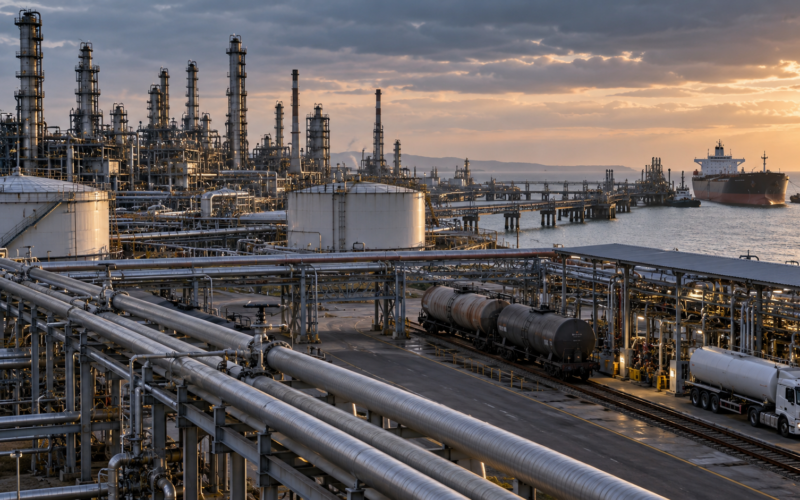
One of the most important changes in Europe’s energy system since Russia’s invasion of Ukraine has happened not in power generation but in the less-visible logistics feeding Central European refineries.
ORLEN S.A. spent years reducing a historical dependence on Russian crude that had once dominated its refining system. By March 2025, all of the group’s refineries were processing crude sourced outside Russia, and its final contractual relationship for Russian oil expired at the end of June that year.
The next stage is no longer simply about removing Russian barrels. It is about creating durable replacement supply chains.
Equinor ASA and ORLEN have now signed a three-year agreement beginning in September 2026 under which annual supplies can range from roughly 5 million tonnes to more than 9 million tonnes of crude. At the upper end, the volume could meet approximately one-quarter of ORLEN’s annual requirements, with Johan Sverdrup crude forming the principal supply and other Norwegian grades also potentially available.
That makes the agreement a useful case study in what energy diversification actually requires. Replacing one supplier does not create security unless alternative production, ports, pipelines, refinery configurations and commercial contracts work together.
How dependent was Central Europe on Russian crude before the energy shock?
Russian crude had structural advantages for Central European refiners. Pipeline networks connected Russian production directly with inland refineries, creating logistics patterns that had been embedded for decades.
ORLEN said Russian crude accounted for almost 100% of its feedstock as recently as 2015. By early 2023, that share had fallen to around 10%, reflecting years of diversification toward the North Sea, Middle East, Africa and the Americas.
The European Union’s wider dependence changed dramatically after 2022. European Commission data says Russian crude fell from about 20% of European Union crude imports in 2022 to roughly 2% in 2025.
That transition was not achieved simply by signing different purchase contracts. Refineries designed around particular crude characteristics had to test and optimise alternative feedstocks, while infrastructure capable of transporting seaborne oil inland needed enough capacity.
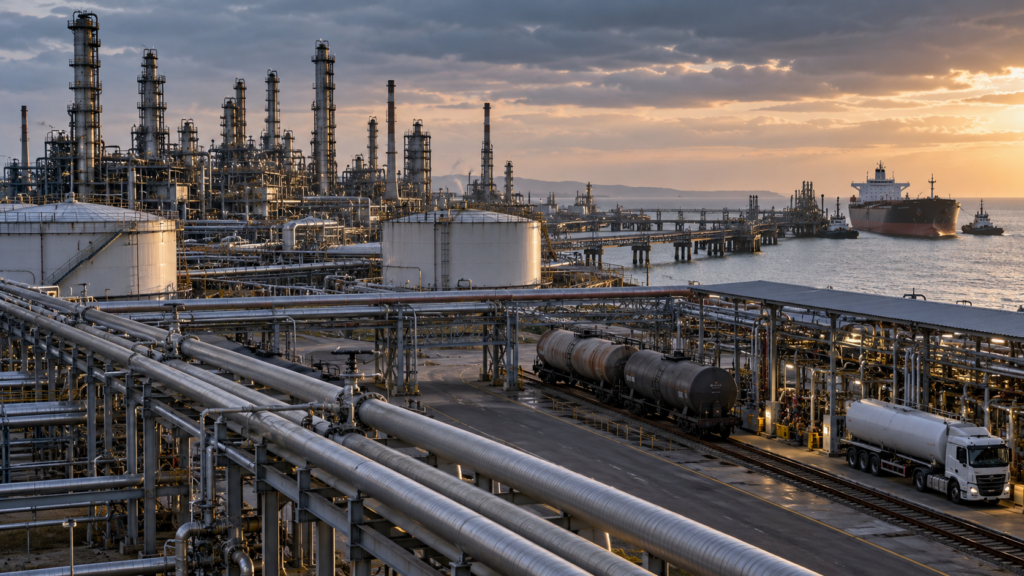
The Czech Republic provides a particularly clear example. ORLEN’s Litvínov refinery historically depended on Russian deliveries through the Druzhba pipeline because alternative pipeline capacity was insufficient. Expansion of the Transalpine Pipeline system and refinery modifications eventually allowed the facility to switch fully to non-Russian crude in 2025.
Why is Johan Sverdrup crude attractive to ORLEN?
Supply security starts with scale and reliability. Johan Sverdrup is one of the largest producing fields on the Norwegian Continental Shelf, giving Equinor the ability to support sizeable contractual commitments.
ORLEN had already signed an earlier one-year contract covering more than 6 million tonnes beginning in September 2025, equivalent to around 15% of group crude demand. The new three-year agreement expands the potential annual volume to more than 9 million tonnes.
Norwegian crude also offers geopolitical advantages. Norway is closely integrated with European energy markets and has become more important to European security across both oil and natural gas as Russian flows have declined.
There is an emissions dimension as well. ORLEN said Johan Sverdrup’s production emissions are substantially lower than the global average, supported by electrification of offshore facilities using power from shore. That does not make refined petroleum a low-carbon product, but upstream carbon intensity can increasingly matter to refiners facing emissions targets and investor scrutiny.
Most importantly, the agreement provides predictability without recreating the old dependence on a single source. ORLEN still processes crude from multiple regions, making Norway an anchor within a diversified system rather than an exclusive replacement for Russia.
Why does refinery flexibility matter as much as supplier diversification?
Crude oils are not interchangeable commodities in an operational sense. Different grades vary in density, sulphur content and product yields, while refinery equipment is optimised around particular feedstock combinations.
A refinery accustomed to one crude slate can therefore require technical modifications, testing and changed blending practices before alternative grades can be processed efficiently.
ORLEN said it carried out modifications and testing at Litvínov to enable the Czech facility to handle non-Russian crude. This operational flexibility was necessary before contractual diversification could become physical diversification.
That is a crucial energy-security lesson. A country may have access to alternative crude on global markets but remain vulnerable if ports, pipelines or refinery configurations cannot accommodate it.
The same principle applies to natural gas, electricity interconnections and critical minerals. Security depends on the capacity to switch sources, not simply the theoretical existence of alternative suppliers.
Is seaborne diversification more secure than pipeline dependence?
Diversification reduces supplier concentration but introduces different vulnerabilities.
Seaborne crude can be purchased from a much wider range of producers, allowing refiners to respond to sanctions, outages or commercial disputes. Ports can receive cargos from Norway, the Middle East, Africa or the Americas without requiring a dedicated pipeline from every producing country.
The trade-off is exposure to shipping costs, maritime chokepoints, port congestion and global freight conditions. In periods of geopolitical tension, insurance and tanker rates can increase rapidly.
That tension is especially relevant in September 2026 as crude markets respond to renewed Middle East instability. Brent prices were above $100 a barrel during recent trading before retreating on September 11, illustrating that geographic diversification cannot remove global price risk.
Energy security therefore has at least two dimensions. Supply security asks whether crude can physically reach the refinery. Price security asks what that crude will cost when global markets become stressed.
The Norwegian agreement improves the first question considerably but cannot eliminate the second.
What does the ORLEN–Equinor relationship suggest about Europe’s new energy map?
The relationship increasingly extends beyond a simple buyer-seller transaction.
Equinor supplies crude and natural gas into European markets, while ORLEN has upstream interests on the Norwegian Continental Shelf and continues to build a wider regional energy portfolio. The result is deeper integration between Northern European production and Central European consumption.
That pattern is strategically important because Europe’s post-Russian energy system is likely to rely on networks of overlapping partnerships rather than one dominant external corridor.
Norway, liquefied natural gas terminals, expanded port infrastructure, interconnectors and global commodity trading have all become more important. The system can be more expensive and operationally complex, but it is also harder for one supplier to disrupt.
Poland’s experience demonstrates that diversification is not a single contract announcement. It is a multi-year infrastructure and commercial programme involving procurement, pipelines, shipping, refinery modification and storage.
What does Equinor’s share performance say about the current oil backdrop?
Equinor’s Oslo-listed shares ended September 11 around NOK415.50, having risen sharply during the preceding weeks and traded close to their 52-week high as elevated oil prices strengthened energy-sector sentiment.
That rally reflects much more than the ORLEN contract. Equinor is one of Europe’s largest energy producers, so commodity prices, Norwegian production and wider geopolitical conditions dominate valuation.
The ORLEN agreement nevertheless strengthens the strategic case for Norwegian supply. Long-term contracts can provide commercial visibility while reinforcing Norway’s position within Europe’s reshaped energy architecture.
For Central Europe, the transformation is even clearer. The region has moved from asking whether it can function without Russian crude to optimising the diversified system that replaced it.
The most durable sign of energy independence may therefore not be the termination of the final Russian contract. It is the creation of enough alternative infrastructure and commercial relationships that losing any single supplier no longer threatens the entire refining system.
Discover more from Business-News-Today.com
Subscribe to get the latest posts sent to your email.