

Drax Group plc (LSE: DRX) has upgraded its 2026 earnings expectations after strong summer power demand and the completion of its £561 million acquisition of Bluefield Solar Income Fund expanded the UK power producer’s generation portfolio. Drax now expects full-year adjusted EBITDA around the top of the £680 million to £711 million analyst consensus range, compared with previous guidance around £665 million that excluded Bluefield.
The July 31 acquisition is central to the change. Drax paid £561 million for Bluefield Solar Income Fund at an enterprise value of approximately £1.082 billion, gaining around 0.9GW of operating solar and wind assets and a gross development pipeline of about 2.9GW. Total capacity under Drax management has consequently increased to roughly 6.1GW.
Why did Britain’s summer heatwave improve Drax’s earnings outlook?
Periods of extreme heat can increase electricity demand as commercial buildings, data centres and households consume more power for cooling. They can also create grid-balancing challenges when demand and renewable production move unexpectedly.
Drax said its generating assets were repeatedly called upon to support Britain’s electricity system during the summer, increasing output or reducing it as required by system conditions. Since its previous July 30 update, the company added approximately 0.3 terawatt-hours of contracted power sales at an average price of £175.90 per megawatt-hour.
That price is materially above the average achieved price across much of Drax’s broader contracted portfolio, illustrating how periods of system stress can increase the value of flexible generating capacity.
As of September 15, Drax had more than £1 billion of contracted forward power sales covering 2026 through 2028 across biomass, pumped-storage hydro and related generation assets, alongside more than £800 million of associated Renewable Obligation Certificates.
The earnings upgrade therefore reflects more than hot weather. It demonstrates the commercial value of owning assets capable of responding quickly when the electricity system needs additional supply.
How does Bluefield change the structure of Drax Group?
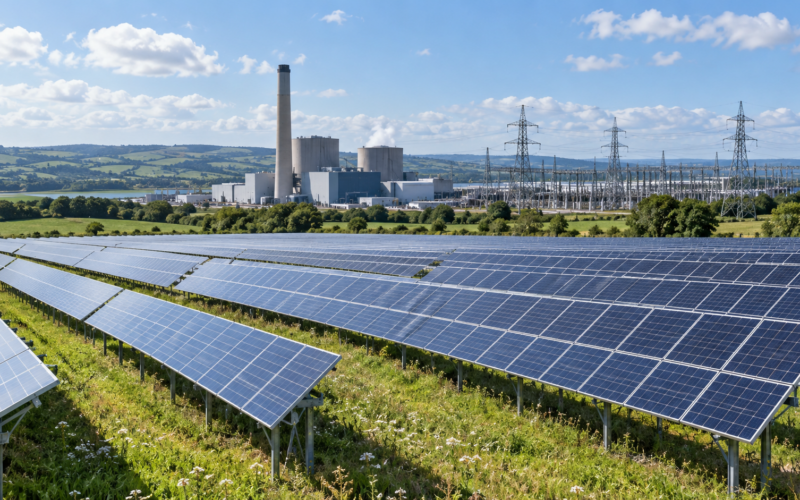
Historically, Drax has been associated primarily with its large power station at Selby, biomass generation and flexible power assets. The Bluefield transaction adds a much larger portfolio of distributed solar and wind assets, broadening the company’s revenue mix.
Bluefield brings roughly 0.8GW of operating solar and 0.1GW of onshore wind spread across more than 250 assets in England, Scotland, Wales and Northern Ireland. Drax plans to operate the portfolio as a separate Solar & Wind reporting segment alongside Flexible Generation and Biomass from 2027.
The operating portfolio also benefits from long-term renewable-support schemes and contracted power-purchase agreements, potentially giving Drax more predictable revenue alongside the more market-sensitive earnings generated by flexible assets.
Management believes there are additional commercial synergies from combining Bluefield with Drax’s trading and route-to-market operation. Drax already provides market access for approximately 2,000 smaller renewable assets totalling roughly 0.8GW and generating around £5 million to £10 million of annual adjusted EBITDA. Bluefield’s 0.9GW operating portfolio gives Drax another large asset base across which those optimisation capabilities can potentially be applied.
Why could Bluefield’s 2.9GW development pipeline matter more than its existing assets?
The acquired portfolio includes approximately 2GW of battery energy-storage projects and around 0.9GW of prospective solar capacity on a gross basis. Bluefield’s economic share of the pipeline is smaller, but the development inventory gives Drax options to deploy additional capital without having to acquire another entire platform.
Around 0.5GW of gross solar development already has long-term Contracts for Difference with strike prices of approximately £69 to £74 per megawatt-hour in 2026 real terms, indexed to inflation. Roughly 0.2GW is in nearer-term development and could enter service in 2028 if Drax takes final investment decisions.
Battery storage could be particularly complementary to the broader portfolio. Solar produces electricity when sunlight is available, while batteries can move some of that power into higher-value periods or participate in grid-balancing services.
The combined model therefore gives Drax a potentially wider set of revenue streams: contracted renewable generation, merchant electricity sales, system services, biomass, hydro, gas flexibility and storage.
The challenge is capital discipline. Development pipelines can look attractive on paper, but only projects capable of producing returns above Drax’s cost of capital should proceed.
Has the Bluefield acquisition increased balance-sheet risk?
Yes, at least temporarily. Drax drew approximately £0.8 billion under a bridge facility to fund the acquisition and repay around £0.3 billion of Bluefield facilities, while retaining approximately £0.2 billion of existing Bluefield debt. The company plans to refinance the bridge financing.
Drax targets long-term net debt to adjusted EBITDA of around two times. Management expects leverage to exceed that level during 2026 following the transaction before returning to approximately the long-term target by the end of 2027.
That creates an important test for the acquisition. Bluefield needs to generate enough cash and synergies to justify both the purchase price and the temporary increase in leverage.
Capital expenditure for 2026 is still expected at £210 million to £250 million including the Bluefield portfolio, although development decisions around additional solar assets could increase investment.
Investors should consequently track leverage alongside EBITDA. A higher earnings outlook is encouraging, but the quality of the acquisition will ultimately depend on the cash generated relative to the capital committed.
Why is Drax also considering a data centre at its Selby power station?
Drax is examining longer-term options for its Selby site that include a large-scale data centre, with an initial phase of around 100MW. Management expects to submit a planning application for the first phase in the coming months.
The idea reflects a wider transformation in energy infrastructure. Data-centre developers increasingly value sites with access to high-capacity electricity connections, and existing power-station locations can have significant grid infrastructure already in place.
Drax says it has approximately 4GW of grid access around the Selby site, making the location potentially valuable as artificial-intelligence and cloud-computing companies search for sites capable of supporting large electrical loads.
A data centre would represent a very different business from electricity generation, and the project remains at an early planning stage. It nevertheless illustrates how grid connections themselves are becoming strategically valuable assets as electricity demand from computing grows.
What does the higher Drax outlook mean for shareholders?
Analyst consensus published by Drax on September 11 put 2026 adjusted EBITDA at £698 million, within a range of £680 million to £711 million. Management now expects performance around the upper end of that range, provided operating conditions remain supportive.
Drax shares were up around 1% during September 17 trading after the update, following a period in which the stock had remained slightly lower for the year. The market reaction suggests investors welcomed the guidance improvement without treating it as a complete revaluation of the company.
That caution is understandable because Drax is simultaneously integrating Bluefield, carrying higher leverage and considering substantial future development spending.
The next major strategic checkpoint is the company’s November 23 Capital Markets Day. Investors should receive greater detail on Bluefield synergies, solar and battery investment, leverage reduction and the future of the Selby site.
The important shift is already visible. Drax is trying to become less dependent on one generation technology and more exposed to the broader economics of Britain’s increasingly complex electricity system.
Discover more from Business-News-Today.com
Subscribe to get the latest posts sent to your email.