




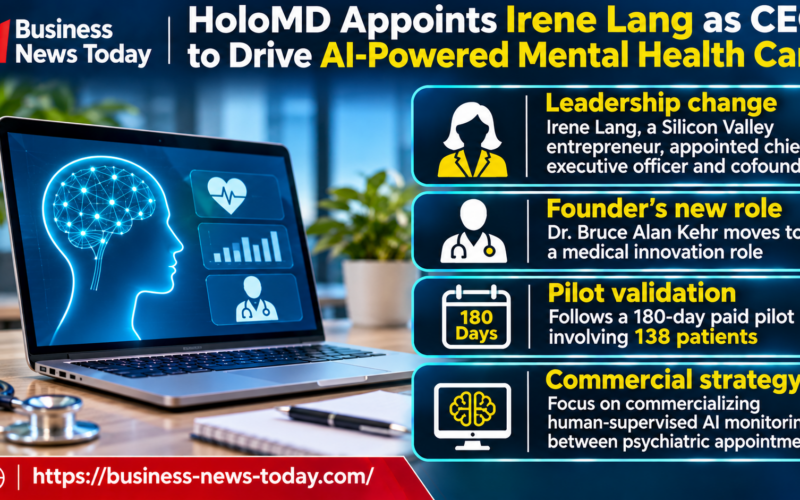
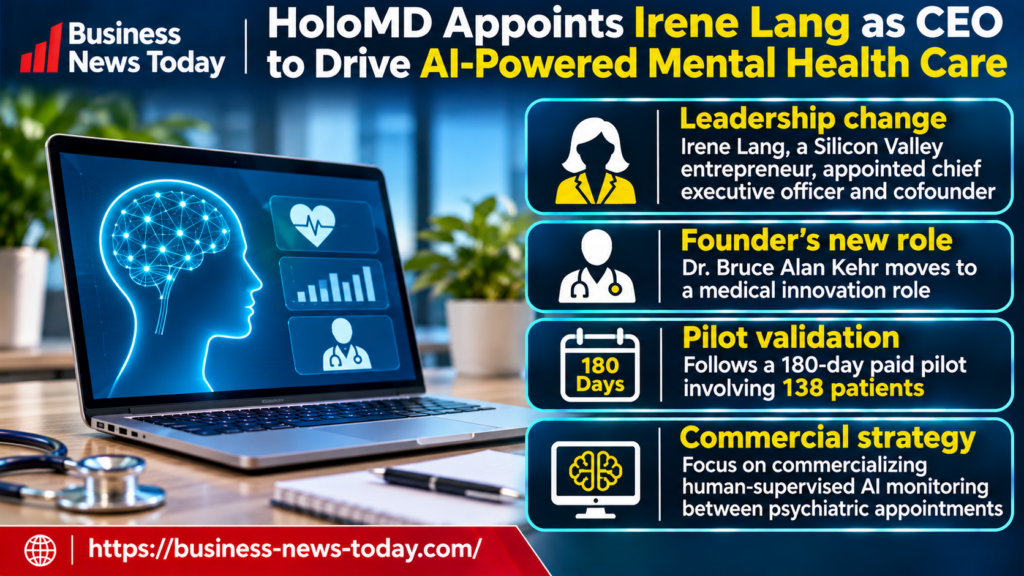
HoloMD, the Maryland-based healthcare technology company developing a human-supervised artificial intelligence platform for psychiatric care, has appointed Silicon Valley entrepreneur Irene Lang as chief executive officer and cofounder as it prepares for a broader commercialization effort. Announced on October 27, 2026, the leadership change moves company founder Dr. Bruce Alan Kehr into the role of chief medical innovation officer while placing product development, customer adoption and business expansion under Lang’s leadership. The transition follows results from a 180-day paid pilot with Banyan Treatment Centers involving 138 patients, which reported 83% retention and generated 43 human-reviewed escalations. The announcement provides early evidence of patient engagement and clinical workflow activity, although the company has not established through a controlled study that its system reduces relapse, hospitalization or overall treatment costs.
HoloMD develops Dr. Holo, a software platform intended to maintain contact with patients between scheduled psychiatric appointments. It combines AI-supported conversations and ongoing engagement with review by human personnel when the system identifies information that may require clinical attention.
The company refers to this model as Continuous Precision Psychiatry, a term it uses to describe more frequent monitoring and individualized responses outside conventional appointments. Its objective is to provide clinicians with additional information about a patient’s condition during periods when traditional care may offer limited visibility.
Lang previously co-founded Eliza, an AI-enabled mental health technology business acquired by Spring Health approximately 18 months after its inception. Her experience includes behavioral research, machine learning, product development and commercial growth. The appointment reflects HoloMD’s decision to complement Kehr’s clinical leadership with an executive focused on bringing the product to a wider market.
The company has not disclosed a new financing amount, valuation or revenue forecast alongside the appointment. It has confirmed that it is engaging investors to support the next stage of development, making product validation and commercial readiness central to its immediate strategy.
Why is HoloMD appointing Irene Lang CEO while founder Bruce Alan Kehr moves into medical innovation?
HoloMD’s leadership transition separates two functions that can become increasingly demanding as a healthcare technology business grows. Kehr has led the development of the clinical philosophy behind the platform, while Lang is expected to concentrate on customer adoption, product development, partnerships and capital formation.
Kehr is a psychiatrist with more than four decades of clinical experience and the founder of Potomac Psychiatry. His work has informed HoloMD’s emphasis on personalized care and the use of clinical information to guide decisions between appointments. The company intends to retain that expertise through his new position as chief medical innovation officer.
Lang brings a different professional background. She developed quantitative machine learning and decision-support models for financial investment professionals before undertaking research-related responsibilities at Twitter. She subsequently co-founded Eliza, where she worked on AI tools intended to support mental health providers.
According to HoloMD, one adoption initiative at Eliza increased therapist engagement from approximately 15% to nearly 100% of caseload. This figure describes a specific company-reported initiative and should not be interpreted as a general outcome across all Eliza users or evidence of clinical improvement among patients.
The appointment gives Lang the title of cofounder within HoloMD’s current leadership structure. It does not change the historical fact that Kehr established the business. The company is presenting the arrangement as a partnership combining clinical knowledge with technology commercialization experience.
For healthcare software businesses, that combination can be commercially important. Products developed around specialist clinical insight must still work within the daily responsibilities of healthcare providers. Clinicians may reject systems that create excessive documentation, produce unreliable alerts or require substantial additional effort.
Lang’s immediate challenge will be converting HoloMD’s existing technology into a product that organizations can adopt and operate consistently. That includes understanding customer requirements, improving usability and demonstrating that the service offers benefits sufficient to justify its cost.
The transition may also influence investor discussions. Healthcare technology investors frequently assess whether a company’s management team includes the capabilities needed to move from early product validation into repeatable commercial deployment. However, an executive appointment alone does not establish that financing or a broader customer rollout has been secured.
What does HoloMD’s 180-day Banyan Treatment Centers pilot reveal about patient engagement and risk detection?
HoloMD’s latest operational evidence comes from a 180-day paid pilot conducted with Banyan Treatment Centers. The programme enrolled 138 patients and reported retention of 83%, suggesting that a substantial proportion of participants continued engaging with the platform during the evaluation period.
The pilot also generated 43 human-reviewed escalations, including 19 relapse-related alerts. These findings indicate that the system identified information considered important enough for human review. However, they do not establish how many alerts corresponded to independently confirmed clinical deterioration or preventable adverse outcomes.
The distinction is particularly important when evaluating AI-supported psychiatric monitoring. An alert may identify a genuine concern requiring intervention, but it may also arise from ambiguous language, incomplete information or circumstances that are resolved without a change in treatment. Assessing the quality of alerts requires more than counting the number generated.
The company has not disclosed a controlled comparison showing whether patients using Dr. Holo experienced fewer relapses or hospitalizations than comparable patients receiving conventional follow-up care. The announcement also does not provide independently established sensitivity, specificity or false-positive rates for its risk detection system.
Earlier results from the Banyan collaboration offer additional context. In March 2026, the organizations reported findings from a 90-day pilot at Banyan Treatment Centers Texas. Approximately 90.1% of eligible discharged clients enrolled, 89% accepted the service terms and initiated monitoring, and 83% remained active.
The earlier programme generated 19 human-reviewed clinical alerts, including three relapse-related alerts. The later 180-day announcement reports 43 escalations, of which 19 were relapse-related. These figures cover different reporting periods and should not be treated as directly comparable monthly rates without additional information about the populations and observation periods.
The March report also described an instance in which a patient disclosed a relapse-related concern after a prolonged period without communication, prompting staff outreach within approximately 20 minutes. The example illustrates how an escalation process can support timely contact, although an individual case does not establish the system’s overall clinical effectiveness.
Together, the findings provide evidence that patients may engage with a between-visit monitoring system and that information can be escalated for human assessment. Whether those activities consistently improve treatment outcomes remains a separate question requiring further evidence.
How does the Dr. Holo platform extend psychiatric care between conventional appointments?
Traditional psychiatric care often depends on scheduled appointments during which patients describe recent symptoms, treatment responses and changes in circumstances. Clinicians use that information, together with their assessments and medical records, to make decisions about treatment.
However, changes in a patient’s condition can occur between appointments. Some individuals may experience difficulties without contacting their provider immediately, particularly when they are transitioning from a structured treatment environment back to ordinary daily routines.
HoloMD’s platform is intended to create additional opportunities for patients to communicate relevant information during those intervals. Dr. Holo uses AI-supported interactions to maintain engagement and identify signals that may warrant attention.
The human-supervised structure is central to the model. Rather than presenting the AI system as an independent psychiatrist, HoloMD describes a process in which selected concerns are reviewed and may be escalated to appropriate clinical personnel.
This distinction matters because psychiatric information can be complex and sensitive. A patient’s statement may require interpretation in the context of their history, current treatment and circumstances. Automated systems can assist with collecting or organizing information but may not have sufficient context to make safe clinical decisions independently.
An effective workflow must therefore define when information should be reviewed, who is responsible for responding and what happens when a concern is identified outside normal operating hours. The system also needs to distinguish urgent issues from routine information so that clinicians are not overwhelmed by unnecessary notifications.
The commercial benefit would arise if the platform helps care teams identify relevant changes earlier while maintaining manageable staffing requirements. Such an outcome could support continuity of care and improve the quality of information available during subsequent appointments.
However, the announcement does not demonstrate that Dr. Holo replaces conventional treatment or provides continuous real-time observation of every patient’s condition. Patients still need to engage with the system, and the information available to clinicians depends on what is collected and appropriately reviewed.
The platform is best understood as a potential extension of professional psychiatric care rather than a substitute for clinicians or an independently validated emergency response service.
Why is the period after discharge from mental health or addiction treatment important to HoloMD’s business model?
HoloMD’s pilot with Banyan Treatment Centers focused on patients receiving follow-up support after discharge from structured treatment. This period creates distinct care coordination challenges because individuals may move from a highly supervised environment into daily circumstances with less frequent professional contact.
A treatment provider may have established an appropriate discharge plan, but continued follow-up depends on communication, appointment attendance and the availability of support. Patients may encounter changing circumstances that affect their engagement with the plan.
The Banyan Companion model seeks to maintain a structured communication channel during this transition. It allows relevant information to be identified and reviewed, potentially helping care teams determine when additional contact may be appropriate.
For treatment organizations, the commercial proposition includes improving continuity after discharge without requiring every patient to attend frequent additional appointments. Digital communication may provide a supplementary channel that helps staff identify where their attention is most needed.
However, the benefits depend on meaningful patient participation. A person who does not respond to prompts or share relevant information may remain difficult to assess through the platform. High retention does not necessarily establish that the system captures every clinically important change.
A further challenge involves distinguishing indicators that require urgent intervention from those that may be addressed during routine care. Excessive alerts could increase staff workload, while missed alerts could undermine confidence in the technology.
The pilot’s human-reviewed escalation process suggests that HoloMD is attempting to manage this challenge through clinical oversight. Nevertheless, the company has not published independent evidence quantifying the system’s accuracy or the staffing hours required to review alerts.
A broader customer rollout would need to demonstrate that the approach works across different treatment organizations and patient populations. Results from one provider’s pilot cannot automatically establish comparable performance in outpatient psychiatry, primary care or other behavioral health settings.
Can reimbursement-enabled workflows create a sustainable commercial model for continuous psychiatric monitoring?
HoloMD describes Dr. Holo as incorporating reimbursement-enabled clinical workflows. This suggests the company is developing its platform around services that healthcare organizations may be able to provide and bill for under applicable reimbursement arrangements.
The United States healthcare system already recognizes certain behavioral health integration and collaborative psychiatric care activities. Medicare payment frameworks include services involving care management, patient follow-up, coordination and consultation under specified clinical and documentation requirements.
For example, psychiatric collaborative care management codes can support eligible services involving a treating provider, behavioral health care manager and psychiatric consultant. Such services require specific activities, time commitments and documentation rather than simply the availability of a digital monitoring application.
This creates a potential business opportunity for technology that helps healthcare organizations organize and deliver qualifying care. Software may support patient engagement, clinical records and workflow coordination, allowing providers to manage the activities associated with covered services.
However, a reimbursement-enabled product does not automatically qualify for payment under every insurance plan. Eligibility depends on the specific service, provider, payer, coding requirements and applicable regulations.
The company has not disclosed the reimbursement codes used by its pilot customers or the amount of reimbursement generated through Dr. Holo. It would therefore be premature to estimate revenue per monitored patient based on general Medicare payment schedules.
Commercial arrangements could involve software subscriptions, implementation fees or other contractual structures, but HoloMD has not published definitive pricing or customer contract economics. The announcement also does not establish that every participating patient generates reimbursement.
A financially sustainable model would require the value of eligible care activity and operational benefits to justify the cost of the technology and associated clinical oversight.
For HoloMD, demonstrating attractive economics will be particularly important because human-reviewed escalation is part of its safety proposition. Clinical supervision adds value but also creates staffing and operating requirements that must be considered when assessing scalability.
What clinical safety, privacy and AI governance requirements could affect adoption of HoloMD’s psychiatry technology?
Psychiatric monitoring involves sensitive health information and potentially serious consequences when concerning signals are missed or interpreted incorrectly. Healthcare organizations evaluating HoloMD will therefore need evidence that the platform can operate within appropriate clinical governance and information security frameworks.
Patient consent and privacy protection are central requirements. A platform collecting personal information about symptoms, treatment engagement or substance use recovery must have suitable controls over access, storage, sharing and retention.
Providers will also need clarity about how the AI system generates alerts and how human reviewers evaluate them. A transparent workflow is important when clinicians need to understand why a patient has been flagged for additional attention.
False positives and false negatives create different operational risks. An excessive number of false alerts may overwhelm staff or lead patients to lose confidence in the system. Missed concerns could create a misleading sense of security if clinicians or patients assume that monitoring is more comprehensive than it actually is.
The effectiveness of the platform may also vary across patient populations. Language, communication style, cultural context and the clinical circumstances of particular individuals can influence how information is expressed. Validation should therefore consider whether the system performs reliably across the populations it is intended to serve.
HoloMD emphasizes human supervision as a safeguard, but the company has not disclosed an independent clinical validation establishing the platform’s safety across all proposed uses. The announcement does not identify a U.S. Food and Drug Administration clearance or approval for specific medical-device claims.
The regulatory treatment of AI-enabled clinical software depends on its intended functions and how it is used. Organizations adopting the platform will need to assess the applicable requirements rather than assuming that human oversight automatically resolves every regulatory issue.
For commercial customers, the strongest proposition would combine reliable engagement, clinically appropriate escalation and clear responsibilities for responding to concerns. Those capabilities need to be supported by evidence and workable operating procedures.
How does Irene Lang’s Eliza experience position HoloMD within the competitive mental health technology market?
Lang’s experience at Eliza provides HoloMD with leadership familiar with building AI-related tools for mental health professionals. The earlier business focused on clinical decision support and outcome measurement, seeking to help therapists understand patient progress and make more informed decisions.
Spring Health acquired Eliza approximately 18 months after the venture was established, according to HoloMD’s announcement. The acquisition demonstrates that Lang has participated in developing a mental health technology business through an exit, although the financial terms of that transaction have not been disclosed in the HoloMD release.
The broader digital mental health sector includes businesses focused on patient access, provider networks, treatment engagement and clinical technology. Some platforms concentrate on delivering virtual care, while others supply software intended to support existing providers.
Spring Health itself has expanded through acquisitions and partnerships, including its completed combination with Alma in May 2026. These developments illustrate ongoing investment in mental healthcare technology and provider infrastructure.
HoloMD’s stated positioning differs from that of a general therapy marketplace or virtual appointment provider. Its core proposition involves monitoring and engagement between clinical encounters, with information reviewed by human personnel and integrated into care workflows.
That focus may create opportunities among treatment organizations seeking to maintain relationships with patients after discharge or between appointments. However, other healthcare technology suppliers can also develop remote engagement, care management and clinical decision-support capabilities.
The company will need to demonstrate that its approach provides meaningful differentiation through clinical utility, ease of implementation and economic returns. Having an experienced technology executive may improve commercialization efforts, but competitive advantage will ultimately depend on product performance and customer adoption.
What commercial milestones should investors and healthcare organizations watch after the CEO appointment?
HoloMD enters the leadership transition with an early paid pilot and a stated plan to broaden commercialization. The immediate objective is to convert those initial results into customer relationships that can be maintained and expanded.
Evidence of repeat contracts would help establish whether healthcare organizations consider the platform sufficiently valuable to continue purchasing after evaluation. The announcement does not disclose the annual contract value of the Banyan arrangement, the number of other paying customers or the size of the prospective sales pipeline.
Additional clinical evaluation will also be important. Larger studies across different provider settings could clarify whether the reported engagement and escalation findings are reproducible. Comparisons with conventional follow-up care would provide stronger evidence of any effect on treatment outcomes.
The quality of alert performance deserves particular attention. Human-reviewed escalations can be useful, but healthcare organizations need to understand how frequently alerts identify meaningful concerns and how much staff time is required to respond.
The financial model should also become clearer as HoloMD expands. Investors will need information about implementation expenditure, subscription revenue, customer retention and the cost of clinical oversight. These measures will determine whether the platform can support attractive economics at larger scale.
Lang is also expected to support investor engagement. However, no new financing commitment, valuation or completed capital raise was announced alongside her appointment. Funding plans remain an objective rather than a confirmed financial milestone.
The leadership change gives HoloMD a clearer division between clinical innovation and commercial execution. Kehr will remain responsible for advancing the medical direction, while Lang focuses on building a scalable product and business.
The company’s opportunity is to make between-visit psychiatric support more systematic and useful for care providers. Its challenge is to establish that increased monitoring produces meaningful benefits without introducing excessive clinician workload, privacy risks or unverified expectations of clinical protection.
The most convincing evidence of progress would be sustained patient engagement accompanied by independently evaluated clinical outcomes and commercially sustainable customer contracts. Until those measures become available, the pilot results should be treated as encouraging operational evidence rather than proof of broad clinical effectiveness.
What are the key takeaways from HoloMD’s appointment of Irene Lang as chief executive officer?
- HoloMD appointed Irene Lang chief executive officer and cofounder on October 27, 2026.
- Founder Dr. Bruce Alan Kehr is transitioning to chief medical innovation officer.
- Lang previously co-founded Eliza, an AI-enabled mental health technology business acquired by Spring Health.
- HoloMD develops Dr. Holo, a human-supervised AI platform designed to support communication and risk detection between psychiatric appointments.
- A 180-day paid pilot with Banyan Treatment Centers involved 138 patients and reported 83% retention.
- The pilot generated 43 human-reviewed escalations, including 19 relapse-related alerts.
- These findings demonstrate engagement and alert activity but do not independently establish reductions in relapse, hospitalization or treatment costs.
- HoloMD is developing reimbursement-enabled clinical workflows, although actual coverage depends on qualifying services and payer requirements.
- The company is seeking additional investor support but has not disclosed a new funding round or valuation.
- Successful commercialization will depend on clinical validation, patient privacy, alert accuracy, customer retention and sustainable operating economics.
Discover more from Business-News-Today.com
Subscribe to get the latest posts sent to your email.
