

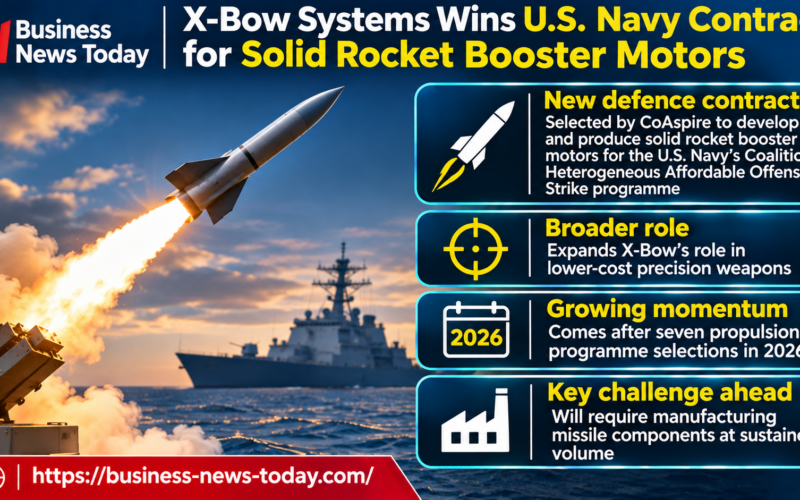
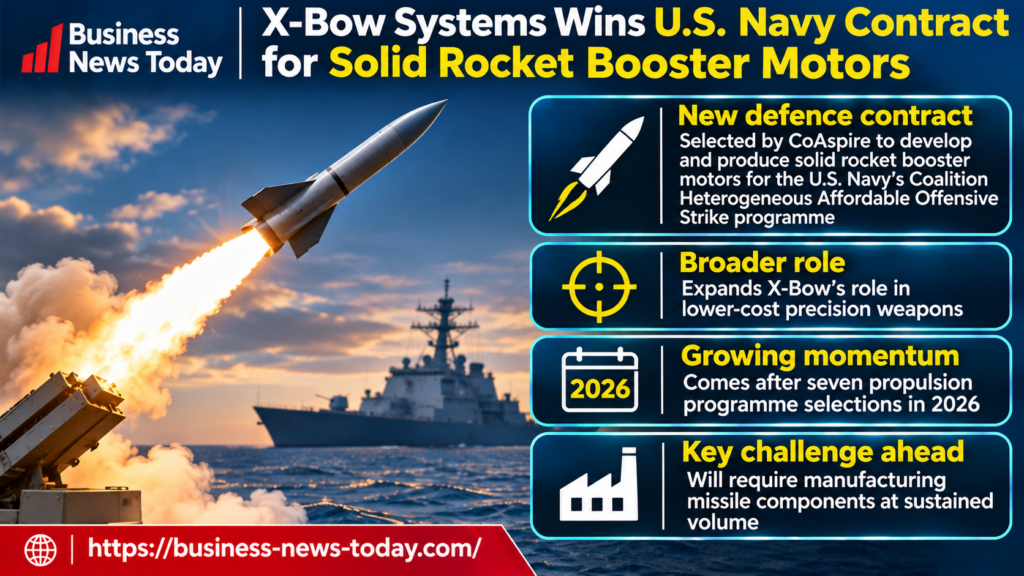
X-Bow Systems Inc., the Albuquerque-based manufacturer of solid rocket motors, has been selected by CoAspire to develop and manufacture booster motors for the U.S. Navy’s Coalition Heterogeneous Affordable Offensive Strike programme, known as CHAOS. Announced on October 27, 2026, the supplier agreement places X-Bow within a programme intended to deliver lower-cost, mass-producible cruise missiles for U.S. allies and coalition partners. The work concerns the ground-launched version of CoAspire’s Rapidly Adaptable Affordable Cruise Missile-Extended Range, or RAACM-ER, designed to engage land and maritime targets. The selection adds to a growing portfolio of defence propulsion programmes for X-Bow, although neither the value of its subcontract nor a production quantity has been disclosed.
The decision follows CoAspire’s selection earlier in 2026 for a U.S. Navy prototype agreement valued at approximately $70 million. That programme supports development, testing and delivery of a new affordable cruise missile capability under the Navy’s munitions acquisition organization. CoAspire is the prime contractor, while X-Bow is supplying a specific propulsion component.
The distinction matters because the programme’s headline funding should not be attributed entirely to X-Bow. CoAspire’s agreement covers the broader weapon system and associated development activities, including the missile, booster and launch configuration. X-Bow’s commercial contribution will depend on the terms of its supplier arrangement and any subsequent production orders.
X-Bow founder and Chief Executive Officer Jason Hundley has positioned the selection as evidence that alternative manufacturing approaches can support the expansion of America’s defence industrial base. The company reports seven new propulsion programme selections during 2026 across the Navy, Army and Missile Defense Agency. Its latest appointment brings additional commercial exposure but also increases the importance of manufacturing capacity, qualification testing and reliable delivery.
What is the U.S. Navy’s CHAOS programme, and why is affordability central to its missile strategy?
CHAOS stands for Coalition Heterogeneous Affordable Offensive Strike, a U.S. Navy initiative designed to improve access to relatively affordable precision strike weapons for allies and coalition partners. The programme focuses on providing capabilities that can engage maritime and land targets while supporting production at a larger scale than might be economical with more complex and expensive weapons.
The Navy’s Precision Strike Weapons programme office, PMX-201, is overseeing the effort under Program Acquisition Executive Munitions. The programme uses prototype Other Transaction Authority arrangements intended to support faster development and experimentation with nontraditional defence suppliers.
In August 2026, the Navy confirmed awards involving CoAspire and Zone 5 Technologies. These businesses were selected to advance competing or complementary approaches to affordable weapons capabilities, reflecting a deliberate effort to expand the industrial base beyond established missile manufacturers.
The programme’s emphasis on coalition users is commercially and strategically relevant. Allied nations may require precision weapons in quantities that are difficult to afford if every missile carries the cost and complexity associated with high-end systems. A lower-cost design could allow customers to procure larger inventories, provided performance and reliability meet the intended operational requirements.
However, affordability is not simply a matter of reducing the cost of individual components. The finished weapon must satisfy requirements involving performance, storage, maintenance, launch compatibility and operating reliability. A cheap component that introduces additional integration or qualification problems may not reduce overall programme costs.
The Navy is seeking a balance between capability, repeatability and production economics. CoAspire’s selection demonstrates demand for an alternative missile architecture, while X-Bow’s supplier role addresses one part of the industrial system needed to manufacture it.
Neither company has disclosed a final approved production quantity under the October booster announcement. Development and prototype activity should therefore remain distinct from a guaranteed multiyear procurement programme.
How will X-Bow’s booster motors support CoAspire’s ground-launched RAACM-ER cruise missile?
CoAspire’s CHAOS offering uses the RAACM-ER missile in a ground-launched configuration. The overall system includes the cruise missile, a booster and associated launch equipment. X-Bow has been selected to supply the solid rocket booster motors used during the launch phase.
The booster performs a different function from the propulsion system supporting the missile during the remainder of its flight. Its role is associated with the initial launch and transition to the missile’s intended operating conditions. The reliability of this stage is essential because a failure during launch can prevent an otherwise functional missile from completing its mission.
Solid rocket propulsion is widely used for missile boosters because the propellant can be stored within the motor and provides a defined propulsion capability when activated. However, manufacturing requirements can be demanding, particularly when production must remain consistent across large numbers of units.
CoAspire has developed several variants within its RAACM family, including systems intended for air, ground and surface launch applications. Its ground-launched development programme builds upon earlier work involving the GHOST variant associated with low-cost containerized munition initiatives.
The ability to adapt a family of missiles for different launch configurations may offer opportunities to reuse some design and manufacturing resources. However, commonality does not eliminate the need to qualify individual configurations for their intended operating conditions.
X-Bow’s selection indicates that CoAspire considers its manufacturing and propulsion capabilities suitable for the relevant booster-development requirements. Nevertheless, the announcement does not confirm that the final motor has completed every qualification test or entered full-rate CHAOS production.
Future evidence will need to include successful development and testing, followed by production orders if the broader system progresses. The supplier relationship establishes an important role in the programme, but technical execution remains a separate milestone.
Why is X-Bow’s additive manufacturing approach attracting new U.S. defence propulsion programmes?
X-Bow promotes a proprietary manufacturing approach described as Additive Manufacturing of Solid Propellant. The technology forms part of the company’s strategy for developing solid rocket motors using more digitally controlled production processes. Management believes the approach can support greater flexibility and more efficient production than certain traditional manufacturing methods.
The potential commercial advantage lies in repeatability and manufacturing capacity. When defence customers require substantial numbers of propulsion components, suppliers must produce them consistently while maintaining quality and meeting contractual schedules. Manufacturing methods that reduce unnecessary process variation may support those objectives.
X-Bow has combined its proprietary manufacturing approach with a broader digital-first operating strategy. The company is seeking to standardize selected production activities while preserving the ability to accommodate requirements across different motor programmes.
However, proprietary manufacturing technology must still demonstrate its suitability for each application. Solid rocket motors are subject to demanding qualification and acceptance requirements, and a process that works successfully for one design may require additional validation for another.
The October selection does not provide independently verified comparisons of manufacturing costs, production rates or defect levels against competing suppliers. Management’s claims of speed and efficiency therefore remain strategic assertions until supported by sufficiently comparable operating data.
The broader industrial context helps explain interest in alternative suppliers. The U.S. defence sector has experienced pressure to expand rocket motor production, with concentrated supply chains and long manufacturing lead times affecting some programmes. Defence customers are consequently considering technologies and businesses capable of adding qualified capacity.
X-Bow’s growing programme portfolio suggests that its capabilities are being evaluated for several applications. The key test will be converting those selections into reliable manufacturing output while maintaining cost discipline.
How does the CHAOS selection fit X-Bow’s seven propulsion programme wins in 2026?
X-Bow described the CoAspire decision as its seventh new propulsion programme selection during 2026. Earlier announcements covered work involving the Navy, Army and Missile Defense Agency, showing that the business is expanding across multiple defence customers rather than depending on one product.
On October 12, X-Bow announced that Leidos had selected it to develop and produce booster motors for the U.S. Army’s Low-Cost Containerized Munition programme. That arrangement involves a separate missile development effort and is not the same contract as the October 27 CHAOS selection.
Under the Leidos arrangement, X-Bow expects to progress through design work, qualification testing and static-fire demonstrations ahead of a targeted production ramp during 2027. The programme provides another opportunity to establish manufacturing performance for lower-cost missile applications.
Earlier in October, X-Bow announced a separate Navy prototype agreement with a total potential value of approximately $69.7 million. The arrangement includes a $50.4 million first-phase development effort and a $19.3 million qualification option.
The award included approximately $50 million obligated initially and supports tooling for a production line designed for capacity of up to 500 motors annually at the company’s Luling, Texas, facility. That programme involves development of a booster for a different future Navy capability.
The October 27 CHAOS supplier selection should not be combined with the $69.7 million agreement as though both figures represented funding for the same deliverable. The contracts are separate developments, and the newly announced CoAspire subcontract does not disclose its financial consideration.
X-Bow also reported completing its first major production contract, delivering more than 2,100 combat-ready rocket motors. This provides evidence that the company has moved beyond prototype development into delivery of manufactured propulsion equipment.
Nevertheless, completion of one production contract does not establish that every new motor design has been qualified or that the company can immediately manufacture all selected programmes at the proposed future volumes.
What does CoAspire’s approximately $70 million Navy award reveal about the wider CHAOS commercial opportunity?
CoAspire announced its selection for the Navy’s CHAOS programme in July 2026 through a prototype agreement valued at approximately $70 million. The agreement supports development, testing and delivery of its ground-launched RAACM-ER system.
The award was arranged through an Other Transaction Authority structure involving the Naval Aviation Systems Consortium. Such arrangements are used in selected defence research and prototyping programmes to support development through contractual mechanisms different from conventional procurement contracts.
For CoAspire, the award establishes an opportunity to demonstrate an affordable cruise missile architecture. It does not guarantee a follow-on production contract of any particular size. Additional procurement will depend on technical performance, budget decisions and the Navy’s assessment of programme requirements.
CoAspire has identified a supply network of 56 first-tier suppliers distributed across much of the United States. This illustrates the industrial coordination required to produce a complete weapon system, even when the prime contractor is a relatively small business.
X-Bow’s role addresses the propulsion element, which must be integrated with the missile and launcher design. Commercial benefits could increase if the programme advances into larger production commitments, but the value of such future work has not been disclosed.
The company could also benefit from broader demand for propulsion components used in related programmes. However, similarity between motor applications does not establish that one contract automatically leads to another.
The immediate financial significance is therefore best understood as access to a new development programme and potential follow-on production opportunities. It would be premature to add CoAspire’s entire programme value to X-Bow’s revenue or order backlog.
Can X-Bow scale its rocket motor manufacturing while managing seven development programmes simultaneously?
Expanding across multiple defence programmes creates opportunities for revenue diversification, but it also places pressure on engineering capacity, manufacturing resources and quality assurance. Each project may involve different technical requirements, production schedules and customer acceptance procedures.
X-Bow operates manufacturing and development facilities across the United States, including activities in New Mexico, California and Texas. Its Luling operation is an important element of the company’s manufacturing expansion, while other locations support research, development and testing.
The company has reported that revenue and backlog have more than doubled since 2023. This provides an indication of commercial growth, although the announcement does not disclose actual revenue, annual profitability or the current dollar value of its order backlog.
A larger backlog can provide greater visibility over future activity, but it is not equivalent to revenue already earned. Contracts may involve development milestones, options and conditions that determine the timing and amount of payments.
The manufacturing challenge is particularly important where several programmes enter qualification or production preparation at similar times. Engineering resources may need to support multiple motor designs, while manufacturing systems must meet differing quality and documentation requirements.
Investment in tooling and production infrastructure may allow greater throughput, but additional capacity introduces expenditure before the corresponding production demand is fully realized. Utilization will influence whether new facilities generate attractive economic returns.
Successful execution would involve completing qualification work on schedule and demonstrating that finished motors can be supplied consistently. Delays or technical rework could affect profitability, particularly where contract terms place responsibility for development performance on the supplier.
The CHAOS selection therefore strengthens X-Bow’s commercial opportunities while adding another commitment to an increasingly complex programme portfolio.
How could lower-cost cruise missile production change the competitive structure of the U.S. defence industrial base?
Traditional precision weapons programmes often involve highly specialized systems developed by large defence contractors. These companies maintain substantial engineering resources and established relationships with military customers, but their systems can be expensive and require lengthy production preparation.
The demand for affordable precision weapons has encouraged greater attention to smaller developers and specialized suppliers. Programmes such as CHAOS seek to demonstrate whether suitable performance can be delivered through architectures designed for manufacturing efficiency and large-scale procurement.
CoAspire’s role as a prime contractor illustrates this change. Rather than relying exclusively on a conventional major defence contractor, the Navy is working with smaller companies to evaluate alternative missile solutions.
X-Bow’s supplier selection extends that model into the propulsion supply chain. A new generation of prime contractors still requires motors, electronics, structures and other components from qualified suppliers. The ability to manufacture those inputs may become a constraint on programme scale.
However, smaller suppliers face their own competitive challenges. Established defence manufacturers have decades of production experience, accumulated technical data and large operating facilities. New entrants must demonstrate that lower costs and greater flexibility do not come at the expense of reliability.
Government support for additional industrial capacity can encourage competition, but the long-term outcome depends on sustained procurement demand. Facilities developed for expected production volumes may become underutilized if programme priorities or budgets change.
The commercial opportunity for X-Bow is to establish itself as a repeat supplier across several programmes rather than relying on a single large award. Its growing portfolio suggests progress toward that objective, although the company’s ability to convert development work into recurring production revenue remains the key test.
What financial and production milestones will determine the value of X-Bow’s CHAOS selection?
The immediate milestone is the execution of development and qualification activities associated with CoAspire’s ground-launched missile. X-Bow will need to demonstrate that its booster meets the relevant system requirements and can be manufactured consistently.
Subsequent testing of the integrated missile system will help determine whether the Navy advances the broader CHAOS effort. Follow-on development or production decisions could create additional opportunities for X-Bow, subject to programme requirements and future contractual arrangements.
Another important measure will be the progress of X-Bow’s separate Navy and Army propulsion programmes. The company’s October agreements demonstrate demand for its capabilities, but execution across multiple customers will determine whether that interest becomes sustainable business growth.
Production capacity at Luling and other facilities will provide a practical indication of manufacturing readiness. Qualifying equipment and maintaining consistent output will be more commercially meaningful than theoretical capacity alone.
X-Bow has not announced a public stock-market listing, so there is no directly traded X-Bow ticker through which investors can assess the programme. Leidos (NYSE: LDOS) is publicly traded and has a separate rocket-motor relationship with X-Bow, but the October 27 CHAOS announcement is a CoAspire supplier selection rather than a new Leidos contract.
Both X-Bow and CoAspire remain privately held, and the companies have not disclosed the financial terms of their new arrangement. The announcement therefore cannot support a reliable estimate of near-term earnings or valuation changes.
The wider investment implication concerns the development of a more diversified American propulsion manufacturing base. If smaller suppliers demonstrate reliable production at attractive costs, defence customers may gain additional sourcing options.
For X-Bow, the decisive commercial evidence will be programme qualification, actual delivery volumes and repeat production contracts. The latest selection provides another opportunity to demonstrate those capabilities, but the financial return remains conditional on successful execution.
What are the key takeaways from X-Bow’s selection for the U.S. Navy CHAOS programme?
- X-Bow Systems announced on October 27, 2026, that CoAspire selected it to develop and produce booster motors for the U.S. Navy’s CHAOS programme.
- CHAOS stands for Coalition Heterogeneous Affordable Offensive Strike and focuses on affordable precision strike capabilities for allies and coalition partners.
- CoAspire is developing a ground-launched version of its RAACM-ER cruise missile under an approximately $70 million Navy prototype agreement.
- X-Bow is a selected propulsion supplier, not the recipient of the full CoAspire programme value.
- The October agreement represents X-Bow’s seventh new propulsion programme selection in 2026.
- The company previously completed a production contract involving more than 2,100 combat-ready rocket motors.
- X-Bow also secured a separate nearly $70 million Navy booster-development agreement earlier in October.
- Its manufacturing strategy uses proprietary additive manufacturing technology and digitally controlled production processes.
- The new CHAOS agreement does not disclose subcontract consideration, production volume or guaranteed follow-on orders.
- Qualification results, manufacturing scale, cost control and subsequent procurement decisions will determine the long-term commercial importance of the selection.
Discover more from Business-News-Today.com
Subscribe to get the latest posts sent to your email.