

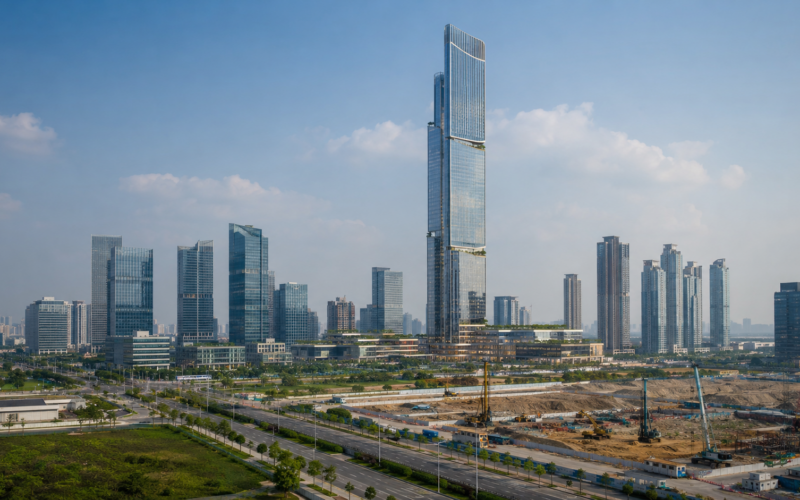
The Haryana State Industrial and Infrastructure Development Corporation is moving ahead with plans for a proposed 620 to 700 metre mixed-use tower inside the Gurugram Global City project, a development that could position the National Capital Region for one of India’s most ambitious vertical urban infrastructure projects. The tower is expected to be planned on a 6.7-acre plot within the wider Global City development in Sectors 36B and 37B near Dwarka Expressway. The proposal matters because it links real estate branding, state-led urban planning, commercial demand and infrastructure readiness in one high-visibility project. For Gurugram, the plan is not only about building India’s tallest structure, but about whether Haryana can create a globally competitive business district without repeating the infrastructure mismatches that have long shadowed rapid NCR urbanisation.
Why does the Gurugram Global City tower plan matter for NCR real estate investors?
The Gurugram Global City tower plan matters because it gives Haryana a symbolic anchor for a larger attempt to reposition Gurugram beyond its established office corridors. Gurugram already has Cyber City, Golf Course Road, Golf Course Extension Road and newer activity around Dwarka Expressway, but the proposed Global City project is being framed as a more planned, integrated business and urban district. A possible 620 to 700 metre tower would give that district immediate visibility, but the real investment question is whether it can generate sustained office, retail, hospitality, residential and institutional demand.
For real estate investors, the project could influence land values, leasing expectations and capital flows along the Dwarka Expressway belt. Tall buildings can attract attention, but attention alone does not build rental yields. The project will need strong transport access, utilities, civic management, parking systems, pedestrian design, safety infrastructure and long-term tenant demand. Without that foundation, even a landmark tower risks becoming a postcard in search of an operating model.
The proposal also reflects a wider shift in India’s urban real estate market. State governments are increasingly using planned cities, global business districts and transit-linked corridors to compete for investment. Gurugram Global City is therefore not just a Haryana project. It is part of a national competition among cities such as Mumbai, Noida, Hyderabad, Bengaluru, Chennai, Ahmedabad and Pune to capture corporate expansion, financial services activity, technology campuses and high-value urban consumption.
How could India’s tallest building plan reshape the Gurugram Global City project?
The proposed tallest building could become the branding centre of the Gurugram Global City project, but its strategic value will depend on how it is integrated into the larger master plan. A mixed-use tower of this scale can support offices, hotels, serviced apartments, retail, observation decks, convention facilities or premium residential components. However, a vertical landmark works best when it is connected to a district that already has a clear economic purpose.
That purpose cannot be cosmetic. Gurugram Global City needs to answer what type of demand it is targeting. If the project is intended to attract multinational corporate occupiers, it must compete with established office clusters. If it is aimed at premium residential and retail demand, it must compete with already active private-sector corridors. If it is positioned as a broader economic district, it will need a strong mix of commercial, civic and transport infrastructure that encourages companies and residents to stay beyond the launch buzz.

The height of the proposed tower may dominate the headlines, but district economics will decide the outcome. A single tall building can generate curiosity, media attention and initial investor interest. A functional urban district generates recurring value. Haryana’s challenge is to make sure the Global City project does not become a height contest when the real competition is around quality of life, business convenience and infrastructure reliability.
What infrastructure risks could decide whether Gurugram Global City succeeds or struggles?
The biggest risk for Gurugram Global City is that landmark ambition could run ahead of infrastructure delivery. Gurugram’s growth story has always been impressive, but it has also been uneven. The city has built corporate districts and premium residential markets at speed, yet water, drainage, traffic, last-mile mobility, public transport integration and civic maintenance have often struggled to keep pace. A mega tower inside Global City would intensify those questions.
A 620 to 700 metre tower and its surrounding development would require exceptional planning around access roads, emergency response, fire safety, vertical transportation, power redundancy, water supply, sewage systems and crowd management. These are not small supporting details. They are the operating system of a modern urban district. If these systems are weak, the project could face criticism even before its commercial potential is fully tested.
Transport connectivity will be particularly important. The Dwarka Expressway corridor gives the project a strong geographic story, but business districts succeed when commutes are predictable and multi-modal. Metro connectivity, feeder systems, road capacity, airport access and pedestrian design will matter as much as the tower’s height. In Gurugram, infrastructure cannot be treated like a background extra. It usually insists on becoming the main character.
Why is Haryana using Global City to compete for corporate and institutional capital?
Haryana appears to be using the Global City project to strengthen Gurugram’s role as a next-generation corporate and investment hub within the National Capital Region. This is strategically logical. Gurugram already has a deep base of technology firms, consulting companies, financial services offices, start-ups, hotels, malls and premium residential communities. Global City could extend that ecosystem if it offers a more planned and modern business district format.
The state-level motivation is also economic. Large urban projects can attract land monetisation, private investment, employment, commercial leasing, tourism, hospitality demand and tax revenue. A proposed tallest building becomes a signal to investors that Haryana wants to compete in the premium infrastructure category rather than only offering industrial plots or conventional office campuses. It is a visual message, and in real estate, visual messages often arrive before spreadsheets.
However, institutional capital will still ask harder questions. Investors will want clarity on project phasing, land use, development rights, financing structure, approvals, anchor tenants, infrastructure funding and governance. Large projects can create value when the state provides certainty and private developers bring execution discipline. They can also slow down if approvals, infrastructure contracts or demand projections do not align. The tower can attract attention, but transparency will attract capital.
How could the proposed tower affect developers, office occupiers and homebuyers in Gurugram?
For developers, Gurugram Global City could create a new competitive corridor that influences pricing and positioning across the city. If the project is executed well, it could raise expectations for integrated district planning, high-grade commercial space and premium mixed-use development. This may force existing and upcoming projects along Dwarka Expressway, Southern Peripheral Road and other NCR corridors to sharpen their own infrastructure and amenity offerings.
For office occupiers, the Global City project could eventually provide another large-format alternative to existing business districts. Companies expanding in Gurugram often evaluate location through the lens of commute times, employee catchment, rental cost, building quality, power reliability and proximity to clients. A planned district with strong infrastructure could appeal to occupiers seeking scale and brand value. However, occupiers are practical. They will not move just because a tower is tall. They will move if the economics and employee experience work.
For homebuyers, the project could improve the appeal of nearby residential micro-markets if infrastructure delivery is credible. Large commercial districts often support housing demand by creating jobs, improving retail ecosystems and attracting civic upgrades. At the same time, speculative pricing could become a risk if developers and brokers oversell the Global City story before delivery milestones are visible. Buyers should watch infrastructure progress, not just skyline promises.
What does the Gurugram Global City plan reveal about India’s vertical urbanisation trend?
The Gurugram Global City proposal reflects India’s growing appetite for vertical urban symbols, especially in cities trying to signal global ambition. Tall buildings are often used as shorthand for economic confidence, financial depth and urban modernity. Mumbai has long carried that vertical identity, but NCR cities are now increasingly interested in similar landmark-led development narratives.
The danger is that height can distract from functionality. India’s urban future will not be decided by which city has the tallest tower, but by which cities can manage density without breaking everyday life. High-rise development requires deep coordination across mobility, utilities, safety, environmental management and public space. When that coordination works, vertical growth can conserve land and create compact economic districts. When it fails, it produces congestion with better views.
Gurugram’s opportunity is to treat the proposed tower as part of a broader urban upgrade rather than as a standalone trophy. If Global City delivers strong planning, infrastructure and governance, the tower could become a credible marker of NCR’s next phase. If the project becomes too dependent on height-led marketing, it may struggle to convert attention into long-term urban value.
What execution signals should investors and policymakers watch next in the Global City project?
The first signal to watch is project phasing. A mega district cannot be delivered in one dramatic sweep. Investors should track how Haryana sequences trunk infrastructure, roads, utilities, land auctions, private developer participation and commercial components. Early infrastructure delivery will be more important than architectural renderings, however shiny they may be.
The second signal is the development model for the tower. The market will need clarity on whether the project is developed through a public-private partnership, outright land auction, joint development model or another structure. The financing and risk-sharing model will influence bidder interest, project pace and eventual commercial viability. A landmark tower can be capital-intensive, and the wrong financing structure can turn ambition into delay.
The third signal is demand validation. Anchor tenants, hotel operators, institutional investors, global design partners and infrastructure contractors will all shape market confidence. A tower of this scale needs more than civic enthusiasm. It needs a bankable demand case. Haryana can set the vision, but the market will decide whether Global City becomes a genuine business district or simply another ambitious entry in India’s long file of announced megaprojects.
Key takeaways on what Gurugram Global City’s proposed tallest tower means for NCR real estate
- The proposed Gurugram Global City tower could give Haryana a high-visibility landmark within the National Capital Region’s competitive real estate and infrastructure market.
- The real significance of the project lies less in its proposed height and more in whether it can anchor a functional, investment-ready business district.
- Gurugram Global City could strengthen the Dwarka Expressway corridor by improving its commercial positioning and attracting interest from developers, occupiers and investors.
- Infrastructure delivery will determine the project’s credibility, especially around transport connectivity, power, water, drainage, safety systems and last-mile access.
- The proposed tower could support mixed-use demand across offices, hospitality, retail and premium residential components if the district master plan is commercially coherent.
- Haryana’s strategy appears aimed at competing for corporate, institutional and real estate capital by positioning Gurugram as a more globally visible urban hub.
- Developers in nearby Gurugram micro-markets may benefit from stronger sentiment, but speculative pricing could become a risk if delivery milestones lag.
- Office occupiers are unlikely to be influenced by height alone and will assess commute quality, rentals, building operations and employee convenience.
- The project reflects India’s wider vertical urbanisation trend, where cities use landmark towers to signal ambition but must still solve basic urban functionality.
- Investors should track phasing, financing structure, anchor demand and infrastructure contracts before treating the Global City tower as a bankable real estate catalyst.
Discover more from Business-News-Today.com
Subscribe to get the latest posts sent to your email.