


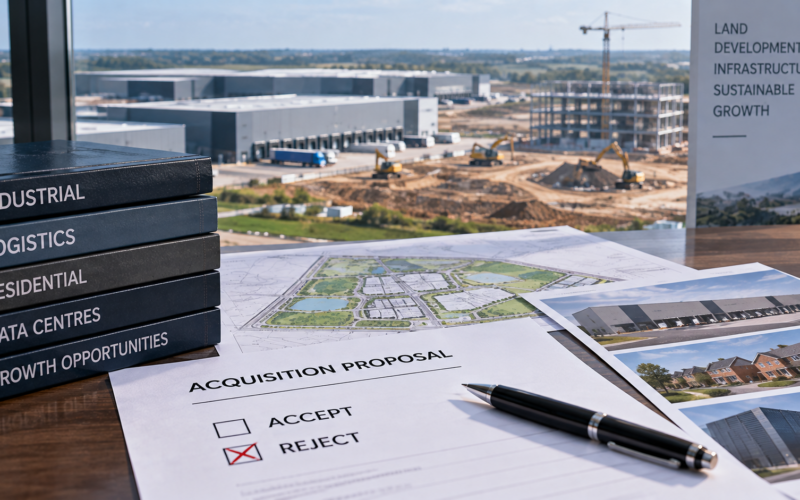
Harworth Group plc (LSE: HWG), a Rotherham-based land regeneration and property development company focused on former industrial sites across northern and central England, has rejected an improved takeover proposal from its largest shareholder, Peel Holdings Group Limited, arguing that the approximately £599.8 million cash offer still materially undervalues the business and its longer-term development potential. The latest rejection, announced on September 18, pushes an already contested takeover into a more consequential phase after Peel increased its ownership to exactly 30%, automatically converting its approach into a mandatory offer under the United Kingdom Takeover Code.
Peel Pepper (UK) Limited, a vehicle indirectly wholly owned by Peel Holdings Group Limited, increased its proposal from 172.5 pence to 177.5 pence per Harworth share on September 16. The revised terms value Harworth’s entire issued and to-be-issued share capital at approximately £599.77 million and represent a 23.6% premium to the 143.6-pence closing price immediately before the offer period began on August 6. Peel also points to a roughly 40% premium over Harworth’s three-month volume-weighted average price of 126.8 pence before the takeover process started.
Harworth’s board sees the valuation very differently. It has unanimously advised shareholders who have not accepted the offer to reject it and has gone further by encouraging investors who have already tendered their shares to withdraw those acceptances. That unusually firm response reflects a widening disagreement over whether shareholders should focus on the premium to Harworth’s historical trading price or the value that could potentially be realised from its land bank, logistics developments and increasingly important pipeline of powered sites suitable for hyperscale data centres.
Why has Harworth Group rejected Peel’s improved 177.5-pence takeover offer?
The central dispute is valuation. Harworth reported European Public Real Estate Association Net Disposal Value, or EPRA NDV, of 214.8 pence per share at June 30, 2026, compared with Peel’s revised cash offer of 177.5 pence. That means the bid remains roughly 17% below this particular measure of underlying net asset value even after Peel added five pence per share to its original proposal.
Harworth also believes traditional balance-sheet measures do not capture all the potential embedded within its development pipeline. The company controls a land and development pipeline of approximately 34.8 million square feet, including around 0.8 gigawatts of powered land, and management argues that sites with advanced planning positions and secured electricity connections have become increasingly difficult to reproduce. That argument has become particularly important as artificial intelligence and cloud computing drive demand for very large data centres in locations where both land and electrical capacity are available.
The company has already demonstrated that such sites can produce significant value. Harworth sold land for a hyperscale data centre to Microsoft for £106.6 million in 2024 and said earlier this year that it was in advanced negotiations involving another powered site capable of supporting a hyperscale facility. Management has indicated that the potential value creation from the second transaction could exceed that generated by the Microsoft sale, giving shareholders a concrete reason to consider whether a near-term takeover price adequately captures Harworth’s emerging data-centre opportunity.
Why does Peel Holdings believe £599.8 million is a fair price for Harworth?
Peel Holdings is presenting essentially the opposite investment case. Rather than valuing Harworth primarily around what its sites might eventually become, the bidder has focused on current market conditions, recent asset-value movements, leverage and the execution risks attached to Harworth’s development ambitions. Peel has argued that its 177.5-pence cash proposal gives shareholders immediate and certain value at a substantial premium to where Harworth traded before takeover speculation began.
There is evidence supporting some of that caution. Harworth’s EPRA NDV per share declined to 214.8 pence at June 30 from 224.4 pence at the end of 2025, while statutory net assets fell to £670.8 million from £699 million. The group recorded a £14.9 million negative portfolio value movement during the first half, including a £16.9 million decline in residential values, while its net loan-to-portfolio-value ratio increased to 20.3% at June 30 from 15.6% at the end of 2025.
Harworth has subsequently reduced leverage, reporting that the loan-to-value ratio had fallen to 17.1% by August 31 using June valuations, and it maintained available liquidity of £99.5 million at the half-year point. The company has also launched a cost programme intended to create a simpler and higher-returning operating platform. Peel nevertheless argues that shareholders are being asked to accept the execution risk involved in Harworth’s strategy when a cash exit at a substantial premium to the pre-bid market price is already available.
How did Peel’s 30% stake turn the Harworth bid into a mandatory takeover offer?
One of the most important developments occurred on September 17 when Peel Bidco purchased another 137,669 Harworth shares in the market. Those purchases took the combined interest of Peel and parties acting in concert from 29.96% to exactly 30% of Harworth’s voting rights.
That threshold matters under the United Kingdom Takeover Code. Reaching 30% triggered Rule 9, requiring Peel to make a mandatory offer to other shareholders rather than continuing solely with the voluntary approach it had launched in August. The mandatory offer remains priced at 177.5 pence per share, so crossing the threshold changed the regulatory status of the bid but did not force Peel to increase the consideration again.
The development substantially increases the strategic tension around the transaction. Peel is no longer merely an outside bidder testing shareholder appetite; it is already the largest shareholder and now controls 30% of Harworth. At the same time, Harworth’s independent board is explicitly telling the remaining investors that they should not sell at the current price.
Why are data centres becoming central to the Harworth takeover battle?
Harworth historically built its investment case around regeneration, industrial and logistics developments and residential land, particularly on large former mining and industrial sites. Data centres have added a new potential source of value because the company owns sites where land, planning and high-capacity power connections come together, three elements that have become major constraints for hyperscale developments.
The importance of electrical connections cannot be overstated in the current data-centre market. Artificial intelligence infrastructure can require enormous quantities of power, while delays in obtaining grid connections can stretch for years in parts of Europe. A developer that already controls powered land can therefore possess something materially more valuable than ordinary development acreage, particularly if the site is near fibre infrastructure and major centres of demand.
Harworth says its 0.8-gigawatt powered land bank and wider 34.8-million-square-foot development pipeline would be difficult to replicate in the current market. That does not mean every site will necessarily achieve premium data-centre valuations, but it explains why the board considers a conventional premium-to-share-price analysis inadequate when assessing Peel’s proposal.
What does Harworth’s latest financial performance tell shareholders?
The first half of 2026 provides ammunition to both sides. Harworth recorded an operating loss of £24.9 million compared with a £7.1 million operating profit a year earlier, while total accounting return was negative 3.7%. Net debt increased to £190 million from £145.9 million at the end of 2025, although the business continued to hold substantial liquidity and has subsequently reduced leverage through transactions and other activity.
Industrial and logistics remains central to the portfolio, accounting for an increasingly large share of Harworth’s land and development exposure. Management has deliberately shifted the business in this direction and said industrial and logistics represented 71% of its land and development portfolio, giving Harworth greater exposure to warehouses, manufacturing, logistics infrastructure and powered development land rather than relying primarily on residential plots.
Harworth also completed the sale of a 40-acre strategic site in St Helens to Tritax Big Box Developments on September 18, the same day it formally rejected Peel’s revised offer. The timing reinforced management’s argument that the portfolio continues to generate transactions and liquidity even while the takeover contest unfolds.
What is the stock market signalling about Peel’s 177.5-pence bid?
Harworth shares had already closed at 178.4 pence on September 17, slightly above Peel’s revised 177.5-pence offer, before the board formally published its rejection the following morning. Trading above an all-cash takeover price can indicate that some investors expect the bidder to improve its terms, that another bidder could emerge, or simply that shareholders believe retaining the stock offers greater value than accepting the existing proposal.
That does not guarantee Peel will increase the bid. Its latest proposal is only 2.9% higher than the original 172.5-pence offer, and Peel has already emphasised the substantial premium relative to Harworth’s unaffected trading levels. Funding is also straightforward because Peel has said the revised acquisition would be financed entirely from its own cash resources, removing financing uncertainty as a major obstacle to completion.
The share price nevertheless creates an interesting negotiating dynamic. A cash bidder normally wants shareholders to see the offer as an attractive exit price, but a market price above the bid suggests at least some investors are currently unwilling to treat 177.5 pence as the final clearing price for control.
Could Peel Holdings increase its Harworth takeover offer again?
A further increase remains possible, but investors should not assume one will happen. Peel has already sweetened its proposal once and now holds 30% of the company, giving it substantial strategic influence even if the current offer does not secure enough acceptances to deliver full ownership.
The next meaningful battleground is shareholder support. Harworth’s board is asking investors to focus on its asset values, industrial and logistics strategy, cost reductions and data-centre opportunities, while Peel is offering immediate liquidity and arguing that the company’s standalone plan carries substantial execution and market risk. Neither side can settle that disagreement simply by repeating its own valuation methodology.
Peel’s ownership position also gives it considerable leverage over Harworth’s future even if the takeover remains contested. Conversely, the board’s ability to point to an EPRA NDV of 214.8 pence per share and potentially valuable hyperscale data-centre opportunities strengthens the argument for demanding a materially higher price before surrendering control.
What happens next in the Harworth and Peel Holdings takeover battle?
The takeover has now moved beyond a preliminary approach and into a formal mandatory-offer process. Harworth shareholders must decide whether certainty at 177.5 pence outweighs exposure to the company’s longer-term redevelopment strategy, while Peel must determine whether its current ownership position and existing offer are sufficient or whether a higher price is needed to unlock broader shareholder support.
The unusually wide gap between the two sides’ valuation narratives makes this more than a routine property takeover. Peel views the offer as a substantial premium for a company facing property-market uncertainty and execution risk. Harworth sees a portfolio whose current stock-market valuation fails to reflect the scarcity of its industrial, logistics and powered development sites.
That disagreement is precisely why the transaction is likely to remain closely watched. Harworth is no longer simply a brownfield land regeneration company being valued on conventional property metrics; its data-centre pipeline has introduced an infrastructure and technology angle into the investment case. Peel’s challenge is to convince shareholders that £599.8 million already captures enough of that potential, while Harworth’s challenge is to prove that rejecting cash today can create materially more value tomorrow.
Discover more from Business-News-Today.com
Subscribe to get the latest posts sent to your email.