

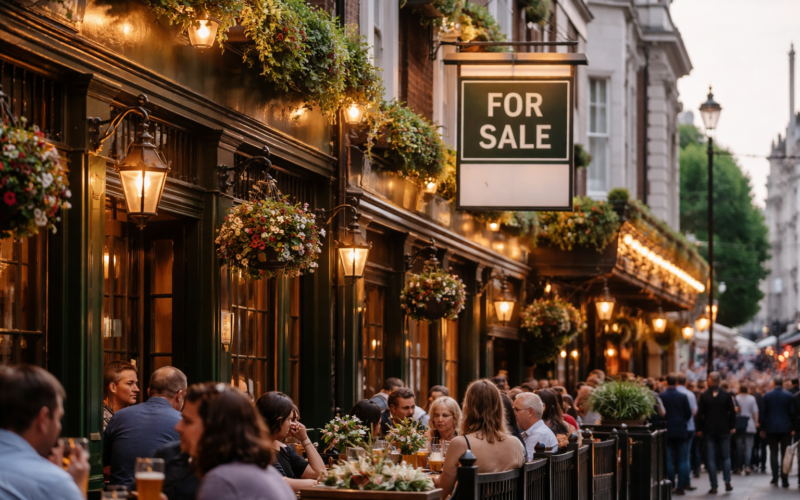
Greene King, the UK’s second-largest pub operator and brewer owned by Hong Kong conglomerate CK Asset Holdings Limited, announced on 18 March 2026 a sweeping restructure of its managed estate that will affect approximately 300 sites across England, Wales, and Scotland. Around 150 of the identified venues will be moved into the company’s Pub Partners division as leased, tenanted, or franchise operations, while a further 150 have been earmarked for potential disposal over the medium term. A small number of closures, representing fewer than 2% of its 1,500-strong managed estate, will also proceed in line with the group’s typical annual activity. The announcement marks one of the most consequential reshaping exercises in Greene King’s 227-year history and signals the depth of structural pressure now facing even the most established operators in Britain’s pub industry.
What is driving Greene King’s decision to sell 150 pubs and why is it happening now in 2026?
The proximate cause is a sustained and multi-layered cost escalation that has compressed margins across the hospitality sector for several years. The national minimum wage rose 6.7% in 2025, employer National Insurance contributions were increased and their threshold lowered in the November 2024 Budget with effect from April 2025, and alcohol duty increased by 3.55% from February 2026. Business rates, intended to be reformed in favour of retail and hospitality, instead generated higher bills for thousands of operators after an upward revaluation of rateable values, prompting Chancellor Rachel Reeves to announce a three-year, GBP 300 million support package in January 2026 as partial mitigation. Industry bodies argued the package did not go far enough.
Against this backdrop, consumer spending on out-of-home food and drink has softened as households absorb higher mortgage costs and a persistent cost-of-living squeeze. An industry tracker cited in coverage of the announcement noted that sales across pubs, bars, and restaurants fell 0.2% in February 2026, partly attributed to wet weather. The combination of input cost inflation and demand fragility has meant that a significant cohort of managed pubs, previously viable under a centrally operated model, no longer generates sufficient returns to justify the overhead that model entails. Greene King’s response is to systematically reclassify those sites into structures that transfer operational risk to tenants or buyers.

How does the new Greene King pub estate structure work and what changes for the 300 affected sites?
The 300 identified venues will be moved into a newly created, separate business unit while their transition unfolds. This ringfencing mechanism allows Greene King to manage the affected portfolio under a simplified operating model focused on maximising financial returns, without allowing operational complexity or transitional uncertainty to contaminate the performance reporting of the retained core estate. The approach is structurally sensible and consistent with how large pub groups have historically handled contested or underperforming assets ahead of disposal or conversion.
For roughly half of the 300 sites, the destination is Greene King’s Pub Partners division, which already oversees more than 1,000 leased, tenanted, and franchise venues across Britain. Converting a managed pub to a tenanted arrangement substantially changes the economics: Greene King cedes direct revenue and operating control but removes direct exposure to wage costs, energy bills, and staffing risk. The tenant assumes those liabilities in exchange for the opportunity to operate a branded venue at their own commercial risk. From a corporate balance sheet perspective, the shift reduces working capital intensity and narrows the cost base. For the remaining 150 sites earmarked for sale, proceeds will be recycled back into the core portfolio.
What will Greene King do with the proceeds from selling 150 pubs and how does it connect to the 2030 strategy?
Greene King has committed to reinvesting a substantial portion of disposal proceeds back into its retained core estate, and the restructure is framed explicitly within a 2030 group strategy focused on market share growth and improving margins. Two investment programmes underscore this ambition. Construction is already underway on a new GBP 40 million brewery at Suffolk Business Park in Bury St Edmunds, replacing the historic Westgate Brewery and targeting completion by 2027. The facility will produce both traditional cask ales, including Greene King IPA, Abbot Ale, and Old Speckled Hen, and newer beer ranges designed to track shifting consumer tastes.
Separately, the group has committed GBP 35 million to a digital customer loyalty initiative for 2026. The company’s revised app reached one million sign-ups within three months of its September 2025 launch, providing a data asset that Greene King intends to leverage for personalised marketing, retention, and frequency-driving across its retained brands, which include Chef and Brewer, Farmhouse Inns, Flaming Grill, and Hungry Horse. Artificial intelligence technology trials are underway at two Leicestershire innovation pubs, testing intelligent dispense equipment, food waste capture, and smart kitchen technology ahead of potential wider rollout. The investment trajectory is consistent with a business concentrating resources into a smaller but more profitable and technologically enabled estate.
How does the Greene King restructure compare to what Stonegate Group and other UK pub operators are doing?
The Greene King announcement lands at a moment when the broader UK pub sector is undergoing the most concentrated period of structural adjustment since the pandemic. Stonegate Group, Britain’s largest pub operator by site count with approximately 4,300 venues, has been managing a GBP 3 billion debt burden accumulated largely through its 2019 acquisition of Ei Group. Stonegate reported a GBP 214 million pre-tax loss for the year to September 2024 and finance costs of GBP 455 million in the same period. It has been reviewing options for its so-called platinum portfolio of roughly 1,034 leased and tenanted venues, with a potential transaction valued at up to GBP 1 billion.
However, the comparison with Stonegate is instructive precisely because the two situations are structurally different. Stonegate’s asset review is debt-driven and urgent, constrained by a non-call period on an Apollo-backed securitisation that lifted in January 2026 and a credit rating at CCC+ from Fitch. Greene King’s exercise is operationally motivated and conducted from a position of relative financial stability, given its 2019 acquisition by CK Asset Holdings in a GBP 4.6 billion deal that took it private without the acquisition leverage that Stonegate carries. This distinction matters: Greene King is optimising a portfolio to redeploy capital, while much of the sector is rationalising simply to survive.
BrewDog, which was sold to US brewer Tilray Brands in March 2026 following mounting losses and costly debt servicing, represents the more acute end of the spectrum. The British Beer and Pub Association has warned that more than 2,000 pubs could close permanently in 2026, and industry data from Lumina Intelligence estimated a net closure rate of approximately eight pubs per week during 2025. Against that backdrop, Greene King’s ability to conduct a planned, strategic disposal rather than a distressed fire sale is itself a competitive advantage.
What are the risks in executing the Greene King pub estate restructure over the medium term?
The plan’s success depends critically on finding buyers and tenants willing to absorb the sites being repositioned, at prices and rental terms that reflect Greene King’s valuation expectations rather than distressed market conditions. If the disposal process coincides with a broader surplus of pub assets on the market, including Stonegate’s potential sale of up to 1,000 venues, pricing pressure could compress the proceeds available for reinvestment. The managed-to-tenanted conversion model also carries execution risk: not all managed pub managers will transition successfully into independent operators, and the quality of tenant selection will materially influence whether the converted estate performs as intended or generates void costs and underperformance.
The management transition is also notable. Greene King managing director Zoe Bowley stepped down from her role at the time of the announcement, removing a key operational leader at a moment when the business is simultaneously executing a major estate restructure, a brewery relocation, and a digital transformation. Chief executive Nick Mackenzie has outlined a clear strategic narrative, but delivery across three concurrent programmes, while managing the day-to-day operations of a 1,200-plus site core estate employing roughly 40,000 people, represents a meaningful execution test.
What does the Greene King estate review signal about the long-term direction of British pub ownership models?
The direction of travel across the industry is unmistakably towards leased and tenanted structures, smaller managed estates, and technology-enabled operations at scale. Stonegate has been converting hundreds of directly managed pubs into leased and tenanted venues, reporting an average profit uplift of approximately GBP 110,000 per converted pub. Greene King’s move reinforces the same logic: the centralised managed model that drove pub group expansion during the 2000s and 2010s is structurally disadvantaged in an environment of high and sticky wage costs, complex scheduling obligations under new workers’ rights legislation, and consumer demand volatility.
There is a broader capital allocation question that CK Asset Holdings’ ownership of Greene King raises here. When Victor Li’s company acquired Greene King in 2019, the stated rationale was the resilience of British pub real estate as a long-term asset class and the defensive characteristics of the category. The estate restructure is consistent with a property-focused ownership perspective: concentrating value in fewer, higher-quality sites, underpinning each with capital investment, and extracting income from the remainder through tenancy rather than direct operation. Seen through that lens, the announcement is as much a real estate portfolio optimisation as it is a hospitality operational decision.
IBISWorld projects UK pub sector market growth of 0.5% in 2026, reaching GBP 24.9 billion, with Lumina Intelligence forecasting a 2.1% compound annual growth rate from 2025 to 2028. The sector is not terminal; it is consolidating around operators with stronger balance sheets, clearer brand propositions, and better digital infrastructure. Greene King’s restructure, undertaken by a business with no immediate financing pressure and a well-funded parent, is precisely the kind of proactive rebalancing that positions it favourably against peers who are acting from necessity rather than choice.
Key takeaways: What the Greene King pub estate overhaul means for the company, competitors, and the UK hospitality sector
- Greene King is restructuring 300 of its 1,500 managed pubs, with 150 earmarked for conversion to leased or tenanted operation and 150 assessed for potential sale, in the most significant reshaping of its estate in over two decades.
- The move is operationally motivated, not debt-driven, distinguishing it from the more urgent restructuring activity at Stonegate Group, which carries over GBP 3 billion in debt and is exploring a potential GBP 1 billion pub sale from a position of financial constraint.
- A new dedicated business unit will manage transitional sites, protecting core estate performance metrics and allowing each affected venue to be handled at its own pace rather than on a distressed timeline.
- Disposal proceeds will be reinvested into the retained estate, underpinning a GBP 40 million brewery project in Bury St Edmunds, a GBP 35 million digital loyalty initiative, and AI-enabled pub technology trials ahead of broader rollout.
- The managed-to-tenanted conversion model is the dominant strategic response across the UK pub sector, with Stonegate reporting an average GBP 110,000 profit uplift per converted venue, reinforcing Greene King’s directional logic.
- CK Asset Holdings’ ownership provides financial stability absent in most peer situations, allowing Greene King to conduct a planned disposal rather than a distressed fire sale into a market where competing supply, including Stonegate’s assets, may compress prices.
- The departure of managing director Zoe Bowley at this juncture adds execution risk to a programme requiring simultaneous delivery of estate restructuring, brewery relocation, and digital transformation.
- The British Beer and Pub Association has warned of more than 2,000 pub closures in 2026, and industry data points to a net closure rate of approximately eight pubs per week in 2025, providing a sobering backdrop for any expectation that buyers or tenants for the 300 affected sites will be easy to source.
- For private equity, regional operators, and independent publicans, the Greene King process and the wider industry rationalisation represent the largest pipeline of pub acquisition and tenancy opportunity in years, provided financing conditions remain accessible.
- UK pub sector revenues are projected to reach GBP 24.9 billion in 2026 with further growth to GBP 25.7 billion by 2028, suggesting the category retains long-term investability for operators able to navigate the current cost environment and retain consumer loyalty.
Discover more from Business-News-Today.com
Subscribe to get the latest posts sent to your email.