


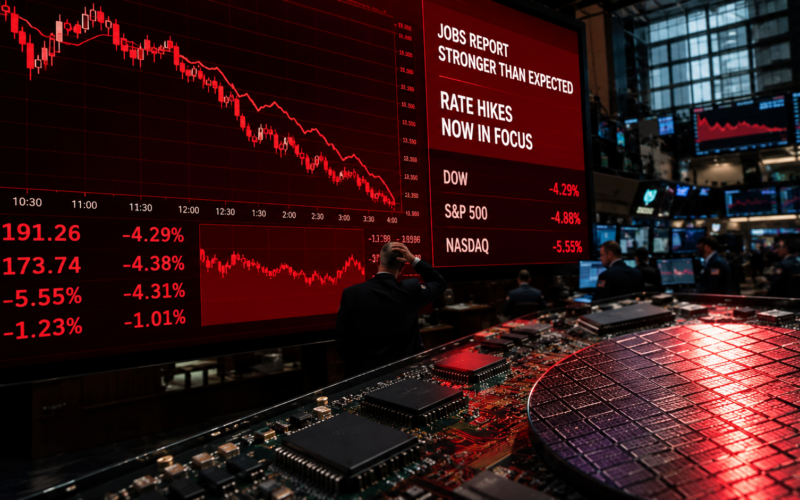
Wall Street’s nine-week winning streak ended violently on Friday, as a far stronger than expected May jobs report ignited fears that the Federal Reserve could raise interest rates rather than cut them, triggering a brutal selloff in the artificial intelligence and chip stocks that had powered the market to record after record. The economy added 172,000 jobs in May, more than double analyst expectations, while the unemployment rate held at 4.3 percent, a robust report that in normal times would cheer investors but instead sparked a classic good-news-is-bad-news reaction. The Nasdaq Composite plunged 4.18 percent, its worst day since the tariff shock of April 2025, while the S&P 500 fell 2.64 percent and the Dow Jones Industrial Average lost 1.35 percent. The Philadelphia Semiconductor Index cratered more than 10 percent, its largest one-day plunge since March 2020, erasing over 1 trillion dollars in market value, as the VIX volatility gauge spiked nearly 40 percent. Coming days after Broadcom’s disappointing guidance had already rattled the sector, the rout crystallized a growing unease that the AI trade had simply run too far, too fast.
Why did a blowout jobs report trigger a stock market selloff instead of a rally?
The reaction reflects the peculiar logic of a market fixated on the Federal Reserve. The economy added 172,000 jobs in May, roughly double the consensus, with upward revisions to prior months confirming a healthy labor market. Ordinarily a sign of economic strength, the report instead alarmed investors because a strong labor market reduces the case for interest rate cuts and raises the odds of a hike later this year.
The inflation backdrop made the data especially threatening. Recent figures had shown inflation heating up, driven in part by the oil price spike from the war with Iran, and a robust jobs report risks shifting the Fed’s focus toward fighting inflation rather than supporting growth. Treasury yields surged in response, with the 10-year climbing past 4.5 percent, tightening financial conditions for the entire market.
This is the textbook good-news-is-bad-news dynamic. When investors are positioned for rate cuts and a hot economic report threatens that assumption, equities can fall even on objectively positive news, because higher rates lower the present value of future earnings and make risk-free bonds more attractive. The market, having priced in an accommodative Fed, was forced to reprice abruptly, and the selling concentrated where valuations were most stretched.
Why were AI and semiconductor stocks hit hardest in Friday’s rout?
The chip sector bore the brunt because it had risen the most. Semiconductor stocks had surged to record highs in recent weeks on AI enthusiasm, making them the most overbought and richly valued corner of the market, and therefore the most vulnerable to a shift in sentiment. The Philadelphia Semiconductor Index suffered its worst day since the pandemic crash, with an exchange-traded fund tracking memory chips sinking around 15 percent.
The damage spanned the AI leaders. Nvidia fell roughly 6 percent, Micron Technology dropped more than 13 percent, Intel slid over 11 percent back below 100 dollars, Broadcom lost nearly 8 percent, and Marvell, which had soared more than 50 percent in six sessions, tumbled nearly 17 percent. Hyperscalers including Meta, which is reportedly considering a large equity raise to fund AI infrastructure, also declined.
Strategists framed it as a positioning unwind more than a fundamental break. Ohsung Kwon, chief equity strategist at Wells Fargo, said the reaction was driven by positioning rather than fundamentals and that the semiconductor sector had become way overbought, while adding he did not think it marked the end of the chip bull market. The interpretation is that rate-hike fears provided the trigger, but the underlying cause was a sector primed for a pullback after a near-vertical ascent.
How did Broadcom’s guidance set off the selloff before the jobs report?
The unraveling began midweek, before the jobs data. Broadcom reported quarterly results late Wednesday that, despite record revenue and surging AI sales, included guidance and a full-year AI forecast that disappointed investors expecting an upward revision. The stock fell sharply, and that disappointment sparked a broader reassessment of whether AI chip demand could keep meeting ever-higher expectations.
The episode fit a troubling pattern. In recent weeks, a string of AI-linked leaders including Broadcom, CrowdStrike, and Palo Alto Networks delivered strong results yet saw their shares fall, because the bar of expectations had risen so high that merely good performance was treated as a letdown. This beat-but-fell dynamic signaled that sentiment, not fundamentals, had become the dominant force, leaving the sector fragile.
Friday’s jobs report then poured fuel on the fire. A selloff that began over questions about the AI boom’s longevity was compounded by the rate-hike fears the employment data unleashed, turning a sector-specific wobble into a market-wide rout. The combination of stretched valuations, a high expectations bar, and a sudden macro shock produced one of the sharpest declines of the year.
What does the surge in Treasury yields and the VIX signal about risk appetite?
The bond market drove the equity reaction. Treasury yields jumped after the payrolls report, with the policy-sensitive 2-year yield surging and the 10-year pushing past 4.5 percent, as traders repriced the path of Fed policy toward a possible hike. Rising yields are particularly damaging to high-growth and AI stocks, whose valuations depend heavily on distant future earnings.
The spike in volatility revealed a swift change in mood. The VIX, Wall Street’s fear gauge, surged nearly 40 percent to its highest level in two months, and a widely watched sentiment index flipped from greed to fear, underscoring how quickly investor psychology turned. Such a sharp move in volatility indicates that the selloff was driven by genuine repositioning rather than mild profit-taking.
Notably, even traditional havens fell. Gold plunged more than 3 percent, nearly erasing its gains for the year, as the prospect of higher rates undercut the metal and led some to argue it is trading more like a risk asset than a safe haven, while Bitcoin fell below 60,000 dollars. The simultaneous decline of stocks, gold, and crypto points to a broad de-risking in which investors raised cash rather than rotating between assets, a hallmark of a liquidity-driven shakeout.
Is this a healthy correction in an overbought AI trade or the start of something worse?
The optimistic interpretation is that this is a needed reset. Ryan Detrick, chief market strategist at Carson Group, observed that after the record run of the prior nine weeks the dam simply broke, describing the move as the market throwing a fit by hitting the biggest winners. On this view, a sector that had become dangerously overbought is correcting, which can be healthy and set the stage for renewed gains, with some strategists arguing the bull market still has room to run despite AI fatigue.
The cautious interpretation points to deeper fragility. More than half the S&P 500 had been priced for perfection, one closely followed bear-market indicator reached its highest level since the global financial crisis, and the AI boom that drove the rally shows signs of strain, including a paradox in which massive AI investment coincides with rising technology-sector layoffs attributed to AI. If the Fed does hike and earnings expectations prove unsustainable, the correction could deepen.
The honest answer is that it depends on the Fed and on AI demand. If inflation cools and the Fed holds rates steady while AI spending stays robust, Friday will likely look like a buying opportunity in hindsight. If the labor market and inflation force the Fed to tighten while AI growth merely meets rather than exceeds lofty expectations, the repricing has further to go. The market is caught between a genuinely strong economy and valuations that left little room for disappointment, and that tension will not resolve quickly.
What should investors watch for as the rate and AI debates collide?
The first signal is upcoming inflation data and Fed communication. With a rate hike now a live possibility, every inflation report and central bank comment will carry outsized weight, and the trajectory of the oil price, still elevated by the Iran conflict, feeds directly into that inflation picture. Clarity on whether the Fed leans toward hiking or holding would do much to stabilize sentiment.
The second is the breadth and durability of the AI earnings story. The selloff has raised the bar for AI companies to not merely beat expectations but to decisively exceed them and raise guidance, and the next round of results from chipmakers and hyperscalers will test whether demand justifies the valuations. Continued strong, accelerating growth would support the bull case, while any further disappointment would validate the skeptics.
The third is market internals and positioning. None of this is investment advice, and a single sharp day does not determine a trend, but the surge in volatility, the rotation out of crowded trades, and the behavior of yields and havens will indicate whether this was a one-off shakeout or the beginning of a broader de-rating. After nine weeks of records built heavily on AI optimism, the market is reminding investors that even powerful bull runs face moments of reckoning, and how this one resolves will hinge on the collision between a resilient economy, an uncertain Fed, and an AI trade that must now prove it can grow into its expectations.
Key takeaways on the jobs-driven selloff and the cracking AI trade
- A blowout May jobs report of 172,000, more than double expectations, sparked fears of a Fed rate hike and triggered a market-wide selloff.
- The Nasdaq fell 4.18 percent, its worst day since April 2025, the S&P 500 lost 2.64 percent, and the nine-week winning streak ended.
- The Philadelphia Semiconductor Index plunged more than 10 percent, its worst day since March 2020, erasing over 1 trillion dollars in value.
- Nvidia, Micron, Intel, Broadcom, and Marvell led the chip rout, with memory-chip funds down around 15 percent.
- The selloff began midweek with Broadcom’s disappointing guidance and the broader beat-but-fell pattern among AI leaders, then intensified on the jobs data.
- Treasury yields surged past 4.5 percent and the VIX jumped nearly 40 percent as investors repriced Fed policy and raised cash.
- Gold fell over 3 percent and Bitcoin dropped below 60,000 dollars, signalling a broad de-risking rather than a rotation.
- Bulls call it a healthy correction in an overbought sector, with strategists citing positioning rather than fundamentals.
- Bears point to more than half the S&P 500 priced for perfection and a bear-market indicator at a post-financial-crisis peak.
- The outcome hinges on upcoming inflation data, Fed policy, and whether AI earnings can grow into their elevated valuations.
Discover more from Business-News-Today.com
Subscribe to get the latest posts sent to your email.